6 Best Wi-Fi Extenders Under $75 in 2026
Six Wi-Fi extenders under $75 led by the TP-Link RE550 and NETGEAR EX6120, with honest notes on antennas, AC1900 versus AC1200 and range claims.



At a Glance
With room to spend, you can finally buy extenders that behave like proper network gear. The standout is the TP-Link RE550 at AC1900 with three adjustable antennas, but the cap also admits NETGEAR's app-guided EX6120 and several AC1200 plug-ins from lesser-known brands. The difference between these and the cheapest tier is bandwidth headroom, antenna count and the quality of documentation.
What the extra budget does not fix is physics. An extender still halves the signal at best when it relays traffic, still adds a second network name in most cases, and still needs a good spot halfway between router and dead zone. If three rooms are weak, no model here replaces a mesh system. If one far bedroom or a garage is weak, a well-placed AC1900 unit can be transformative.
We evaluated each pick from its listing and buyer feedback, not from claimed hands-on testing. The sections that follow explain which unit suits a larger home, which suits a simple relative's flat, and where the lesser-known brands make sense and where they do not. A useful rule is to decide your single worst room before you shop, measure how many walls separate it from the router, and choose the unit whose antenna layout and bandwidth match that one room rather than your whole home. Extenders reward focus and punish ambition.
6 Criteria to Look For Before Buying a Wi-Fi Extenders Under $75
Key buying criteria so you get the right fit the first time.
Class and total bandwidth
AC1900 units like the TP-Link RE550 list 1.9 Gbps total, while AC1200 units such as the NETGEAR EX6120, TP-Link RE315 and the generic 1200 Mbps models list 1.2 Gbps. Total bandwidth is shared between the link to the router and your devices, so more headroom matters in busy homes. For a couple with a few devices, AC1200 is enough. Remember that the figure on the box is a theoretical sum of both bands, not a speed you will see on one phone, so use it to rank units rather than to predict downloads. A higher class mostly buys the ability to keep several streams smooth at once.
Antenna count and aiming
Three adjustable antennas on the RE550 and two on the RE315 let you point signal toward a stubborn room, while the four omni antennas on the Rinkarlay cannot be aimed. Aimable antennas help when the weak area is in a known direction. Omni antennas help when coverage must be broad. Choose by the shape of your problem.
Realistic range
Coverage claims range from 1500 sq ft on the NETGEAR EX6120 to 5000 sq ft on the VERMEYEN, and all are best-case open-space numbers. The nohzio claims 3000 sq ft, the RE550 2100. Walls, floors and metal cut real range sharply, so treat figures above about 2100 as marketing ceilings. Branded ratings are generally more conservative. A better habit is to count walls: each brick or concrete wall between router and extender, and between extender and device, can cost a large share of the signal, so a smaller claim from a trusted brand often beats a larger claim from an unknown one.
Setup and brand support
Documentation and setup flow matter more than they appear. The NETGEAR EX6120 offers the Nighthawk app and WPS, TP-Link units use their own guided flow, and the lesser-known brands depend on thinner manuals. If the person installing it is not technical, brand support is worth paying for. A failed install usually leads to a return or an unplugged box in a drawer, which wastes the savings from a cheaper model. A printed quick-start guide, a phone app and a pairing button that works on the first try are the features that quietly decide whether an extender gets used.
Ports and modes
An Ethernet port wires a TV or console to the extender, and access-point mode turns a cable run into Wi-Fi. The VERMEYEN offers both, while the nohzio and EX6120 do not list a port. If your dead zone has a streaming box, a port may beat extra wireless speed.
Placement and generation match
Place the extender roughly halfway between router and dead zone, at chest height and away from microwaves. Match the generation to the router: every pick here is Wi-Fi 5 or older, so a Wi-Fi 6 router will fall back on the extended link. For several weak rooms, mesh is the better answer.
6 Best Wi-Fi Extenders Under $75 in 2026
TP-Link AC1900 WiFi Range Extender RE550
About this pick
The RE550 is the largest and most capable extender in the group. It combines AC1900 dual-band speed, a listed 1.9 Gbps total on Wi-Fi 5, and three adjustable antennas that can be pointed toward a garage or far bedroom. Both bands serve phones and gadgets, and the 2100 sq ft listed coverage is the highest rating from a major brand here.
The 2.4 GHz speed is not broken out, the body is the largest in this lineup, and it is Wi-Fi 5 only, so a Wi-Fi 6 router will not run at its full speed through it. It is a plug-in wall unit that sticks out further than the compact models.
It earns the top place because extra antennas and bandwidth give real headroom for a busy household. Against the RE315 it adds a third antenna and higher class, and against the NETGEAR EX6120 it trades app guidance for hardware reach. If one stubborn area matters more than neatness, choose this.
Best for: Larger homes with one far-off zone and many connected devices.
Check price on AmazonSpecs
- Class: AC1900 dual band
- Antennas: 3 adjustable
- Coverage: Up to 2100 sq ft
- Total speed: 1.9 Gbps
Pros
- +Both bands serve gadgets and phones alike
- +Three antennas can be pointed at a garage
- +Highest listed coverage here at 2100 sq ft
- +Lists 1.9 Gbps total on Wi-Fi 5 hardware
Cons
- −2.4 GHz speed is not broken out
- −Physically the largest body in this group
- −Wi-Fi 5 only, with no Wi-Fi 6 features
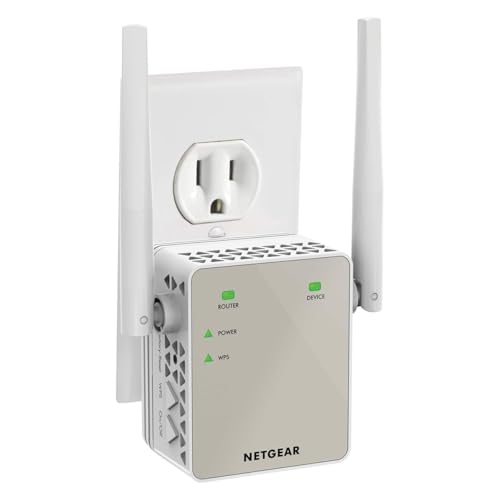
NETGEAR WiFi Extender EX6120, 1.2 Gbps
About this pick
The EX6120 is the friendliest extender for someone who does not enjoy networking. The Nighthawk app guides setup step by step, and a WPS push button offers a menu-free route. Its 1.2 Gbps rating fits a typical small-home plan, and brand support is easy to find when something goes wrong.
It offers few extras beyond the basic AC1200 feature set, and the 1500 sq ft claim limits larger homes. It cannot match the bandwidth headroom of the RE550, and it is a plain wall plug without extra antennas.
For a parent's flat or a simple two-room fix, the clear setup is worth more than raw speed. Compared with the RE315 it brings a polished app instead of aimable antennas, and compared with the generic AC1200 units it adds support and documentation. Choose it when the person installing it needs to succeed first time.
Best for: Relatives or beginners who need a guided, low-risk install.
Check price on AmazonSpecs
- Class: AC1200 Wi-Fi 5
- Total speed: 1.2 Gbps
- Coverage: Up to 1500 sq ft
- Setup: Nighthawk app or WPS
Pros
- +Nighthawk app guides setup step by step
- +WPS push-button offers a menu-free route
- +1.2 Gbps rating fits a typical small-home plan
- +Brand support is easy to find online
Cons
- −Few extras beyond the basic AC1200 feature set
- −1500 sq ft claim limits larger homes
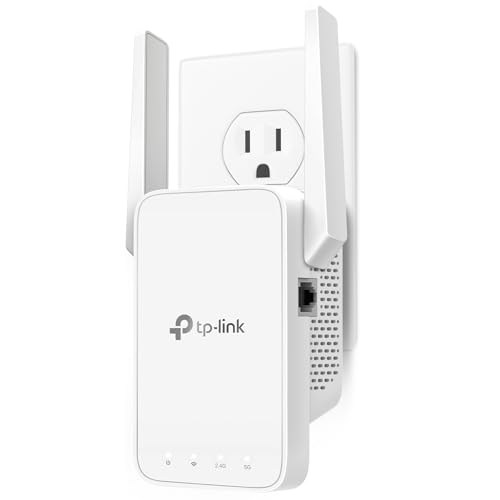
TP-Link AC1200 Dual Band Extender (RE315)
About this pick
The RE315 is the sensible mid-point of the group: AC1200 class with 867 Mbps on 5 GHz, two aimable antennas, and Adaptive Path Selection to choose a good route. It is compact enough to avoid blocking a second outlet, and TP-Link documentation is straightforward.
Its 2.4 GHz speed is not stated separately, and two antennas is modest next to the three on the RE550. The 1500 sq ft figure is a best-case rating, and the ceiling falls quickly with walls.
At this cap it is the value choice, because you pay less than for the RE550 and keep the adjustable antennas that NETGEAR omits. Compared with the VERMEYEN it offers clearer branding and support, and compared with the Rinkarlay it has aimable antennas instead of four fixed ones. If your home is small to medium, it may be all you need.
Best for: Small to medium homes needing a branded, adjustable dual-band fix.
Check price on AmazonSpecs
- 5 GHz: 867 Mbps
- Coverage: Up to 1500 sq ft
- Antennas: 2 adjustable
- Routing: Adaptive Path Selection
Pros
- +867 Mbps on the 5 GHz band for nearby devices
- +Two antennas you can angle toward the weak spot
- +Adaptive Path Selection picks a better route
- +Compact body keeps neighbouring outlets free
Cons
- −No separate 2.4 GHz speed on the listing
- −Two antennas is modest next to the RE550
- −1500 sq ft is an open-space rating
Rinkarlay Long Range WiFi Extender, 4 Antennas
About this pick
The Rinkarlay is built around four high-gain omni-directional antennas and a marketing focus on 2.4 GHz wall penetration. It claims 1200 Mbps across two bands and a stated capacity of more than 90 devices, which sounds generous on paper.
The brand is less established than TP-Link or NETGEAR, so support is a question mark. Omni antennas cannot be aimed, which loses the targeting that the RE550 and RE315 offer, and the device count is a theoretical limit rather than a recommendation.
It could suit a multi-room flat where you want a general boost rather than a precise one. Compared with the nohzio it has more antennas but a similar speed class, and compared with the RE550 it offers no bandwidth advantage. Test pairing soon after buying and keep the return window in mind.
Best for: General coverage in a flat when you accept less brand support.
Check price on AmazonSpecs
- Speed: 1200 Mbps dual band
- Antennas: 4 omni-directional
- Focus: 2.4 GHz penetration
- Devices: 90+ stated
Pros
- +Four high-gain omni antennas for broad coverage
- +Marketed around 2.4 GHz wall penetration
- +1200 Mbps rating across two bands
- +High stated device capacity on paper
Cons
- −Less established brand, so support is uncertain
- −Omni antennas cannot be aimed at a room
- −Device count is a theoretical limit
VERMEYEN WiFi Extender 5G 1200Mbps Dual Band
About this pick
The VERMEYEN offers three selectable modes, including access-point mode, and an Ethernet port that supports a wired streaming box. Its 1200 Mbps rating matches the AC1200 class, with 300 Mbps stated on 2.4 GHz, and the listing claims up to 5000 sq ft of reach.
That coverage claim is a best-case open-space figure, and the lesser-known brand means support is less certain. Documentation is lighter than TP-Link's, so expect to learn the modes by trial.
The wired port and AP mode are the practical draw: you can feed a TV by cable and also convert a wired jack into Wi-Fi. Against the RE315 it adds the port, while against the NETGEAR EX6120 it lacks the app guidance. Choose it if you have a cable run or a streaming box near the dead spot.
Best for: Wired streaming boxes and access-point conversions near a dead spot.
Check price on AmazonSpecs
- Speed: 1200 Mbps dual band
- 2.4 GHz: 300 Mbps
- Modes: Repeater, AP
- Port: Ethernet
Pros
- +Three selectable modes include access-point mode
- +Ethernet port supports wired streaming boxes
- +1200Mbps rating matches the AC1200 class
- +Listing claims up to 5000 sq ft of reach
Cons
- −Coverage claim is a best-case open-space number
- −Lesser-known brand means less certain support
nohzio 1200Mbps Dual Band WiFi Extender
About this pick
The nohzio is the plain dual-band plug-in. It lists 1200 Mbps across two bands with 300 Mbps on 2.4 GHz, claims compatibility with any Wi-Fi router or gateway, and supports WPA2 security on the wireless link. Its simple plug-in design suits a first extender.
The 3000 sq ft claim is hard to compare with branded ratings, and the listing mentions no Ethernet port. It offers no Wi-Fi 6 option and less bandwidth than the RE550, so it does not match the top unit on capacity.
Its value is in being the straightforward choice for a basic upgrade. Compared with the VERMEYEN it has no wired port, and compared with the Rinkarlay it has fewer antennas and lower marketing ambition. If you need a clean, uncomplicated dual-band repeater and accept the lesser-known brand, it will do the job.
Best for: A basic dual-band boost with no frills for a first-time extender buyer.
Check price on AmazonSpecs
- Speed: 1200 Mbps dual band
- 2.4 GHz: 300 Mbps
- Coverage claim: Up to 3000 sq ft
- Security: WPA and WPA2
Pros
- +1200 Mbps dual-band with 300 Mbps on 2.4GHz
- +Listed as compatible with any router or gateway
- +Supports WPA2 security on the wireless link
- +Simple plug-in design for a first extender
Cons
- −3000 sq ft claim is hard to compare with brands
- −Listing mentions no Ethernet port
How We Evaluated These Wi-Fi Extenders Under $75
Each pick was assessed across 5 criteria weighted for real-world use.
Bandwidth class
We compared class and stated totals. The RE550 leads at AC1900 and 1.9 Gbps, the EX6120, RE315 and generic units follow at AC1200, and Wi-Fi 5 is common to all.
Antennas and reach
We weighed antenna count and aiming. The RE550 has three adjustable antennas, the RE315 two, and the Rinkarlay four fixed omni antennas. Range claims were treated as ceilings and branded ones as more credible.
Setup and documentation
We read setup flows. The EX6120 leads with app and WPS guidance, TP-Link follows with its own flow, and the Rinkarlay, VERMEYEN and nohzio rely on lighter documentation.
Ports and flexibility
We credited Ethernet ports and modes. The VERMEYEN offers a port and AP mode, while the others are wireless-only as listed. Flexibility counted for homes with wired devices.
Value at this ceiling
We judged the picks against the cap. The RE550 leads for capability, the RE315 for value, and the EX6120 for ease. Results rely on specs and buyer feedback, not claimed testing.
How to Choose the Right Wi-Fi Extenders Under $75
By Home Size and Layout
Match the unit to the size of the problem.
| Situation | Pick | Why |
|---|---|---|
| Large home, one far zone | TP-Link AC1900 WiFi Range Extender RE550 | Three antennas and 2100 sq ft |
| Medium home, one weak room | TP-Link AC1200 Dual Band Extender (RE315) | Aimable antennas, 867 Mbps on 5 GHz |
| Parent's flat | NETGEAR WiFi Extender EX6120, 1.2 Gbps | App-guided setup |
| Multi-room flat, general boost | Rinkarlay Long Range WiFi Extender, 4 Antennas | Four omni antennas |
| Cable run to the dead spot | VERMEYEN WiFi Extender 5G 1200Mbps Dual Band | Ethernet port and AP mode |
If three rooms are weak, a mesh system beats any single extender.
By Budget
Within this cap, tiers reflect class and support.
| Tier | Pick | What you get |
|---|---|---|
| Lower end | nohzio 1200Mbps Dual Band WiFi Extender | Plain dual-band repeater |
| Lower end | Rinkarlay Long Range WiFi Extender, 4 Antennas | Four omni antennas, generic brand |
| Middle | VERMEYEN WiFi Extender 5G 1200Mbps Dual Band | Port and AP mode |
| Middle | TP-Link AC1200 Dual Band Extender (RE315) | Branded, aimable antennas |
| Near the cap | NETGEAR WiFi Extender EX6120, 1.2 Gbps | Brand support and app setup |
| Near the cap | TP-Link AC1900 WiFi Range Extender RE550 | AC1900 and three antennas |
The higher tiers buy support and bandwidth, not magic range.
Aimable Antennas vs Omni Antennas
Antenna design changes how you place the unit.
Aimable
The RE550 and RE315 let you point the signal at the weak area. This helps when the dead zone is in a known direction. Pick this side for garages, far bedrooms and long hallways.
Omni
The Rinkarlay's four omni antennas spread signal in all directions and cannot be aimed. This helps in open flats but wastes energy elsewhere. Pick this side for broad, general coverage.
Aim when the problem has a direction; go omni when it does not.
By Device Load
More devices means more need for bandwidth headroom.
| Load | Pick | Reason |
|---|---|---|
| Many devices, 4K streaming | TP-Link AC1900 WiFi Range Extender RE550 | 1.9 Gbps total |
| Family of four | NETGEAR WiFi Extender EX6120, 1.2 Gbps | 1.2 Gbps and app support |
| Couple with a TV | TP-Link AC1200 Dual Band Extender (RE315) | 867 Mbps on 5 GHz |
| Smart home sensors | nohzio 1200Mbps Dual Band WiFi Extender | 300 Mbps on 2.4 GHz is plenty |
| Wired TV and phones | VERMEYEN WiFi Extender 5G 1200Mbps Dual Band | Ethernet for the TV |
Stated device counts of 90 or more are theoretical, not guidance.
For a Garage or Outbuilding Specifically
Detached spaces are the hardest extender jobs.
Look for
Aimable antennas, a strong 2.4 GHz band for penetration, and a plug-in point close to the router side of the wall. Expect speeds to drop with each barrier.
In this comparison
The RE550's three antennas can be pointed at a garage. The VERMEYEN's AP mode suits a buried cable. The Rinkarlay markets 2.4 GHz wall penetration.
A wired access point is the best fix for a detached building.
When to Spend More
Know where the cap runs out.
| Spend more if | Save if |
|---|---|
| Three or more rooms are weak and you want one network name | The RE315 covers one stubborn bedroom |
| Your router is Wi-Fi 6 and you want matching speed | Your router is Wi-Fi 5 and the RE550 matches it |
| You want a stronger support path than the generic brands | The EX6120 already provides brand support |
| You need a tri-band backhaul | A dual-band RE550 is enough for your home |
Mesh is the real step up from any extender.
Frequently Asked Questions
Is the RE550 worth the extra over the RE315?
It is if you have a large home or many devices. The RE550 gives AC1900 class, three antennas and 2100 sq ft, while the RE315 is AC1200 with two. For one bedroom, the RE315 is enough.
Will an extender speed up my internet plan?
No. It extends the reach of the signal your router already provides. It cannot exceed your plan's speed, and relaying traffic costs some throughput.
Why choose NETGEAR over TP-Link?
The EX6120 leans on app-guided setup and WPS, while the TP-Link units lean on antenna hardware. Both are solid brands. Pick by whether setup ease or antenna aiming matters more.
Are generic brands risky?
They can work, but documentation and support are thinner and coverage claims are bigger. The VERMEYEN's 5000 sq ft and the nohzio's 3000 sq ft are ceilings. Keep the return window in mind.
Do I need an Ethernet port?
Only if a wired device sits near the extender. The VERMEYEN is the one pick here with a port and AP mode. A cable avoids wireless contention for a TV.
Will it work with a Wi-Fi 6 router?
Yes, but the extended link falls back to Wi-Fi 5 speeds. Every pick here is Wi-Fi 5 or older, so a weaker extender becomes the bottleneck for fast plans.
Where should I plug it in?
Midway between router and dead zone, at chest height, away from metal and microwaves. Plugging in the dead zone only rebroadcasts a weak signal.
Bottom Line
best overall: TP-Link AC1900 WiFi Range Extender RE550 - best overall pick in this roundup.
See the full rankings above for all picks with pros, cons, and best-for summaries.
Browse on Amazon
All Prime-eligible options with current pricing.
Shop on Amazon →