5 Best Verizon Cell Phone Signal Boosters for Home (2026)
Five home cell signal boosters that list Verizon support, compared by band coverage, gain and square footage, for steadier calls and data indoors.


At a Glance
CELSGN Home Office Metal Building Booster, Up to 3,000 Sq Ft
↓ See why we picked itVerizon owners shopping for a home booster face a choice between kits aimed at every carrier and kits built around Verizon's Band 13 on 700MHz. This guide covers both, from the HiBoost kit claiming up to 4,000 square feet to the ISNMDND, which lists Band 13 700MHz with 65dB of gain and automatic gain control.
The HiBoost is our top pick because it combines the largest coverage claim here with support for all US and Canadian carriers and 5G and 4G LTE. The CELSGN is the best-documented on bands, listing 2, 4, 5, 12, 13 and 17 and telling you to confirm your phone supports them. The ZORIDA lists the highest gain at 72dB for up to 2,000 square feet, and the ISNMDND is the lowest-cost, Verizon-focused option.
We evaluated each pick on published specs and buyer feedback, not on installation tests, and we flag where the listing is thin. Because a booster only amplifies an outdoor signal that already exists, the kit that suits you best depends on the signal at your roofline as much as on the brand.
6 Criteria to Look For Before Buying a Verizon Cell Phone Signal Boosters for Home (2026)
Key buying criteria so you get the right fit the first time.
Verify Verizon bands on your phone
The ISNMDND targets Band 13 on 700MHz, while the Phonetone lists 12, 13 and 17 and the CELSGN lists 2, 4, 5, 12, 13 and 17. Check your phone's field test mode to see which bands it uses at home. A booster that does not cover your active band will not help. The CELSGN listing even says it will only amplify 5G on those bands.
Outdoor signal is the limit
A booster amplifies only what the outdoor antenna captures. The CELSGN asks for at least two bars of signal outside, which is a sensible rule. If you see none at the roof, even the ZORIDA with 72dB cannot help. Test with a coverage map or your phone first.
Coverage claims are best cases
The HiBoost claims 4,000 square feet, the CELSGN 3,000 and the ZORIDA 2,000. These depend on floor plan, building materials and the outdoor signal. Metal buildings can block signal, so the booster's help is greater but so is the challenge. Choose a kit one size larger if your signal is weak.
Gain and antenna separation
The ZORIDA lists 72dB and the Phonetone and ISNMDND list 65dB. Higher gain needs more distance between the outdoor and indoor antennas, since feedback forces the booster to reduce gain or shut off. Required distance varies by model, with weBoost suggesting about 25 to 30 feet vertical and SureCall listing about 60 feet for one model. A forced lower gain shrinks coverage.
Automatic gain control
The Phonetone and ISNMDND both list automatic gain control, which adjusts the booster to the incoming signal. This protects the network and reduces feedback risk. Without it, you may need to tune the booster manually. Look for it on any kit you buy.
Carrier scope and approvals
The HiBoost and ZORIDA support all US carriers, while the ISNMDND focuses on Verizon. If your household has mixed carriers, a wide-scope kit helps. Also look for an FCC ID and network protection wording. The ZORIDA states no carrier registration is needed.
5 Best Verizon Cell Phone Signal Boosters for Home (2026)
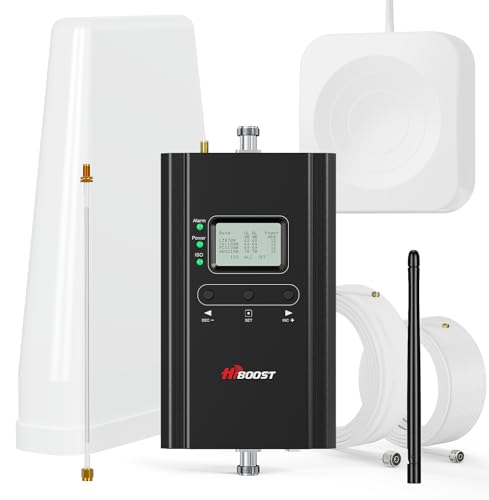
HiBoost Home and Office Booster, 4,000 Sq Ft
About this pick
The HiBoost 4,000 square foot booster is the roomiest kit in this guide, listing coverage for a home, office, shop or metal building. It supports 5G and 4G LTE and names Verizon and AT&T among all US and Canadian carriers. That breadth means a household with mixed phones can use one booster. The mention of metal buildings is useful, because steel walls block signal and make a booster more valuable. The cost is the highest price tier among the five, and the brief gives no gain figure. The 4,000 square foot number is a best-case maximum. Install is the usual outdoor antenna, cable and indoor antenna. Compared with the ZORIDA, it covers twice the claimed area but lists no gain. Against the ISNMDND, it supports every carrier instead of just Verizon's Band 13.
Best for: Larger homes, workshops and metal buildings with mixed carriers
Check price on AmazonSpecs
- Coverage claim: Up to 4,000 sq ft
- Network: 5G and 4G LTE
- Use: Home, office, shop, metal building
Pros
- +Largest coverage claim at 4,000 sq ft
- +Supports all US and Canadian carriers
- +5G and 4G LTE listed
- +Works for metal buildings and shops
Cons
- −Highest price tier of the five
- −No gain figure in the brief
- −Coverage claim depends on outdoor signal
CELSGN Home Office Metal Building Booster, Up to 3,000 Sq Ft
About this pick
The CELSGN booster claims up to 3,000 square feet and lists support for bands 2, 4, 5, 12, 13 and 17. Its listing is unusually helpful, telling you to confirm your phone supports those bands and that you receive at least two bars outside. It names Verizon among carriers that should work as long as the bands match. That clarity is its main strength, because it helps a Verizon owner decide before buying. It is also honest that 5G will only be amplified if your phone uses those bands. The cost is a smaller coverage claim than the HiBoost and the need to verify before you spend. It suits homes, offices and metal buildings. Compared with the Phonetone, it covers six bands instead of three. Against the ZORIDA, it claims more area but lists no gain.
Best for: Buyers who want clear band guidance before purchase
Check price on AmazonSpecs
- Coverage claim: Up to 3,000 sq ft
- Bands: 2, 4, 5, 12, 13, 17
- Signal need: At least 2 bars outside
- Use: Home, office, metal building
Pros
- +Clear guidance on bands and signal needs
- +Works across several carriers
- +Up to 3,000 sq ft listed
- +Suits home, office and metal buildings
Cons
- −Needs at least 2 bars outside to help
- −Must verify band support first
- −No gain figure in the brief
ZORIDA 72dB Home Cell Phone Signal Booster
About this pick
The ZORIDA booster lists 72dB of gain, the highest figure in this guide, and claims coverage of up to 2,000 square feet. It works with all US carriers, including Verizon, AT&T and T-Mobile, and supports 5G and 4G. The listing says it needs no carrier registration, which removes one step from setup. High gain is a mixed blessing, because it needs careful antenna separation to avoid feedback. If the antennas sit too close, the booster must lower its gain, which shrinks the coverage area. The 2,000 square foot claim is modest next to the HiBoost. It sits in the upper-middle price tier. Compared with the Phonetone, it has more gain but no listed band numbers. Against the CELSGN, it claims less area but offers higher amplification.
Best for: Small to mid-size homes with a weak outdoor signal
Check price on AmazonSpecs
- Gain: 72dB (listed)
- Coverage claim: Up to 2,000 sq ft
- Network: 5G and 4G
- Registration: No carrier registration needed
Pros
- +Highest listed gain at 72dB
- +No carrier registration needed
- +Supports all major US carriers
- +Upper mid-range price tier
Cons
- −Needs careful antenna separation
- −Only 2,000 sq ft listed
- −No band list in the brief
Phonetone Home Booster, Bands 12/13/17, 65dB
About this pick
The Phonetone Home Booster lists bands 12, 13 and 17 directly and a 65dB gain with automatic gain control. It supports VoLTE and 4G LTE data, and the listing says it boosts Verizon and AT&T signals. For a Verizon user whose phone uses band 13, that targeting is the main appeal. Automatic gain control watches the incoming signal and adjusts the booster, which helps prevent interference. The limits are plain: the brief gives no coverage area, and the listing is not aimed at T-Mobile. It sits in the mid-range price tier. Install follows the standard outside antenna, cable and indoor antenna. Compared with the ISNMDND, it lists three bands instead of one, at a higher cost. Against the CELSGN, it covers fewer bands but names its gain and VoLTE support.
Best for: Verizon and AT&T users with phones on bands 12, 13 or 17
Check price on AmazonSpecs
- Bands: 12, 13, 17
- Gain: 65dB (listed)
- Gain control: Automatic gain control
- Voice: VoLTE and LTE data
Pros
- +Lists bands 12, 13 and 17 directly
- +65dB gain with automatic control
- +VoLTE and LTE data support
- +Mid-range price tier
Cons
- −No coverage area in the brief
- −Not aimed at T-Mobile
- −Narrower band list than the CELSGN
ISNMDND Verizon Home Booster, Band 13 700MHz
About this pick
The ISNMDND Verizon Home Booster is designed specifically for Verizon's Band 13 on 700MHz, with 5G and 4G LTE compatibility and up to 65dB gain. It includes automatic gain control and targets homes, offices and cabins. For a Verizon-only household, the narrow focus keeps cost low. That focus is also the limit: a phone on another carrier gets little help. The brief gives no coverage area, so you must judge the size of the space yourself. It is the lowest-cost pick in this guide. Install is the usual antenna and cable routine. Compared with the HiBoost, it costs much less but covers one band. Against the Phonetone, it lists a single band instead of three.
Best for: Verizon-only households on a tight budget
Check price on AmazonSpecs
- Band: Verizon Band 13, 700MHz
- Gain: Up to 65dB (listed)
- Gain control: Automatic gain control
- Use: Homes, offices, cabins
Pros
- +Lowest cost of the five picks
- +65dB gain with automatic control
- +Suits homes, offices and cabins
Cons
- −Single band, little use on other carriers
- −No coverage area in the brief
- −Little detail on installation
How We Evaluated These Verizon Cell Phone Signal Boosters for Home (2026)
Each pick was assessed across 5 criteria weighted for real-world use.
Band documentation
The CELSGN lists six bands and gives pre-purchase checks, while the ISNMDND names Band 13 and the Phonetone names 12, 13 and 17. The HiBoost and ZORIDA give no band list. Clear band detail helps Verizon owners decide.
Gain and control
The ZORIDA lists 72dB, the Phonetone and ISNMDND list 65dB with AGC, and the HiBoost and CELSGN list no gain. We treated gain as a seller claim. Automatic control earned extra credit. Higher numbers help only if bands match.
Coverage and building fit
We compared coverage claims, with the HiBoost at 4,000 square feet and the ZORIDA at 2,000. Picks naming metal buildings, such as the HiBoost and CELSGN, scored higher for tricky structures. Claims were treated as ceilings. The strongest is the HiBoost and the most basic is the ZORIDA.
Setup and honesty
We rewarded listings that state setup requirements, such as the CELSGN's two-bar rule and the ZORIDA's no-registration note. Vague listings lost points. This matters for buyers who want to avoid returns. Beginners benefit from clear guidance.
Value for a Verizon household
The ISNMDND is the lowest-cost pick and the most Verizon-focused, while the HiBoost is the highest-cost. Value is highest when the booster matches your bands and size.
How to Choose the Right Verizon Cell Phone Signal Boosters for Home (2026)
By Home Size
Match the claim to your space.
| Space | Recommended pick |
|---|---|
| Large home, workshop or metal building | HiBoost Home and Office Booster, 4,000 Sq Ft |
| Mid-size home or office | CELSGN Home Office Metal Building Booster |
| Small home, weak outdoor signal | ZORIDA 72dB Home Cell Phone Signal Booster |
| Mid-size home, bands 12, 13 or 17 | Phonetone Home Booster, Bands 12/13/17 |
| Cabin or small home, Verizon only | ISNMDND Verizon Home Booster, Band 13 |
By Budget
| Budget tier | Recommended pick |
|---|---|
| Lowest-cost pick | ISNMDND Verizon Home Booster, Band 13 |
| Low to mid | Phonetone Home Booster, Bands 12/13/17 |
| Mid-range | CELSGN Home Office Metal Building Booster |
| Upper mid-range | ZORIDA 72dB Home Cell Phone Signal Booster |
| Premium | HiBoost Home and Office Booster, 4,000 Sq Ft |
Verizon-Only vs All-Carrier Kits
Scope shapes price and flexibility.
Verizon-focused
The ISNMDND targets Band 13 on 700MHz and the Phonetone targets bands 12, 13 and 17. They cost less but help only compatible phones.
All-carrier
The HiBoost and ZORIDA support all US carriers, which suits mixed households but costs more.
Recommendation
Choose the ISNMDND if everyone uses Verizon, and the HiBoost if carriers vary.
By Gain Need
Gain matters most with a weak outdoor signal.
| Signal situation | Recommended pick |
|---|---|
| Very weak outdoor signal | ZORIDA 72dB Home Cell Phone Signal Booster |
| Weak signal, automatic control wanted | Phonetone Home Booster, Bands 12/13/17 |
| Weak signal, Verizon only | ISNMDND Verizon Home Booster, Band 13 |
| Decent signal, large space | HiBoost Home and Office Booster, 4,000 Sq Ft |
For Rural and Metal-Building Homes Specifically
Look for
A booster that names metal buildings or cabins, with clear band and signal guidance. Metal walls block signal, so outdoor antenna placement matters.
In this comparison
The HiBoost and CELSGN both name metal buildings. The ISNMDND names cabins and targets Verizon Band 13.
When to Spend More
Spend more if
You have a large space or mixed carriers, since the HiBoost offers the biggest claim and widest carrier support.
Save if
Everyone uses Verizon and you have a small space, since the ISNMDND costs the least. Save with the Phonetone if your phone uses bands 12, 13 or 17.
Frequently Asked Questions
Which booster is best for Verizon specifically?
The ISNMDND targets Verizon Band 13 on 700MHz and costs the least. The Phonetone covers bands 12, 13 and 17. For a mixed household, the HiBoost supports all carriers.
How much signal do I need outside?
The CELSGN asks for at least two bars outside, which is a sensible rule for any booster. With less, results fall sharply. Test at the roofline first.
Does the ZORIDA need carrier registration?
Its listing says no registration is needed. Rules vary, so check your carrier's policy. Look for an FCC ID as well.
Why do antennas need separation?
If the antennas are too close, the booster can feed back and must lower gain or shut off. High-gain kits like the ZORIDA need extra care. Follow the manual's distance guidance.
Will a booster improve 5G?
Only on bands it supports. The CELSGN notes it amplifies 5G only if your phone uses its listed bands. Check your phone's bands first.
Is the HiBoost worth the price?
It is if you have a large space or mixed carriers. The 4,000 square foot claim is the biggest here. For a small Verizon home, the ISNMDND is more sensible.
Bottom Line
best overall: HiBoost Home and Office Booster, 4,000 Sq Ft - best overall pick in this roundup.
See the full rankings above for all picks with pros, cons, and best-for summaries.
Browse on Amazon
All Prime-eligible options with current pricing.
Shop on Amazon →