6 Best Verizon Cell Phone Signal Boosters (2026)
Six Verizon-friendly signal boosters compared by coverage, band support, and setup effort, for homes, cars, and anyone tired of dropped calls.




At a Glance
Verizon customers shopping for a signal fix run into a confusing mix of products. Some are true boosters that amplify the outdoor signal you already have, one is a carrier-branded network extender, and one is built for a vehicle. This guide sorts six options by what they actually do, so you can match the device to the dead spot instead of buying on a coverage number alone.
The lineup spans a wide range. The Phonetone and GAGBK units target Verizon's Band 13 and Band 12/17 spectrum, the HiBoost Hero is rated for up to 3,000 square feet at 65dB, and the YJXcell is listed for 8,000 square feet and above. The Verizon ASK-SFE116 is a different category, and the SignalBrick is the only pick meant for a car.
Every listed square footage is a best case that depends on how strong your outdoor signal already is. The YJXcell listing itself says 1 to 2 bars outside covers roughly 600 square feet, which is far below its headline number. We evaluated each pick on specs and buyer feedback, with setup effort weighted heavily because most buyers are installing alone.
6 Criteria to Look For Before Buying a Verizon Cell Phone Signal Boosters (2026)
Key buying criteria so you get the right fit the first time.
Match bands to Verizon
Verizon's low-band LTE sits on Band 13 and Band 12/17 depending on market, so a booster that omits your band cannot help. The GAGBK lists 700MHz Band 13 only, while the Phonetone covers Band 12/17 and Band 13 together. Check your phone's field-test screen or an app such as CellMapper to see which band you actually connect on. A multi-band unit like the Phonetone is safer if you are unsure.
Measure outdoor signal first
A booster only amplifies a signal that already exists outdoors, so it cannot create service where there is none. The YJXcell listing admits that 1 to 2 bars outside gives about 600 square feet inside, far below its 8,000 square foot headline. Walk the roof or yard with your phone and note where bars are strongest before you mount anything. Place the outdoor antenna at that spot, not wherever the cable reaches easily.
Gain versus output power
With a weak outdoor signal, gain matters most, and with a strong one, output power matters more. The Phonetone and HiBoost Hero both list 65dB, which is a common home-kit figure, but gain numbers vary by source and should not be read as a hard rule. Higher gain is not automatically better because overdriven units cut themselves back. Pick the model that suits your signal level instead of the biggest number.
Antenna separation
If the outside and inside antennas are too close, the booster feeds back on itself and reduces gain to compensate, which shrinks the coverage area. Separation guidance is model specific, with vendors citing roughly 25 to 60 feet vertically depending on the unit. The HiBoost Hero and YJXcell both add multiple indoor antenna choices, which gives you more freedom to keep distance. Read the manual for your exact model and plan the cable path before you drill.
Treat coverage ratings as a ceiling
No maker can guarantee a square footage, because floor plan, wall materials, and outdoor signal all change the result. The Phonetone lists 4,500 square feet and the HiBoost Hero 3,000, but the real number depends on your house. Choose by realistic need: one or two rooms rarely require the YJXcell's 8,000. Overbuying range costs more and complicates installation.
Booster versus network extender
A booster amplifies an outdoor signal through two antennas, while a network extender like the Verizon ASK-SFE116 is a different kind of device tied to one carrier. The extender avoids antenna installation but helps only Verizon phones. If your household is all Verizon and you dislike cable work, it is worth considering. If anyone else uses another carrier, a multi-band booster such as the Phonetone is the better choice.
6 Best Verizon Cell Phone Signal Boosters (2026)
Phonetone Verizon and AT&T Home Booster
About this pick
The Phonetone is the most balanced Verizon pick in this group. It covers Band 12, 13, and 17, which means it handles Verizon's main low-band spectrum and also works for AT&T households, and it lists 65dB of gain with a 4,500 square foot rating. Automatic Gain Control watches the incoming signal and backs off on its own, which matters because overdriven boosters are a common source of poor results.
The tradeoff is that it is a home kit, so you still need to mount an outdoor antenna and run cable to an indoor one. That is a manageable weekend job but not a plug-and-play one. If you live in a spot with no outdoor signal at all, no booster here including this one can create service from nothing.
In practice the Phonetone sits between the compact HiBoost Hero at 3,000 square feet and the much larger YJXcell listing. It is also the lowest-cost pick in the roundup, so it is the easiest way to try a booster without committing to a premium system. For a typical single-family home with a usable outdoor signal, it is the sensible starting point.
Best for: Most Verizon households with one or two weak rooms
Check price on AmazonSpecs
- Coverage: Up to 4,500 sq ft
- Bands: 12/13/17
- Gain: 65dB
- Carriers: Verizon and AT&T
Pros
- +Covers Band 12, 13, and 17 for Verizon
- +AGC adjusts gain automatically
- +Lowest-cost pick in this roundup
Cons
- −Needs an outdoor antenna and cable run
- −Coverage rating is a best case, not a promise
GAGBK Verizon Band 13 Booster
About this pick
The GAGBK is built around one band. It is listed for Verizon and Straight Talk on 700MHz Band 13, which is the spectrum Verizon uses for much of its LTE coverage. A single-band design is simple to reason about: if your phone shows Band 13 in a field-test screen, this unit is aimed squarely at that signal.
The narrow focus is also its limit. It does not list the Band 12/17 or Band 5 coverage that the Phonetone and BrstsWhel-style multi-band kits carry, so it is a poor fit if other carriers share the house. It also leans on marketing language about materials and speed that we would not rely on.
Ownership is similar to any home kit: outdoor antenna, indoor antenna, power, and time spent on antenna separation. As the second-lowest priced pick here, it suits a Verizon-only home with a known weak signal on Band 13. Compared with the Phonetone it gives up carrier flexibility for a more targeted spec sheet.
Best for: Verizon or Straight Talk only households
Check price on AmazonSpecs
- Carriers: Verizon, Straight Talk
- Band: 13 (700MHz)
- Network: 4G LTE and 5G
- Type: Home booster
Pros
- +Targets Verizon's 700MHz Band 13 directly
- +Listed for 4G LTE and 5G devices
- +Second-lowest cost in the roundup
Cons
- −Single-band focus limits other carriers
- −Listing leans on vague marketing claims
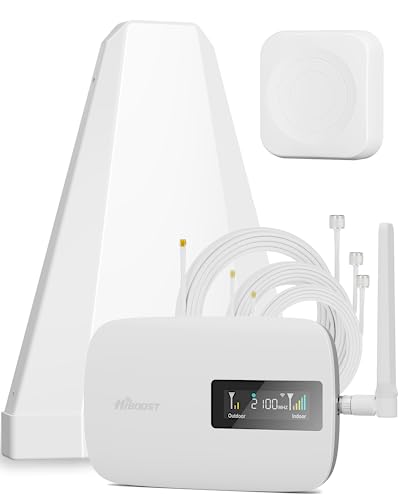
HiBoost Hero 3000 Home Booster
About this pick
The HiBoost Hero is the pick for a mid-size home where a flexible indoor antenna layout matters. It is rated for up to 3,000 square feet at 65dB and comes with two indoor antenna options, so you can choose a placement that suits a living room or a long hallway. The listing notes 5G support delivered through dynamic spectrum sharing within 4G bands.
Its coverage figure is smaller than the Phonetone at 4,500 square feet, so it is not the answer for a large or multi-level house. HiBoost is also a recognized name in the category, which helps if you want a brand with an established support channel.
Setup follows the usual outdoor antenna, cable, and indoor antenna pattern. Choose the indoor antenna that suits your floor plan, and keep it well away from the outdoor one to avoid feedback. It costs more than the Phonetone and GAGBK, so buy it for the antenna flexibility rather than for extra raw range.
Best for: Mid-size homes needing antenna placement choices
Check price on AmazonSpecs
- Coverage: Up to 3,000 sq ft
- Gain: 65dB
- Indoor antennas: Two options
- Carriers: Multi-carrier
Pros
- +Two indoor antenna options for layout flexibility
- +65dB gain with 3,000 sq ft rating
- +Established brand name in the category
Cons
- −Smaller coverage than the Phonetone
- −Costs more than the cheapest picks
YJXcell Home and Office Booster
About this pick
The YJXcell carries the largest headline coverage in the roundup at 8,000 square feet and up, and it ships with two inside antennas. That makes it the logical candidate for a big house, a workshop, or a small office where one indoor antenna would leave gaps. It also lists support for all U.S. carriers, so a mixed household is covered.
Be careful with the number. The listing itself explains that coverage varies with the outdoor signal, and that 1 to 2 bars outside gives only about 600 square feet inside. The 8,000 square foot figure assumes a strong source signal, which is rarely the case for someone who needs a booster in the first place.
Installation is the heaviest of the home kits because two indoor antennas mean more cable and more planning. It sits in the middle of the price range, below the HiBoost Hero in cost rank but with far more claimed reach. Treat it as a good option when you have strong outdoor signal and a large footprint.
Best for: Large homes and small offices with a decent outdoor signal
Check price on AmazonSpecs
- Coverage: Up to 8,000 sq ft
- Inside antennas: Two
- Network: 5G and 4G LTE
- Carriers: All U.S.
Pros
- +Largest listed coverage area in this roundup
- +Includes two inside antennas
- +Lists support for all U.S. carriers
Cons
- −Headline range needs strong outdoor signal
- −More cabling and planning to install
Verizon ASK-SFE116 Network Extender
About this pick
The Verizon ASK-SFE116 is sold as a network extender, which is a different product class from the boosters around it. Rather than amplifying an outdoor signal through a roof antenna, a unit of this type is designed to be placed inside the home and work with Verizon's own network. That removes the cable run and antenna separation puzzle entirely.
The tradeoff is flexibility. Check the current listing and Verizon's own documentation for connection requirements before buying, because how an extender links to the network differs from a booster.
For someone who dreads antenna work, this is the simplest ownership experience here. Compared with the Phonetone it costs more and covers fewer carriers, but it avoids the single biggest setup risk, which is feedback from poorly separated antennas. We include it because many Verizon shoppers actually want this exact product.
Best for: Verizon-only homes that want no antenna install
Check price on AmazonSpecs
- Brand: Verizon
- Network: 4G and 5G LTE
- Category: Network extender
- Install: Plug in at home
Pros
- +Carrier-branded, built for Verizon service
- +Skips the outdoor antenna and cable run
- +Simple setup compared with booster kits
Cons
- −Verizon only, no other carrier help
- −Highest cost in this roundup
SignalBrick Car Cell Phone Booster
About this pick
The SignalBrick is the only vehicle booster in the roundup, and it covers Verizon along with AT&T and other carriers. It lists Bands 12/17, 13, 5, 2/25, and 4, and it uses a magnetic omni-directional outdoor antenna that receives from every direction. That last detail matters in a moving car, where the nearest tower keeps changing.
It is not a home product, so do not buy it for a dead spot in the living room. Its value is on highway drives, rural routes, and long trips where the signal flickers. The magnetic mount makes it easy to remove, which suits someone who rides in different cars.
Setup is simpler than any home kit because there is no building penetration to plan. It sits in the middle of the price range, and unlike the weBoost-style trucker units it is aimed at everyday passenger vehicles. Pair it with the Phonetone if you want both home and car covered.
Best for: Drivers who lose Verizon signal on the road
Check price on AmazonSpecs
- Use: Car and vehicle
- Bands: 12/17, 13, 5, 2/25, 4
- Outdoor antenna: Magnetic, omni-directional
- Carriers: All major U.S.
Pros
- +Omni-directional magnetic outdoor antenna
- +Lists five band groups for broad carrier use
- +Easy to move between vehicles
Cons
- −Useless for fixing signal inside a house
- −Vehicle gain will not match a home kit
How We Evaluated These Verizon Cell Phone Signal Boosters (2026)
Each pick was assessed across 5 criteria weighted for real-world use.
Verizon band support
We read each listing for the bands it names and compared them against Verizon's low-band spectrum. The Phonetone's Band 12/13/17 support ranked strongest, while the GAGBK's single Band 13 focus ranked narrower. Picks that did not clearly name bands lost points.
Realistic coverage
We looked at claimed square footage alongside the maker's own caveats about outdoor signal. The YJXcell has the biggest claim at 8,000 square feet, but its listing also admits a 600 square foot case at weak signal. Honest framing earned more credit than a bare big number.
Installation effort
We weighed how many antennas, cables, and placement decisions each kit demands. The Verizon ASK-SFE116 is simplest, and the YJXcell with two indoor antennas is most involved. This criterion mattered because most buyers install alone.
Carrier flexibility
We checked whether a mixed-carrier household would still be served. The Phonetone and YJXcell handle more than one carrier, while the Verizon extender and GAGBK are narrower. The strongest pick here is the Phonetone, and the most basic is the single-carrier extender.
Value and fit
The Phonetone is lowest cost with solid specs, and the Verizon extender is highest cost for a narrower job.
How to Choose the Right Verizon Cell Phone Signal Boosters (2026)
By Where You Need Signal
Start with the place where calls drop, because home and vehicle boosters are not interchangeable.
| Scenario | Recommended pick |
|---|---|
| One or two weak rooms in a typical house | Phonetone Verizon and AT&T Home Booster |
| Mid-size home needing flexible indoor antenna placement | HiBoost Hero 3000 Home Booster |
| Large house, workshop, or small office | YJXcell Home and Office Booster |
| Verizon-only house, no antenna work | Verizon ASK-SFE116 Network Extender |
| Dropped calls while driving | SignalBrick Car Cell Phone Booster |
By Budget
| Budget tier | Recommended pick |
|---|---|
| Lowest-cost pick | Phonetone Verizon and AT&T Home Booster |
| Low-cost, Verizon specific | GAGBK Verizon Band 13 Booster |
| Mid-range, large coverage claim | YJXcell Home and Office Booster |
| Mid-range, car use | SignalBrick Car Cell Phone Booster |
| Premium, compact home | HiBoost Hero 3000 Home Booster |
| Highest cost, carrier branded | Verizon ASK-SFE116 Network Extender |
Booster Kit vs Network Extender
Booster kit
A booster uses an outdoor antenna, cable, and indoor antenna to amplify an existing signal, and it can serve several carriers. In this roundup that is the Phonetone, GAGBK, HiBoost Hero, and YJXcell. The cost is installation work and the need for antenna separation.
Network extender
An extender is tied to one carrier and avoids the roof antenna. The Verizon ASK-SFE116 is the only one here. It is easier to set up but helps only Verizon phones, so mixed households should skip it. Pick a booster kit if anyone uses another carrier, and the extender if everyone is on Verizon and installation is the obstacle.
By Number of Carriers in the House
| Household | Recommended pick |
|---|---|
| All Verizon, want simplest setup | Verizon ASK-SFE116 Network Extender |
| Verizon and Straight Talk only | GAGBK Verizon Band 13 Booster |
| Verizon plus AT&T family members | Phonetone Verizon and AT&T Home Booster |
| Mixed carriers, large footprint | YJXcell Home and Office Booster |
For Rural Verizon Customers Specifically
Look for
Check that some outdoor signal exists at the roof, and favor a booster with Band 12/13/17 support and automatic gain control. Plan antenna separation before buying, since weak sources force the unit to work hard.
In this comparison
The Phonetone fits best because it covers Band 12/13/17 with AGC at a low cost. If your house is big, the YJXcell adds two indoor antennas, but only if the outdoor signal is strong enough to support its 8,000 square foot claim.
When to Spend More
Spend more if
You want antenna flexibility, which points to the HiBoost Hero with two indoor options, or you want zero installation and are all Verizon, which points to the Verizon ASK-SFE116. Spend more also if a large footprint demands the YJXcell.
Save if
You have one or two weak rooms and a usable outdoor signal. The Phonetone offers 4,500 square feet at the lowest cost, and the GAGBK is the budget Verizon-specific alternative.
Frequently Asked Questions
How do I choose between a booster and the Verizon network extender?
A booster amplifies the outdoor signal and can serve several carriers, while the Verizon ASK-SFE116 extender is Verizon only and avoids antenna work. If everyone in the home uses Verizon and you dislike installing antennas, the extender is simpler. If anyone uses another carrier, choose a booster such as the Phonetone.
Which of these is the cheapest way to try a booster?
The Phonetone is the lowest-cost pick in this roundup and the GAGBK is next. Both are home kits that need an outdoor antenna. Remember that a lower price does not remove the need for decent outdoor signal.
Will a booster work if I have no signal outside?
No. A booster only amplifies an existing signal, so with none outdoors it cannot help. Check your outdoor bars at the roof or highest point first. If there is truly none, a different solution is needed.
Is higher gain always better?
Not always. With a strong outdoor signal, output power matters more, and with a weak one gain matters most. Boosters also reduce their own gain if antennas are too close, which shrinks coverage. Both the Phonetone and HiBoost Hero list 65dB, so choose on bands and layout rather than the number alone.
Can I use the SignalBrick car booster in my house?
It is designed for vehicles, with a magnetic outdoor antenna for driving. It is not meant to cover rooms in a house. Use a home kit such as the Phonetone for that job.
What is the real coverage of a listed square footage?
Treat it as a ceiling. The YJXcell lists 8,000 square feet but its own listing says 1 to 2 bars outside covers only about 600 square feet. Your floor plan, wall materials, and outdoor signal decide the real result.
How much maintenance does a booster need?
Very little once installed. Keep the outdoor antenna secure and unobstructed, check cable connections after storms, and avoid moving the antennas closer together. If calls degrade, recheck antenna separation first.
Bottom Line
best overall: Phonetone Verizon and AT&T Home Booster - best overall pick in this roundup.
See the full rankings above for all picks with pros, cons, and best-for summaries.
Browse on Amazon
All Prime-eligible options with current pricing.
Shop on Amazon →