6 Best Cell Phone Signal Boosters for Home (2026)
Six home cell phone signal boosters compared by coverage, antenna setup and carrier bands, so you can fix dead zones in the rooms you actually use.


At a Glance
Dead zones at home are common even in places with decent service outside. Metal roofing, brick, low-E glass and thick walls all weaken the signal on its way in, and a home booster re-broadcasts the outdoor signal inside. The six kits here range from the Callone+ at 3,500 sq ft on its title to the YJXcell, which advertises 8,000 sq ft and up with two inside antennas.
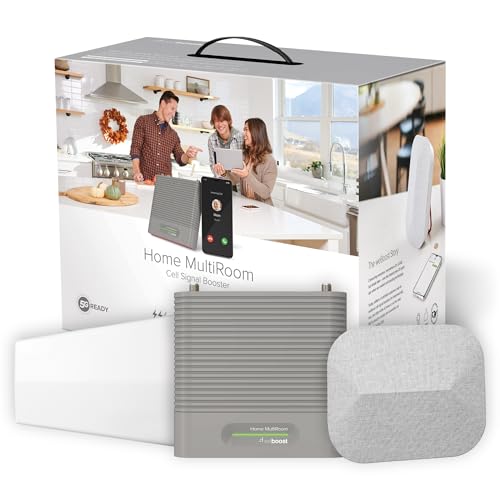
The weBoost Home MultiRoom is the best-known name in the lineup, listed for up to 5,000 sq ft or three to four rooms for any carrier. The HiBoost Hero is the smallest of the premium kits at 3,000 sq ft, while the subroad and ESBANY sit in the middle with 5,000 sq ft and dual output ports respectively. The spread in listed coverage is wide, and the spread in realistic coverage is wider.
Whichever kit you choose, the outdoor signal sets the ceiling. Where the outside antenna sees one or two bars, expect much less coverage than the headline figure. Read the picks below with that in mind.
6 Criteria to Look For Before Buying a Cell Phone Signal Boosters for Home (2026)
Key buying criteria so you get the right fit the first time.
Measure the outdoor signal where the antenna goes
Every kit here, from the Callone+ to the YJXcell, depends on the outdoor signal. Gain matters most when that signal is weak, while output power matters more when the signal is strong. Use a signal mapping app and check bars at roof and window height. If you see only one or two bars, expect the YJXcell's 8,000 sq ft claim to shrink dramatically, as its own feature text shows with 600 sq ft at one to two bars.
Treat coverage numbers as best-case
The weBoost Home MultiRoom lists up to 5,000 sq ft or three to four rooms, while the Callone+ title says 3,500 sq ft but its features say 2,000. No maker can guarantee square footage because floor plan, wall materials and outdoor signal all change the result. Buy for the rooms where you need calls, and plan for the smaller figure when a listing disagrees with itself.
Keep the antennas far apart
Antennas that sit too close can cause feedback, which makes the booster cut gain or, if that fails, shut off under FCC rules. Separation rules are model specific, with makers suggesting roughly 25 to 30 feet vertically as a rule of thumb and some models needing far more. Lower gain from poor separation shrinks the coverage area. Check the manual for the HiBoost Hero or YJXcell before deciding where each antenna goes.
Confirm bands for your carrier
The Callone+ lists eight bands while the ESBANY lists 12, 17, 4 and 66 aimed at T-Mobile, AT&T and US Cellular. Check the bands your phone uses and make sure the kit includes them. A Verizon household on the ESBANY would not see Band 13 in its list. Carrier band compatibility, coverage area and gain are the three key variables to compare.
Plan for expansion with extra output ports
The ESBANY's dual output ports let you attach an extra indoor antenna, and the YJXcell and HiBoost Hero already ship with two. If your problem rooms are spread across the house, an expandable kit avoids buying twice. A single-antenna kit like the Callone+ is fine for one room but cannot grow.
Look for FCC approval and kit completeness
A consumer booster should arrive as a complete kit with antennas and cables, and it should carry an FCC ID and network protection wording. Buying a bare unit is a mistake. When listings from brands such as subroad and YJXcell look similar, prefer the one that names its approvals and its supported network generations, like subroad's 5G through 2G list.
6 Best Cell Phone Signal Boosters for Home (2026)
weBoost Home MultiRoom
About this pick
The weBoost Home MultiRoom is listed for up to 5,000 sq ft or three to four rooms, and it works across any carrier without extra service fees. It is marketed as the best option for most people, and the specification mix backs that up: a mid-sized coverage claim, whole-household carrier support and a well-known brand name behind it. For a typical family home it hits the sweet spot between a bare-bones kit and an oversized one. The tradeoff is price, since it sits in the premium tier of this roundup. Its coverage is also smaller than the YJXcell's headline figure, so a sprawling house may need a larger kit. As with every booster, real-world reach depends on how strong the outdoor signal is where the antenna goes. It is a set it up and forget it device once antennas are positioned. Against the HiBoost Hero at 3,000 sq ft, it covers considerably more space, and against the YJXcell it trades listed size for brand support. If you want the least risky purchase for a three-bedroom house, this is the one.
Best for: Typical family homes that want a proven name
Check price on AmazonSpecs
- Listed coverage: Up to 5,000 sq ft
- Rooms: 3 to 4 rooms
- Carriers: Any carrier
- Fees: No additional fees
Pros
- +Whole-household carrier support with no extra fees
- +Sized for three to four rooms
- +Established brand reputation
- +Balanced coverage for the money
Cons
- −Premium price tier among the six
- −Large homes may need a bigger kit
HiBoost Hero 3K Home Booster
About this pick
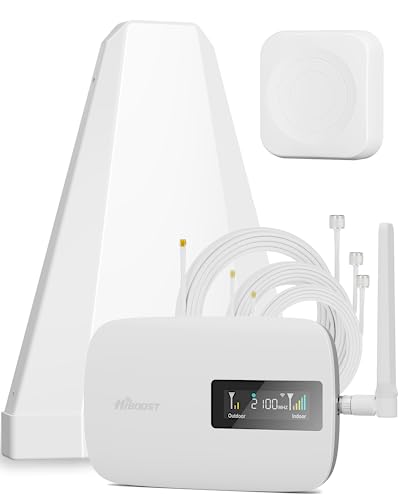
The HiBoost Hero is the compact premium choice, listed for up to 3,000 sq ft with a 65dB gain. It supports 5G through DSS in 4G, and it ships with two indoor antenna options so you can pick the one that suits the layout. That flexibility is useful in homes where the problem is a particular wing or floor, not the whole building. The limit is range. At 3,000 sq ft it will not blanket a large house, and it is priced near the top of the lineup, so someone who needs more coverage is better served by the weBoost or YJXcell. Antenna choice also means a bit more thinking at setup. Ownership is quiet once running. Compared with the Callone+ at 3,500 sq ft on its title, the Hero lists a higher stated gain and a clearer 5G story, but costs more. For a mid-sized home or a single floor, it is the tidy option.
Best for: Single floors and mid-sized homes
Check price on AmazonSpecs
- Listed coverage: Up to 3,000 sq ft
- Gain: 65dB
- 5G: Via DSS in 4G
- Antennas: Two indoor options
Pros
- +Two indoor antenna options for different layouts
- +65dB listed gain
- +5G supported via DSS in 4G
- +Compact kit for a focused area
Cons
- −Smaller listed range than most others
- −High price for 3,000 sq ft
YJXcell Home Office Booster (8,000 sq ft)
About this pick
The YJXcell lists coverage of 8,000 sq ft and up with two inside antennas, making it the largest claim in this group at a lower-middle price. The listing notes that coverage depends on the outdoor signal, and the feature text gives much smaller figures for weak signal locations, down to 600 sq ft with one to two bars. That honesty is helpful, because it shows what a real home with a mediocre signal should expect. The tradeoff is that it does not come from a large, established support brand, so the buyer is trusting the specifications more than a reputation. Two inside antennas also mean more cable and more placement choices, which can overwhelm a first-time installer. The headline number will be rare in practice. Once installed, it needs little attention. Against the weBoost Home MultiRoom it trades brand support for greater listed reach and a lower price. If your home is big and the outdoor signal is strong, it is a cost-effective gamble.
Best for: Large homes with a decent outdoor signal
Check price on AmazonSpecs
- Listed coverage: 8,000 sq ft and up
- Indoor antennas: 2 included
- 5G: Supported
Pros
- +Largest listed coverage in the group
- +Two inside antennas for multiple zones
- +Lower-middle price tier
- +Listing is upfront about weak-signal results
Cons
- −Weak outdoor signal cuts coverage sharply
- −Install is busier with two antennas
subroad Home Cell Repeater (5,000 sq ft)
About this pick
The subroad kit lists up to 5,000 sq ft and supports 5G, 4G LTE, 3G and 2G call and data signals, which is broader generation coverage than most budget kits mention. It is described as working with smartphones, hotspots, tablets and laptops from U.S. and Canadian carriers. That makes it a sensible choice for a household with a mix of older and newer devices. Its limitation is that it offers nothing special beyond that: no listed gain figure, no second antenna and no standout feature in the brief. Marketing copy leans on productivity and business use, which is less relevant for a retired household. It also sits in the upper-middle price tier, close to the weBoost, which has a stronger brand. Setup is standard and ownership is hands-off. Compared with the ESBANY it covers all carriers and more network generations, but loses the second output port. If the home holds a tablet, a hotspot and an older phone, it earns its place.
Best for: Households with older and newer devices
Check price on AmazonSpecs
- Listed coverage: Up to 5,000 sq ft
- Networks: 5G, 4G LTE, 3G, 2G
- Devices: Phones, hotspots, tablets, laptops
Pros
- +Lists support for 5G, 4G LTE, 3G and 2G
- +Works with phones, tablets and hotspots
- +5,000 sq ft listed coverage
- +All U.S. and Canadian carriers
Cons
- −No listed gain figure to compare
- −Priced close to the better-known weBoost
ESBANY Dual-Band Home Booster
About this pick
The ESBANY kit covers Band 12, 17, 4 and 66 and is aimed at T-Mobile, AT&T and US Cellular. Its dual output ports allow an extra indoor antenna to be added, which is a practical way to extend coverage to a second area later. It claims to cope with metal roofs and low-E glass, which are frequent causes of weak indoor reception. The limit is the carrier list, because Band 13 for Verizon is not in the set. A household on Verizon should look at the weBoost, YJXcell or subroad instead. The extra antenna is also an additional purchase, so the true cost of covering two zones is higher than the sticker suggests. It sits near the bottom of the price range, making it appealing to cost-aware buyers. Against the Callone+, which covers more bands including 13, it gives up the broader carrier support but adds the second output. If you are on T-Mobile or AT&T and want room to grow, it is a smart low-cost start.
Best for: T-Mobile and AT&T homes that may expand coverage later
Check price on AmazonSpecs
- Bands: 12, 17, 4, 66
- Carriers: T-Mobile, AT&T, US Cellular
- Outputs: Dual ports
Pros
- +Second output port allows an extra antenna
- +Second lowest cost group
- +Aimed at metal roofs and low-E glass
- +Long-range plus capacity bands
Cons
- −Band 13 for Verizon is not listed
- −Extra antenna costs more
Callone+ Home Office Booster (3,500 sq ft)
About this pick
The Callone+ is the lowest-cost kit in the group and lists eight bands, including 66, 25, 2, 4, 5, 12, 13 and 17. That broad band list means it covers the major carriers without needing to guess which one the household uses. The title promises 3,500 sq ft, but the feature text describes one to two rooms and up to 2,000 sq ft, so plan around the smaller figure. That makes it a one-room fix, not a whole-house solution. Buyers who expect the headline number will be disappointed, and the small coverage means placement of the inside antenna becomes very important. It is the right kind of purchase for a home office or a single bedroom with poor reception. The install is light and the budget is friendly. Against the ESBANY, it covers more bands including Band 13 for Verizon, but lacks the dual output ports. For a first-time buyer who wants to see whether a booster helps, it is the cheapest entry.
Best for: One room and a first-time trial
Check price on AmazonSpecs
- Title coverage: Up to 3,500 sq ft
- Feature coverage: 1 to 2 rooms, 2,000 sq ft
- Bands: 66/25/2/4/5/12/13/17
Pros
- +Lowest cost in the lineup
- +Light install for one room
- +All major carriers supported
Cons
- −Listing contradicts its own coverage figure
- −Realistic reach is one to two rooms
How We Evaluated These Cell Phone Signal Boosters for Home (2026)
Each pick was assessed across 5 criteria weighted for real-world use.
Coverage claims
We compared the headline number to the feature text for each kit, since the two often disagree. The Callone+ and ESBANY listings showed the biggest gaps. We trusted the more conservative figure for ranking, and we favoured listings that were clear about weak-signal results.
Carrier and band support
We checked which bands and carriers each kit lists. The Callone+ with eight bands and the subroad with 5G through 2G support were widest, while the ESBANY was narrowest. A kit that leaves out a major carrier lost points for general-purpose use.
Setup complexity
We looked at the number of antennas, optional accessories and cable runs. The YJXcell with two inside antennas and the HiBoost Hero with two antenna options require more planning than the Callone+ one-room kit. Simpler installs were weighted for buyers with limited help.
Expandability
We considered whether coverage can grow later. The ESBANY's dual output ports are the clearest example, while the weBoost is built to cover three to four rooms from the start. Kits that force a second purchase to expand scored lower.
Value across the lineup
We compared the strongest all-round pick, the weBoost Home MultiRoom, to the most basic, the Callone+. Value meant fit for the house, not lowest price. This guide is based on product specs and buyer feedback, not hands-on lab work.
How to Choose the Right Cell Phone Signal Boosters for Home (2026)
By House Size
| Situation | Recommended pick |
|---|---|
| Single room or home office | Callone+ Home Office Booster (3,500 sq ft) |
| One floor or mid-sized home | HiBoost Hero 3K Home Booster |
| Typical three to four room family home | weBoost Home MultiRoom |
| Large house with a strong outdoor signal | YJXcell Home Office Booster (8,000 sq ft) |
| Mid-sized home with mixed devices | subroad Home Cell Repeater (5,000 sq ft) |
By Budget
| Budget tier | Recommended pick |
|---|---|
| Lowest cost | Callone+ Home Office Booster (3,500 sq ft) |
| Low cost with T-Mobile or AT&T bands | ESBANY Dual-Band Home Booster |
| Lower-middle, large coverage | YJXcell Home Office Booster (8,000 sq ft) |
| Upper-middle, broad networks | subroad Home Cell Repeater (5,000 sq ft) |
| Premium, proven brand | weBoost Home MultiRoom |
| Premium, compact | HiBoost Hero 3K Home Booster |
Single-Zone vs Multi-Zone Coverage
Single zone
One problem area such as a bedroom or office. The Callone+ and HiBoost Hero fit here, with light installs and focused coverage.
Multi zone
Rooms spread across the house, which needs more antennas or output ports. The YJXcell, ESBANY and weBoost fit here.
Recommendation
Pick the HiBoost Hero for one defined area, or the weBoost if you need three to four rooms covered without fuss.
By Carrier Mix
| Household | Recommended pick |
|---|---|
| Any carrier, mixed phones | weBoost Home MultiRoom |
| Eight bands including Band 13 | Callone+ Home Office Booster (3,500 sq ft) |
| T-Mobile, AT&T or US Cellular only | ESBANY Dual-Band Home Booster |
| Older 3G and 2G devices still in use | subroad Home Cell Repeater (5,000 sq ft) |
| 5G via DSS in 4G | HiBoost Hero 3K Home Booster |
For Metal Roofs and Thick Walls Specifically
Look for
A kit that lists penetration of metal roofs and low-E glass, and ideally extra output for a second antenna. High gain and good antenna separation matter most.
In this comparison
The ESBANY explicitly targets metal roofs and low-E glass and adds dual output ports. The YJXcell and its two inside antennas are a good second choice for large metal-roof homes.
When to Spend More
Spend more if
You want a known brand and three to four rooms covered. The weBoost Home MultiRoom and HiBoost Hero reward that spending.
Save if
You only need one or two rooms, or want a trial. The Callone+ and ESBANY are the lowest cost, and the YJXcell gives large listed coverage at a lower-middle price.
Check the outdoor signal before paying for more power.
Frequently Asked Questions
How do I choose between a premium and a budget home booster?
Match the kit to the rooms and the outdoor signal. The weBoost Home MultiRoom suits three to four rooms with a known brand behind it, while the Callone+ is for one or two rooms. Paying more for range you cannot use is wasted money.
How much do home boosters cost?
Prices spread across a wide range in this roundup, from the lowest cost Callone+ and ESBANY to the premium weBoost and HiBoost Hero. Because prices change, use the buttons to check the current figure. Compare what each kit covers, not just the number.
Do boosters need maintenance?
Very little. Once the antennas are placed and the unit is powered, you mainly check that cables are tight and nothing has been moved. If calls get worse, check antenna separation and the outdoor signal before replacing anything.
Does a higher square footage number mean a better booster?
No. The Callone+ title and its feature text disagree by 1,500 sq ft, and the YJXcell shows how a listed 8,000 sq ft falls to 600 sq ft at one to two bars. The outdoor signal sets the ceiling.
Why does my booster keep reducing gain?
Usually the inside and outside antennas are too close, causing feedback. The unit cuts gain to protect the network and may shut off if that fails. Move the antennas farther apart, often 25 to 30 feet vertically as a starting rule, and check the model manual.
Will a booster help with 5G?
Several kits list 5G compatibility, such as the HiBoost Hero via DSS in 4G and the subroad. What they boost is the carrier's existing bands in your area. Confirm your carrier's bands are on the kit's list before expecting a difference.
Bottom Line
best overall: weBoost Home MultiRoom - best overall pick in this roundup.
See the full rankings above for all picks with pros, cons, and best-for summaries.
Browse on Amazon
All Prime-eligible options with current pricing.
Shop on Amazon →