5 Best Transfer Boards Under $75 in 2026
Five transfer boards at an upper-mid budget, from plain pine to ABS with extra handles, compared on stated limits, reach and grip, with therapist advice.



At a Glance
Raising the budget ceiling opens the door to boards that go beyond a plain plank. At this level you can find wider and longer boards, models with three handles, and plastic designs with a grip pad, alongside the familiar wooden boards. The question is which of those extras solve a real problem in your home.
The five picks are a DMI handled pine board, two boards from suboton, a Weybaihe 36 inch wide board and a Weybaihe 24 inch hardwood board. We evaluated them from product specs, stated limits and buyer feedback patterns, and we do not claim hands-on testing. Two of the five do not state a weight capacity in the text we reviewed, and that gap is weighed in the rankings.
Please take this seriously as a safety product. Have a physical or occupational therapist teach the technique before first use, measure your own gap and seat heights, and confirm any missing specification with the seller in writing.
6 Criteria to Look For Before Buying a Transfer Boards Under $75
Key buying criteria so you get the right fit the first time.
A stated limit that covers the user
Weight capacity is the first filter, and boards range from roughly 220 lb to 600 lb. In this lineup the DMI 30 inch and the suboton ABS board state 440 lb, and the Weybaihe 24 inch states 500 lb. The suboton with the sheet and the Weybaihe 36 inch give no figure in the text we reviewed. Choose a rating with real margin, and over about 400 lb use a bariatric board.
Reach for wider gaps
Measure the gap from the front of the wheelchair cushion to the destination, then add margin. A 24 to 30 inch board covers most beds, while a 30 to 36 inch board suits a car, SUV or van seat. The Weybaihe 36 inch and the suboton 31.5 inch are the long options here, and the Weybaihe 24 inch is the shortest. Longer boards bridge more but are harder to carry.
Thickness and flex
A thicker plank is stiffer but sits higher, and a thinner one sits lower but may flex more. The DMI is one inch thick, the Weybaihe boards are 0.75 inch and the suboton ABS board is only 0.5 inch. Keep both surfaces within about half an inch of each other. A very slim plastic or long plank deserves extra care near its stated limit.
Number and layout of handles
Cutout handles give grip for placing the board, but hands can get trapped in them. The suboton boards offer three handles, while the DMI and both Weybaihe boards offer two. More grip points help a caregiver reposition the board alone. Keep fingers clear of the openings during the slide.
Grip under the board
The board must stay put between two surfaces. The suboton boards add an anti-slip back or a 10 inch non-slip pad, while the DMI and Weybaihe wood boards rely on friction. Check the seat cover and floor before the first practice. A board that creeps is a fall risk.
Width and platform size
Most boards are 8 inches wide, and a wider board gives a bigger target but is bulkier. The Weybaihe 36 inch board is 12.8 inches wide, far above the 8 inch norm. Width only helps if you have storage space and a caregiver able to handle it. Ask a therapist whether the extra surface helps the specific user.
5 Best Transfer Boards Under $75 in 2026
DMI Transfer Board 30 Inch with Handles
About this pick
Even with a larger budget to spend, the DMI plank remains the most convincing all round choice. It is a thick Scotch pine board, 30 by 8 by 1 inches, with a clearly stated 440 lb capacity and two cutout handles that the listing describes as rounded and sealed. Tapered ends help it slip under a seated user.
What the extra money elsewhere buys is features, not a better core. A plain board has no electronics, no hinge and no disc to fail, so there is little to go wrong beyond surface wear. The one thing it lacks is an anti-slip underside, which matters on smooth floors or slick seat covers.
It weighs more than the ABS boards in this group, and its one inch height sits above the 0.5 inch suboton ABS board. Compared with the Weybaihe 24 inch it reaches six inches farther. Compared with the suboton at 31.5 inches it is a touch shorter but states its capacity plainly.
Best for: Anyone who wants the best documented, most conventional board in this range.
Check price on AmazonSpecs
- Length: 30 in
- Width: 8 in
- Thickness: 1 in
- Stated capacity: 440 lb
- Handles: Two cutouts
Pros
- +440 lb capacity is clearly stated
- +Sturdy one inch plank with sealed handles
- +30 inch reach suits common gaps
- +No moving parts to fail
Cons
- −No anti-slip underside
- −Heavier than the plastic alternatives
- −Sits higher on the seat than thin boards
suboton ABS Transfer Board with Non-Slip Pad, 29.5 Inch
About this pick
This suboton board is molded from high density ABS polymer, measures 29.5 by 8 by 0.5 inches and is listed for support up to 440 lb. It has three built-in handles, tapered ends and side notches that help the board clear armrests. A 10 inch round non-slip pad is included to add traction on smooth surfaces.
The listing is careful to say the pad is a grip aid, not a transfer sheet, which is an honest distinction. It also tells buyers to test the fit and move slowly before regular use, which is exactly the right instinct. At half an inch thick the board sits very low, so it can help when the destination is a little lower than the chair.
The tradeoff is flex, since a slim plastic plank may bend more than a one inch pine board even at the same stated rating. Against the DMI 30 inch it adds handles and a pad but loses thickness. Compared with the other suboton, which ships with a slide sheet, it gives a clear capacity figure.
Best for: Assisted transfers where a light board with several grip points and a pad is welcome.
Check price on AmazonSpecs
- Length: 29.5 in
- Width: 8 in
- Thickness: 0.5 in
- Stated capacity: 440 lb
- Included: 10 inch round non-slip pad
Pros
- +Three handles give flexible grip points
- +Includes a 10 inch non-slip pad
- +Stated capacity of 440 lb in the listing
- +Side notches help clear armrests
Cons
- −Thin 0.5 inch plastic may flex under load
- −Pad is not a slide sheet
- −Handles still need careful finger placement
suboton Board with Slide Sheet, 31.5 Inch
About this pick
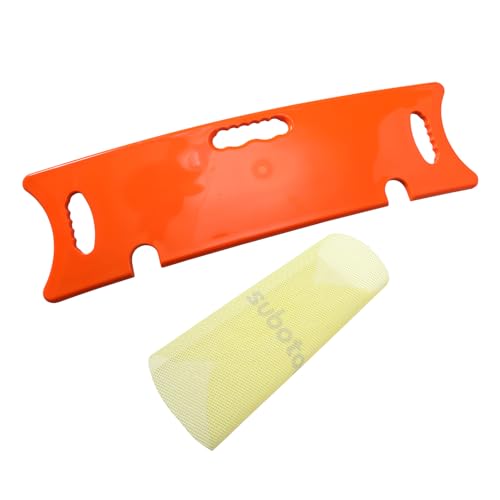
The first suboton listing bundles a 31.5 by 8 inch board with a green 28 by 28 inch slide sheet. The board has three handles and curved edges, and the underside carries an anti-slip pattern intended to keep it from creeping. It is the longest plain rigid board in this selection.
What the listing does not do is state a weight capacity in the text we reviewed. That omission is a real concern for a safety product, so ask the seller for the figure before committing. The sheet adds its own technique, and a caregiver should be shown how to combine it with the board.
On features alone it is attractive, since it pairs a long board with an anti-slip back and a sheet. Compared with the 29.5 inch suboton ABS board it is two inches longer but has no stated limit. Next to the DMI it trades documented strength for extras, so confirm the rating before relying on it.
Best for: Caregivers who want a board and sheet together and will confirm the weight limit.
Check price on AmazonSpecs
- Board size: 31.5 x 8 in
- Sheet: 28 x 28 in, green
- Handles: Three
- Back: Anti-slip design
- Capacity: Not clearly stated
Pros
- +Includes a 28 x 28 inch slide sheet
- +31.5 inch length for wider gaps
- +Three handles and an anti-slip back
- +Curved edges reduce snagging
Cons
- −No clearly stated weight capacity
- −Sheet requires separate training
- −Documentation is thinner than DMI
Weybaihe Wide Transfer Board, 36 x 12.8 Inch
About this pick
The Weybaihe wide board stretches to 36 inches long and 12.8 inches wide at 0.75 inch thick, which makes it the biggest surface in this group. It has two cutout handles and a polished, sealed face. The listing positions it as a transfer tool for wheelchairs, beds and other seats.
Size is the whole story. A 36 inch board can bridge a car or van gap that shorter boards cannot, and a 12.8 inch width gives a more generous target for a user who wants more support under the hips. The listing text we reviewed does not state a weight capacity for this size, so confirm one in writing before use.
The cost of all that surface is handling. It is the hardest board here to carry and store, and a thin plank this long may flex mid span. Against the DMI 30 inch it adds six inches of reach and four and a half inches of width, but loses the clear 440 lb statement.
Best for: Wide gaps and users who want a larger platform, once the seller confirms capacity.
Check price on AmazonSpecs
- Length: 36 in
- Width: 12.8 in
- Thickness: 0.75 in
- Handles: Two cutouts
- Capacity: Not stated in listing text
Pros
- +36 inch length reaches wide gaps
- +12.8 inch width gives a larger target
- +Two cutout handles for placement
- +Sealed polished wood surface
Cons
- −No weight capacity in the listing text
- −Awkward to carry and store
- −Long thin plank may flex mid span
Weybaihe Hardwood Transfer Board, 24 Inch
About this pick
This is the compact member of the Weybaihe pair: a 24 by 8 by 0.75 inch hardwood board with two cutout handles and a listed capacity of up to 500 lb. The wood is polished and sealed and described as non-latex. It is the easiest board in this group to tuck away.
The 500 lb figure is the highest stated capacity here, but it comes from a maker claim on a thin plank, so it deserves a question to the seller. The listing language is loose, so request written specifications. For anyone near the stated limit, a clinician should weigh in on a bariatric board.
Its short reach limits it to close transfers, and it will not span the gaps the 36 inch Weybaihe or the 31.5 inch suboton can. Against the DMI 30 inch it is lighter and lower but shorter. For a small bedroom with a tight chair position, it is a neat choice.
Best for: Close transfers in small rooms where a light hardwood board is enough.
Check price on AmazonSpecs
- Length: 24 in
- Width: 8 in
- Thickness: 0.75 in
- Stated capacity: 500 lb
- Material: Hardwood, non-latex
Pros
- +500 lb stated capacity is the highest here
- +Light and easy to store
- +Handles shaped for varied hand sizes
- +Non-latex hardwood construction
Cons
- −24 inch reach suits close gaps only
- −Thin plank may flex near its limit
- −Listing wording is vague
How We Evaluated These Transfer Boards Under $75
Each pick was assessed across 5 criteria weighted for real-world use.
Capacity documentation
We checked whether each listing states a weight limit and whether it is plausible for the plank. The DMI and suboton ABS board state 440 lb and the Weybaihe 24 inch states 500 lb. The other two lost points for leaving it out.
Reach and surface area
We compared length and width against typical gaps. The Weybaihe 36 inch leads with 36 by 12.8 inches, the suboton sheet board follows at 31.5 inches, and the DMI sits at 30 inches. The Weybaihe 24 inch trails.
Grip and slip control
We looked at handle count and underside traction. The suboton boards lead with three handles and an anti-slip back or pad, and the wood boards rely on friction. Slip control earns credit for assisted transfers.
Thickness against flex risk
We weighed rigidity against seat height. The DMI is the stiffest at one inch, while the 0.5 inch ABS suboton board and the long Weybaihe 36 inch raise flex questions. Thin and long boards need extra caution.
Value at this ceiling
We considered what the extra budget buys versus a plain plank. Extras here are handles, a pad, a sheet and a wider surface. The DMI remains the safest default, and the suboton ABS board is the best step up with a stated rating.
How to Choose the Right Transfer Boards Under $75
By Gap Width
Reach decides the board more than any other feature, so measure first.
| Situation | Pick | Reason |
|---|---|---|
| Chair pushed tight to the seat | Weybaihe Hardwood Transfer Board, 24 Inch | Compact and light for close gaps |
| Typical bed gap | DMI Transfer Board 30 Inch with Handles | 30 inches with a clear 440 lb figure |
| Slightly wider gap | suboton Board with Slide Sheet, 31.5 Inch | Longer board plus three handles |
| Car or van style gap | Weybaihe Wide Transfer Board, 36 x 12.8 Inch | 36 inches is the longest reach here |
Never choose a board that only just reaches the far surface.
By Budget Tier
The upper-mid ceiling adds features rather than raw strength.
| Tier | Pick | What you get |
|---|---|---|
| Entry | Weybaihe Hardwood Transfer Board, 24 Inch | Light hardwood with a 500 lb stated figure |
| Mid | DMI Transfer Board 30 Inch with Handles | Long thick plank with clear specs |
| Upper | suboton ABS Transfer Board with Non-Slip Pad, 29.5 Inch | Three handles and a grip pad |
| Upper | suboton Board with Slide Sheet, 31.5 Inch | Board plus sheet, capacity unconfirmed |
Paying for extras only pays off if you will use them.
Wood vs ABS Plastic
The material changes weight, thickness and cleaning.
Wooden boards
Sealed pine or hardwood feels rigid and glides well, though it is heavier and needs a surface check for cracks. It includes the DMI 30 inch and both Weybaihe boards. Pick it for stiffness and a classic, repairable feel.
ABS plastic board
Molded plastic is light, thin and easy to wipe clean, and can add grip features. It includes the suboton ABS board at 0.5 inch. Pick it when weight, wiping and an included pad matter more than plank stiffness.
Either material must be inspected regularly for damage.
By Handle and Grip Needs
Who places the board matters as much as who rides on it.
| Need | Pick | Why |
|---|---|---|
| Several grip points to reposition | suboton ABS Transfer Board with Non-Slip Pad, 29.5 Inch | Three handles and a 10 inch pad |
| Two simple cutouts | DMI Transfer Board 30 Inch with Handles | Rounded, sealed handles |
| Anti-slip back plus sheet | suboton Board with Slide Sheet, 31.5 Inch | Back pattern and 28 x 28 inch sheet |
| Handles on a large platform | Weybaihe Wide Transfer Board, 36 x 12.8 Inch | Two cutouts on a 12.8 inch wide board |
Keep fingers out of the cutouts during the slide.
For Toilet and Commode Transfers Specifically
Bathrooms are tight, hard and sometimes wet.
Look for
Look for a shorter board with a wipeable surface and good grip, because space is limited and moisture is likely. Confirm the commode height matches the chair. A therapist should rehearse the move.
In this comparison
The suboton ABS board at 29.5 inches has a pad and a wipeable surface, and the Weybaihe 24 inch is compact. Wooden boards need drying after any splash. The 36 inch Weybaihe is usually too long for a small bathroom.
When to Spend More
Spend more only where a pick fixes a clear problem.
| Spend more if | Save if |
|---|---|
| You want three handles and a pad, as on the suboton ABS board | Two handles on the DMI are enough |
| The gap needs the Weybaihe 36 inch reach | A 30 inch DMI reaches comfortably |
| A caregiver wants a bundled sheet, as with the suboton 31.5 inch | You can use a plain board without a sheet |
| The user needs a turntable, which sits above this ceiling | The user shifts sideways without help |
Ask for written specs on any listing that leaves out the capacity.
Frequently Asked Questions
Why do two of these boards have no stated capacity?
The listing text we reviewed for the suboton sheet board and the Weybaihe 36 inch does not give a weight limit. That is a documentation gap, not proof the board is weak. Ask the seller to confirm the figure in writing. Do not use an unrated board for a person near any limit.
Is a plastic board as strong as a wooden one?
Strength depends on the stated rating and the thickness, not the material alone. The suboton ABS board states 440 lb at 0.5 inch, while the DMI states 440 lb at one inch. The thinner plank may flex more. Ask a therapist whether the flex is acceptable for the user.
Do I need a slide sheet with my board?
Not for every user. A sheet reduces friction under a seated person, but it adds a second technique and can make a transfer less controlled if used poorly. The suboton 31.5 inch bundles one. Have a therapist show you whether a sheet helps your situation.
Is a wider board safer?
A wider board such as the Weybaihe 36 inch at 12.8 inches gives a larger target. It is also bulkier and harder to move. Safety depends on stable placement and good technique more than width. Ask a therapist whether a wide platform helps the user.
What does the non-slip pad do?
The 10 inch round pad that comes with the suboton ABS board adds traction on smooth surfaces and helps the board stay put. The listing states it is not a transfer sheet. It helps placement but does not remove the need for good technique. Check it for wear over time.
How do I check a board before each use?
Look over the plank for cracks, splinters, rough edges or a damaged finish, and test that the handles are intact. Place it on both surfaces and press down to confirm it does not rock. Retire any board that looks damaged. A failure mid transfer is a fall risk.
Which board is best if I am unsure where to start?
The DMI 30 inch board with handles is the safest default, because it states 440 lb clearly, reaches 30 inches and has no moving parts. Move to the suboton ABS board if you want three handles and a grip pad with a stated rating. Move to the Weybaihe 36 inch only if the gap truly demands it and the seller confirms capacity. Whichever you pick, rehearse the move with a therapist before relying on it at home or in a car.
Does a transfer board treat a medical condition?
No. It is a mobility aid that bridges two seats and makes no medical claim. Whether it suits someone depends on strength, balance and the home setup. A physical or occupational therapist can advise on both fit and technique.
Bottom Line
best overall: DMI Transfer Board 30 Inch with Handles - best overall pick in this roundup.
See the full rankings above for all picks with pros, cons, and best-for summaries.
Browse on Amazon
All Prime-eligible options with current pricing.
Shop on Amazon →