6 Best Soil Moisture Meters for Lawns (2026)
Six soil moisture meters for lawns compared: wireless multi-zone, battery-free dial and digital models, with tips on probe depth, hard soil and sprinkler zones.




At a Glance
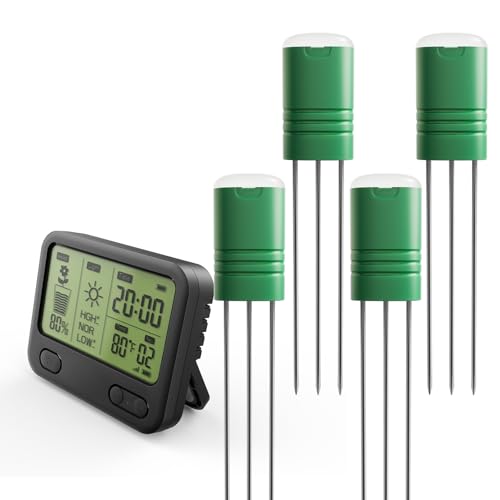
NexusLab Wireless Soil Moisture Meter, 3-Probe Sensors
↓ See why we picked itA lawn is the hardest place to judge soil moisture by eye. Grass blades can look fine while the root zone is dry, a sprinkler can soak the surface and leave the soil below barely damp, and the sunny strip along the driveway dries at a very different pace than the shaded corner under a tree. A moisture meter gives you a reading at root depth, so you can water the spots that need it and skip the spots that do not.
This guide compares six meters that can be used on turf. The NexusLab Wireless is a multi-zone system with remote sensors and an indoor screen. The XLUX Orange 2-Pack, the Hathdia and the Thlevel are battery-free dial probes with simple readouts. The EDGEVEIL 4-in-1 is a digital screen model that adds temperature, light and a clock, and the HSLGOVE 7-in-1 combines a dial with an LCD for extra readings.
We evaluated these from the listings, stated specs and buyer feedback, without claiming hands-on testing. For lawns we looked at probe construction, how the reading is displayed outdoors, whether the tool can stay in place, and what extras help or distract. The notes below also cover the habits that matter on turf, such as testing several spots, pushing through thatch and avoiding hard, dry ground that can bend a thin probe.
6 Criteria to Look For Before Buying a Soil Moisture Meters for Lawns (2026)
Key buying criteria so you get the right fit the first time.
Probe length, thatch and hard ground
Turf adds obstacles that a pot does not. Thatch and dense roots can block a short probe, and compacted or dry ground can bend a thin stem. Most dials here, including the XLUX Orange, Thlevel and Hathdia, are short single probes. Water the area first or press slowly with steady pressure, and never twist or lever the meter. The NexusLab uses triple stainless steel probes in a sensor designed to stay in the ground.
Handheld versus fixed sensors
A handheld dial gives one reading at one spot, and you walk the yard. A fixed system like the NexusLab leaves sensors in several zones and reads them from an indoor screen, with two sensors included and up to 12 zones possible. Handheld suits a small lawn and occasional checks, while fixed sensors suit a large or zoned yard. The EDGEVEIL falls between the two, with a digital screen aimed at monitoring from a distance.
Reading display outdoors
Sunlight washes out some screens and small dials. The Thlevel color-codes red, green and blue so you can read it at a glance, the XLUX has a large three-zone dial, and the EDGEVEIL uses a large digital screen. An LCD can be hard to read in bright sun, while a high-contrast dial is easy. Read your meter in the shade of your own body, and keep a cloth handy to wipe soil off the face.
Power and weather exposure
Outdoor tools face rain, dew and dirt. Battery-free dials from XLUX, Thlevel and Hathdia have no electronics to fail, while the HSLGOVE needs three batteries and the EDGEVEIL and NexusLab depend on power. Sensors left in the ground should be designed for it, so read the listing carefully. Bring handheld meters indoors when not in use, and dry the probe before storage.
Sampling different lawn zones
One reading never describes a lawn. Sun, shade, slopes, soil type and sprinkler coverage all change how fast soil dries. Take several readings in each zone, note whether they agree, and compare before and after watering. The XLUX Orange 2-Pack lets you test two spots at once, and the NexusLab lets you watch multiple zones continuously. Moving a probe a foot can change the result.
Extras that actually help on turf
Temperature, light and humidity can help, but they should not distract from moisture. The EDGEVEIL shows temperature, light and a clock, and the HSLGOVE adds air humidity and pH. Soil temperature affects grass growth, and light level helps explain why a shaded patch stays wet. pH and fertility readings from these low-cost tools are rough, so use them to compare areas, not to plan lime or fertilizer purchases.
6 Best Soil Moisture Meters for Lawns (2026)
NexusLab Wireless Soil Moisture Meter, 3-Probe Sensors
About this pick
The NexusLab is a wireless system built around remote sensors and an indoor LCD receiver. It starts with two included sensors and can grow to 12 zones, each a triple stainless steel probe that measures moisture, temperature and light, and it uses Time Domain Reflectometry, a technique more often seen in professional equipment. The listing quotes a 230 foot wireless range in open air, so you can watch the front lawn from the kitchen.
For a lawn this layout is the right shape. Different parts of a yard behave differently: a sunny slope, a shaded corner, the strip by the walkway. Putting a sensor in each zone and reading all of them from one screen lets you spot the dry area before the grass shows stress, and see whether a sprinkler zone is actually delivering water to the root layer.
The costs are complexity and range. The quoted distance applies in open air, so walls, fences and hills will shorten it. The sensors stay in the ground, so they need batteries or power as described on the listing, and the system is more involved to set up than a dial. Compared with the XLUX, you swap a handheld glance for a monitoring network. It is the pick for a larger lawn, several zones, or anyone who wants to watch without walking out in bad weather.
Best for: Larger lawns with several zones that need remote monitoring.
Check price on AmazonSpecs
- Sensing: Time Domain Reflectometry
- Probes: Stainless steel, triple
- Zones: 2 included, up to 12
- Range: 230 ft open air
Pros
- +Two sensors included, expandable to 12
- +TDR sensing with triple stainless probes
- +Indoor screen shows all zones
- +Long range in open air
Cons
- −Range falls with walls and obstacles
- −More setup than a handheld dial
- −Sensors left outdoors need power and care
XLUX Orange 2-Pack Soil Moisture Meter
About this pick
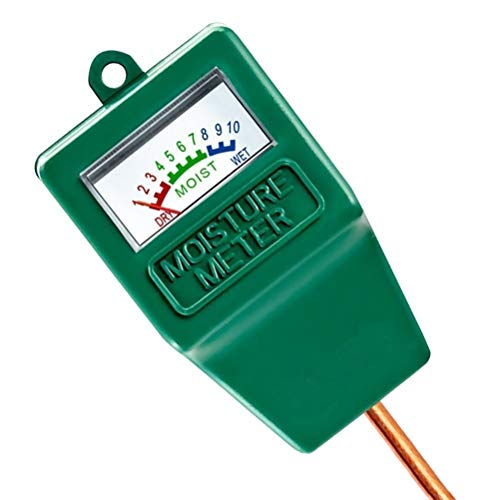
The XLUX Orange 2-Pack is a pair of battery-free dial meters that the listing advertises for garden and lawn use as well as pots. It detects deep soil moisture as dry, moist or wet, which matters on turf where eyes and fingers only judge the top. The large dial has three zones and ten scales, and the needle moves as soon as you insert the probe.
Two meters let you work two ways. You can test two lawn areas at once, say sun and shade, and compare them side by side. Or you can keep one for the yard and one for the house plants. The bright orange body is also easier to spot in the grass than a green or gray meter, which helps with a tool that gets set down while you carry a hose.
The limits are those of any short dial probe. Thatch, dense roots and compacted soil can make insertion difficult, and forcing a thin probe into hard ground can bend it. Water first or press slowly. Compared with the Hathdia and Thlevel, the XLUX is the pair with the clearest scale information, while the NexusLab is the monitoring system. For most lawn owners who want to test a few spots and decide whether to run the sprinkler, this is a sensible, uncomplicated choice.
Best for: Testing sun and shade zones side by side with a simple, bright dial.
Check price on AmazonSpecs
- Count: 2 meters
- Power: None needed
- Dial: 3 zones, 10 scales
- Reading: Immediate
Pros
- +Two meters in one pack
- +Instant reading, no battery
- +Three-zone dial is easy to interpret
- +Bright body is easy to spot in grass
Cons
- −Short probe in thick thatch
- −Thin probe can bend in hard ground
- −Relative reading only
Thlevel Plant Moisture Meter for Garden and Lawn
About this pick
The Thlevel is a battery-free dial meter that the listing recommends for house plants, gardens and lawns. The probe is described as an upgraded stainless steel sensing probe, and the large dial uses ten scales in three colors: red means dry, green means moist and blue means wet. That plain color code is the heart of the product. You do not need to interpret a number, just see where the needle sits.
The listing says to insert the probe tip to the root level and leave it for several minutes, which is slower than the instant read on the XLUX. On a lawn that wait is worth respecting, because the needle on a resistance-style probe can keep creeping as moisture equalizes around the metal. Take the reading when the needle has stopped moving, and then move to a new spot.
Outdoor tools get dropped and left on the grass, so a stainless probe is a sensible feature. Compared with the Hathdia, the Thlevel gives a clearer color scheme, and compared with the XLUX Orange pair, it is a single meter. It fits someone who wants a tool for the garden and the lawn without paying for wireless or digital features. Clean the probe after each session to keep soil and fertilizer from building up on the metal.
Best for: Lawn owners who want a color-coded dial with a stainless probe.
Check price on AmazonSpecs
- Probe: Upgraded stainless steel
- Power: None needed
- Dial: Ten scales, color-coded
- Wait: Several minutes in soil
Pros
- +Red, green and blue zones are easy to read
- +Upgraded stainless steel probe
- +No battery or electricity needed
- +Suits lawn, garden and indoor pots
Cons
- −Needs several minutes in the soil
- −Single short probe
- −Relative reading only
Hathdia Single Probe Soil Moisture Meter
About this pick
The Hathdia is a single-probe soil moisture meter with a pointer dial and no batteries, offered for potted plants, gardens, farms and lawns. The listing tells you to insert the probe to the plant root level and read where the indicator settles. A single probe is a straightforward design, and the pointer moves quickly according to the listing.
Its value on a lawn comes from being the most basic and the least costly kind of tool in the lineup. If you want a quick check before running a sprinkler, a single probe and a needle is enough. You will not get remote monitoring or extra readings, but you also will not have anything that needs charging or can lose connection.
The tradeoffs are the same as with any budget dial: a relative reading and a short probe. Push it in slowly at several spots, wait for the pointer to settle, and wipe it clean afterward. Compared with the Thlevel, the Hathdia does not offer the same color-coded dial layout, and compared with the XLUX pair it gives you one meter instead of two. It is a reasonable pick for a small lawn, a front yard strip, or as a spare tool in the garden shed.
Best for: Small lawns and quick checks before turning on the sprinkler.
Check price on AmazonSpecs
- Probe: Single, sensitive
- Power: None needed
- Display: Pointer dial
- Use: Pots, garden, farm, lawn
Pros
- +Single probe is simple to use
- +No batteries or electricity needed
- +Pointer reacts quickly per the listing
- +Works on lawns, gardens and pots
Cons
- −Short probe for deep turf roots
- −No color code or extra readings
- −Relative reading only
EDGEVEIL 4-in-1 Digital Soil Moisture Meter
About this pick
The EDGEVEIL is a digital meter with a large screen that shows soil moisture, temperature, light level and a real-time clock together. The listing's pitch is confidence in watering and the ability to check plants from across the home and yard without walking from pot to pot, bending down or stepping outside in bad weather. Treat the exact connection details as something to confirm on the product page before you buy.
On a lawn the temperature and light readings have real use. Soil temperature affects how grass grows and how it uses water, and light levels tell you which parts of the yard are shaded. A clock on the display also lets you note when you took a reading, which helps when comparing morning with evening conditions.
The tradeoffs are the usual ones for a digital unit: it needs power, and low power can distort readings. The extras are guides, not laboratory values. Compared with the NexusLab, the EDGEVEIL is a simpler, less expandable system, and compared with the dials it gives you numbers and context. It suits a lawn owner who likes to log data and wants one screen with several readings, not a quick needle check.
Best for: Lawn owners who want moisture, temperature and light on one screen.
Check price on AmazonSpecs
- Functions: Moisture, temperature, light, clock
- Display: Large screen
- Reading: Real-time
- Use: Home and yard plants
Pros
- +Moisture, temperature and light together
- +Real-time clock helps log readings
- +Large screen is easy to read
- +Aimed at checking from across the yard
Cons
- −Needs power and attention
- −Connection details need confirming
- −Extras are rough guides
HSLGOVE 7-in-1 Soil Test Kit with Dual Screen
About this pick
The HSLGOVE is a seven-in-one kit with one dial and one LCD screen, designed for beginners according to the listing. It combines a soil moisture dial with an LCD that shows air and soil temperature and humidity, plus pH and fertility readings, and it requires three batteries. The listing describes a switch that turns the LCD on and off, so you can save power.
The pairing of a dial and a screen is its main idea. You get the quick needle for soil moisture and a digital readout for the surrounding conditions, such as air temperature and humidity, which can matter for a lawn deciding between a morning and an afternoon watering. Air humidity helps you judge how fast water will evaporate from the surface.
More functions mean more complexity. The pH and fertility settings are rough guides, and batteries need replacing. Compared with the EDGEVEIL, the HSLGOVE adds a dial and a different set of readings, and compared with the Thlevel it is far more involved. Choose it if you want a single kit that can double as a general garden station, and skip it if you simply want to know when to water the grass.
Best for: Beginners who want a dial and a screen with air and soil data.
Check price on AmazonSpecs
- Screens: 1 dial and 1 LCD
- Functions: 7 in 1
- Power: 3 batteries
- Design: Dual-dial, patented
Pros
- +Dial and LCD in one tool
- +Adds air humidity and temperature
- +Switch lets you turn the LCD off
- +Many functions for a general garden kit
Cons
- −Requires three batteries
- −pH and fertility are rough guides
- −Complex for a simple lawn check
How We Evaluated These Soil Moisture Meters for Lawns (2026)
Each pick was assessed across 5 criteria weighted for real-world use.
Suitability for turf
We looked at whether each listing names lawns, and how the probe is built. The XLUX Orange, Hathdia and Thlevel advertise lawn or garden use, while the NexusLab and EDGEVEIL describe yard monitoring. We did not measure insertion force on real turf, so this is a spec-based judgment.
Monitoring approach
The lineup spans handheld dials, a digital screen and a wireless multi-zone system. The NexusLab leads on coverage with 12 possible zones and a quoted 230 foot open-air range, and the dials lead on simplicity. We weighed the setup effort against the value of continuous information.
Readability outdoors
A lawn meter is read in bright light, often standing. We compared the Thlevel color code, the XLUX three-zone dial and the digital screens of the EDGEVEIL and HSLGOVE. Simple high-contrast dials scored well for quick checks, while screens scored for logged data.
Durability and weather
Outdoor use is rough on tools. We noted stainless steel probes on the Thlevel and NexusLab, the absence of electronics on the dials, and the battery dependence of the digital units. Buyer-feedback themes about bent probes in hard soil were weighed against each design.
Extras and value
We scored extras by how well they help lawn care. Temperature and light on the EDGEVEIL and air humidity on the HSLGOVE were treated as useful context, while pH and fertility were treated as rough. Value was judged relative to the others without quoting prices.
How to Choose the Right Soil Moisture Meters for Lawns (2026)
By Lawn Size and Layout
Match the tool to how much ground you need to cover.
| Lawn | Recommended pick | Why |
|---|---|---|
| Small front lawn | Hathdia Single Probe | Simple needle check |
| Sun and shade areas to compare | XLUX Orange 2-Pack | Two meters, test both at once |
| Several sprinkler zones | NexusLab Wireless 3-Probe | Two sensors, up to 12 zones |
| Want an easy color-coded read | Thlevel Moisture Meter | Red, green, blue scale |
| Want data logged on one screen | EDGEVEIL 4-in-1 Digital | Moisture, temperature, light, clock |
By Budget
Tiers are relative and avoid dollar figures.
| Budget tier | Recommended pick | What you get |
|---|---|---|
| Entry | Hathdia Single Probe | Basic battery-free needle |
| Entry to mid | Thlevel Moisture Meter | Color-coded stainless dial |
| Mid | XLUX Orange 2-Pack | Two dial meters |
| Mid to upper | HSLGOVE 7-in-1 Kit | Dial plus LCD with extras |
| Upper | EDGEVEIL 4-in-1 Digital | Large screen with a clock |
| Premium | NexusLab Wireless 3-Probe | Remote multi-zone sensors |
A dial pair is enough for most lawns, and wireless is for large or zoned yards.
Handheld Dial vs Wireless Sensors
This is the central decision for lawn monitoring.
Handheld dial
The XLUX Orange, Thlevel and Hathdia are walk-and-test tools. They cost no power, give an instant or near-instant reading and can be put in a pocket. You must go outside to use them. Pick a dial for a small to medium lawn and occasional checks.
Wireless sensors
The NexusLab leaves sensors in the ground and reports to an indoor screen, with two sensors included and up to 12 zones possible. You see conditions without walking the yard. Setup and power are more involved, and range depends on obstacles. Pick wireless for a large or multi-zone lawn.
Dial for occasional checks, wireless for continuous watching.
Simple Moisture vs Extra Data
The second decision is how much information you want.
| Preference | Recommended pick | Why |
|---|---|---|
| Moisture only | Thlevel Moisture Meter | Single clear dial |
| Air humidity and temperature | HSLGOVE 7-in-1 Kit | LCD for air and soil conditions |
| Soil temperature and light | EDGEVEIL 4-in-1 Digital | Temperature, light and clock |
| Triple probe TDR sensing | NexusLab Wireless 3-Probe | Time Domain Reflectometry |
| Pair for two spots | XLUX Orange 2-Pack | Two identical dial meters |
For Deep, Infrequent Watering Specifically
Grass generally does better with deeper, less frequent watering than daily light sprinkling.
Look for
Look for a meter that tells you whether water has reached the root zone, not just the surface. Test before watering, water, then retest an hour or a day later to see how deep it went. Keep a note of how long each zone needs to reach the moist band.
In this comparison
The NexusLab triple-probe sensors stay in place to show how moisture changes after a sprinkler cycle, and the XLUX Orange pair lets you check two depths or areas quickly. The Thlevel's color code makes before-and-after comparison easy.
When to Spend More
Spend more when the feature saves you effort over a whole season.
| Spend more if | Save if |
|---|---|
| The NexusLab's remote zones would save you daily walks across a big yard | A pair of XLUX Orange dials covers your lawn |
| The EDGEVEIL's logged temperature and light would guide your routine | You only need a dry or moist answer |
| The HSLGOVE's dial and LCD would serve as a garden station | The Hathdia single probe is enough |
| The Thlevel's color code would help others in the household water correctly | You are the only one reading the meter |
Frequently Asked Questions
How do I choose between a dial meter and a wireless system for my lawn?
A dial like the XLUX Orange, Thlevel or Hathdia suits a small or medium lawn where you can walk and test a few spots. A wireless system like the NexusLab suits a large or zoned yard where sensors stay in place and report to an indoor screen. Choose by lawn size and how often you want to check.
Can I push a moisture meter into hard or dry ground?
Be careful. Thin probes can bend in compacted or very dry soil. Water the spot first and let it soak in, then press slowly and steadily without twisting. A thick sensor such as the NexusLab triple probe is built for staying in the ground, but still follow the setup instructions.
How many spots should I test on a lawn?
Test at least three spots per zone, and include sunny, shaded and sloped areas. Soil moisture changes quickly with sun, soil type and sprinkler coverage. If your readings disagree, trust the driest spot for watering decisions, or water by zone. The XLUX Orange pair makes it easy to compare two places.
When is the best time to test?
Test before you water, in the morning when conditions are cooler and the soil has stabilized overnight. Avoid reading right after rain, since surface water takes time to move down. Retest a day after watering to see how deep the water went. Consistent timing makes your readings easier to compare.
Are pH and fertility readings on these meters reliable?
They are rough. The HSLGOVE and similar kits include them, but low-cost sensors cannot match a lab test. Use them to compare areas of your yard, and send a soil sample to a lab if you plan to adjust pH with lime or sulfur. Rely on the moisture reading for watering.
Do I need to clean the probe?
Yes. Wipe it with a damp cloth after each session and dry it fully. Soil, fertilizer and moisture corrode metal over time, which makes readings drift. Stainless probes such as the Thlevel's last longer, but no probe is immune. Store dial meters indoors between uses.
Will a wireless sensor work through walls and fences?
The NexusLab quotes 230 feet in open air, and obstacles reduce that range. Walls, fences, hills and metal can all weaken the signal. Place the indoor screen near a window or an outside wall, and test the connection before burying the sensor permanently.
Bottom Line
best overall: NexusLab Wireless Soil Moisture Meter, 3-Probe Sensors - best wireless multi-zone pick in this roundup.
See the full rankings above for all picks with pros, cons, and best-for summaries.
Browse on Amazon
All Prime-eligible options with current pricing.
Shop on Amazon →