6 Best Soil Moisture Meters for Indoor Plants (2026)
Six soil moisture meters for houseplants compared: leave-in sticks, dial and top-display probes, and 4-in-1 testers, with notes on pot size and roots.




At a Glance
Indoor plants usually die from too much love, not too little. A pot on a shelf has no rain to correct a bad guess, drainage is limited, and a peat-based mix can stay wet at the bottom for days after the top has dried. A moisture meter helps because it reads below the surface, where the roots sit, and replaces the finger test with something you can repeat on every plant in the house.
This guide compares six meters chosen for pots and windowsills. The XLUX Battery-Free and the Dr.meter are simple dial probes with ten scales. The Jxikatx puts its display on top of the handle. The SUStee Aquameter is a different idea entirely, a leave-in sensor stick for small pots. The Raintrip and the YAMRON are 4-in-1 testers that add pH, light and more to the moisture reading, in a dial form and a backlit digital form respectively.
We evaluated these from the listings, stated dimensions and buyer feedback, without claiming hands-on testing. For indoor use we paid special attention to pot size, how much damage a probe might do to roots, how easy it is to read at plant height, and whether the extras make sense on a windowsill. The notes below explain which meter suits a single orchid, a shelf of succulents or a room full of large foliage plants.
6 Criteria to Look For Before Buying a Soil Moisture Meters for Indoor Plants (2026)
Key buying criteria so you get the right fit the first time.
Pot size and probe thickness
A probe takes up room and cuts through roots. In a pot of two to three inches, a full-size probe can disturb a large share of the root ball, which is why the SUStee Aquameter sticks, at about 4.7 inches long and sized for two to three inch pots, make sense for small succulents. For medium and large pots, the XLUX or Dr.meter dials are better. Insert gently, avoid the stem base, and pick spots a few inches from the plant when you can.
Reading position and visibility
Indoor plants live on shelves, plant stands and the floor, so how you read the meter matters. The Jxikatx puts its display on top of the handle so you can look straight down, and the Raintrip has a 90 degree rotating dial to avoid bending. Side dials like the XLUX are fine on a table. If you have trouble crouching or reading small numbers, favor these position-friendly designs.
Leave-in versus handheld
A handheld meter gives you a reading whenever you ask, and you can use one tool on many pots. A leave-in stick like the SUStee gives constant monitoring for one pot but needs one stick per plant. Handhelds suit a big, varied collection, while leave-in sticks suit a few tiny pots you tend to forget. Many plant owners use both: a dial like the XLUX for large pots and sticks for small ones.
Indoor soil mixes and relative readings
A peat-heavy tropical mix holds water much longer than a gritty cactus blend, so the same needle position means different things. Learn each mix by watering a pot, letting it drain, and taking a baseline reading, then compare later readings to that. This is why relative dial meters like the Dr.meter work fine as long as you calibrate them by feel. Digital values from the YAMRON are numbers, but they are no more absolute.
Extras that matter on a windowsill
Light and temperature readings are useful for choosing a spot, but they are rough. The YAMRON and Raintrip both include them, and the Raintrip adds nutrient and pH. A light reading helps you see whether a shelf is much dimmer than a window, but is not a precise lux measurement. Treat extras as a guide and spend your attention on the moisture function, which is what keeps plants alive.
Power and upkeep
Houseplant tools get used in short bursts and then forgotten. Battery-free dials like the XLUX, Dr.meter and Raintrip are ready each time, while the YAMRON digital unit needs a working battery, and low power can mimic dry soil. Wipe each probe and dry it after use, since constant contact with moist soil and fertilizer salts is what corrodes metal. A small cloth kept near your plants makes this a habit.
6 Best Soil Moisture Meters for Indoor Plants (2026)
XLUX Plant Soil Moisture Meter, Battery-Free
About this pick
The XLUX Plant Soil Moisture Meter is the all-rounder for a household with several houseplants. The listing says the maker has sold it since 2015, and it pairs an anti-rust 304 stainless steel probe with a large color-coded dial that has 10 distinct scales. There is no battery, so it is ready whenever you walk past a thirsty-looking fern.
The listing makes a point that matters indoors: eyes and fingers only judge the surface, while the meter reads deeper. In a typical pot the top inch dries quickly under a heater or a sunny window, which tempts people to water, while the lower soil is still wet. A probe that reaches the root zone catches this and prevents the slow rot that overwatering causes.
The tradeoff is that the dial gives a relative reading, so learn your own mixes. A cactus blend and a peat-heavy tropical mix will sit at different positions even at the same true wetness. Compared with the SUStee Aquameter, the XLUX is a check-it-when-you-want tool, not a continuous indicator, and compared with the Raintrip it lacks the extras but also lacks the noise. Wipe the probe and dry it after each plant so soil and salts do not build up. For most indoor gardeners it is the dependable first choice.
Best for: Households with a mix of pot sizes who want one dependable battery-free dial.
Check price on AmazonSpecs
- Power: None needed
- Probe: Anti-rust 304 stainless
- Display: Large dial, 10 scales
- Since: 2015
Pros
- +No battery to forget or replace
- +Readable ten-scale color dial
- +Stainless probe resists corrosion
- +Instant reading in each pot
Cons
- −Relative reading, not an exact value
- −Probe disturbs soil in tiny pots
- −No pH or light function
Dr.meter Soil Moisture Meter for Plants
About this pick
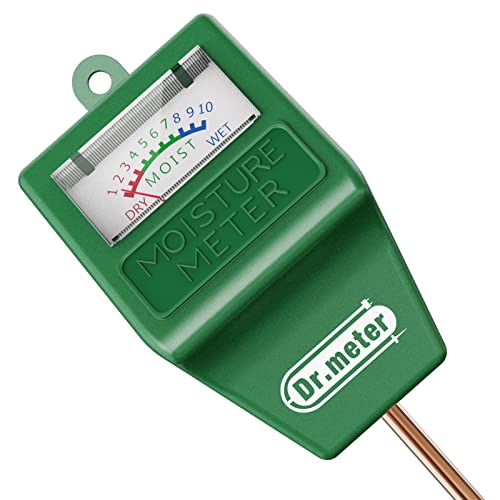
The Dr.meter is a compact plant water gauge that aims squarely at people who still stick a finger in the soil and hope for the best. The listing describes an interface using ten scales and promises that no experience is required. There are no batteries and no electricity involved; you plug the probe into the soil and read the dial.
Compact size has a real benefit indoors. A small meter fits in a drawer, a pocket or the caddy where you keep your spray bottle, and it is easy to use between crowded pots on a shelf. Its portability also means you can carry it from room to room and compare plants against each other, which is the best way to use any dial meter.
It is a simple tool and it behaves like one. The reading is relative, so a few weeks of watching it alongside your own judgment will teach you what each needle position means for each plant. Compared with the XLUX, the Dr.meter offers a similar ten-scale concept in a lighter package but without the stated stainless steel or the long history in the listing. Choose it if you want a no-frills compact gauge to keep on hand for a modest plant collection.
Best for: Small collections where a pocket-size dial is enough.
Check price on AmazonSpecs
- Power: None needed
- Scales: Ten
- Size: Compact, portable
- Use: Houseplants
Pros
- +Compact enough for a drawer or caddy
- +Ten-scale dial is easy to read
- +No batteries or electricity needed
- +Portable between rooms
Cons
- −Fewer build details in the listing
- −Relative reading only
- −No extra measurements
Jxikatx Soil Moisture Meter with Top-Facing Display
About this pick
The Jxikatx uses a single corrosion-resistant probe and a full-screen display that faces up from the top of the handle. The listing says the display is designed for instant reading, which solves a practical indoor annoyance: with most side-mounted dials you have to tilt your head or pick up the pot to read the number. A top-facing screen is visible as you look down at the plant.
The listing promises root-level measurement, quick response and the latest sensor technology, which are marketing statements that we treat as intent, not as proof. The single-probe design is gentler on roots than a twin-prong tester, and fewer moving parts mean fewer things to go wrong. A corrosion-resistant probe is important for a tool that lives in damp soil and fertilizer residue.
It works best as an everyday check on tall plants, hanging pots and crowded shelves, where reading position matters. Compared with the XLUX, the Jxikatx is easier to read from above but gives you less background on the build. Compared with the YAMRON, it keeps the setup simple. Clean the probe between plants, as with all meters, and cross-check with a finger test during the first week to learn how its readings relate to your soil.
Best for: Readers who find side dials awkward and want to read from above.
Check price on AmazonSpecs
- Display: Full-screen, top-facing
- Probe: Corrosion-resistant, single
- Reading: At root level
- Use: Potted plants
Pros
- +Display faces up for easy reading
- +Single probe is gentle on roots
- +Corrosion-resistant probe
- +Simple operation
Cons
- −Fewer published build details
- −Accuracy claims are the maker's own
- −No pH or light
SUStee Aquameter Leave-In Sensor Set of 5
About this pick
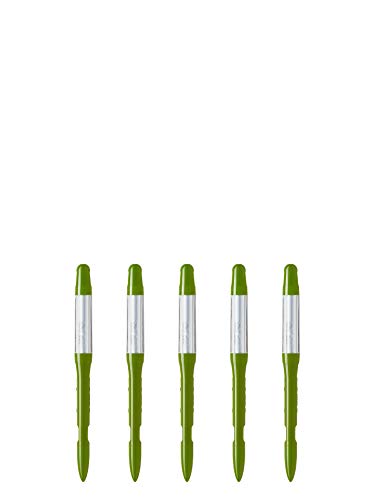
The SUStee Aquameter is not a probe you carry around. It is a leave-in moisture sensor pen, a small stick that stays in the soil for continuous monitoring. The listing says the set includes five green sticks, each measuring about 0.4 by 0.3 by 4.7 inches, intended for pots of two to three inches, which makes it the clear choice for small succulents and propagation pots.
The concept is different from the dials. Each stick has a refillable core, so it can be reused, and it signals when the soil is dry without you taking any reading at all. That makes it ideal for a windowsill of tiny pots where inserting and removing a full-size probe would disturb roots or simply be impractical. Five sticks mean you can put one in each of several small plants.
The limitations are clear. It is sized for small pots, so it will not work in a large foliage plant, and it gives a simple signal, not a graded reading. Compared with the XLUX, it demands no habit of checking but also gives less detail. It fits best alongside a dial meter, which you can use on the big pots while the SUStee sticks keep watch over the little ones. Replace the cores as directed on the product page.
Best for: Windowsills of small pots and succulents that need constant monitoring.
Check price on AmazonSpecs
- Count: 5 sticks
- Size: 0.4 x 0.3 x 4.7 in
- Pot size: 2 to 3 inch pots
- Type: Leave-in, refillable
Pros
- +Leave-in design needs no checking routine
- +Five sticks in one set
- +Refillable core can be reused
- +Sized for two to three inch pots
Cons
- −Too small for large plants
- −Gives a simple signal, not a graded value
- −Cores need refilling over time
YAMRON 4-in-1 Digital Soil Moisture Meter
About this pick
The YAMRON is a digital soil tester that measures soil moisture, pH, temperature and sunlight, and shows them on a large LCD with a white backlight. For an indoor grower, the temperature and light readings are the interesting extras: they help you decide whether a plant is happier in an east window than a south one, or whether a cold sill is slowing growth.
The backlit screen is a real benefit in a dim corner or an evening check, and numeric readings let you note a value, water, and see how it changes. The listing describes quick, accurate measurement from the latest probe technology, but with multi-function testers it is wise to treat the moisture reading as the most useful and the pH and light as rough indicators. Light readings in particular are coarse.
A digital unit needs a battery, and a weak battery can make soil seem drier than it is, so replace cells when the readings look odd. Compared with the Raintrip 4-in-1 dial, the YAMRON gives numbers, while the Raintrip leans on its rotating dial. Compared with the XLUX, it asks for more attention but offers more information. Choose it if you like to log data for a collection of fussy plants.
Best for: Plant hobbyists who want light and temperature data along with moisture.
Check price on AmazonSpecs
- Functions: Moisture, pH, temperature, sunlight
- Display: Large LCD, white backlight
- Type: Digital
- Use: Plants and garden
Pros
- +Backlit screen shows numbers clearly
- +Four measurements in one tool
- +Light and temperature help placement
- +Digital readings are easy to log
Cons
- −Needs a battery and monitoring
- −pH and light are rough indicators
- −More to learn than a simple dial
Raintrip 4-in-1 Soil Tester with Rotating Dial
About this pick
The Raintrip is a four-in-one soil tester that covers moisture, pH, nutrient and light, and it adds a 90 degree adjustable dial, listed as a US design patent, so you do not need to bend or squat to read it. For anyone who finds leaning over low shelves or floor planters uncomfortable, that tilting dial is the practical hook. You angle the dial toward your eyes and read it standing.
It also ships with a free plant growing guide and a piece of sandpaper. The sandpaper matters: probes can build up a film of oxidation or residue, and a gentle rub restores the contact surface, which helps readings stay sensible over time. That is a genuinely useful accessory, not filler.
As with other multi-function dials, the moisture reading is the one to rely on, and the nutrient, pH and light settings are guides to compare between spots. Compared with the YAMRON, the Raintrip has no battery and no numeric screen, which suits people who prefer analog simplicity. Compared with the XLUX, it does more but is a little more involved. Choose it for large floor plants, tall shelves and anyone who wants to read the meter without bending.
Best for: Floor plants and low shelves where reading without bending matters.
Check price on AmazonSpecs
- Functions: Moisture, pH, nutrient, light
- Dial: 90 degree adjustable
- Extras: Growing guide, sandpaper
- Type: Analog dial
Pros
- +Dial rotates 90 degrees for easier reading
- +Four functions in one tool
- +Sandpaper included to clean the probe
- +Growing guide included
Cons
- −Extra functions are rough guides
- −More to learn than a single dial
- −Rotating dial adds a moving part
How We Evaluated These Soil Moisture Meters for Indoor Plants (2026)
Each pick was assessed across 5 criteria weighted for real-world use.
Suitability for pot sizes
We compared probe and stick dimensions with typical indoor containers. The SUStee sticks are about 4.7 inches long and meant for two to three inch pots, while the dials suit medium and large pots. We judged fit from the listings and did not measure root damage in practice.
Readability at plant height
Plants sit low and high, so display design matters. The Jxikatx has a top-facing screen, the Raintrip a 90 degree rotating dial, the XLUX and Dr.meter ten-scale dials, and the YAMRON a backlit LCD. We scored picks on how easily a reader could see the result without moving the pot.
Probe build and care
Probes live in damp soil, so material matters. The XLUX lists anti-rust 304 stainless steel and the Jxikatx a corrosion-resistant probe. The Raintrip ships with sandpaper to refresh contacts. We also considered buyer-feedback themes about rusting and drift when ranking durability.
Extra functions and realism
The YAMRON and Raintrip add pH, light and more. We treated moisture as the dependable function, and rated extras as bonuses that guide plant placement. Picks that rely on extras to justify themselves were scored lower than ones that do the moisture job well.
Ownership effort
Battery-free dials need almost no upkeep, the leave-in SUStee needs core refills, and the YAMRON needs battery attention. Within this lineup the XLUX and Dr.meter are lowest effort, the SUStee needs the least habit, and the digital unit is the most involved.
How to Choose the Right Soil Moisture Meters for Indoor Plants (2026)
By Plant Collection
The size and mix of your plants decides the best meter.
| Collection | Recommended pick | Why |
|---|---|---|
| A shelf of tiny succulents | SUStee Aquameter Set of 5 | Leave-in sticks for two to three inch pots |
| Mixed medium pots around the house | XLUX Battery-Free Meter | Stainless probe and clear dial |
| A few plants, minimal tools | Dr.meter Soil Moisture Meter | Compact ten-scale dial |
| Tall plants and hanging pots | Jxikatx Top-Display Meter | Read the screen from above |
| Large floor planters | Raintrip 4-in-1 Rotating Dial | Dial turns so you need not bend |
By Budget
Tiers are relative and avoid dollar figures.
| Budget tier | Recommended pick | What you get |
|---|---|---|
| Entry | Dr.meter Soil Moisture Meter | Compact battery-free dial |
| Entry to mid | XLUX Battery-Free Meter | Stainless probe, clear dial |
| Mid | Jxikatx Top-Display Meter | Top-facing screen |
| Mid to upper | Raintrip 4-in-1 Rotating Dial | Four functions with a tilting dial |
| Upper | SUStee Aquameter Set of 5 | Five leave-in sensors |
| Premium | YAMRON 4-in-1 Digital Meter | Backlit digital readouts |
For a first indoor meter, the XLUX Battery-Free is the safest middle choice.
Probe vs Leave-In Stick
The central question is whether you want to check or be told.
Handheld probe
The XLUX, Dr.meter, Jxikatx, Raintrip and YAMRON all go in and come out. One tool covers every pot, and readings are graded. You need to remember to check. Pick a probe for a varied collection with some large pots.
Leave-in stick
The SUStee Aquameter stays in the soil and signals dryness without a reading routine. It needs one stick per pot and suits small containers of two to three inches. Pick sticks for tiny plants you often forget.
Probe for variety, sticks for tiny pots.
Simple Dial vs Multi-Function
The second axis is how many measurements you want.
| Preference | Recommended pick | Why |
|---|---|---|
| Water decisions only | XLUX Battery-Free Meter | Single purpose, no distractions |
| Moisture plus light for placement | YAMRON 4-in-1 Digital Meter | Sunlight and temperature readouts |
| Moisture, pH and nutrients on a dial | Raintrip 4-in-1 Rotating Dial | Analog with four functions |
| Easiest read position | Jxikatx Top-Display Meter | Top-facing screen |
| Almost no learning | Dr.meter Soil Moisture Meter | Ten-scale compact dial |
For Avoiding Root Rot Specifically
Root rot comes from soil that stays wet too long, so deeper readings matter.
Look for
Look for a probe that reaches the lower half of the pot, a display you will actually check, and a habit of waiting for the dry zone before watering. Make sure the pot drains, and avoid measuring the saucer. Check again a day after watering to see how long the soil stays wet.
In this comparison
The XLUX reaches the root zone with a clear dial, and the Raintrip lets you read large floor pots without bending. For tiny pots, the SUStee Aquameter sticks watch continuously so you are not guessing.
When to Spend More
Spend more only when the extra feature fits how you garden.
| Spend more if | Save if |
|---|---|
| The YAMRON's light and temperature data would guide plant placement | You only need to know when to water |
| The SUStee set would watch a shelf of tiny pots for you | You have a few large pots and can use a dial |
| The Raintrip's rotating dial would spare your back | Your plants sit at table height |
| The XLUX stainless probe would last for years | The compact Dr.meter covers a small collection |
Frequently Asked Questions
How do I choose between a dial meter and a leave-in stick?
A dial meter like the XLUX is a handheld you move between pots, giving graded readings on demand. A leave-in stick like the SUStee sits in one small pot and signals dryness continuously. Choose a dial for a varied collection and sticks for tiny pots. Many owners use both.
Will pushing a probe into the pot harm the roots?
It can, especially in small pots. Insert gently, away from the stem, and avoid repeatedly stabbing the same spot. For pots of two to three inches, a leave-in stick like the SUStee is gentler than moving a full probe in and out. In larger pots the damage is usually minor.
How often should I check each plant?
Check before you water, not on a fixed daily schedule. Most houseplants only need checking every few days, and more often in summer or under a heater. Take the reading, compare it with your baseline for that plant, and water only if it falls in the dry zone.
Do cactus and tropical mixes read the same?
No. A gritty cactus mix drains fast and dries quickly, while a peat-rich tropical mix holds water longer. The same needle position can mean different amounts of water. Calibrate each mix by watering, letting it drain and noting the reading, then use that as your reference.
Are the pH and light readings worth having indoors?
They are useful as rough guides. The YAMRON and Raintrip include them, and a light reading can show whether one shelf is much dimmer than another. They are not laboratory measurements. Rely on the moisture function for watering and use the extras to compare locations.
Why does my meter show wet when the top is dry?
Because the probe reads below the surface, where moisture lingers. That is exactly the situation the XLUX listing describes, with fingers judging only the surface. If the lower soil is wet, wait before watering, and check that the pot drains freely.
How do I keep the probe in good condition?
Wipe it clean and dry after every use, and do not leave it sitting in a damp pot. Fertilizer salts and moisture corrode metal over time. The Raintrip includes sandpaper to refresh the probe surface. A meter kept clean can last for years of regular use.
Bottom Line
best overall: XLUX Plant Soil Moisture Meter, Battery-Free - best overall pick in this roundup.
See the full rankings above for all picks with pros, cons, and best-for summaries.
Browse on Amazon
All Prime-eligible options with current pricing.
Shop on Amazon →