6 Best Soil Moisture Meters in 2026
Six soil moisture meters compared: battery-free dials, long-probe and compost meters and multi-function testers, with tips on depth, salts and care.



At a Glance
A soil moisture meter answers the question your finger cannot: how wet is the soil down where the roots actually are? The top inch of a pot can feel dry while the bottom stays soggy, and the opposite is just as common in a garden bed baked by afternoon sun. A good meter turns that guesswork into a reading, which is why gardeners with large pots, deep raised beds or a habit of overwatering find them so useful.
This guide compares six meters that cover different needs. The XLUX Battery-Free dial and the XLUX 2-Pack Long Probe are simple instant-read analog meters. The Censinda is another battery-free single-probe design aimed at house plants. The Reotemp 15 Inch is a rugged garden and compost meter with a long stainless stem. The SONKIR 3-in-1 adds pH and light, and the Buladeke 7-in-1 is a digital tester with a backlit screen and extra measurements.
We evaluated these from listings, stated specs and buyer feedback, without claiming hands-on testing. We focused on probe length, how the reading is displayed, whether batteries are needed, what extra functions are included and how realistic those functions are. The notes below also flag the habits that matter most with any meter: reading at root depth, taking more than one reading and keeping the probe clean.
6 Criteria to Look For Before Buying a Soil Moisture Meter
Key buying criteria so you get the right fit the first time.
Probe length and insertion depth
A meter is only useful if it reads where the roots live. The Reotemp 15 Inch has a 15 inch stem built for compost and deep beds, the XLUX Long Probe 2-Pack is designed for deep pots and gardens, and the standard XLUX suits ordinary containers. Insert the probe to about two-thirds of the root depth, not automatically to its full length, because a surface reading mostly reflects evaporation. In a small pot a very long probe will simply hit the bottom, so match the length to the container.
Analog dial versus digital screen
An analog dial like the XLUX or Censinda needs no battery and reads instantly, but it gives a relative position, not an exact percentage. A digital screen like the Buladeke 7-in-1 shows numbers that are easier to compare across days, though it depends on batteries and can drift as they weaken. Use an analog meter if you want a quick dry, moist or wet answer, and a digital one if you like to track values and spot trends. The Reotemp 15 Inch is analog too, so even the biggest meter here follows the same read-the-needle logic.
Probe material and corrosion
Probe corrosion is the most common reason a meter stops being trustworthy. The XLUX lists an anti-rust 304 stainless steel probe, and the Reotemp is rugged stainless steel with a thick 5/16 inch stem. Cheap plated probes can pit and drift, and fertilizer salts speed up the damage. Wipe the probe clean and dry after each use, and do not leave it sitting in wet soil between readings.
Extra functions and how far to trust them
The SONKIR adds pH and light, and the Buladeke adds pH, EC, TDS, temperature and light. These extras are tempting but are best treated as rough guides. Light readings are coarse, pH readings are hard to verify without a buffer solution, and the SONKIR itself warns that it cannot test liquids. Moisture is the most dependable function on any of these tools, so base your watering decisions on it and use the others for general direction.
Power source and ownership effort
Battery-free meters like the XLUX, Censinda and SONKIR are always ready and cannot fail from a dead cell. A digital unit like the Buladeke runs on batteries, and a weak battery can make soil look drier than it is. If you want a tool you can leave in a drawer for months and trust, choose a battery-free dial. If you accept the upkeep in return for a backlit screen, a digital model is fine.
Soil type and fertilizer effects
A reading means different things in different soil. A peat-based potting mix and a sandy succulent mix can show the same needle position yet hold very different amounts of water. Fertilizer salts can push readings higher, especially on cheap probes, and very dry soil may not register at all on a meter like the SONKIR. Calibrate by feel: water a pot, let it drain, take a reading, and use that as your reference for that specific plant.
6 Best Soil Moisture Meters in 2026
XLUX Plant Soil Moisture Meter, Battery-Free
About this pick
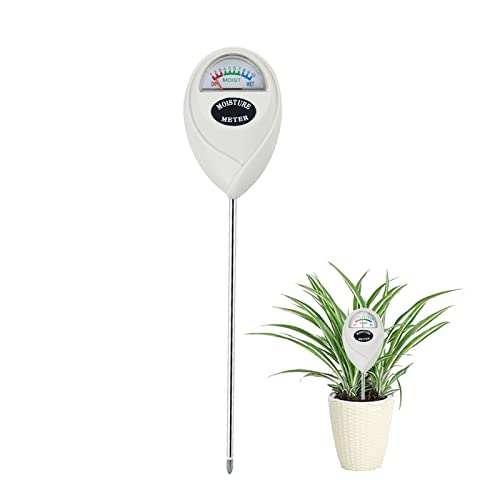
The XLUX Plant Soil Moisture Meter is a battery-free analog meter with an instant-read dial and an anti-rust 304 stainless steel probe. The listing says the maker has been selling this design since 2015, and the large color-coded dial with 10 distinct scales is built to be understood by beginners and experienced gardeners alike. You push the probe into the soil and the needle moves right away, with no waiting and nothing to charge.
The main selling point is simplicity. A finger or a glance at the surface only tells you about the top layer, while the probe reads deeper, which is exactly where overwatering damage starts. Because it uses no battery, there is no low-battery issue that can mimic dry soil, and the stainless probe resists the corrosion that kills many cheap meters. The tradeoff is that an analog dial gives a relative reading, so treat it as a comparison tool between pots, not an exact percentage.
Ownership is easy: wipe the probe and dry it after use, and do not leave it sitting in wet soil between readings. Compared with the XLUX Long Probe 2-Pack, this standard model has a shorter stem, which suits ordinary pots and small beds. Compared with the Buladeke, it lacks extra measurements, but it also lacks the screen, the battery and the guesswork about what the extras mean. For most households it is the pick that does the job with the least fuss.
Best for: Most gardeners who want a simple, instant-read meter with nothing to charge.
Check price on AmazonSpecs
- Power: None needed
- Probe: 304 stainless steel
- Display: Color-coded dial, 10 scales
- Use: Indoor and outdoor
Pros
- +No batteries to buy or replace
- +Large dial with ten readable scales
- +304 stainless probe resists rust
- +Works for indoor pots and outdoor beds
Cons
- −Analog reading is relative, not exact
- −Shorter stem than long-probe models
- −No pH or light function
XLUX 2-Pack Long Probe Soil Moisture Meter
About this pick
The XLUX 2-Pack Long Probe is two battery-free dial meters with a longer stem designed for deeper use. The listing says it can tell you whether soil deep inside a pot or garden is dry, moist or wet, whereas a fingertip can only judge the surface. The large dial is split into three zones across ten scales, so you read dry, moist or wet at a glance and then refine with the number.
The longer stem is the practical upgrade. Large containers, tall planters and deep raised beds all have a root zone that sits well below the top few inches, and a short probe can mislead by reading the surface. A pair of meters also means you can keep one for indoors and one for the garden, or give one to a family member, which is a thoughtful use of a two-pack.
Like the standard XLUX, it reads instantly with no battery, which keeps ownership simple. Push it down to the root zone, not just to its full length unless the roots are that deep, and take two or three readings in different spots. Compared with the Reotemp 15 Inch, it is lighter and more compact, but the Reotemp is built for compost and heavy soil. Choose this XLUX pair for big pots and beds, and the standard XLUX for small ones.
Best for: Large pots and deep beds, and households that want two meters.
Check price on AmazonSpecs
- Count: 2 meters
- Stem: Longer than standard
- Dial: 3 zones, 10 scales
- Power: None needed
Pros
- +Longer stem reaches deeper root zones
- +Two meters in one pack
- +Three-zone dial is easy to read
- +Instant reading with no battery
Cons
- −Longer stem is awkward in small pots
- −Analog reading is relative
- −No pH or light measurements
Reotemp 15 Inch Garden and Compost Moisture Meter
About this pick
The Reotemp 15 Inch is a garden and compost moisture meter with a long, thick stainless steel stem. The stem is 15 inches long and 5/16 inch across, which makes it far more rugged than the thin probes on typical houseplant meters. The listing positions it for home composting, gardening, schools and community programs, and also for soil, plant, farm and lawn moisture testing.
A 15 inch stem opens up uses a short probe cannot manage. It can reach the middle of a compost pile, check the moisture deep in a raised bed, or sample a lawn or orchard soil well below the surface. The thick stainless construction is made to be pushed into dense material without bending, which matters because thin probes often snap or flex in compacted soil.
The cost of that size is bulk. It is not the meter you tuck beside a windowsill plant, and in a small pot a 15 inch stem would hit the bottom long before it reached its full length. Compared with the XLUX Long Probe, the Reotemp is built tougher but is also less suited to a potted fern. Clean the probe after each use, especially in compost, since acids and salts can pit metal over time. If your main need is the garden, compost bin or a deep bed, this is the one.
Best for: Compost piles, deep raised beds and lawn or orchard checks.
Check price on AmazonSpecs
- Stem length: 15 inches
- Stem diameter: 5/16 inch
- Build: Stainless steel
- Use: Compost, soil, lawn
Pros
- +Fifteen inch stem reaches deep layers
- +Thick stainless stem resists bending
- +Built for compost and garden soil
- +Suits schools and community gardens
Cons
- −Too long and bulky for small pots
- −Needs cleaning after compost use
- −No extra functions beyond moisture
Censinda Soil Moisture Meter for House Plants
About this pick
The Censinda is a no-battery soil hygrometer for house plants, with a probe sensor that you plunge into the soil to read moisture. The listing frames the whole product around preventing overwatering, which it names as a leading cause of plant problems, and promises fast reading with no electricity or batteries involved. It also mentions use in the garden, so it is not limited to indoor pots.
It works the same way as the other analog meters in this guide: the probe goes to root depth, and the needle tells you dry, moist or wet. That makes it useful for a plant parent who waters on a schedule and wants a second opinion before adding more. Because it is a basic dial, it has no screen to fail and no extra features to learn.
Below the surface, the usual caveat applies: an analog meter gives a relative reading, so learn what your particular mix looks like at each needle position. Wipe the probe after use. Compared with the XLUX Battery-Free, the Censinda is a plainer, lower-profile option without the stainless steel and heritage claims, so it fits someone who wants a basic tool for a few houseplants. If you want a sturdier probe or a longer stem, look to the XLUX models or the Reotemp.
Best for: Houseplant owners who want a basic, battery-free check before watering.
Check price on AmazonSpecs
- Power: None needed
- Type: Single probe analog
- Use: House plants and garden
- Reading: Fast, dial display
Pros
- +No battery or electricity needed
- +Fast reading from a single probe
- +Aimed at preventing overwatering
- +Works indoors and in the garden
Cons
- −Basic build with fewer durability claims
- −Relative dial reading only
- −No pH or temperature readings
SONKIR 3-in-1 Soil Moisture, Light and pH Meter
About this pick
The SONKIR MS02 is a three-in-one meter that tests soil moisture, soil pH and sunlight level, switched with a function button. It needs no battery: you insert it into the soil, wait a few minutes and read the panel. For a gardener who wants to know whether a spot is wet enough, acidic enough and bright enough in one tool, that range is the attraction.
The listing includes two useful warnings. The tester is meant only for soil and cannot measure the pH of other liquids, and if the soil is too dry the indicator will not move. That second point is a real limitation of this type of probe: it needs some moisture to conduct. Moisture is the most dependable of the three readings, while the pH and light readings are coarse, so treat them as rough guidance and not laboratory numbers.
Compared with the XLUX models, the SONKIR does more but with less precision on each task. Compared with the Buladeke 7-in-1, it keeps the battery-free simplicity and gives up the digital display and extra measurements. It is a decent choice for a new gardener who wants a feel for light and acidity in different parts of a yard. If moisture is your main interest, a dedicated dial like the XLUX is the cleaner tool.
Best for: New gardeners who want rough moisture, light and pH checks in one tool.
Check price on AmazonSpecs
- Functions: Moisture, pH, light
- Power: None needed
- Switch: Function button
- Model: MS02
Pros
- +Three tests in a single tool
- +No battery required
- +Function button switches modes easily
- +Covers moisture, pH and light
Cons
- −Indicator will not move in very dry soil
- −pH and light readings are rough
- −Not suitable for liquids
Buladeke 7-in-1 Digital Soil Moisture Meter Kit
About this pick
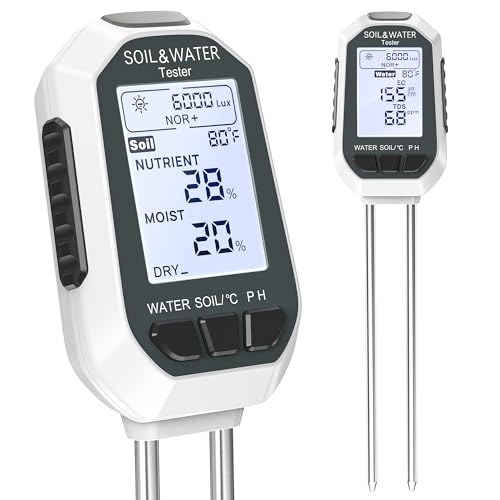
The Buladeke 7-in-1 is a digital soil tester kit with a large LCD and white backlight that shows numerical readings. The listing says it measures soil moisture, pH, temperature and light intensity, and the title adds EC and TDS, which relate to dissolved salts and nutrient levels. It is the most feature-rich meter in this guide and the only one that gives you numbers rather than a needle position.
Numbers are appealing because they let you track change over days: you can note a reading, water, and see how it moves. The backlight is a real convenience in a dim corner or at dusk. The listing describes the latest probe technology as fast and accurate, but as with any inexpensive multi-tester, a mix of functions means each one is simpler than a dedicated instrument, so use the readings to compare and spot trends.
Ownership needs a little more care than an analog dial. It runs on batteries, and low power can make the screen show odd readings that look like dry soil, so replace them when values seem inconsistent. Clean the probe after use. Compared with the SONKIR, the Buladeke offers a screen and more measurements, and compared with the XLUX, it asks for more attention. Pick it if you like data and will use the extra readings, and skip it if you only need to know when to water.
Best for: Data-minded gardeners who want numbers, a backlight and extra readings.
Check price on AmazonSpecs
- Functions: 7-in-1
- Display: Large backlit LCD
- Measures: Moisture, pH, EC, TDS, temperature, light
- Type: Digital kit
Pros
- +Backlit LCD is easy to read in low light
- +Seven measurements in one kit
- +Numeric readings help track changes
- +Includes EC and TDS for salts
Cons
- −Needs batteries and monitoring
- −Extras are rougher than dedicated tools
- −More to learn than a simple dial
How We Evaluated These Soil Moisture Meters
Each pick was assessed across 5 criteria weighted for real-world use.
Probe design and reach
We compared stem length and thickness since that decides where the meter can read. The Reotemp 15 Inch has the longest, thickest stem, the XLUX Long Probe is built for deeper use, and the others suit standard containers. We read this from the listings and did not measure depth in practice.
Display and readability
A reading is only useful if you can understand it. The XLUX dial has a color-coded layout with 10 scales, the Buladeke has a large backlit LCD, and the SONKIR uses a panel with a function switch. We considered how quickly a first-time user could tell dry from wet.
Power and reliability
Battery-free dials from XLUX, Censinda and SONKIR avoid the battery problem entirely, while the Buladeke needs power and care. We weighed the convenience of a digital display against the risk of weak-battery misreadings, and favored designs that stay dependable with little upkeep.
Durability and probe materials
Corrosion shortens meter life, so we looked for stainless steel. The XLUX lists 304 stainless, and the Reotemp is rugged stainless steel. We also noted buyer feedback themes about probes bending in dense soil and readings drifting over time, then weighted picks by how well their build addressed these.
Extra functions and honesty
Multi-function meters add pH, light, EC and TDS, which sound impressive but are rough. We scored the SONKIR and Buladeke on how useful their extras are in practice, noting that moisture is the dependable reading, and positioned the dedicated dials as the better tools for pure watering decisions.
How to Choose the Right Soil Moisture Meters
By What You Are Watering
The container or bed decides probe length and style.
| Situation | Recommended pick | Why |
|---|---|---|
| A few houseplants on a windowsill | Censinda Soil Moisture Meter | Battery-free single probe |
| Mixed indoor pots and patio planters | XLUX Battery-Free Meter | Stainless probe, clear dial |
| Large tubs and deep raised beds | XLUX 2-Pack Long Probe | Longer stem, two meters |
| Compost pile or orchard soil | Reotemp 15 Inch Meter | 15 inch rugged stem |
| New garden needing light and pH hints | SONKIR 3-in-1 Meter | Moisture, pH and light in one |
By Budget
Tiers are relative and avoid dollar figures.
| Budget tier | Recommended pick | What you get |
|---|---|---|
| Entry | Censinda Soil Moisture Meter | Basic battery-free probe |
| Entry to mid | SONKIR 3-in-1 Meter | Three functions with no battery |
| Mid | XLUX Battery-Free Meter | Stainless probe and clear dial |
| Mid to upper | XLUX 2-Pack Long Probe | Two long-probe meters |
| Upper | Buladeke 7-in-1 Digital Kit | Backlit screen and seven readings |
| Premium | Reotemp 15 Inch Meter | Rugged long stainless build |
For plain watering decisions, the XLUX Battery-Free offers the best balance of cost and trust.
Analog Dial vs Digital Screen
This is the main style decision for a moisture meter.
Analog dial
The XLUX, XLUX Long Probe, Censinda and Reotemp give a quick needle reading with no battery. They are simple, durable and ready whenever you are. The reading is relative, so learn how your mix looks at each position. Pick analog for speed and low upkeep.
Digital screen
The Buladeke shows numbers on a backlit LCD, which makes it easier to compare readings over days and see extras like temperature. It needs batteries and a little more learning. Pick digital if you enjoy data and will actually use it.
Analog for a quick answer, digital for tracking.
Moisture Only vs Multi-Function
Extra measurements add features and noise.
| Preference | Recommended pick | Why |
|---|---|---|
| Just tell me when to water | XLUX Battery-Free Meter | Single-purpose, instant dial |
| Rough pH and light checks as well | SONKIR 3-in-1 Meter | Function button, no battery |
| Salts and temperature data | Buladeke 7-in-1 Digital Kit | EC, TDS and temperature included |
| Deep soil and compost checks | Reotemp 15 Inch Meter | Moisture only but built for depth |
| Two meters for two locations | XLUX 2-Pack Long Probe | Pair in one purchase |
For Avoiding Overwatering Specifically
Overwatering is the problem a moisture meter solves best.
Look for
Look for a probe long enough to reach the lower root zone and a display that makes wet obvious. Take two or three readings in different spots, and wait a day after rain before trusting a garden reading. Water only when the needle sits in the dry zone.
In this comparison
The XLUX Long Probe 2-Pack reads deep in big pots with three clear zones, and the Censinda is a simple check for house plants. The Reotemp handles deep beds and compost where overwatering is harder to see.
When to Spend More
Spend more only when the extra feature changes what you do.
| Spend more if | Save if |
|---|---|
| The Reotemp's 15 inch stem would reach your compost or deep beds | Your plants live in small pots that a short probe covers |
| The Buladeke's screen and numbers would help you track change | A needle position is enough to decide when to water |
| The XLUX stainless probe would last through years of use | The basic Censinda covers a few houseplants |
| The SONKIR's light and pH hints would guide a new bed | You only care about moisture |
Frequently Asked Questions
How do I choose between an analog and a digital moisture meter?
Analog meters such as the XLUX and Censinda are battery-free, instant and simple, but give a relative needle reading. Digital meters such as the Buladeke give numbers on a backlit screen and extra measurements, but depend on batteries. If you want a quick watering decision, choose analog. If you like to track data over time, choose digital.
How deep should I push the probe?
Push it to about two-thirds of the root depth, not automatically to the full length of the stem. A surface reading mostly shows evaporation, while a reading near the bottom of a pot can reflect trapped water. For deep beds and compost, a longer probe like the Reotemp 15 Inch reaches the layers that matter.
Are the pH and light readings accurate?
They are rough guides. The SONKIR and Buladeke include them, but light readings are coarse and pH readings are hard to verify without a buffer solution. Use them to spot big differences between locations, and rely on the moisture reading for watering decisions. For precise pH, a dedicated tester or lab test is better.
Why does my meter read wet right after fertilizing?
Fertilizer salts increase conductivity, which can push readings higher on cheaper probes. Wait until the next watering cycle, or flush the soil, then retake the reading. A stainless probe like the XLUX resists corrosion, but salts can still affect the number. Compare against how the soil feels to confirm.
Will the meter work in very dry soil?
Sometimes not. The SONKIR listing says the indicator will not move if the soil is too dry, because the probe needs some moisture to conduct. If you see no movement, water lightly, wait a few minutes and read again. This is normal behavior for many meters of this type.
How should I clean and store the probe?
Wipe it with a damp cloth after each use, dry it completely, and store it in a dry spot. Corrosion is the most common failure, so do not leave the probe in wet soil between readings. After compost use with the Reotemp, rinse the stem as well, since acids and salts can pit metal.
Can one reading tell me everything?
No. Take two or three readings in different spots, because soil moisture varies within a pot or bed. Avoid reading right after rain, and wait for the needle or screen to settle. Compare readings between plants, and learn what your particular soil mix looks like at each position.
Bottom Line
best overall: XLUX Plant Soil Moisture Meter, Battery-Free - best overall pick in this roundup.
See the full rankings above for all picks with pros, cons, and best-for summaries.
Browse on Amazon
All Prime-eligible options with current pricing.
Shop on Amazon →