6 Best Personal Sound Amplifiers for Seniors (2026)
Six personal sound amplifiers compared on listed gain, battery life, controls and comfort, for TV, dinner table talk and quiet conversation.



At a Glance
Personal sound amplifiers are consumer devices that make quiet sounds louder, and they suit everyday situations such as the TV, a dinner table conversation or a quiet talk across a room. This guide compares six models, from the Williams Sound PockeTalker Ultra DUO with 20 to 40 dB of listed acoustic gain to the Reizen Elite that lists 120 dB and the IceHeat that lists 50 dB with seven tone levels.
The lineup spans very different designs. The IROGER lists up to 120 hours of use and a one hour charge, the MSA PRO lists up to 20 hours in a nearly invisible body, the YI-HORO is a 35 gram open ear bone conduction design, and the PockeTalker is a wired kit with a headphone and earbud. Gain claims here are manufacturer figures and are not directly comparable across different measurement methods.
One distinction matters before you buy. The FDA treats hearing aids as medical devices for people with hearing loss, while personal sound amplifiers are consumer electronics, and since October 2022 certain over the counter hearing aids are available for adults with perceived mild to moderate loss. If you suspect hearing loss, an audiologist visit is the better first step, and these amplifiers are best viewed as situational tools.
6 Criteria to Look For Before Buying a Personal Sound Amplifiers for Seniors (2026)
Key buying criteria so you get the right fit the first time.
Amplifier or hearing aid
The FDA draws a line: hearing aids are medical devices for people with hearing loss, while personal sound amplifiers are consumer electronics. Since October 17, 2022, certain over the counter hearing aids are available for adults with perceived mild to moderate loss. If you suspect hearing loss, an audiologist visit is the better first step. These amplifiers fit situational use such as TV and quiet conversation.
Stated gain
Gain is the amount of extra sound the device adds. The PockeTalker lists 20 to 40 dB, the IceHeat lists 50 dB and the Reizen lists 120 dB. Manufacturer gain figures are not always measured the same way, so compare cautiously. More gain is not better if it causes discomfort. Start low.
Battery and charging
Battery life affects daily use. The IROGER lists up to 120 hours with a one hour charge, the PockeTalker up to 100 hours on disposable batteries and the MSA PRO up to 20 hours. One listing for a different model cites 80 hours on two AAA batteries, which shows how much it varies. Choose rechargeable if you dislike buying batteries.
Controls and tone
Simple controls help. The PockeTalker has separate volume and tone controls and the IceHeat has seven tone levels. The MSA PRO has few controls. Pick controls you can use without glasses.
Comfort and fit
Comfort decides whether you wear it. The YI-HORO is a 35g open ear design, the MSA PRO is small and the PockeTalker uses a headset or earbud. Try for fit and cord comfort. A device that hurts will sit in a drawer.
Feedback and microphone
Whistling feedback and directional behavior are rarely documented independently. The IROGER has a directional microphone and the PockeTalker has a removable microphone with an extension. Check reviews for feedback. Place the microphone away from the speaker.
6 Best Personal Sound Amplifiers for Seniors (2026)
Williams Sound PockeTalker Ultra DUO
About this pick
The Williams Sound PockeTalker Ultra DUO is the best overall pick because it is the most complete and best documented kit in this group. It comes with a listening headset, a single earbud, a removable microphone with an extension cord and a TV listening cord. The listing states 20 to 40 dB of acoustic gain and up to 100 hours of battery life.
Separate volume and tone controls sit on the outside of the unit, and a removable belt clip lets you wear it at the waist. The tradeoff is that it is a wired design with a cord to manage, and it uses disposable batteries that you will replace over time. A five year manufacturer warranty is part of the listing, which is longer than most products here offer.
Setup is plugging in the headset or earbud and clipping the unit on. The extension cord lets you place the microphone near a speaker or the TV. Compared with the IROGER, it has more included accessories, while the IROGER is rechargeable and cordless.
Best for: TV listening and one on one talk where a wired, documented kit is fine
Check price on AmazonSpecs
- Acoustic gain: 20 to 40 dB
- Battery: Up to 100 hours
- Included: Headphone, earbud, removable microphone
- Warranty: 5 years from the manufacturer
Pros
- +States 20 to 40 dB of acoustic gain
- +Headset and earbud both included
- +Separate tone and volume controls
- +Five year manufacturer warranty
Cons
- −Wired headset adds a cord to manage
- −Disposable batteries needed over time
IROGER Rechargeable Hearing Amplifier
About this pick
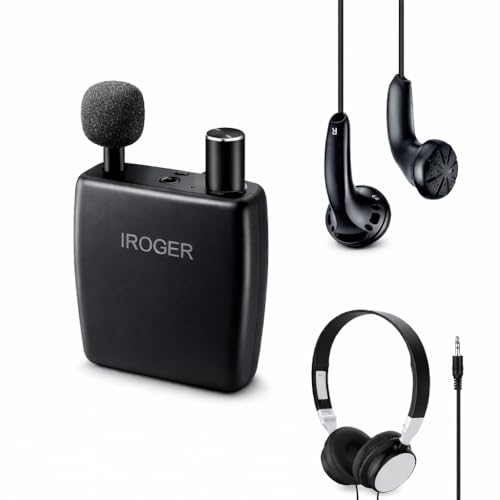
The IROGER has the longest battery claim in this lineup, up to 120 hours, plus a one hour full charge. Those two numbers together mean a short top up can cover many days. Its smart auto gain control is meant to balance levels so sudden loud sounds are not boosted as hard as quiet speech.
A directional microphone favors the person in front of you while reducing other noise. The tradeoff is that the listing does not state a gain ceiling in dB, so you cannot compare its power directly with the PockeTalker or IceHeat. The auto gain behavior is also not explained in detail, and a directional mic may miss a speaker beside or behind you.
Setup is charging the unit and putting it on. Charging by cable replaces a stock of batteries. It suits a person who dislikes buying batteries, while the PockeTalker offers more accessories.
Best for: People who want a rechargeable, low maintenance amplifier for daily use
Check price on AmazonSpecs
- Battery: Up to 120 hours listed
- Charge time: About 1 hour
- Microphone: Directional, noise reducing
- Control: Smart auto gain
Pros
- +Lists up to 120 hours of use per charge
- +About one hour to charge fully
- +Auto gain evens out sudden loud sounds
- +Directional mic favors the person facing you
Cons
- −Auto gain behavior is not explained in detail
- −No gain ceiling in dB is listed
IceHeat Personal Sound Amplifier, 50dB Gain
About this pick
The IceHeat is the pick for people who like to fine tune. It lists 50 dB of gain, the highest figure in this guide apart from the Reizen's 120 dB claim, and seven tone levels. The maker pitches it for the living room and the dinner table, claiming it picks up conversation from about 30 feet.
Noise reduction is mentioned by the maker, though how well it works is not independently documented. The tradeoff is that the battery life is not described, and seven tone levels are more settings to learn than a simple knob. The listing also gives few details beyond the figures.
Setup is putting it on and adjusting the volume and tone. It is the lowest cost pick here. Choose it if tone matters more than a long warranty or a rechargeable body.
Best for: TV and dinner table listening where tone adjustment helps
Check price on AmazonSpecs
- Gain: 50 dB listed
- Tone: 7 level control
- Feature: Noise reduction
- Pickup: Hear from 30 feet claimed
Pros
- +Lists 50 dB of gain
- +Seven tone levels for fine tuning
- +Noise reduction mentioned by the maker
- +Aimed at TV and dinner table talk
Cons
- −Battery life is not described
- −More settings to learn than a simple knob
MSA PRO Sound Amplifier, 30X
About this pick
The MSA PRO is the small, quiet option. The maker calls it virtually unnoticeable and claims it amplifies sound by 30 times. It lists up to 20 hours of continuous use.
It is the unit to choose when the main worry is how it looks. The tradeoff is a shorter run time than the IROGER's 120 hours, and tiny parts are easy to drop or misplace. The listing says little about charge time or tips.
Setup is putting it on and adjusting the volume. It is light enough to wear for an evening. A small body means fewer controls than the IceHeat.
Best for: People who want the smallest, least noticeable amplifier
Check price on AmazonSpecs
- Amplification: 30 times claimed
- Battery: Up to 20 hours continuous
- Size: Small and lightweight
- Look: Described as nearly invisible
Pros
- +Small body described as nearly invisible
- +Lists amplification of 30 times
- +Up to 20 hours on one charge
- +Light enough to wear for an evening
Cons
- −Shorter run time than the IROGER
- −Tiny parts are easy to drop or misplace
YI-HORO Bone Conduction Sound Amplifier
About this pick
The YI-HORO is a different kind of amplifier: an open ear bone conduction design that leaves the ear canal uncovered. It weighs 35g and uses soft silicone contact surfaces for everyday comfort. The listing describes it as designed for clearer conversations for older adults, with speech focused listening.
Open ear designs suit people who dislike plugs in the ear or who want to stay aware of surroundings. The tradeoff is that the listing gives no gain figure in dB or battery life in the details provided. It is also the highest cost pick here.
Setup is wearing it and adjusting the volume. Bone conduction works through the bones near the ear, which may feel unusual at first. Choose it for comfort over the PockeTalker, which offers more documented specs.
Best for: People who dislike ear plugs and want open ear comfort
Check price on AmazonSpecs
- Weight: 35g, about 1.23 oz
- Design: Bone conduction, open ear
- Contact: Soft silicone surfaces
- Focus: Speech focused listening
Pros
- +Open ear design leaves ear canal free
- +Lightweight 35g body
- +Soft silicone contact surfaces
- +Speech focused listening
Cons
- −No gain or battery figure in the details
- −Highest cost in this guide
Reizen Loud Ear 120dB Personal Amplifier
About this pick
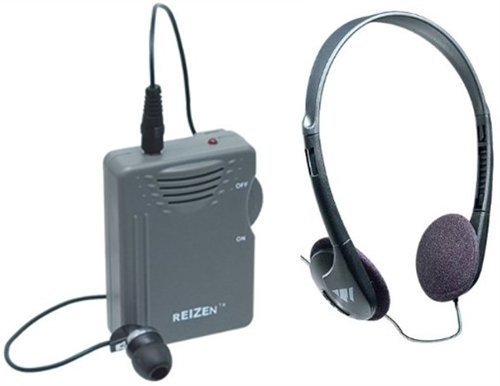
The Reizen Elite headlines a gain of 120 dB, the largest claim in the group. A built in microphone captures sound and a mini earphone delivers it. The elite package is pitched as ready to try on arrival.
A claim that high demands care, because very loud output can be uncomfortable and harmful at high volume. The tradeoff is that the listing gives few details beyond its figures, with no tone control or battery life stated. It is not documented like the PockeTalker.
Setup is plugging in the earphone and starting at low volume. Keep the volume low and increase slowly. Choose it only if you need strong output and will use it carefully.
Best for: Situations that need a very high claimed gain, used with care
Check price on AmazonSpecs
- Gain: 120 dB claimed
- Microphone: Built in
- Output: Mini earphone
- Package: Elite package
Pros
- +Lists 120 dB gain, the highest claim here
- +Built in microphone needs no extras
- +Mini earphone is small and light
- +Elite package arrives ready to try
Cons
- −Very high gain demands careful volume use
- −No tone control or battery life stated
How We Evaluated These Personal Sound Amplifiers for Seniors (2026)
Each pick was assessed across 5 criteria weighted for real-world use.
Documented specs
We looked at how much each listing documents gain, battery and warranty. The PockeTalker scored strongest and the YI-HORO scored lowest. Clear figures scored higher.
Battery and upkeep
We compared battery life and charging, from 120 hours on the IROGER to 20 hours on the MSA PRO. Rechargeable designs scored well. Disposable battery models scored lower for upkeep.
Controls
The PockeTalker and IceHeat scored well. The simplest was the MSA PRO.
Comfort
We read for weight and fit. The YI-HORO at 35g scored well for comfort. Wired designs scored lower for cord management.
Value
We weighed the lowest cost IceHeat against the PockeTalker as the best documented kit.
How to Choose the Right Personal Sound Amplifiers for Seniors (2026)
By Use
| Use | Recommended pick |
|---|---|
| TV listening with a TV cord | Williams Sound PockeTalker Ultra DUO |
| Daily use without batteries | IROGER Rechargeable Hearing Amplifier |
| Dinner table and tone control | IceHeat Personal Sound Amplifier |
| Discreet everyday wear | MSA PRO Sound Amplifier |
| Open ear comfort | YI-HORO Bone Conduction Sound Amplifier |
By Budget
| Budget tier | Recommended pick |
|---|---|
| Lowest cost | IceHeat Personal Sound Amplifier |
| Low cost, discreet | MSA PRO Sound Amplifier |
| Mid range, high gain claim | Reizen Loud Ear 120dB Personal Amplifier |
| Mid range, rechargeable | IROGER Rechargeable Hearing Amplifier |
| Upper range, documented kit | Williams Sound PockeTalker Ultra DUO |
| Premium open ear | YI-HORO Bone Conduction Sound Amplifier |
Rechargeable vs Disposable Batteries
Rechargeable models
These charge by cable and need no battery stock. The IROGER and MSA PRO fall here. Charge time and runtime matter.
Disposable battery models
These use replaceable batteries. The PockeTalker falls here with up to 100 hours. They are easy to swap.
Recommendation: rechargeable for convenience, disposable for easy swaps.
By Wear Style
| Preference | Recommended pick |
|---|---|
| Wired headset and belt clip | Williams Sound PockeTalker Ultra DUO |
| Small and nearly invisible | MSA PRO Sound Amplifier |
| Open ear, no plug | YI-HORO Bone Conduction Sound Amplifier |
| Mini earphone | Reizen Loud Ear 120dB Personal Amplifier |
| Directional mic | IROGER Rechargeable Hearing Amplifier |
For TV Listening Specifically
Look for
A TV cord or a placeable microphone, plus tone control. Raise the TV listening level without raising the room volume.
In this comparison
The PockeTalker includes a TV listening cord and tone control. The IceHeat is a lower cost option with seven tone levels.
When to Spend More
Spend more if
You want documentation and a warranty. The PockeTalker justifies more with a five year warranty.
Save if
You only want occasional use. The IceHeat and MSA PRO do that for less.
Frequently Asked Questions
Is a sound amplifier the same as a hearing aid?
No. The FDA treats hearing aids as medical devices and amplifiers as consumer electronics. If you suspect hearing loss, see an audiologist. Amplifiers suit situations like TV.
How much do sound amplifiers cost?
The IceHeat is the lowest cost here and the YI-HORO the highest. Insurance and Medicare usually do not cover them. Check current prices on Amazon.
Should I see a professional first?
Yes, if you suspect hearing loss. Earwax or infection should be ruled out too. An audiologist can guide you.
Can a high gain amplifier hurt my ears?
Very loud output can be uncomfortable or harmful. The Reizen lists 120 dB. Start at low volume.
Which is best for TV?
The PockeTalker includes a TV listening cord. The IceHeat is aimed at TV. Place the microphone near the source.
Why does my amplifier whistle?
Feedback happens when output returns to the microphone. Lower the volume or move the microphone. Check reviews.
How long do the batteries last?
The IROGER lists up to 120 hours and the PockeTalker up to 100 hours. Others vary. Manufacturer claims differ.
Bottom Line
best overall: Williams Sound PockeTalker Ultra DUO - best overall pick in this roundup.
See the full rankings above for all picks with pros, cons, and best-for summaries.
Browse on Amazon
All Prime-eligible options with current pricing.
Shop on Amazon →