5 Best Personal Sound Amplifiers Under $150 (2026)
Five budget personal sound amplifiers compared on stated gain, battery life, controls and comfort, with honest notes on what each listing leaves unsaid.



At a Glance
Personal sound amplifiers cover a surprisingly wide range of claims, even within a modest budget. In this roundup the stated gain runs from 45 dB on the Ujhosld behind-the-ear model to a 110 dB figure on the Reizen Loud Ear, and the listed runtime stretches from 40 hours on the Ujhosld to up to 120 hours on the IROGER. Those spreads matter more than the brand names, because they decide whether a unit feels gentle and wearable or loud and fiddly.
We evaluated five picks based on product specs and buyer feedback, and we left out the second Reizen listing because it is the same family of product as the one we kept. The IROGER earns the top spot for its one-knob control, auto gain control and long runtime. The Bell+Howell Silver Sonic is the lowest-cost pick and the only one here with a HI/LOW frequency switch, while the MEDca leans on a 100 foot distance claim.
One caution applies to every product in this guide. Personal sound amplifiers are consumer electronics for situational listening, such as the television or a quiet dinner conversation, and they are not the same as hearing aids, which the FDA regulates as medical devices. If you suspect real hearing loss, an over-the-counter or prescription hearing aid is the better category, and a quick check for earwax or infection is worth doing before you spend anything.
6 Criteria to Look For Before Buying a Personal Sound Amplifiers Under $150 (2026)
Key buying criteria so you get the right fit the first time.
Amplifier or Hearing Aid
Personal sound amplifiers are consumer electronics meant for situational listening, while the FDA treats hearing aids as medical devices for people with hearing loss. Since the over-the-counter hearing aid rule took effect on October 17, 2022, adults with perceived mild to moderate loss can buy certain hearing aids without a prescription. If you notice trouble in many settings, step up to that category instead of relying on a unit like the IROGER or the Reizen. Use an amplifier for the TV, a quiet table talk or a lecture, and rule out earwax or infection first.
Stated Gain Numbers
Gain claims in this guide run from 45 dB on the Ujhosld to 50 dB on the Bell+Howell and MEDca and up to 110 dB on the Reizen Loud Ear. A bigger number is not automatically better, because too much gain in a quiet room is uncomfortable and can cause whistling feedback. Independent testing of feedback and directional microphones is rare for these products, so those details have to come from buyer comments. As a rule of thumb, pick the lowest gain that makes speech clear and always begin with the volume turned all the way down.
Battery and Charging
The IROGER lists a one hour charge and up to 120 hours of use, while the Ujhosld lists up to 40 hours per charge. The Bell+Howell, MEDca and Reizen pages say little or nothing about runtime, which is worth knowing before you rely on one all day. Manufacturer hour counts are claims that shift with volume, so cut any figure by a fair margin when planning. If you hate fiddly parts, a rechargeable unit means no tiny disposable cells, though the built-in cell will age over time.
Controls You Can Actually Use
The IROGER keeps things to one knob that powers the unit on and sets volume, which suits stiff fingers and poor close vision. The Bell+Howell adds a HI/LOW frequency switch, a rare bit of tone control at this budget. The Reizen offers an adjustable volume control and the Ujhosld is built around its behind-the-ear shape and battery. Choose controls you can find without looking, and avoid anything that requires tiny buttons held for several seconds.
Fit, Look and Comfort
The Ujhosld hooks behind the ear for long wear, the Bell+Howell resembles a wireless phone earpiece, and the Reizen uses a dual earphone set with cables. Where a unit sits changes how comfortable it is with glasses, a hat or a hearing-friendly hairstyle. The MEDca stresses light weight, which helps if you carry it in a pocket between uses. Try wearing the unit through a full TV program before the return window closes, because discomfort shows up after the first hour, not the first minute.
What Budget Really Buys
Within this budget the extra spend mostly buys runtime and convenience, as the IROGER's 120 hour listing and auto gain control show, rather than certified performance. The lowest-cost Bell+Howell gives you tone control but little battery detail, so the missing information is the trade. These devices and OTC hearing aids are usually not covered by insurance or Medicare, so the price you see is what you pay. Treat this tier as a way to try amplification for specific situations, and move up to a real hearing aid if you rely on it daily.
5 Best Personal Sound Amplifiers Under $150 (2026)
IROGER Rechargeable Hearing Amplifier
About this pick
The IROGER is the pick that asks the least of you day to day. Its single volume knob handles both power and loudness, so there are no tiny buttons to hunt for with a thumb. Auto gain control is listed as well, which adjusts amplification as the room changes so sudden loud moments are evened out.
Charging is the other strong point, with the listing giving a one hour full charge and up to 120 hours of use, the longest runtime claim in this group. That figure depends on how loud you run it, so treat it as a ceiling rather than a promise. The listing names no separate tone control, which means voices and background noise get boosted together.
Ownership is straightforward because the cell is built in, so there are no disposable batteries to buy or swap. The flip side is that a rechargeable cell wears over the years and cannot be changed like a battery door unit. Compared with the Bell+Howell Silver Sonic, you give up the HI/LOW frequency switch but gain a far longer listed runtime, and it sits at the top price tier of this lineup.
Best for: Everyday listeners who want a simple knob, quick charging and the longest listed runtime.
Check price on AmazonSpecs
- Control: Single volume knob
- Charge time: About 1 hour
- Listed runtime: Up to 120 hours
- Sound feature: Auto gain control
Pros
- +Single knob handles power and volume
- +Auto gain control evens out loud moments
- +Full charge in about an hour
- +Longest listed runtime in this roundup
Cons
- −Built-in cell cannot be swapped out
- −Listed hours depend on volume setting
- −No tone control for voices
Ujhosld Behind-the-Ear Amplifier
About this pick
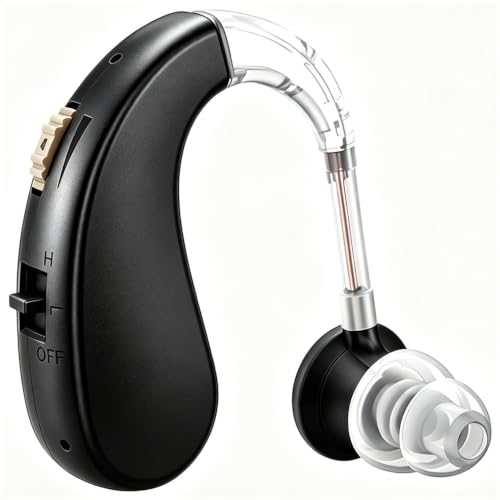
Ujhosld designed this one to sit behind the ear, which is a quieter look than a bulky earpiece on a cord. The listing states up to 45 dB of sound amplification aimed at conversation, TV audio and everyday sounds. It is the lowest stated gain figure in this roundup, and for someone who just needs speech a little clearer that restraint can be a plus.
Battery life is listed at up to 40 hours on a full charge, enough for several days of ordinary use before the next top up. That is a third of what the IROGER claims, but still far from a burden. The listing gives no charge time or weight, so you cannot judge how quickly it recovers or how it feels after hours of wear.
Because the shape hooks around the ear, comfort over a long afternoon depends on how it sits with glasses. Expect to start the volume low and raise it slowly, since even 45 dB of gain can feel strong in a quiet room. Against the MEDca, which lists 50 dB and a distance claim, this model trades a bit of reach for a more wearable form and a battery figure that is actually stated.
Best for: Wearers who prefer a discreet behind-the-ear shape and a modest, manageable gain.
Check price on AmazonSpecs
- Stated gain: Up to 45 dB
- Listed runtime: Up to 40 hours
- Wear style: Behind the ear
- Power: Rechargeable
Pros
- +Lightweight shape for long wear
- +States up to 40 hours per charge
- +Gentle 45 dB gain is easy to manage
- +Rechargeable, so no disposable cells
Cons
- −No charge time or weight in the listing
- −Fit with glasses is unknown
- −Lower gain may fall short for some
Bell+Howell Silver Sonic
About this pick
Silver Sonic from Bell+Howell is the lowest-cost pick here, and it brings the one feature several pricier units skip. A HI/LOW frequency switch lets you favor higher or lower tones, which can help when voices sound muddy. The listing gives up to 50 dB of amplification along with an adjustable volume control.
It is styled to resemble a wireless phone earpiece, so wearing it at a lecture or a family dinner draws little attention. The listing says it can pick up sound from as far as 90 feet, although a claim like that depends heavily on the room and the speaker. The page text says nothing about battery type or runtime, which is a real gap for something you may wear all day.
Plan on checking the battery situation as soon as it arrives, since you want to know how often it needs attention before relying on it at events. Start at low volume and move the switch between positions to see which setting makes speech clearest to you. Next to the IROGER you get tone shaping instead of runtime, and next to the Reizen you get a far gentler gain ceiling that is easier to manage.
Best for: Budget shoppers who want a tone switch and a discreet earpiece look.
Check price on AmazonSpecs
- Stated gain: Up to 50 dB
- Tone control: HI/LOW switch
- Distance claim: Up to 90 feet
- Look: Wireless earpiece style
Pros
- +HI/LOW switch gives basic tone control
- +Looks like a phone earpiece
- +Adjustable volume for TV and talk
- +Most affordable pick in this group
Cons
- −No battery detail in the page text
- −Distance claim depends on the room
- −No stated charge or runtime figures
MEDca Personal Sound Amplifier
About this pick
The MEDca voice enhancer is built around a distance promise, saying it can help you hear sounds up to 100 feet away. It lists 50 dB of sound gain and a built in microphone, so there is no accessory to plug in. Light weight is stressed in the listing, which suits carrying it in a pocket or wearing it for a while.
That 100 foot figure is the most generous claim in the group, yet it is a marketing number, and walls, echo and background noise will shrink real results. The page text provides no battery information, so you cannot compare its endurance with the 40 hour Ujhosld or the 120 hour IROGER. Like the others it appears to offer a plain boost without any tone adjustment mentioned.
Try it first in the situation you care about, such as across a living room or in a meeting hall, because that is where the distance feature either earns its place or does not. Keep the volume modest, since amplified sound at close range can become uncomfortable fast. It makes the most sense for lectures and group settings, while the Bell+Howell is better when you want to adjust tone at a lower entry price.
Best for: People who mostly want to follow a speaker or TV from across a room.
Check price on AmazonSpecs
- Stated gain: 50 dB
- Distance claim: Up to 100 feet
- Microphone: Built in
- Weight: Described as light
Pros
- +Built-in microphone needs no extras
- +Lists 50 dB of gain
- +Light enough to carry unnoticed
- +Aimed at hearing from a distance
Cons
- −No battery detail in the page text
- −Distance claim is a marketing figure
- −No tone adjustment mentioned
Reizen Loud Ear 110dB
About this pick
The Reizen Loud Ear unit makes the boldest numbers in this lineup, listing 110 dB of gain and 120 dB of sensitivity. It has a built in microphone and an adjustable volume control, and it ships with a dual earphone set. The listing mixes gain and sensitivity language, so those figures describe the marketing more than a measured result.
Gain that high demands care, because turning it up fully in a quiet room can be painful rather than helpful. There is no tone control and no battery life stated in the listing, which leaves you guessing about everyday runtime. The page also says little beyond the headline figures, so you are buying on trust more than on detail.
Set it up by starting the volume at its lowest and raising it in small steps until speech is comfortable, then leaving it there. The dual earphone arrangement is a useful bonus if you want to share it or keep a spare, though it adds cables to manage. Compared with the Ujhosld at 45 dB, this is a much louder device in claim only, and for most mild listening needs the gentler units are the safer match.
Best for: Shoppers who want maximum headroom and are comfortable managing volume carefully.
Check price on AmazonSpecs
- Stated gain: 110 dB
- Sensitivity listed: 120 dB
- Earphones: Dual set included
- Controls: Adjustable volume
Pros
- +Lists the highest gain figure here
- +Built-in microphone needs no extras
- +Dual earphone set in the box
- +Simple adjustable volume control
Cons
- −Very high gain needs careful volume use
- −Listing offers little detail beyond the figures
- −No tone control or battery life stated
How We Evaluated These Personal Sound Amplifiers Under $150 (2026)
Each pick was assessed across 5 criteria weighted for real-world use.
Stated Gain and Claim Honesty
We compared the listed amplification of each unit, from the 45 dB Ujhosld to the 110 dB Reizen, and checked whether the page explained what the number meant. Listings that mixed gain with sensitivity or gave a distance figure without context lost points for clarity. We also weighed whether a gain level suits everyday listening instead of just looking impressive.
Battery and Charging Detail
Each product was scored on how clearly it states runtime and charging, and the IROGER with its one hour charge and 120 hour listing sits at the top. The Bell+Howell and MEDca fell lower because their pages give no battery information at all. Any unit that depends on guesses about runtime was marked down, because a dead amplifier at a family dinner is a real cost.
Control Simplicity
We looked at how many steps it takes to power the unit on, change volume and adjust tone, favoring large single controls. The IROGER's lone knob is the strongest example, and the Bell+Howell earns credit for its HI/LOW switch. Controls that need small buttons or long presses were treated as a drawback for older fingers.
Comfort and Discretion
This criterion covers the shape, weight and look of each device, from the behind-the-ear Ujhosld to the earpiece-style Bell+Howell. We favored units that can be worn through an afternoon without drawing attention. Information about weight and fit was often missing, so we leaned on product descriptions and buyer feedback.
Value at This Budget
We weighed what each pick delivers relative to its price tier, placing the lowest-cost Bell+Howell against the premium-priced IROGER. The strongest value pick combines clear specs, a usable battery story and a simple control scheme, while the most basic pick offers the least detail. Value also means being honest that none of these replaces a hearing aid.
How to Choose the Right Personal Sound Amplifiers Under $150 (2026)
By Listening Situation
Start with where you will actually use the device, since the right unit for TV is not always the right unit for a lecture.
| Situation | Recommended pick | Why |
|---|---|---|
| Daily TV and quiet conversation | IROGER Rechargeable Hearing Amplifier | One knob, auto gain control and long runtime |
| Lectures or meetings from a distance | MEDca Personal Sound Amplifier | Lists a 100 foot hearing claim |
| Muddy voices that need tone shaping | Bell+Howell Silver Sonic | Only pick with a HI/LOW switch |
| Long wear with a discreet look | Ujhosld Behind-the-Ear Amplifier | Light behind-the-ear shape and 40 hour listing |
| Maximum volume headroom | Reizen Loud Ear 110dB | Highest gain figure in the roundup |
By Budget
| Budget tier | Recommended pick | What you get |
|---|---|---|
| Lowest-cost | Bell+Howell Silver Sonic | Tone switch and discreet earpiece style |
| Low | Ujhosld Behind-the-Ear Amplifier | Rechargeable behind-the-ear unit with 40 hours listed |
| Mid-range | MEDca Personal Sound Amplifier | 50 dB gain and a distance claim |
| Upper tier | Reizen Loud Ear 110dB | Very high gain claim and dual earphones |
| Premium | IROGER Rechargeable Hearing Amplifier | Auto gain control and the longest listed runtime |
Rechargeable vs Unstated Battery
The biggest practical split in this group is whether the listing tells you how the unit is powered.
Rechargeable with stated hours
The IROGER (up to 120 hours, one hour charge) and the Ujhosld (up to 40 hours) fall here. You skip disposable cells and know roughly how long a charge lasts, though the built-in cell ages. Pick this group if you want predictable ownership.
Battery details not stated
The Bell+Howell, MEDca and Reizen pages say little about runtime. That is acceptable for occasional use but risky for all-day wear. Pick this group only if you plan short, planned sessions such as an evening of TV.
Recommendation: choose the IROGER if runtime matters most, or the Ujhosld if you also want a behind-the-ear shape.
By Control Style
| Preference | Recommended pick | Reason |
|---|---|---|
| Largest, simplest control | IROGER Rechargeable Hearing Amplifier | Single knob for power and volume |
| Want to adjust tone | Bell+Howell Silver Sonic | HI/LOW frequency switch |
| Set once and forget | Ujhosld Behind-the-Ear Amplifier | Wear-and-go shape with a stated charge life |
| Plain adjustable volume | Reizen Loud Ear 110dB | Volume control with dual earphones |
| Pocketable, minimal fuss | MEDca Personal Sound Amplifier | Light body with a built-in microphone |
For Watching TV Specifically
Look for
A unit with simple volume control and some way to keep loud scenes from overwhelming you. Tone shaping helps with dialogue that sounds muffled against music. Long runtime matters because a movie plus a few shows can run for hours.
In this comparison
The IROGER is the best fit, since its auto gain control evens out loud commercials and its one knob is easy to find in the dark. The Bell+Howell Silver Sonic is a good second choice if dialogue sounds muddy and you want the HI/LOW switch.
When to Spend More
Spend more if
You want the IROGER's auto gain control and long listed runtime rather than a bare boost, or you wear the unit most of the day. You also should spend more, in the form of an OTC hearing aid, if you struggle to follow speech in several places.
Save if
You only need a boost for occasional TV or a lecture, in which case the lowest-cost Bell+Howell Silver Sonic or the Ujhosld is plenty. Save, too, if you want to test whether amplification helps before committing to something more serious.
Frequently Asked Questions
Is a personal sound amplifier the same as a hearing aid?
No. The FDA treats hearing aids as medical devices for people with hearing loss, while personal sound amplifiers are consumer electronics for people with normal hearing who want a boost in certain settings. Since October 17, 2022 certain hearing aids can be bought over the counter by adults with perceived mild to moderate loss. If you suspect loss, that route is the better category than any unit in this guide.
Which pick is best for watching television?
The IROGER is our top choice because it combines a one-knob control with auto gain control, which helps even out loud commercials against quiet dialogue. Its listed runtime of up to 120 hours also means a long evening of viewing will not run out of power. If voices sound muffled, the Bell+Howell Silver Sonic offers a HI/LOW switch that may help.
Does a higher dB number mean a better amplifier?
Not at all. The Reizen lists 110 dB while the Ujhosld lists 45 dB, but a much bigger number simply means more headroom to turn things up uncomfortably loud. Too much gain in a quiet room causes pain and feedback whistling. Choose the lowest gain that makes speech clear and begin each session with the volume at its minimum.
How much battery life should I expect?
The IROGER lists up to 120 hours and the Ujhosld up to 40 hours, but these are manufacturer claims that depend on volume. The Bell+Howell, MEDca and Reizen pages give little or no runtime information, so treat their endurance as unknown. Plan on recharging or checking cells more often than the headline hours imply.
Will insurance or Medicare cover these devices?
Generally no. Personal sound amplifiers and over-the-counter hearing aids are usually not covered by insurance or Medicare, so you pay the full price at checkout. That makes the budget tier a low-risk way to try amplification. If you find you rely on it daily, a proper hearing aid after an audiologist visit is a more durable investment.
What should I do before buying one?
Ask your doctor or an audiologist to rule out earwax or infection, since both can mimic hearing loss and are easy to treat. Then decide on your main situation, such as TV, lectures or quiet conversation, so you can match it to the right pick. When the unit arrives, test it at low volume in the room where you will really use it.
Why do some amplifiers whistle?
Whistling, called feedback, happens when amplified sound leaks back into the microphone and loops. It is more likely at high gain and when the earpiece fits loosely. Independent documentation of feedback for these budget models is rare, so buyer comments are the best clue. Lower the volume, reseat the earpiece and keep the microphone away from the speaker.
Bottom Line
best overall: IROGER Rechargeable Hearing Amplifier - best overall pick in this roundup.
See the full rankings above for all picks with pros, cons, and best-for summaries.
Browse on Amazon
All Prime-eligible options with current pricing.
Shop on Amazon →