6 Best Personal Sound Amplifiers Under $100 in 2026
Six personal sound amplifiers up to a $100 cap, compared on running cost, battery type, kit contents and control layout. Amplifiers, not hearing aids.



At a Glance
By the time the budget reaches this level, the biggest difference between personal sound amplifiers is how they are powered and what they bring in the box. Some run on disposable AAA cells, others charge in an hour, and a few come with headphone sets, microphones and carrying accessories. Those details shape the cost of owning one more than the headline loudness does.
It is worth saying again that these are consumer amplifiers and not hearing aids. A hearing aid is a regulated medical device fitted to an individual loss, while an amplifier raises volume broadly for casual listening, such as television or a quiet chat. Several listings here quote very large gain numbers, which makes careful volume use a necessity.
We evaluated six amplifiers from product pages and buyer feedback instead of hands-on testing. The picks are arranged around running cost and ownership: who wants rechargeable convenience, who wants a complete kit, and who wants the most adjustability. If you notice your hearing changing, see an audiologist first.
6 Criteria to Look For Before Buying a Personal Sound Amplifiers Under $100
Key buying criteria so you get the right fit the first time.
Running cost and power type
How a unit is powered determines what it costs to keep going. The IROGER charges in about an hour and lists up to 120 hours, the SuperEar SE7500 uses two AAA batteries included in the box, and the MSA PRO lists up to 20 hours per charge. Disposable cells are a recurring chore, while a built-in rechargeable cell may limit long-term life. Pick the model whose routine suits your household.
What is in the box
Kits save second purchases. The SuperEar SE5000 includes stereo headphones and earbuds, the SE7500 adds an accessory package and batteries, and the Reizen Elite arrives with a mini earphone. The Joanbro includes three microphone types. Compare what you receive, not only what the amplifier is.
Gain claims and safety
Big numbers need careful use. The Reizen Elite lists 120 dB, far above typical consumer figures, and very high gain near the ear can be harmful. The SuperEar and Joanbro list none. Start at the lowest volume and increase gradually, whatever the claim. A lower stated number is not a weakness, because a unit that is easy to keep at a comfortable level is the one that protects your ears. Take breaks during long sessions and remove the earphones if sound begins to feel sharp.
Control simplicity
Controls decide whether a device gets used. The IROGER offers one knob for power and volume, the SuperEar SE5000 a tactile wheel, and the Joanbro separate tone and volume controls. Fewer controls suit hands and eyes that struggle, and more controls reward patient tuning. Match the layout to the user.
Automatic gain control
Some units level out loud peaks automatically. The IROGER and Joanbro both list auto gain control, which smooths the difference between soft and loud speakers. It reduces the need to adjust the volume constantly. It is not a substitute for managing the level yourself. In a living room with a loud television and a quiet speaker, it can spare you from turning the knob every few minutes, and in a restaurant it softens the clatter of plates. Units without it, like the SuperEar SE5000, leave every adjustment to you.
Wired versus wireless listening
A cord adds control but also fuss. The SuperEar kits and the Reizen use wired earphones, which keep sound reliable and reduce the loss risk. The MSA PRO has no cord and is easier to forget you are wearing. Decide whether you prefer a leash or a free ear. A cord also means the unit sits in a pocket or on a table, which keeps its controls large and reachable, whereas a cordless earpiece hides them in a tiny shell. For someone with limited dexterity, that difference can matter more than anything on the spec sheet.
6 Best Personal Sound Amplifiers Under $100 in 2026
IROGER Rechargeable Hearing Amplifier with Headphone
About this pick
The IROGER has the strongest ownership story. A built-in rechargeable battery reaches full in about an hour, and the page claims up to 120 hours of listening, an exceptional figure for the group. A single knob turns the unit on and off and sets the volume, so there is no row of tiny buttons.
Two caveats apply. The listed hours depend on the volume setting, so a loud setting will shorten them, and a built-in cell may limit the long-term life of the unit. There is also no tone control for adjusting how voices sound.
Auto gain control evens out the sound in real time, which helps when speakers move between soft and loud. For a person who wants to charge once in a while and then forget it, this is the easiest to live with. Compared with the SuperEar SE7500 it removes the AAA chore, and against the Joanbro it trades adjustability for convenience.
Best for: People who want quick charging, very long listed run time and one knob.
Check price on AmazonSpecs
- Charge time: About 1 hour
- Run time: Up to 120 hours listed
- Processing: Auto gain control
- Control: One knob for power and volume
Pros
- +Reaches a full charge in about 1 hour
- +Lists up to 120 hours of listening
- +Single knob handles power and volume
- +Auto gain control evens out sound
Cons
- −Rechargeable cell may limit long-term life
- −Listed hours depend on volume setting
- −No tone control for adjusting voices
SuperEar SE7500 Hearing Amplifier Kit
About this pick
The SuperEar SE7500, sold as the SuperEar Plus, is a ready-to-use kit. The amplifier body ships with headphones, an accessory package and two AAA batteries already in the box, so you can listen the day it arrives. An adjustable volume control covers television and conversation.
Its running cost is the downside. Disposable AAA cells are an ongoing chore, and the listing states no gain figure to compare. The kit takes more room than a single earpiece.
If you already keep spare AAA batteries around the house, that is no hardship, and the kit approach is generous. It belongs to the same family as the SE5000, with a similar layout. Against the IROGER it asks for batteries where that unit asks for a charger, and compared with the Reizen it offers more in the box and less raw output.
Best for: Households that keep AAA batteries on hand and want a ready-to-go kit.
Check price on AmazonSpecs
- Batteries: Two AAA included
- Volume: Adjustable
- In the box: Headphones and accessories
- Use: Conversation and TV
Pros
- +Complete package with headphones and accessories
- +Two AAA batteries are included in the box
- +Adjustable volume for TV and conversation
- +Familiar brand family with the SE5000
Cons
- −No gain figure in the listing details
- −Disposable AAA cells add a running chore
SuperEar SE5000 Hearing Amplifier
About this pick
The SuperEar SE5000 focuses on touch. Its volume wheel can be found and turned without looking, which helps in a dim room or for someone with reduced vision. A complete system arrives with deluxe stereo headphones and discreet stereo earbuds, so there are two ways to listen.
There are no numbers to weigh. The listing gives no gain figure, no battery life and relies on wired headphones that add a cord to manage. The extra pieces also need somewhere to live when they are not in use.
For a home listener who sits in the same chair every evening, the cord matters less and the wheel matters more. Compared with the SE7500 it emphasizes the wheel and the choice of earbuds, while the SE7500 emphasizes batteries in the box. Against the IROGER it is simpler to read but far less informative.
Best for: Evening television viewers who want to adjust volume by feel.
Check price on AmazonSpecs
- Control: Tactile wheel
- Headphones: Stereo included
- Earbuds: Included
- Use: TV and conversation
Pros
- +Tactile wheel is easy to set by touch
- +Kit includes stereo headphones and earbuds
- +Aimed at TV and one-on-one talk
- +Straightforward layout with few settings
Cons
- −Listing gives no gain figure to compare
- −Wired headphones add a cord to manage
- −Battery life is not stated in the listing
Joanbro Pocket Personal Sound Amplifier
About this pick
The Joanbro gives you the most levers. Three removable microphone types suit different situations, a tone wheel shapes how voices sound and a separate knob sets the volume. Automatic gain control levels out loud peaks so a sudden shout is less jarring.
With that flexibility comes work. The settings take time to learn, the listing gives no gain figure and the maker's noise cancelling claim is not independently shown. It is meant for someone who is willing to experiment.
Its pocket size means it slips into a cardigan, and the separate controls let a family member set it up once and leave it. It is the pick for people who find that one-knob units never quite get the voice right. Compared with the IROGER it offers tone control the IROGER lacks, and next to the SuperEar models it offers more microphone choices.
Best for: Experimenters who want to tune tone and microphone for each setting.
Check price on AmazonSpecs
- Microphones: 3 types
- Tone: Wheel
- Volume: Knob
- Processing: Automatic gain control
Pros
- +Three removable microphones for different uses
- +Separate tone wheel and volume knob
- +Automatic gain control levels out loud peaks
- +Pocket size carries easily in a cardigan
Cons
- −More settings take time to learn
- −No gain figure given in the listing
- −Noise cancelling claim is not independently shown
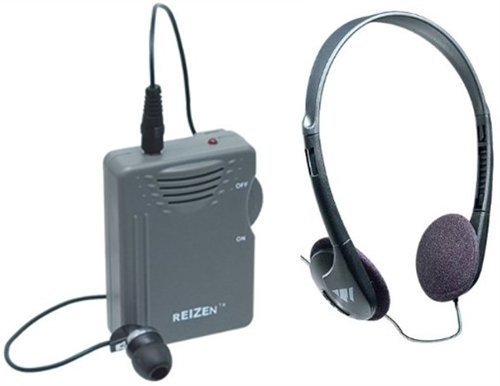
Reizen Loud Ear Elite 120dB Gain Personal Amplifier
About this pick
The Reizen Elite headlines a gain of 120 dB, the largest claim in the group. A built-in microphone captures sound, and a mini earphone delivers it. The elite package is pitched as ready to try on arrival.
Such a figure should make a buyer cautious. Very high gain near the ear can be harmful, the listing gives little more than the numbers, and no tone control or battery life is stated. A unit like this demands a low starting volume.
It may suit someone in a situation where sounds are very faint, though for most households it will be far more than needed. It is the opposite of the IROGER's calm approach, with a loud claim and little detail. Against the SuperEar kits it offers less in the box and more theoretical output.
Best for: Careful users who need strong amplification and will keep volume low.
Check price on AmazonSpecs
- Gain: 120 dB listed
- Microphone: Built in
- Output: Mini earphone
- Package: Elite
Pros
- +Lists 120 dB gain, the highest claim here
- +Built-in microphone needs no extras
- +Mini earphone is small and light
- +Elite package arrives ready to try
Cons
- −Very high gain demands careful volume use
- −Listing gives little detail beyond figures
- −No tone control or battery life stated
MSA PRO Sound Amplifier 30X
About this pick
The MSA PRO is the small, quiet option. The maker calls it virtually unnoticeable and claims it amplifies sound by 30 times, with up to 20 hours of continuous use. It is the unit to choose when the main worry is how it looks in the ear.
The 30 times figure cannot be compared with decibel ratings, the page says little about charge time or tips, and tiny parts are easy to lose. Its run time is the shortest in this lineup.
It works for occasional use at a dinner or a meeting, not for a full day of heavy listening. Compared with the IROGER's 120 hours it lasts a fraction as long, and compared with the Joanbro it offers almost no adjustment. Its single advantage is how little attention it draws.
Best for: Occasional listeners who value a nearly invisible, lightweight unit.
Check price on AmazonSpecs
- Amplification: 30 times
- Run time: Up to 20 hours
- Weight: Lightweight
- Look: Barely visible
Pros
- +Small body described as barely visible
- +Lists amplification of 30 times
- +Up to 20 hours on one charge per listing
- +Light enough to wear for a full evening
Cons
- −Shorter run time than the IROGER
- −Tiny parts are easy to drop or misplace
- −Listing says little about charge time or tips
How We Evaluated These Personal Sound Amplifiers Under $100
Each pick was assessed across 5 criteria weighted for real-world use.
Power and running cost
We compared charge times, stated hours and battery type. The IROGER leads with a one-hour charge and up to 120 hours, ahead of the MSA PRO at 20. The SuperEar SE7500 relies on disposable AAA cells, which counted against it.
Control and adjustability
We rated how much a wearer can tune. The Joanbro's three microphones, tone wheel and volume knob lead, followed by the SuperEar SE5000's tactile wheel. The IROGER's one knob scored for simplicity.
Kit completeness
We looked at what ships with each amplifier. The SuperEar kits include headphones and, for the SE7500, batteries, and the Reizen Elite includes an earphone. Complete kits saved extra purchases.
Claim discipline
We discounted marketing and noted extreme gain figures. Scores rely on product specs and buyer feedback, not hands-on testing, and the Reizen's 120 dB claim triggered a caution.
Value at this budget
We asked what the extra budget adds over a basic earpiece. The IROGER adds charging speed, the SuperEar models add kits, the Joanbro adds control and the MSA PRO adds discretion.
How to Choose the Right Personal Sound Amplifiers Under $100
By Power Preference
How you want to power the unit narrows the list quickly.
| Preference | Best pick | Why |
|---|---|---|
| Charge rarely, forget it | IROGER Rechargeable Hearing Amplifier with Headphone | Up to 120 hours listed, 1 hour charge |
| Keeps AAA cells at home | SuperEar SE7500 Hearing Amplifier Kit | Two AAA batteries included |
| Short outings only | MSA PRO Sound Amplifier 30X | Up to 20 hours per charge |
| Does not want to think about it | SuperEar SE5000 Hearing Amplifier | Simple wheel and complete kit |
Real run time falls as volume rises.
By Budget
Within the cap, think in tiers by what is added.
| Tier | Best pick | What you get |
|---|---|---|
| Entry | MSA PRO Sound Amplifier 30X | A small discreet unit |
| Entry to mid | SuperEar SE5000 Hearing Amplifier | Headphones, earbuds and a tactile wheel |
| Mid | IROGER Rechargeable Hearing Amplifier with Headphone | Fast charge and very long listed run time |
| Upper | Joanbro Pocket Personal Sound Amplifier | Three microphones and separate controls |
Higher tiers add control and convenience, not clinical fitting.
Rechargeable vs Disposable Batteries
The choice affects daily habit and long-term cost.
Rechargeable
The IROGER and MSA PRO charge by cable, so there are no cells to buy. A built-in cell may limit long-term life, and a flat unit stays flat until plugged in. Choose this if you prefer a routine.
Disposable AAA
The SuperEar SE7500 ships with two AAA cells, and replacements are cheap and easy to find. You can swap them in seconds, but they are a recurring chore. Choose this if you dislike waiting for a charge.
How Much Adjustment You Want
Some people want to tune, others want to set and forget.
| Adjustment need | Best pick | Reason |
|---|---|---|
| Wants full control | Joanbro Pocket Personal Sound Amplifier | Tone wheel, volume knob and three microphones |
| Wants a tactile wheel | SuperEar SE5000 Hearing Amplifier | Volume found by touch |
| Wants one knob | IROGER Rechargeable Hearing Amplifier with Headphone | Power and volume on one knob |
| Wants strong output with care | Reizen Loud Ear Elite 120dB Gain Personal Amplifier | Built-in microphone and 120 dB listed |
A family member can set the Joanbro once and leave it.
For Evening Television Specifically
Many buyers want better dialogue in a favorite chair.
Look for
Choose a tactile control, a comfortable headphone or earbud and a unit that stays powered through an evening. Keep volume low and avoid maximum gain for hours.
In this comparison
The SuperEar SE5000 and SE7500 are built around television and conversation, the IROGER offers long run time and the Joanbro gives tone control for dialogue.
When to Spend More
Know when this cap is not enough.
| Spend more if | Save if |
|---|---|
| You suspect real hearing loss and need a fitted device rather than the Reizen Elite | You only want casual help with television and chats |
| You need documented gain, which the SuperEar kits do not list | The IROGER's convenience is enough |
| You want verified build quality and support | A basic kit like the SE7500 works |
| You need a wireless discreet fit beyond the MSA PRO | Occasional use is fine |
No amplifier replaces an audiology exam.
Frequently Asked Questions
Is a personal sound amplifier a hearing aid?
No. A hearing aid is a regulated medical device programmed to an individual loss. A personal sound amplifier raises volume broadly and is meant for casual listening. Listings often blur the line, so judge them on their specs.
Which has the longest battery life?
The IROGER lists up to 120 hours after a one-hour charge, and the MSA PRO lists up to 20 hours. The SuperEar SE7500 uses two AAA batteries and states no hours. Listed figures depend on volume, and a unit used at a modest level for a few hours a day will last far longer between charges than one pushed to the top of its range. Treat every number as a best case and charge before a long event, not during it.
Is 120 dB gain safe?
Very high gain near the ear can harm hearing quickly. The Reizen Elite lists 120 dB, so start at the lowest setting and raise it only a little. Most uses need far less.
Are AAA batteries or rechargeable better?
Neither is better outright. Rechargeable units like the IROGER save the cost of cells but need a charging habit, and AAA units like the SE7500 are quick to swap. Choose what your household will actually do. A person who forgets chargers is safer with cells that can be swapped on the spot, while someone who dislikes buying batteries will prefer the IROGER's hour-long charge.
What does auto gain control do?
The IROGER and Joanbro list it to even out the difference between soft and loud sounds. It reduces constant volume fiddling, but it does not make loud sound safe. Keep the level modest.
Are the wired headphones a problem?
A cord is a trade-off. It reduces the chance of losing the earpiece, but it limits movement. The SuperEar kits and Reizen use cords, while the MSA PRO does not. If you pick a cord, tuck the lead under a sleeve or clip it to clothing so it does not snag when you stand up, and store the headphones in a pouch so the wires do not tangle.
When should I see an audiologist?
When you notice a change in your hearing. A clinician can test and recommend proper devices. An amplifier cannot diagnose or treat any condition.
Bottom Line
best overall: IROGER Rechargeable Hearing Amplifier with Headphone - best overall pick in this roundup.
See the full rankings above for all picks with pros, cons, and best-for summaries.
Browse on Amazon
All Prime-eligible options with current pricing.
Shop on Amazon →