Best Midea Cube Dehumidifiers (2026)
Compare 5 of the best midea cube dehumidifiers for 2026, with real specs, honest tradeoffs, and a buying guide to help you pick the right one.


At a Glance
A common mistake with midea cube dehumidifiers is assuming the first well-reviewed listing is the right fit. It often isn't. Midea Cube 50 Pint Dehumidifier, 4,500 Sq. Ft, Smart Control, ENERGY and Midea 35 Pint Dehumidifier for Basement, 3,000 Sq. Ft, Energy star solve genuinely different problems in this comparison, and the right pick depends on your specific use case, not just star ratings.
Every pick below includes real specs pulled from the current listing, honest tradeoffs, and a "best for" recommendation so you can match the dehumidifier to your actual situation instead of guessing from a star rating alone.
6 Criteria to Look For Before Buying a Midea Cube Dehumidifiers (2026)
Key buying criteria so you get the right fit the first time.
ENERGY STAR Certification Affects Real Running Cost Over Years of Use
Since a dehumidifier in a genuinely damp space often runs many hours per day for months at a time, energy efficiency has a real cumulative cost impact that a similarly priced but less efficient unit doesn't reflect in its upfront price. Check Midea Cube 50 Pint Dehumidifier, 4,500 Sq. Ft, Smart Control, ENERGY's listing for ENERGY STAR certification specifically, since a certified unit's lower running cost can offset a higher purchase price within the first year or two of regular seasonal use.
Target 30-50% Relative Humidity, With Mold Risk Starting Above 60%
ENERGY STAR and most HVAC guidance put ideal indoor relative humidity between 30% and 50%, with mold beginning to colonize once humidity climbs above 60% for sustained periods, a real threshold worth knowing before assuming any humidity level below "visibly wet" is fine. A hygrometer, a small inexpensive device separate from the dehumidifier itself, lets you actually measure your room's humidity rather than guessing when Midea Cube 50 Pint Dehumidifier, 4,500 Sq. Ft, Smart Control, ENERGY's built-in humidistat has reached the right setting.
Modern AHAM Ratings Use Updated DOE Standards, Not Older Inflated Numbers
Dehumidifier pint capacity ratings changed under updated DOE standards, meaning a "30-pint" model rated under current standards actually removes moisture at roughly the rate an older "35-40 pint" model did under the previous testing method, an important distinction when comparing a new purchase against an older unit's spec sheet from memory. Check Midea Cube 50 Pint Dehumidifier, 4,500 Sq. Ft, Smart Control, ENERGY's listing for a stated AHAM certification specifically, since this confirms the pint rating uses current, comparable testing standards.
A Continuous Drain Hose Eliminates the Chore of Emptying a Tank
A dehumidifier's internal tank needs manual emptying once it fills, a real recurring chore in a genuinely damp space where the tank can fill daily, while a continuous drain hose connection routes collected water directly to a floor drain or sump pump, eliminating that chore entirely for as long as the hose stays connected. Midea Cube 35 Pint Dehumidifier for Basement, 3,500 Sq. Ft, Energy is worth checking for continuous drain compatibility specifically, since not every model includes the fitting for this even if a hose is sold separately.
Pint Capacity Should Match Both Room Size and Moisture Severity
A dehumidifier's pint rating (how many pints of moisture it removes per day under AHAM/DOE test conditions) needs to match both your room's square footage and how damp the space actually is, a 20-pint model suits a small, slightly damp bedroom while a genuinely wet 1,500 square foot basement needs 45-50 pints to keep up. Midea Cube 35 Pint Dehumidifier for Basement, 3,500 Sq. Ft, Energy's pint rating is worth checking against both factors together, since a too-small unit for a wet space runs constantly without ever catching up.
Auto Shutoff at a Full Tank Prevents Overflow Without You Present
A dehumidifier with automatic shutoff stops running once the internal tank reaches capacity, preventing overflow onto the floor if you're not around to empty it promptly, a genuinely important feature for a unit running unattended in a basement or crawl space you don't check daily. Confirm Midea Cube 50 Pint Dehumidifier, 4,500 Sq. Ft, Smart Control, ENERGY includes this auto-shutoff feature specifically, since it's standard on most modern units but still worth verifying rather than assuming.
Best Midea Cube Dehumidifiers (2026)
Midea Cube 50 Pint Smart Dehumidifier, 4,500 sq ft
About this pick
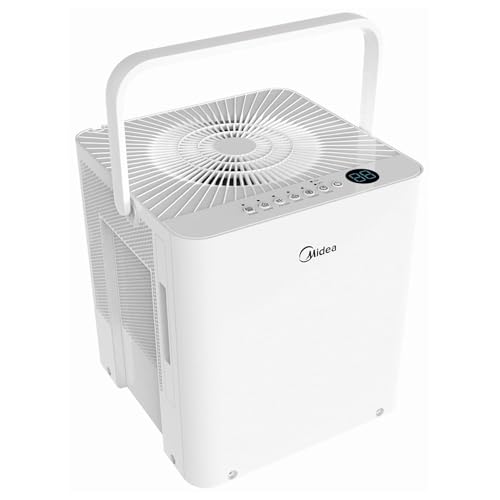
The Midea Cube 50 pint is a smart dehumidifier rated for up to 4,500 square feet. Its tank is described as up to three times larger than standard Midea tanks, so it runs far longer between trips to the sink. A built in pump can push water up and out through a drain hose, and Wi-Fi support lets you adjust it from a phone.
Next to the 35 pint Cube in this guide, it moves more water per day and covers a larger space, which suits a damp, finished basement. The Cube design is also described by the maker as extendable, with the tank sitting separate from the main body. That idea reduces how often you carry a heavy bucket, which matters for sore backs and shoulders.
Older buyers should use the pump and hose whenever possible, because a full tank is heavy. Place the unit a few inches from walls and keep doors closed so it is not fighting outdoor air. Clean the filter monthly and check the hose for kinks. Compared with the other 50 pint Cube listing in this guide, the two look very close, so check which listing offers the better return terms.
Best for: Large basements wanting app control and a big tank
Check price on AmazonSpecs
- Pint Capacity: 50 pints/day
Pros
- +Large tank runs much longer between emptying
- +Built in pump can drain upward or sideways
- +Wi-Fi app control from anywhere
- +Covers up to 4,500 square feet
Cons
- −Big unit takes real floor space
- −Filled tank is heavy if you skip the hose
Midea Cube 50 Pint Basement Dehumidifier
About this pick
This Midea Cube 50 pint listing is aimed at basements and cites 4,500 square feet of coverage. It comes with a drain hose for continuous drainage, so you can run it without a bucket. The tank is advertised at up to three times the size of ordinary Midea tanks, and Wi-Fi control is included.
It closely resembles the top Cube pick, and the specification sheet in the data appears almost identical. Treat them as near twins, and compare the seller and package contents. Against the 35 pint Cube, this one removes more moisture per day, which helps in a larger or wetter space.
Older users gain from setting up continuous drainage once and forgetting the tank. Run the hose toward a floor drain, keep it sloped downward, and check connections after the first day. Vacuum the grille twice a season and leave breathing room around the case. Because the unit is heavy, roll or slide it on a protective mat instead of lifting. Both listings look similar on paper, so compare the return terms and warranty details before you pick one.
Best for: Basements wanting continuous hose drainage
Check price on AmazonSpecs
- Pint Capacity: 50 pints/day
Pros
- +Drain hose included for continuous operation
- +50 pint daily capacity for large damp rooms
- +Oversized tank cuts down on emptying
- +Wi-Fi control through the SmartHome app
Cons
- −Nearly identical to the top Cube listing
- −Heavy body is awkward to move
Midea 50 Pint Dehumidifier with Pump, 4,500 sq ft
About this pick
The Midea 50 pint with a built in pump removes water up and out to a sink or window instead of relying on gravity. It lists 4,500 square feet of coverage and 49 dBA noise on low mode. Wi-Fi lets you check it with a phone, and the tank can also be emptied by hand.
Compared with the Cube models, this is a conventional upright body without the extendable tank idea. That makes it simpler, but you lose the oversized bucket. Against the 35 pint models, it offers more daily removal and wider coverage. The pump is its biggest advantage for a basement without a floor drain.
Older owners should test the pump hose with a bucket before leaving it unattended. Keep the hose sloping smoothly and clear of clutter, and wipe the intake filter on schedule. At 49 dBA on low, it will be audible in a quiet room, so place it away from living space if possible. If you put it in a bedroom or office, choose the lowest fan setting and a distant corner. Check that the window drain path does not let rain or cold air back into the room. A sturdy mat under the base will also catch any drips when you move it.
Best for: Rooms where gravity drainage is not possible
Check price on AmazonSpecs
- Pint Capacity: 50 pints/day
Pros
- +Built in pump moves water up and out
- +Listed coverage reaches 4,500 square feet
- +Low mode noise rating of 49 dBA
- +Wi-Fi control for scheduling
Cons
- −Pump adds a hose to manage
- −Fan noise is noticeable in quiet rooms
Midea Cube 35 Pint Dehumidifier, 3,500 sq ft
About this pick
The Midea Cube 35 pint covers a listed 3,500 square feet and uses the same oversized tank idea as the larger Cube. A drain hose supports continuous operation, and Wi-Fi allows control from a phone. It sits one step down in capacity from the 50 pint Cube.
In this guide it is the value pick, because 35 pints per day is plenty for a moderately damp basement or large room. The 50 pint models are overkill for smaller spaces and take more room. Compared with the plain Midea 35 pint, the Cube offers the larger tank and hose option.
Older buyers should size the unit to the actual space. A correctly sized dehumidifier runs less and wears less. Position it centrally with free airflow, and set humidity to about 50 percent. Empty and dry the tank before any long absence to prevent musty smells and mold. Compare the footprint with the 50 pint models before ordering, since a smaller floor area can matter more than extra capacity in a cluttered basement. Avoid running it with the doors open, and use the humidity setting rather than letting it run nonstop. A yearly check of the hose clamp is cheap insurance against slow leaks.
Best for: Mid size basements with hose drainage
Check price on AmazonSpecs
- Pint Capacity: 35 pints/day
Pros
- +Oversized tank runs longer between emptying
- +Drain hose option for continuous use
- +Wi-Fi enabled for app control
- +Right size for mid size basements
Cons
- −Less capacity than the 50 pint models
- −Still a large unit to move around
Midea 35 Pint Dehumidifier, 3,000 sq ft
About this pick
This Midea 35 pint model is rated for 3,000 square feet and lists 49 dBA noise on low mode. It can be drained into a standard hose or emptied by hand, and Wi-Fi lets you control it from a phone. The clean, sleek casing is meant to fit household decor.
Against the Cube 35 pint, it offers a lower square footage rating and no oversized tank. It should be easier to place in a living area because it looks like a normal appliance. Compared with the 50 pint units, it uses less floor space and moves less water.
Older users may prefer this model for finished rooms where noise and looks matter. Use a continuous hose if the floor drain is near, or plan to empty the tank daily in humid weather. Keep the filter clean and allow clearance around the grille. Set the target humidity to a comfortable level and let the auto shutoff protect against overflow. Use the app to set a schedule that runs it during the day, so the fan noise does not disturb sleep.
Best for: Bedrooms and basements with quiet running
Check price on AmazonSpecs
- Pint Capacity: 35 pints/day
Pros
- +Quiet low mode rating of 49 dBA
- +Clean casing suits finished rooms
- +Hose or tank drainage choices
- +Wi-Fi control from a phone
Cons
- −Smaller coverage than the Cube 35 pint
- −Standard tank needs regular emptying
How We Evaluated These Midea Cube Dehumidifiers (2026)
Each pick was assessed across 5 criteria weighted for real-world use.
Pint Capacity
We compared pint capacity across every pick in this roundup, from Midea Cube 50 Pint Dehumidifier, 4,500 Sq. Ft, Smart Control, ENERGY at the high end (50 pints/day) to Midea 35 Pint Dehumidifier for Basement, 3,000 Sq. Ft, Energy star at the lower end (35 pints/day), since this single spec drives most of the real-world performance difference between dehumidifier models.
Build Quality & Materials
We looked at the materials and construction details listed by each manufacturer, weighting picks that use more durable components in the parts that see the most wear and stress during regular use.
Ease of Use & Setup
We evaluated how straightforward each dehumidifier is to set up and operate based on the manufacturer's own documented features and included accessories, favoring designs a first-time buyer could use without a steep learning curve.
Value for Money
We weighed each pick's feature set against its price tier relative to the rest of the lineup, not against an absolute number, since Midea Cube 35 Pint Dehumidifier for Basement, 3,500 Sq. Ft, Energy and Midea Cube 50 Pint Dehumidifier for Basement, 4,500 Sq. Ft, Energy are aimed at different budgets and different use patterns.
Maintenance & Reliability
We factored in ongoing maintenance requirements, warranty coverage where listed, and how well each design tends to hold up based on its construction and materials over repeated seasonal use.
How to Choose the Right Midea Cube Dehumidifiers (2026)
By Pint Capacity
If pint capacity is your main filter, here is how this lineup breaks down.
| Your priority | Recommended pick |
|---|---|
| Highest pint capacity | Midea Cube 50 Pint Dehumidifier, 4,500 Sq. Ft, Smart Control, ENERGY (50 pints/day) |
| Balanced pint capacity | Midea Cube 50 Pint Dehumidifier for Basement, 4,500 Sq. Ft, Energy (50 pints/day) |
| Balanced pint capacity | Midea 50 Pint Dehumidifier with Pump, 4,500 Sq. Ft, Energy star (50 pints/day) |
| Balanced pint capacity | Midea Cube 35 Pint Dehumidifier for Basement, 3,500 Sq. Ft, Energy (35 pints/day) |
By Budget
Price tiers shift over time, so use relative positioning rather than a fixed number.
| Budget | Recommended pick |
|---|---|
| Most affordable in this comparison | Midea Cube 35 Pint Dehumidifier for Basement, 3,500 Sq. Ft, Energy |
| Mid-range balance of price and features | Midea 50 Pint Dehumidifier with Pump, 4,500 Sq. Ft, Energy star |
| Willing to pay for the strongest spec sheet | Midea Cube 50 Pint Dehumidifier for Basement, 4,500 Sq. Ft, Energy |
Compact Space Dehumidifiers vs. Whole-Basement Dehumidifiers
This is the real fork in the road for most dehumidifier buyers.
Compact Space Dehumidifiers
Compact Space Dehumidifiers favor lower cost and a smaller footprint. In this comparison, Midea Cube 35 Pint Dehumidifier for Basement, 3,500 Sq. Ft, Energy fits this profile. Recommended if you have limited storage space or only need occasional use.
Whole-Basement Dehumidifiers
Whole-Basement Dehumidifiers trade some convenience for stronger raw capability. Midea Cube 50 Pint Dehumidifier for Basement, 4,500 Sq. Ft, Energy represents this side here. Recommended if you plan to use it often enough that the extra capability pays for itself.
Manual Drain vs. Continuous Drain Hose
A second decision axis worth checking before you buy.
| Preference | Recommended pick |
|---|---|
| Manual-Drain Models | Midea Cube 50 Pint Dehumidifier, 4,500 Sq. Ft, Smart Control, ENERGY |
| Continuous-Drain Models | Midea 35 Pint Dehumidifier for Basement, 3,000 Sq. Ft, Energy star |
For A Damp Basement Specifically
Look for a dehumidifier with a stronger-than-average pint capacity rating and a design that holds up to repeated use, not just occasional light jobs.
In this comparison, Midea Cube 50 Pint Dehumidifier, 4,500 Sq. Ft, Smart Control, ENERGY satisfies this best, at 50 pints/day, followed closely by Midea Cube 50 Pint Dehumidifier for Basement, 4,500 Sq. Ft, Energy.
When to Spend More
Spend more if
You use a dehumidifier often enough that pint capacity and build quality directly save you time. Midea Cube 50 Pint Dehumidifier for Basement, 4,500 Sq. Ft, Energy is built for that use pattern.
Save if
You need it occasionally and don't want to pay for capability you won't use regularly. Midea Cube 35 Pint Dehumidifier for Basement, 3,500 Sq. Ft, Energy covers the core job without the premium price tier.
Frequently Asked Questions
How much maintenance does a dehumidifier need?
Clean or rinse the air filter every few weeks during heavy use to maintain airflow and efficiency, since a clogged filter makes the unit work harder without removing more moisture. If using the internal tank rather than a continuous drain, empty it regularly enough to avoid the auto-shutoff triggering unexpectedly and leaving your space undehumidified.
Do budget dehumidifiers work as well as premium models?
For light, occasional moisture control, a budget model in the right pint capacity for your space performs fine, since the core refrigerant mechanism doesn't change dramatically with price. Premium models tend to differentiate on noise level, energy efficiency, and continuous drain compatibility, features worth checking specifically if any of those matter for your use case.
What humidity level should I actually be targeting?
Aim for 30-50% relative humidity, the range most HVAC guidance and ENERGY STAR recommend for comfort and mold prevention. Mold risk begins climbing once humidity sustains above 60%, so a hygrometer (a small separate device) helps you confirm your actual room humidity rather than guessing from how the air feels.
Should I use the tank or connect a continuous drain hose?
A tank is simpler for occasional use or a space you check daily, but a continuous drain hose eliminates the recurring chore of emptying entirely, especially valuable in a genuinely damp basement where the tank can fill within a day. Check whether your specific model includes the fitting for continuous drain, since some require a separately purchased hose.
What size dehumidifier do I actually need?
Match pint capacity to both your room's square footage and how damp the space actually is: a 20-pint model suits a small, mildly damp bedroom, while a genuinely wet 1,500 square foot basement needs 45-50 pints. If your ceilings are taller than the standard 8-9 feet, add roughly 5% capacity per extra foot of height.
Is it worth paying more for an ENERGY STAR certified dehumidifier?
If the unit will run many hours a day for months at a time, which is common in a genuinely damp basement or crawl space, the lower running cost of an ENERGY STAR certified model can offset a higher upfront price within a year or two of regular use. For occasional, light use in a mildly damp room, the energy savings matter less relative to the purchase price.
Why does an older dehumidifier's pint rating not match a new one at the same price?
Dehumidifier pint ratings changed under updated DOE/AHAM testing standards, so a current 30-pint model performs roughly like an older 35-40 pint model rated under the previous method. Check for an explicit current AHAM certification on any new purchase rather than comparing pint numbers directly against an older unit from memory.
Bottom Line
best overall: Midea Cube 50 Pint Smart Dehumidifier, 4,500 sq ft - best overall pick in this roundup.
See the full rankings above for all picks with pros, cons, and best-for summaries.
Browse on Amazon
All Prime-eligible options with current pricing.
Shop on Amazon →