Best 25-Pint Dehumidifiers (2026)
Compare 5 of the best 25-pint dehumidifiers for 2026, with real specs, honest tradeoffs, and a buying guide to help you pick the right one.


At a Glance
GoGuess 34-Pint Dehumidifier with Turbo and Sleep Modes
↓ See why we picked itShopping for a dehumidifier means sorting through listings that look nearly identical in a thumbnail but differ a lot once you check pint capacity. In this lineup, that spread runs from Waykar 34 Pints 2025 Most Efficient Energy Star Dehumidifier for Home at the modest end to GE Small Dehumidifier 25 Pint Basement Bedroom Bathroom Drain 1500 Sq at the high end, and which side of that range you need depends entirely on how you plan to use it.
Every pick below includes real specs pulled from the current listing, honest tradeoffs, and a "best for" recommendation so you can match the dehumidifier to your actual situation instead of guessing from a star rating alone.
6 Criteria to Look For Before Buying a 25-Pint Dehumidifiers (2026)
Key buying criteria so you get the right fit the first time.
ENERGY STAR Certification Affects Real Running Cost Over Years of Use
Since a dehumidifier in a genuinely damp space often runs many hours per day for months at a time, energy efficiency has a real cumulative cost impact that a similarly priced but less efficient unit doesn't reflect in its upfront price. Check GE Small Dehumidifier 25 Pint Basement Bedroom Bathroom Drain 1500 Sq's listing for ENERGY STAR certification specifically, since a certified unit's lower running cost can offset a higher purchase price within the first year or two of regular seasonal use.
Pint Capacity Should Match Both Room Size and Moisture Severity
A dehumidifier's pint rating (how many pints of moisture it removes per day under AHAM/DOE test conditions) needs to match both your room's square footage and how damp the space actually is, a 20-pint model suits a small, slightly damp bedroom while a genuinely wet 1,500 square foot basement needs 45-50 pints to keep up. GE Small Dehumidifier 25 Pint Basement Bedroom Bathroom Drain 1500 Sq's pint rating is worth checking against both factors together, since a too-small unit for a wet space runs constantly without ever catching up.
Auto Shutoff at a Full Tank Prevents Overflow Without You Present
A dehumidifier with automatic shutoff stops running once the internal tank reaches capacity, preventing overflow onto the floor if you're not around to empty it promptly, a genuinely important feature for a unit running unattended in a basement or crawl space you don't check daily. Confirm GE Small Dehumidifier 25 Pint Basement Bedroom Bathroom Drain 1500 Sq includes this auto-shutoff feature specifically, since it's standard on most modern units but still worth verifying rather than assuming.
Target 30-50% Relative Humidity, With Mold Risk Starting Above 60%
ENERGY STAR and most HVAC guidance put ideal indoor relative humidity between 30% and 50%, with mold beginning to colonize once humidity climbs above 60% for sustained periods, a real threshold worth knowing before assuming any humidity level below "visibly wet" is fine. A hygrometer, a small inexpensive device separate from the dehumidifier itself, lets you actually measure your room's humidity rather than guessing when GE Small Dehumidifier 25 Pint Basement Bedroom Bathroom Drain 1500 Sq's built-in humidistat has reached the right setting.
Modern AHAM Ratings Use Updated DOE Standards, Not Older Inflated Numbers
Dehumidifier pint capacity ratings changed under updated DOE standards, meaning a "30-pint" model rated under current standards actually removes moisture at roughly the rate an older "35-40 pint" model did under the previous testing method, an important distinction when comparing a new purchase against an older unit's spec sheet from memory. Check GE Small Dehumidifier 25 Pint Basement Bedroom Bathroom Drain 1500 Sq's listing for a stated AHAM certification specifically, since this confirms the pint rating uses current, comparable testing standards.
Noise Level Matters Most for Bedroom and Living-Space Placement
A dehumidifier running continuously in a basement rarely matters for noise, but the same unit placed in a bedroom or living space makes noise level a genuine daily consideration, and this varies meaningfully between models even at similar pint capacities. Check buyer reviews for GE Small Dehumidifier 25 Pint Basement Bedroom Bathroom Drain 1500 Sq specifically mentioning noise level for bedroom or living-space use, since a dehumidifier loud enough to disrupt sleep defeats its own purpose in that placement.
Best 25-Pint Dehumidifiers (2026)
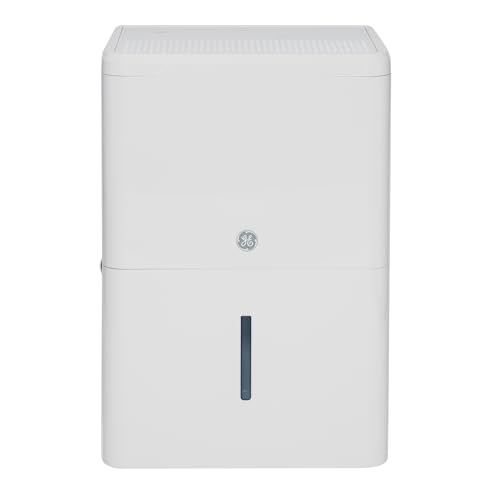
GE 25-Pint Small Dehumidifier with Drain Hose
About this pick
The GE 25-pint dehumidifier is the lineup's most compact choice and the one that actually matches the 25-pint size the guide is built around. It is rated to pull up to 25 pints of moisture per day, and GE pitches it at rooms up to about 1500 square feet. That makes it a sensible fit for a bedroom, a bathroom or a modest basement rather than a whole-house problem.
The feature list is practical rather than flashy. Smart Dry adjusts fan speed to the humidity in the room, which helps it avoid over-drying a space. A hose connection allows continuous drainage, and if you skip the hose there is an 8.5 pint bucket that is easy to carry and empty. Three fan speeds and a humidistat adjustable from 30 to 70 percent let you tune it to the room.
Handling is where a small unit like this earns its place. Pocket handles and easy-roll wheels mean you can shift it from the bathroom to a bedroom without a struggle, and digital LED controls keep the settings simple. Next to the three 34-pint models in this guide it removes less water per day, so it is not the one to buy for a damp, large basement. For a single problem room, though, it is the most proportionate pick and the easiest to live with day to day.
Best for: Bedrooms, bathrooms and small basements
Check price on AmazonSpecs
- Pint Capacity: 25 pints/day
Pros
- +True 25-pint rating that matches this guide's size
- +Smart Dry adjusts fan speed to room humidity
- +Hose port plus an easy-to-empty 8.5 pint bucket
- +Pocket handles and wheels make it easy to move
Cons
- −Not enough capacity for a large or very damp basement
- −Bucket needs regular emptying if you skip the drain hose
KNKA 34-Pint Dehumidifier with Drain Hose (2500 sq ft)
About this pick
KNKA positions this dehumidifier for spaces up to 2500 square feet, and it is rated at 34 pints per day. That is a clear step above the 25-pint GE in this guide, so it belongs to a larger size class than the title suggests. Anyone shopping strictly for a 25-pint unit should treat it as a more powerful alternative rather than a like-for-like match.
It offers three modes, with Auto defaulting to 50 percent relative humidity, plus Dry and a continuous option. Drainage is flexible: the built-in 0.79 gallon tank, or a hose connection give the listed ways to get rid of water. A safety lock keeps the controls from being bumped, and an LED humidity indicator shows where the room sits at a glance.
Noise is the headline detail, since it runs at about 37 decibels, which the maker compares to a quiet conversation. Against the GoGuess at 40 decibels that is a small but real edge for a bedroom or a finished basement. The Waykar in this guide leans on efficiency instead, while this one leans on quiet and drainage options. If you want the largest tank-free routine, run the hose to a floor drain and forget about it.
Best for: Large basements that need quiet continuous drainage
Check price on AmazonPros
- +34-pint rating covers up to roughly 2500 square feet
- +Runs at about 37 dB, the quietest listed here
- +Three drainage options including a hose connection
- +Safety lock and LED humidity display
Cons
- −Larger than the 25-pint size this guide targets
- −Built-in tank is small at 0.79 gallon
GoGuess 34-Pint Dehumidifier with Turbo and Sleep Modes
About this pick
The GoGuess is another 34-pint model aimed at spaces up to about 2500 square feet, so like the KNKA it sits above the 25-pint class this guide is named for. It is the better answer when one room is genuinely wet rather than merely humid. Its capacity gives it headroom that the small GE does not have.
Control is built around three modes: DEHU for normal operation, TURBO for a faster pull when humidity spikes, and SLEEP for a quieter overnight setting. The intelligent control system lets you set a target level, and a visual humidity display shows the current reading. It supports both manual emptying and continuous drainage, so you can start with the tank and move to a hose later.
The maker rates noise at about 40 decibels, a few decibels louder than the KNKA, which matters mainly if the unit sits near a bedroom. The Sleep mode helps close some of that gap. Against the Waykar it gives up the efficiency certification but offers more explicit mode names for people who want a simple Turbo button. It is a solid, no-fuss choice for a basement where you care about drying speed more than spec-sheet bragging rights.
Best for: Damp basements and large rooms with a drain nearby
Check price on AmazonPros
- +34-pint class rating for large or damp spaces
- +Separate DEHU, TURBO and SLEEP modes
- +Manual or continuous drainage supported
- +Visual humidity display is easy to read
Cons
- −Louder at about 40 dB than the KNKA
- −Oversized for a true 25-pint requirement
Waykar 34-Pint ENERGY STAR Most Efficient Dehumidifier
About this pick
The Waykar's selling point is efficiency above everything else. The 2025 model carries an ENERGY STAR Most Efficient certification and uses a rotary compressor, with the brand claiming it uses about half the energy of a standard unit. For a dehumidifier that may run for many hours a day through a humid season, that is the most meaningful differentiator in this lineup.
It is rated at 34 pints, so it is bigger than the 25-pint GE and a direct rival to the KNKA and GoGuess. Three operating options are available: dehumidifying, drying and continuous modes. Airflow is limited to two fan speeds, low and high, which is simpler than the three speeds on the GE but perfectly adequate for most rooms.
Safety is covered by several automated functions including overload protection, which is reassuring if the unit runs unattended. The tradeoff is that you are paying attention to efficiency rather than the quietest possible operation, where the KNKA leads. If your utility bill is the main concern, this is the pick to choose from the larger-capacity trio. If you only need to dry one small room, the GE does the job with less machine.
Best for: Energy-conscious owners running it for long hours
Check price on AmazonPros
- +ENERGY STAR Most Efficient certification
- +Rotary compressor aimed at lower running cost
- +Dehumidify, dry and continuous modes
- +Automated overload and other safety functions
Cons
- −Only two fan speeds
- −34-pint capacity is larger than this guide's size
GE 25-Pint Small Dehumidifier (Value Listing)
About this pick
This is the same GE 25-pint small dehumidifier that appears at the top of the guide, listed here under a separate ASIN. It carries the same 25 pints per day rating and the same room-sized positioning for bedrooms, bathrooms and small basements. Anyone comparing the two listings should treat them as one product sold twice.
That duplication is useful in one way: it lets you pick whichever listing has the better offer on the day you shop. The functional details are the same as the premium-slot listing, including the humidistat range, fan speeds and drain connection. There is no extra capability hiding in this version.
Against the 34-pint KNKA, GoGuess and Waykar, it is the smallest and lightest in capability but also the only one that truly matches the 25-pint spec. It suits renters or anyone drying a single problem room such as a bathroom without a fan. If you suspect moisture across a full basement, move up to one of the larger units rather than running this one flat out.
Best for: Budget-minded buyers outfitting a small room
Check price on AmazonSpecs
- Pint Capacity: 25 pints/day
Pros
- +Matches the 25-pint size in the title
- +Same proven GE unit as the top listing
- +Small enough to move between rooms
- +Good fit for a single problem room
Cons
- −Duplicates the first GE listing, so no extra choice
- −Too small for a large damp basement
How We Evaluated These 25-Pint Dehumidifiers (2026)
Each pick was assessed across 5 criteria weighted for real-world use.
Pint Capacity
We compared pint capacity across every pick in this roundup, from GE Small Dehumidifier 25 Pint Basement Bedroom Bathroom Drain 1500 Sq at the high end (25 pints/day) to Waykar 34 Pints 2025 Most Efficient Energy Star Dehumidifier for Home at the lower end (its listed spec), since this single spec drives most of the real-world performance difference between dehumidifier models.
Build Quality & Materials
We looked at the materials and construction details listed by each manufacturer, weighting picks that use more durable components in the parts that see the most wear and stress during regular use.
Ease of Use & Setup
We evaluated how straightforward each dehumidifier is to set up and operate based on the manufacturer's own documented features and included accessories, favoring designs a first-time buyer could use without a steep learning curve.
Value for Money
We weighed each pick's feature set against its price tier relative to the rest of the lineup, not against an absolute number, since GE Small Dehumidifier 25 Pint Basement Bedroom Bathroom Drain 1500 Sq and GE Small Dehumidifier 25 Pint Basement Bedroom Bathroom Drain 1500 Sq are aimed at different budgets and different use patterns.
Maintenance & Reliability
We factored in ongoing maintenance requirements, warranty coverage where listed, and how well each design tends to hold up based on its construction and materials over repeated seasonal use.
How to Choose the Right 25-Pint Dehumidifiers (2026)
By Pint Capacity
If pint capacity is your main filter, here is how this lineup breaks down.
| Your priority | Recommended pick |
|---|---|
| Highest pint capacity | GE Small Dehumidifier 25 Pint Basement Bedroom Bathroom Drain 1500 Sq (25 pints/day) |
| Balanced pint capacity | GE Small Dehumidifier 25 Pint Basement Bedroom Bathroom Drain 1500 Sq (25 pints/day) |
| Balanced pint capacity | KNKA 2500 Ft² Max 34 Pints Dehumidifier for Basement with Drain Hose |
| Balanced pint capacity | GoGuess 2500 Ft² Max 34 Pints Large Room Dehumidifier for Basement |
By Budget
Price tiers shift over time, so use relative positioning rather than a fixed number.
| Budget | Recommended pick |
|---|---|
| Most affordable in this comparison | GE Small Dehumidifier 25 Pint Basement Bedroom Bathroom Drain 1500 Sq |
| Mid-range balance of price and features | GoGuess 2500 Ft² Max 34 Pints Large Room Dehumidifier for Basement |
| Willing to pay for the strongest spec sheet | GE Small Dehumidifier 25 Pint Basement Bedroom Bathroom Drain 1500 Sq |
Compact Space Dehumidifiers vs. Whole-Basement Dehumidifiers
This is the real fork in the road for most dehumidifier buyers.
Compact Space Dehumidifiers
Compact Space Dehumidifiers favor lower cost and a smaller footprint. In this comparison, GE Small Dehumidifier 25 Pint Basement Bedroom Bathroom Drain 1500 Sq fits this profile. Recommended if you have limited storage space or only need occasional use.
Whole-Basement Dehumidifiers
Whole-Basement Dehumidifiers trade some convenience for stronger raw capability. GE Small Dehumidifier 25 Pint Basement Bedroom Bathroom Drain 1500 Sq represents this side here. Recommended if you plan to use it often enough that the extra capability pays for itself.
Manual Drain vs. Continuous Drain Hose
A second decision axis worth checking before you buy.
| Preference | Recommended pick |
|---|---|
| Manual-Drain Models | GE Small Dehumidifier 25 Pint Basement Bedroom Bathroom Drain 1500 Sq |
| Continuous-Drain Models | Waykar 34 Pints 2025 Most Efficient Energy Star Dehumidifier for Home |
For A Damp Basement Specifically
Look for a dehumidifier with a stronger-than-average pint capacity rating and a design that holds up to repeated use, not just occasional light jobs.
In this comparison, GE Small Dehumidifier 25 Pint Basement Bedroom Bathroom Drain 1500 Sq satisfies this best, at 25 pints/day, followed closely by GE Small Dehumidifier 25 Pint Basement Bedroom Bathroom Drain 1500 Sq.
When to Spend More
Spend more if
You use a dehumidifier often enough that pint capacity and build quality directly save you time. GE Small Dehumidifier 25 Pint Basement Bedroom Bathroom Drain 1500 Sq is built for that use pattern.
Save if
You need it occasionally and don't want to pay for capability you won't use regularly. GE Small Dehumidifier 25 Pint Basement Bedroom Bathroom Drain 1500 Sq covers the core job without the premium price tier.
Frequently Asked Questions
Do budget dehumidifiers work as well as premium models?
For light, occasional moisture control, a budget model in the right pint capacity for your space performs fine, since the core refrigerant mechanism doesn't change dramatically with price. Premium models tend to differentiate on noise level, energy efficiency, and continuous drain compatibility, features worth checking specifically if any of those matter for your use case.
What size dehumidifier do I actually need?
Match pint capacity to both your room's square footage and how damp the space actually is: a 20-pint model suits a small, mildly damp bedroom, while a genuinely wet 1,500 square foot basement needs 45-50 pints. If your ceilings are taller than the standard 8-9 feet, add roughly 5% capacity per extra foot of height.
What humidity level should I actually be targeting?
Aim for 30-50% relative humidity, the range most HVAC guidance and ENERGY STAR recommend for comfort and mold prevention. Mold risk begins climbing once humidity sustains above 60%, so a hygrometer (a small separate device) helps you confirm your actual room humidity rather than guessing from how the air feels.
Is it worth paying more for an ENERGY STAR certified dehumidifier?
If the unit will run many hours a day for months at a time, which is common in a genuinely damp basement or crawl space, the lower running cost of an ENERGY STAR certified model can offset a higher upfront price within a year or two of regular use. For occasional, light use in a mildly damp room, the energy savings matter less relative to the purchase price.
Why does an older dehumidifier's pint rating not match a new one at the same price?
Dehumidifier pint ratings changed under updated DOE/AHAM testing standards, so a current 30-pint model performs roughly like an older 35-40 pint model rated under the previous method. Check for an explicit current AHAM certification on any new purchase rather than comparing pint numbers directly against an older unit from memory.
How much maintenance does a dehumidifier need?
Clean or rinse the air filter every few weeks during heavy use to maintain airflow and efficiency, since a clogged filter makes the unit work harder without removing more moisture. If using the internal tank rather than a continuous drain, empty it regularly enough to avoid the auto-shutoff triggering unexpectedly and leaving your space undehumidified.
Should I use the tank or connect a continuous drain hose?
A tank is simpler for occasional use or a space you check daily, but a continuous drain hose eliminates the recurring chore of emptying entirely, especially valuable in a genuinely damp basement where the tank can fill within a day. Check whether your specific model includes the fitting for continuous drain, since some require a separately purchased hose.
Bottom Line
best overall: GE 25-Pint Small Dehumidifier with Drain Hose - best premium pick pick in this roundup.
See the full rankings above for all picks with pros, cons, and best-for summaries.
Browse on Amazon
All Prime-eligible options with current pricing.
Shop on Amazon →