6 Best Leather Gardening Gloves in 2026
Six leather gardening gloves compared on hide type, thumb and seam construction, lining and care, to find a pair that lasts through years of yard work.


At a Glance
Wells Lamont Men's Cowhide Leather Work Gloves with Reinforced Palm
↓ See why we picked itBamllum Microfiber Leather Gardening Gloves for Women
↓ See why we picked itA good leather glove improves with age in a way no coated knit can. The hide softens to your hand, the palm darkens where it grips, and a pair that was stiff in April feels like a second skin by June. That is also the problem when buying: the listing photo looks the same whether the leather is thick full grain, thin split suede or a microfiber imitation, and the difference only shows up months later when one pair is still going and another has split at the thumb.
The six pairs here cover that spread. The KKOYING and DULFINE are cowhide work gloves with details like a gunn cut and a keystone thumb. The Wells Lamont is a men's cowhide glove with a reinforced palm from a long-established work-glove maker, the WZQH is a lined split cowhide glove, and the SLARMOR is a long full grain cowhide glove aimed at thorny plants. The Bamllum is the exception, a microfiber leather glove for women, included because it is the easy-care alternative to real hide.
We evaluated each pair from its listing specifications and buyer feedback themes, so every leather type and construction detail is as the maker describes it. Leather quality can only be judged by hand, so we focus on the construction clues listings give and on how each glove will age.
6 Criteria to Look For Before Buying a Leather Gardening Glove
Key buying criteria so you get the right fit the first time.
Grain versus split hide
Full grain and grain leather keep the dense outer layer of the hide, and split leather is the softer layer underneath. The SLARMOR and DULFINE advertise grain, the WZQH is split, and the KKOYING and Wells Lamont say cowhide without further detail. Grain wears longer and ages better, while split is cheaper and softer. For a glove you plan to keep for years, favor grain.
Leather thickness
Thickness decides toughness and flexibility. The KKOYING states 1.2 millimeters, which is a reasonable middle for gardening, and other listings give none. Thicker hide resists thorns but strains your grip, while thinner hide feels better but wears faster. If a listing does not state thickness, rely on buyer reports about stiffness.
Seams and thumb design
Seams fail before leather does. The KKOYING moves seams off the palm, and the DULFINE uses a gunn cut with a keystone thumb. Look for double stitching and one-piece thumbs, which spread stress. A glove with a seam across the thumb crotch will usually split there first.
Lining and temperature
A lined glove is warm but holds sweat. The WZQH has a cotton lining and the others are unlined. If you garden in cool weather, a lining is welcome, but in summer an unlined glove is more comfortable. Consider owning two pairs if you work year round.
Cuff length
A short cuff suits general work, and a long one suits thorns. The SLARMOR has a long cuff, while the KKOYING, DULFINE, Wells Lamont and WZQH are shorter. Match the cuff to the plants you handle. A long cuff is a nuisance on a wheelbarrow handle.
Care and conditioning
Leather dries out and cracks when it is soaked and heated repeatedly. Dry gloves slowly at room temperature, brush off soil and rub in a leather conditioner each season. The Bamllum microfiber needs no conditioner, which is its main appeal. Store gloves in a cool, dry place away from sun.
6 Best Leather Gardening Gloves in 2026
KKOYING Full Cowhide Leather Work and Gardening Gloves
About this pick
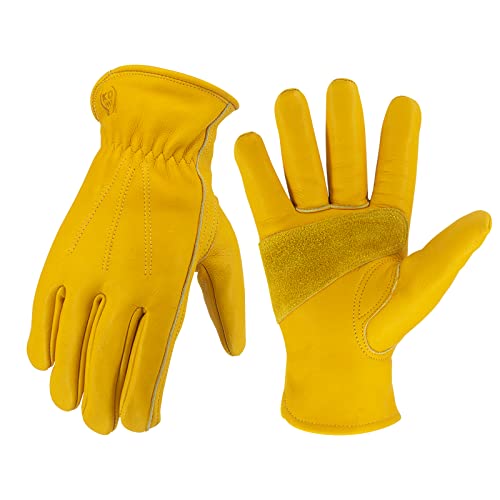
The KKOYING is the leather glove that tells you the most about how it is made. The listing states a cowhide thickness of 1.2 millimeters, describes double thread sewing for stable protection, an elastic wrist, seams that sit away from the palm for durability and flexibility, and a palm section with reinforcement. It is sold for men and women as a work and gardening glove.
A stated thickness is rare and useful. At about a millimeter, cowhide is thick enough to turn a thorn or a splinter and thin enough to still bend around a handle, which is the sweet spot for a general yard glove. Moving the seams off the palm is a clever design choice because seams are the first place a glove wears and the place a thorn finds its way in. Double thread stitching spreads the load so one broken thread does not unravel the seam.
The cost of full cowhide is the break-in period, and the leather will stiffen if it dries quickly after getting soaked. The glove also has only a short cuff, so it is not a rose gauntlet. Compared with the DULFINE, the KKOYING gives a thickness figure and an elastic wrist, and compared with the Wells Lamont it is less established but more detailed. Condition it each season and let it dry slowly.
Best for: General yard and garden work where a well-documented, mid-thickness leather glove is wanted.
Check price on AmazonSpecs
- Leather: Cowhide, 1.2 mm thick
- Stitching: Double thread, seams off the palm
- Wrist: Elastic
Pros
- +Stated 1.2 mm cowhide thickness
- +Seams placed away from the palm
- +Double thread stitching
- +Elastic wrist keeps debris out
Cons
- −Break-in period for thick cowhide
- −Short cuff
DULFINE Genuine Grain Cowhide Gardening Work Gloves
About this pick
The DULFINE calls out construction terms most gloves leave out. The listing describes genuine grain cowhide that the maker calls the best leather for abrasion-resistant work gloves, a reinforced palm patch for grip and wear, and gunn cut seams with a keystone thumb that keep the seams away from the main wear points. The size listed is large, in golden tan, for men.
A gunn cut glove is made from a single piece of leather across the back of the hand, so the seam does not run across the knuckles. A keystone thumb is a one-piece thumb that attaches to the palm at an angle, which lets the hand close more naturally around a handle. Together they matter in a garden, where the hand is constantly closing around rakes, shovels and pruners, and the usual stress points are the thumb crotch and the finger seams.
Grain cowhide is stiffer at first, and a glove sized large will feel loose on average hands. Compared with the KKOYING, the DULFINE has better-described cut patterns but no stated leather thickness. Compared with the Wells Lamont, it is a simpler but more flexible build. Condition it, hang it to dry and keep it out of direct sun to prevent stiffening.
Best for: Gardeners who grip tools all day and want a thumb and seam layout designed for it.
Check price on AmazonSpecs
- Leather: Genuine grain cowhide
- Palm: Reinforced patch
- Construction: Gunn cut and keystone thumb
Pros
- +Keystone thumb closes naturally on handles
- +Gunn cut puts seams away from wear points
- +Reinforced palm patch
- +Grain cowhide wears well
Cons
- −Stiff until broken in
- −Large size runs roomy for some hands
Wells Lamont Men's Cowhide Leather Work Gloves with Reinforced Palm
About this pick
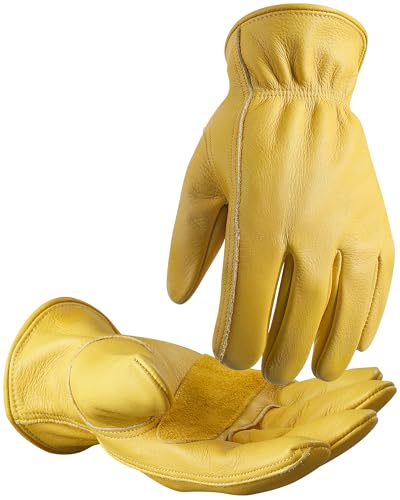
The Wells Lamont is the safe, familiar choice in this group. The listing describes cowhide leather work gloves with unmatched abrasion and puncture resistance, a reinforced leather palm patch for grip and wear resistance, and a design intended to deliver a comfortable fit by reducing wear points. It is listed for men in size large.
Brand reputation counts for something with leather, since consistency is hard to see on a screen. A work-glove maker that has produced millions of pairs tends to have predictable sizing, predictable stitching and a pattern that does not pinch. The reinforced patch is aimed at the part of the palm that touches handles, which is usually the first area to wear through.
The listing is general about the leather grade, and the glove is a classic work glove, not a gardening-specific design. It is not intended to be a thorn gauntlet and it is not lined for cold weather. Compared with the KKOYING, the Wells Lamont gives you predictable fit but less detail, and compared with the WZQH it is less insulated. Brush it clean, let it dry slowly and rub in conditioner every few months.
Best for: Men who want a familiar, no-surprises cowhide work glove for yard and household jobs.
Check price on AmazonSpecs
- Leather: Cowhide
- Palm: Reinforced leather patch
- Design: Fewer wear points for comfort
Pros
- +Reinforced palm patch where handles wear
- +Cowhide resists abrasion and punctures
- +Design reduces pressure points
- +Predictable sizing from an established maker
Cons
- −Little detail on leather grade
- −Not a thorn gauntlet
WZQH Lined Split Cowhide Leather Work Gloves
About this pick
The WZQH is the cozy option, a split cowhide glove with a soft cotton fiber lining. The listing describes its thorn proof and wear resistant qualities for weed pulling, digging, sowing, landscape work and mixing fertilizer, and also lists welding, farm and ranch tasks. It is offered in several sizes, so the fit can be tuned.
Split leather is the lower layer of the hide, rougher and often thinner than grain, and it makes a perfectly serviceable work glove at a friendlier price. The cotton lining turns it into a three-season glove, comfortable on a chilly morning and easy to slide on when your hands are slightly damp. It also acts as a barrier between your skin and any stiffness in the leather.
The lining makes it hotter in summer, and a split hide does not age as gracefully as full grain. Compared with the DULFINE, the WZQH is a more basic pattern, and compared with the SLARMOR it is a short work glove with warmth rather than a long pruning glove. Dry it slowly if it gets wet, because lined gloves hold moisture, and brush it clean before storing.
Best for: Cool-weather yard work where a lined leather glove is more comfortable than an unlined one.
Check price on AmazonSpecs
- Leather: 100% split cowhide
- Lining: Cotton fibers
- Uses: Garden, farm, construction, welding
Pros
- +Cotton lining adds warmth and comfort
- +Split cowhide is tough and affordable
- +Several sizes to choose from
- +Listing names thorn and wear resistance
Cons
- −Hot in summer
- −Split leather is less durable than full grain
SLARMOR Long Full Grain Cowhide Thorn Proof Gloves
About this pick
The SLARMOR is the leather glove for thorny plants. The listing describes 100% cowhide leather, a full grain cowhide palm for wear resistance, a soft and breathable feel, a non-toxic material and a long cuff, with roses, blackberries, cactus, holly and other prickly plants as its target uses.
Full grain is the strongest cut of the hide because it keeps the dense outer fibers that give leather its toughness. Over several seasons it develops a patina rather than a worn-out surface. The long cuff extends that protection up the forearm, which is where thorns land. The maker's claim of softness helps, since a stiff long glove is miserable to wear.
A long glove is warm and bulky for small tasks, and the leather needs care to stay supple. Compared with the KKOYING, the SLARMOR is longer but less detailed in its description, and compared with the Bamllum it is far tougher. Condition the leather before winter storage, and hang the glove by the cuff so the hand stays open to air.
Best for: Thorny plants and long-term leather care where a full grain palm and forearm cuff are wanted.
Check price on AmazonSpecs
- Leather: 100% cowhide, full grain palm
- Cuff: Long cuff for the forearm
- Targets: Roses, blackberries, cactus, holly
Pros
- +Full grain cowhide palm ages well
- +Long cuff protects the forearm
- +Listing names roses, brambles and holly
- +Soft for its thickness
Cons
- −Warm and bulky for small jobs
- −Needs conditioning to stay supple
Bamllum Microfiber Leather Gardening Gloves for Women
About this pick
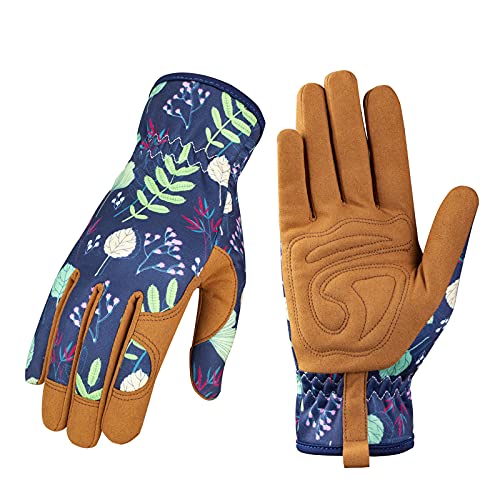
The Bamllum is the synthetic outlier, included because many gardeners want leather feel without leather care. The listing describes microfiber leather that ensures abrasion resistance with a good palm grip, a close-fitting design for long-term comfort, an elastic breathable back and an elastic wrist. It is marketed to women for weeding, digging, planting, raking and pruning.
Microfiber leather is a man-made material that resembles suede. It does not stiffen when it gets wet, does not need conditioning, and can be washed. For anyone whose hands swell a little in hot weather, a stretchy back and close-fitting design are comfortable alternatives to a rigid hide. The synthetic palm also looks less rugged, which some gardeners prefer.
Synthetic palms do not age like real leather, and they wear through sooner under heavy tools. Compared with the KKOYING, the Bamllum is lighter and easier to care for but less durable, and compared with the SLARMOR it is not a thorn glove. Wash it gently by hand and dry it flat to keep the shape.
Best for: Women who want a leather-style palm that washes easily and breathes in warm weather.
Check price on AmazonSpecs
- Palm: Microfiber leather
- Back: Elastic breathable fabric
- Uses: Weeding, digging, planting, raking, pruning
Pros
- +Microfiber palm washes easily
- +Elastic breathable back
- +Close fit for long wear
- +No conditioning needed
Cons
- −Not real leather
- −Wears faster under heavy tools
How We Evaluated These Leather Gardening Gloves
Each pick was assessed across 5 criteria weighted for real-world use.
Hide quality
We looked at stated leather type and thickness. The SLARMOR and DULFINE grain cowhide and the KKOYING with its stated 1.2 millimeters lead, the Wells Lamont cowhide follows, the WZQH split cowhide is next and the Bamllum microfiber is separate. We did not assume quality beyond what the listings say.
Construction details
We compared seam placement and thumb design. The DULFINE gunn cut and keystone thumb and the KKOYING off-palm seams lead, the Wells Lamont reinforced patch follows, and the others describe less. Seams determine lifespan.
Comfort and flexibility
We considered how each glove closes around a handle. The Bamllum elastic back and the DULFINE thumb lead, the KKOYING follows, and the WZQH and SLARMOR are stiffer because of lining and length. Flexibility reduces fatigue.
Protection
We credited cuff length and thorn claims only where listed. The SLARMOR leads with its long cuff and full grain palm, the WZQH names thorn resistance, and the others offer general abrasion resistance. No glove is treated as a certified thorn barrier.
Care effort
We compared maintenance. The Bamllum is the easiest to wash, the unlined leather pairs dry fastest, and the lined WZQH takes longest to dry. Care affects how well leather ages.
How to Choose the Right Leather Gardening Gloves
By Garden Task
Leather gloves differ in how well they handle different jobs.
| Task | Recommended pick | Why |
|---|---|---|
| Digging and raking all season | DULFINE Grain Cowhide Gloves | Keystone thumb and gunn cut seams |
| General yard work | KKOYING Full Cowhide Gloves | Documented thickness and off-palm seams |
| Thorny hedges and roses | SLARMOR Long Full Grain Gloves | Long cuff on a full grain palm |
| Cool-weather chores | WZQH Lined Split Cowhide Gloves | Cotton fiber lining |
| Household and yard mix | Wells Lamont Cowhide Gloves | Reinforced palm and familiar fit |
By Budget
Tiers are relative and no prices are quoted.
| Budget tier | Recommended pick | What you get |
|---|---|---|
| Entry | WZQH Split Cowhide Gloves | Lined split hide |
| Entry to mid | KKOYING Cowhide Gloves | Documented thickness and double stitching |
| Mid | DULFINE Grain Cowhide Gloves | Grain hide with a keystone thumb |
| Mid to upper | Wells Lamont Cowhide Gloves | Established brand with a reinforced palm |
| Upper | SLARMOR Long Full Grain Gloves | Full grain with a forearm cuff |
| Alternative | Bamllum Microfiber Gloves | Easy-care synthetic palm |
Grain leather costs more up front but typically lasts longer than split.
Real Leather vs Microfiber Leather
These two materials trade lifespan for convenience.
Real cowhide
The KKOYING, DULFINE, Wells Lamont, WZQH and SLARMOR are real hide. They are tougher, age well and can be repaired and conditioned. They need drying and care, and they stiffen when neglected.
Microfiber
The Bamllum is synthetic. It washes, dries quickly and does not need conditioner, and it breathes through its elastic back. It wears faster and offers less protection against thorns.
Choose real hide if you want a glove for years, and microfiber if you want easy care and a lighter feel.
By Season
Leather behaves differently in heat and cold.
| Season | Recommended pick | Reason |
|---|---|---|
| Summer | Bamllum Microfiber Gloves | Breathable stretch back |
| Spring and fall | KKOYING Full Cowhide Gloves | Medium thickness, unlined |
| Late autumn | WZQH Lined Split Cowhide Gloves | Lined for warmth |
| Year round on thorny plants | SLARMOR Long Full Grain Gloves | Long cuff and a tough palm |
For Long-Term Durability Specifically
A glove that lasts is one that handles stress points well.
Look for
Grain leather, double stitching, seams away from the palm and a one-piece thumb. Condition the glove each season and avoid heat when drying, since those habits matter as much as the hide.
In this comparison
The DULFINE and KKOYING have the most durable-looking construction in their listings. The SLARMOR has the best hide for thorny jobs, and the Wells Lamont is the safe pick for predictable sizing.
When to Spend More
Spend more where leather quality shows.
| Spend more if | Save if |
|---|---|
| You use tools daily and want the DULFINE construction | You garden occasionally and the WZQH is enough |
| You prune thorny plants and want the SLARMOR full grain | You mostly weed and a simpler glove suffices |
| You want predictable sizing from the Wells Lamont | You are comfortable with a lesser-known brand |
| You want a glove that ages well and will condition it | You prefer the Bamllum and want zero upkeep |
A glove that lasts five seasons is cheaper per year than a bargain pair that lasts one.
Frequently Asked Questions
What is the difference between grain and split leather?
Grain leather keeps the dense outer layer of the hide and is generally stronger and longer lasting. Split leather is the softer layer beneath, often rougher and thinner. The DULFINE and SLARMOR advertise grain, and the WZQH is split.
How do I break in leather gloves?
Wear them for light jobs first, flex your hand repeatedly and condition the leather. Never soak them to speed up the process, since drying can stiffen the hide. A week or two of regular use usually does the job.
How do I clean leather gardening gloves?
Brush off soil and wipe with a damp cloth, then let the gloves air dry away from heat. Apply a small amount of leather conditioner when they feel dry. Avoid machine washing leather unless the maker says it is safe.
What is a keystone thumb?
It is a one-piece thumb design that attaches to the palm at an angle, so the hand closes naturally around handles. The DULFINE uses one. It places seams away from the highest wear points.
Why do leather gloves stiffen after getting wet?
Water removes the oils that keep leather supple, and fast drying leaves the fibers rigid. Dry gloves slowly at room temperature and condition them afterwards. Keeping a spare pair avoids wearing gloves while they are damp.
Are leather gloves safe for thorns?
They are the best common choice, particularly with a long cuff like the SLARMOR. Even so, a hard push can penetrate leather, so cut away from your body. A thorn proof claim is a maker's description, not a rating.
How long should leather gloves last?
With regular conditioning and sensible drying, grain cowhide can last several seasons. Split and lined gloves may wear sooner. Replace a glove when the palm has worn through or the stitching is coming apart.
Bottom Line
best overall: KKOYING Full Cowhide Leather Work and Gardening Gloves - best overall pick in this roundup.
See the full rankings above for all picks with pros, cons, and best-for summaries.
Browse on Amazon
All Prime-eligible options with current pricing.
Shop on Amazon →