6 Best Gardening Gloves in 2026
Six pairs of gardening gloves compared across leather, microfiber and coated knit styles, so you can match protection and dexterity to the jobs you do.



At a Glance
Gardening gloves are a trade. Heavy leather protects against thorns and digging but costs you feel, while a thin coated knit lets you pinch a seedling but gives up protection. No single pair does everything, which is why experienced gardeners often keep two. The useful question is not which glove is best in the abstract, but which job you do most and what your hands need to survive it.
The six pairs here cover the main families. The WZQH is a split cowhide work glove with a cotton lining. The Bamllum is a microfiber leather glove with an elastic back. The HANDLANDY men's model is a synthetic leather glove with padded knuckles and touchscreen fingertips, and the HANDLANDY women's model has a genuine leather palm and an adjustable wrist strap. The WORKPRO and Wells Lamont are lightweight coated knit gloves, one with eco latex and one with nitrile, aimed at weeding and planting.
We evaluated each pair from its listing specs and typical buyer feedback, so materials and features are as the makers describe them. Sizing varies by brand, so check each chart. A glove should fit snugly without pinching, because a loose glove makes you clumsy and a tight one tires the hand.
6 Criteria to Look For Before Buying a Gardening Glove
Key buying criteria so you get the right fit the first time.
Palm material and protection
The palm decides what the glove can survive. Split cowhide, as on the WZQH, offers the most protection against thorns and abrasion. Genuine leather, as on the HANDLANDY women's glove, and microfiber leather, as on the Bamllum, sit in the middle. Coated knits, such as the WORKPRO latex and Wells Lamont nitrile, protect against dirt and light abrasion rather than thorns. Choose the palm for the worst job you do, and keep a lighter pair for everything else.
Dexterity and thickness
Thickness trades protection for feel. The Wells Lamont's 13 gauge knit is the thinnest glove here, and the WZQH's cowhide is the thickest. If you handle seeds, tie stems or use a phone, favor a thin glove. If you dig, haul and clear brush, favor a thick glove. A glove that costs you finger control makes you take it off, which means it protects nothing.
Fit and closure
A glove should fit snugly but not squeeze. The HANDLANDY women's glove has an adjustable wrist strap, the Bamllum and Wells Lamont use elastic or knit cuffs, and the others rely on sizing. A cuff that is too loose lets soil in, and one that is too tight can restrict movement. Check the maker's sizing chart, because sizes vary by brand, and try gloves with your usual inner layer.
Breathability and heat
Hot hands tire quickly and sweat makes gloves slip. The HANDLANDY pair and the Bamllum use stretchable breathable backs, and the WORKPRO and Wells Lamont use knit shells that let air through. The all-leather WZQH is the warmest. In summer, favor a ventilated back or a knit shell, and in cool weather, the extra warmth of leather is a bonus.
Wet-weather performance
Leather soaks through and stiffens if it dries badly, while coated gloves shed water and keep their grip. The nitrile on the Wells Lamont and the latex on the WORKPRO are better in wet soil and damp stems. If you often garden after rain, consider a coated pair as your main glove and keep leather for dry, rough jobs. If you do wet a leather pair, shape it by hand and let it dry slowly at room temperature so it does not shrink or crack.
Pack size and replacement
Coated gloves wear out sooner, so buying a multi-pack makes sense. The WORKPRO offers six pairs and the Wells Lamont offers five. Leather gloves last longer but cost more per pair. Think about how many pairs you lose or wear out in a year, and choose between one durable pair and several affordable ones.
6 Best Gardening Gloves in 2026
WZQH Leather Work Gloves
About this pick
The WZQH is a traditional leather work glove, made of 100% split cowhide with a soft cotton lining. The listing markets it for a broad range of jobs, from gardening and farm work to construction and welding, and highlights thorn resistance and wear resistance for weed pulling, digging, mixing fertilizer and landscape work. It is the thickest, most protective glove in this lineup.
Leather has a particular strength in the yard: thorns and sharp edges struggle to get through it. If your garden includes brambles, rose canes, prickly shrubs or rough stone, this is the kind of glove that keeps scratches off your hands. The cotton lining takes the edge off the leather's stiffness and absorbs a little sweat. Split cowhide is also tough against abrasion, so it handles shovel handles, rakes and rough timber without wearing through quickly.
The tradeoff is feel. A thick leather glove makes it hard to pick up seeds or tie a plant, and it can feel warm in summer. Leather also stiffens if it gets soaked and dries without care. Compared with the Wells Lamont nitrile glove, the WZQH offers far more protection but far less finger control. Compared with the HANDLANDY women's glove, it is heavier and bulkier. Let wet gloves dry away from direct heat, and a little leather conditioner every season keeps them supple.
Best for: Digging, hauling and clearing thorny growth where protection matters more than finger feel.
Check price on AmazonSpecs
- Palm material: 100% split cowhide leather
- Lining: Soft cotton fibers
- Uses: Garden, farm, construction, welding
Pros
- +Split cowhide stands up to rough tools
- +Cotton lining softens the leather
- +Thorn and wear resistance for rough jobs
- +Also suits farm and construction chores
Cons
- −Thick leather limits fine finger control
- −Stiffens if dried near heat after soaking
Bamllum Leather Gardening Gloves
About this pick
The Bamllum glove sits in the middle of the protection spectrum. The palm is microfiber leather, which the listing says gives abrasion resistance and a good grip, and the back of the hand is an elastic, breathable fabric. A close-fitting structure and an elastic wrist help keep the glove in place and the soil out. The maker lists weeding, digging, planting, raking and pruning among its uses.
The design is a compromise that suits most weekend gardening. Microfiber leather is thinner and more flexible than split cowhide, so you can still pick up a seed packet or snip a stem, yet it offers better abrasion resistance than a plain fabric glove. The breathable back keeps the hand cooler than a full-leather glove, which matters for summer work. The elastic cuff avoids the gap at the wrist where soil usually gets in.
The limit is thorn protection. A thin microfiber palm will not stop a determined rose cane the way the WZQH's cowhide will, and the fabric back offers little defense against branches. Compared with the HANDLANDY women's glove, the Bamllum uses a synthetic leather rather than a genuine leather palm, and compared with the WORKPRO latex glove, it has a firmer palm. Wash according to the maker's instructions, and air dry out of sunlight.
Best for: General weeding, planting and raking where a breathable, flexible glove is needed.
Check price on AmazonSpecs
- Palm material: Microfiber leather
- Back: Elastic, breathable fabric
- Cuff: Elastic wrist
Pros
- +Microfiber palm resists abrasion
- +Elastic back keeps hands cooler
- +Close fit helps with dexterity
- +Elastic wrist keeps soil out
Cons
- −Thin palm will not stop thorns
- −Fabric back gives little protection
HANDLANDY Leather Gardening Gloves for Women
About this pick
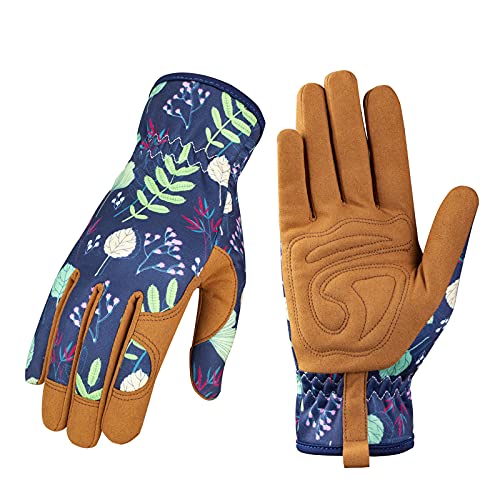
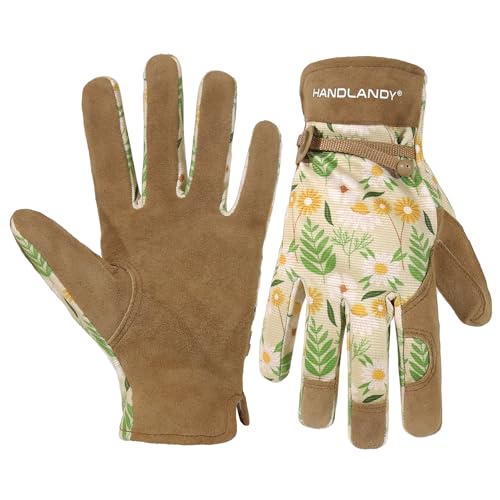
The HANDLANDY women's glove pairs a genuine leather palm with a stretchable spandex back, closed by an adjustable wrist strap. The listing describes the palm as tough, hard wearing and anti-slip, suitable for gardening, trimming and general yard work, and the spandex back as keeping the hand cool. The floral pattern is part of the styling, and the wrist strap lets you tighten the fit at the cuff.
The combination solves a common problem: full leather is hot, but fabric alone wears out quickly. By putting leather only where the hand does the grabbing, the glove gives good protection on the palm and fingers while letting the back of the hand breathe. The strap closes the cuff around the wrist so soil and mulch do not fall inside, and an adjustable cuff helps if you have a narrower wrist than the glove expects.
Because only the palm is leather, protection on the back of the hand is limited. Thorns can catch the spandex, and the glove is not a replacement for a gauntlet when you prune roses. Compared with the Bamllum, the HANDLANDY uses genuine leather for the palm and a strap instead of an elastic cuff. Compared with the WZQH, it is lighter and cooler but less protective. Check the sizing chart, since the listing sells by size, and let the gloves air dry after use.
Best for: Everyday planting and trimming where a leather palm and a snug adjustable cuff are wanted.
Check price on AmazonSpecs
- Palm material: Genuine leather
- Back: Stretchable spandex
- Closure: Adjustable wrist strap
Pros
- +Genuine leather palm resists wear
- +Spandex back keeps hands cool
- +Adjustable strap tightens the cuff
- +Anti-slip palm grips tools well
Cons
- −Back of the hand is lightly protected
- −Not a substitute for a thorn gauntlet
HANDLANDY Touchscreen Utility Work Gloves
About this pick
The HANDLANDY utility glove is built more like a mechanic's glove than a classic garden glove, and that works well for yard maintenance. The palm is synthetic leather, the back is a stretchable, breathable spandex, and foam padding over the knuckles reduces impact to the top of the hand. The fingertips are touchscreen compatible, so you can check a phone or tablet without taking the gloves off.
Knuckle padding is the practical feature. When you pull weeds from between paving stones, reach into a tangle of branches or brush a wall, the back of the hand is the part that gets hit. Foam cushions those hits. A snug, flexible fit gives better finger control than a bulky work glove, and the touchscreen tips are a small but real convenience when you are looking up a plant name or taking a photo.
The synthetic palm is not as tough as cowhide, so heavy digging will wear it faster, and the glove is not thorn proof. Compared with the WZQH, it is lighter, more flexible and cooler. Compared with the Wells Lamont, it has more padding but less grip in wet soil. It suits yard tidying, light construction chores and general maintenance. Wash with mild soap, and air dry away from heat to protect the synthetic palm.
Best for: Yard maintenance and light chores where knuckle padding and a phone-friendly fingertip help.
Check price on AmazonSpecs
- Palm material: Synthetic leather
- Knuckles: Foam padding
- Fingertips: Touchscreen compatible
Pros
- +Foam knuckle padding absorbs impact
- +Touchscreen fingertips work with phones
- +Flexible fit keeps finger control
- +Breathable spandex back
Cons
- −Synthetic palm wears faster than cowhide
- −Not designed to stop thorns
WORKPRO 6 Pairs Eco Latex Garden Gloves
About this pick
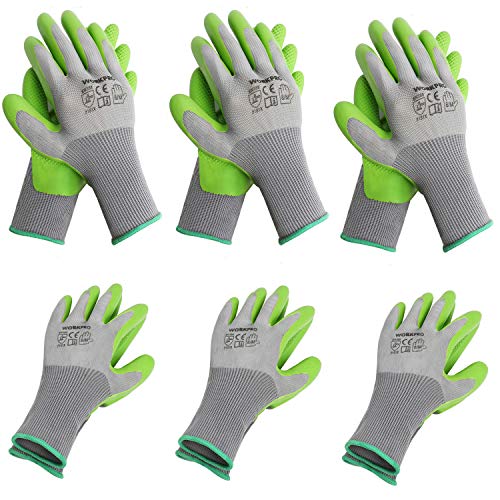
The WORKPRO pack gives you six pairs of lightweight coated gloves, which changes how you use gloves. The shell is breathable, stretchable polyester and the palms carry an eco latex coating that the maker says improves abrasion resistance and flexibility. The listing promises protection from skin injury and says the gloves keep hands and nails clean during yard work.
A pack of six is a different philosophy from a single leather pair. You can keep a pair in the shed, one in the car, one by the back door and one in the wash. Latex-coated gloves also give a secure grip on wet tools and slippery stems, and the knit shell keeps the hand cool in summer. The light weight preserves finger control, so planting seeds and pulling small weeds feels natural.
The tradeoff is durability and protection. A coated knit wears out faster than leather, and it will not stop thorns or sharp edges. Compared with the Wells Lamont nitrile pairs, the WORKPRO uses latex instead of nitrile, which some people prefer for feel and others avoid because of latex sensitivity. Compared with the Bamllum, it is lighter and cheaper to replace. Wash them in cool water, dry them away from the sun and replace a pair when the palm coating cracks.
Best for: Light weeding and planting where having spare pairs matters more than thorn protection.
Check price on AmazonSpecs
- Pack size: 6 pairs
- Palm: Eco latex coating
- Shell: Breathable stretchable polyester
Pros
- +Six pairs cover home, shed and car
- +Eco latex palm grips wet tools
- +Lightweight knit keeps finger control
- +Breathable polyester shell
Cons
- −Coated knit wears faster than leather
- −Latex may not suit everyone
Wells Lamont Nitrile Coated High Dexterity Work Gloves
About this pick
The Wells Lamont pack is a 13 gauge polyester knit glove with a nitrile-coated palm, sold in a five-pair pack. The listing describes the coating as resistant to abrasions, cuts and snags, the knit as lightweight and breathable, and the wrist as a snug stretch knit that keeps dirt and debris out. It is billed as a high-dexterity glove, and that is the right way to think of it.
A 13 gauge knit is a fine, thin fabric, so the glove feels close to bare-handed. That is what you want for tying plants, handling seedlings and feeling for roots. Nitrile is a durable coating that resists oils and abrasion and grips well in damp conditions, and the snug cuff keeps dirt from creeping up the wrist. Five pairs means you can wash one while using another.
Protection is the compromise. A thin nitrile coating may not stop thorns, and sources disagree on how much puncture resistance it provides, so do not rely on it for rose pruning. Compared with the WORKPRO, the Wells Lamont uses nitrile and a finer knit, which gives more dexterity. Compared with the WZQH, it trades toughness for feel. Store the gloves out of direct sun, since nitrile can crack with long UV exposure, and wash them when they get dirty.
Best for: Fine work such as potting, seeding and weeding where dexterity beats thorn protection.
Check price on AmazonSpecs
- Palm: Nitrile coating
- Shell: 13 gauge polyester knit
- Pack size: 5 pairs
Pros
- +Thin 13 gauge knit feels almost bare-handed
- +Nitrile coating grips well and resists abrasion
- +Snug knit cuff keeps dirt out
- +Five pairs let you rotate while washing
Cons
- −Does not reliably stop thorns
- −Nitrile can crack after long sun exposure
How We Evaluated These Gardening Gloves
Each pick was assessed across 5 criteria weighted for real-world use.
Protection level
We ranked the gloves by what their palms can survive. The WZQH split cowhide leads, followed by the HANDLANDY women's genuine leather, the Bamllum microfiber leather and the HANDLANDY synthetic glove, with the coated knit WORKPRO and Wells Lamont gloves at the light end. We did not claim thorn proofing for any glove whose listing did not state it.
Dexterity
We compared how much feel each glove keeps. The Wells Lamont's 13 gauge knit and the WORKPRO's lightweight shell lead, the Bamllum and HANDLANDY gloves follow, and the thick WZQH ranks last for fine work.
Comfort and ventilation
We looked at backs and shells. The spandex backs of the HANDLANDY pair and the elastic back of the Bamllum keep hands cooler, the knit gloves breathe well, and the WZQH is the warmest.
Fit features
We counted closure and cuff features. The HANDLANDY women's strap, the Bamllum elastic wrist and the Wells Lamont knit cuff all keep the glove in place. Gloves with a clear way to adjust fit scored higher.
Value and lifespan
We compared pack size against expected wear. Multi-packs such as the WORKPRO and Wells Lamont suit coated gloves that wear out quickly, while a single leather pair suits those who want one durable glove.
How to Choose the Right Gardening Gloves
By Garden Job
Start with the job that puts your hands at most risk.
| Job | Recommended pick | Why |
|---|---|---|
| Digging and hauling | WZQH Leather Work Gloves | Split cowhide stands up to rough tools |
| Thorny clearing | WZQH Leather Work Gloves | Listing highlights thorn and wear resistance |
| General weeding and planting | Bamllum Leather Gloves | Flexible microfiber palm with breathable back |
| Fine seeding and potting | Wells Lamont Nitrile Gloves | Thin 13 gauge knit keeps finger feel |
| Yard tidying with knuckle knocks | HANDLANDY Touchscreen Gloves | Foam padded knuckles |
By Budget
These tiers are relative, and no dollar figures are quoted because prices change often.
| Budget tier | Recommended pick | What you get |
|---|---|---|
| Entry | WORKPRO 6 Pairs | Six lightweight coated pairs |
| Entry to mid | Wells Lamont Nitrile 5-Pack | Five dexterous nitrile pairs |
| Mid | Bamllum Leather Gloves | Microfiber leather with an elastic back |
| Mid to upper | HANDLANDY Women's Leather Gloves | Genuine leather palm with a strap |
| Upper | WZQH Leather Work Gloves | Heavy split cowhide for rough work |
Leather costs more per pair but lasts longer. Coated gloves cost less but wear out sooner.
Leather vs Coated Knit
The two families offer opposite strengths.
Leather and leather-like
The WZQH, Bamllum and both HANDLANDY gloves use leather or synthetic leather. They offer abrasion resistance and, for the cowhide WZQH, real thorn protection. They are warmer and stiffer, and they do not like being soaked and dried badly.
Coated knit
The WORKPRO latex and Wells Lamont nitrile gloves are thin, breathable and grippy. They are the best choice for wet soil and fine work. They wear out faster and give little thorn protection. Many gardeners keep a pair of each.
In short: leather for rough, dry, thorny jobs and coated knit for fine, wet or warm-weather jobs.
By Climate and Season
Heat and wet change what you want on your hands.
| Condition | Recommended pick | Reason |
|---|---|---|
| Hot summer days | Wells Lamont Nitrile Gloves | Breathable thin knit |
| Hot but rough work | HANDLANDY Touchscreen Gloves | Breathable spandex back with padded knuckles |
| Cool spring clearing | WZQH Leather Work Gloves | Lined leather adds warmth |
| Wet soil after rain | WORKPRO Eco Latex Gloves | Latex palm grips wet tools |
For Thorns and Brambles Specifically
Thorn protection depends on material thickness more than on a label.
Look for
Thick leather on the palm and fingers, ideally with a longer cuff for the wrist. Be cautious about thin coated knits, since sources disagree about how well they resist thorns. Check that the listing actually states thorn resistance.
In this comparison
The WZQH is the only pick whose listing highlights thorn proof and wear resistance, thanks to its split cowhide. The HANDLANDY women's glove with a genuine leather palm is a lighter second option, but neither includes a long gauntlet cuff.
When to Spend More
Spend more when you will use the glove often or in hard conditions.
| Spend more if | Save if |
|---|---|
| You clear brambles and need the WZQH cowhide | Your garden has no thorny plants |
| You want a leather palm with an adjustable strap like the HANDLANDY | A simple elastic cuff on the Bamllum is enough |
| You work with seedlings daily and the Wells Lamont dexterity pays off | You garden occasionally and the WORKPRO six-pack covers it |
| You want knuckle padding on the HANDLANDY Touchscreen pair | You rarely knock your hands on walls or paving |
Two inexpensive pairs for different jobs usually beat one expensive pair for everything.
Frequently Asked Questions
What is the best material for gardening gloves?
It depends on the job. Leather, as on the WZQH, protects best against thorns and rough tools. Coated knits, as on the Wells Lamont and WORKPRO, give the best grip and feel for fine and wet work. Many gardeners keep one pair of each rather than relying on a single compromise.
Do thin coated gloves stop thorns?
Not reliably. Sources disagree on how well a thin nitrile or latex coating resists puncture, and most agree leather is safer for roses and brambles. Use the Wells Lamont or WORKPRO for weeding and planting, and switch to the WZQH for thorny work.
How should gardening gloves fit?
Snug without squeezing. A loose glove reduces dexterity and rubs, while a tight glove restricts movement and tires the hand. Sizing varies by brand, so check the maker's chart. A glove with an adjustable cuff, such as the HANDLANDY women's pair, helps fine-tune the fit at the wrist.
How do I clean leather gloves?
Brush off dry soil, wipe with a damp cloth and let the gloves dry at room temperature away from heat. A little leather conditioner each season keeps them supple. Avoid soaking leather repeatedly, since it stiffens as it dries. The WZQH and HANDLANDY leather palms both benefit from this care.
Are touchscreen gloves useful in the garden?
They are a convenience rather than a necessity. The HANDLANDY gloves let you check a phone or take a photo without removing them, which is handy for identifying plants. The main reason to choose them is the knuckle padding and flexible fit, not the screen feature.
Why buy a multi-pack of gloves?
Coated knit gloves wear out faster than leather, and a spare pair is useful when one is in the wash. The WORKPRO six-pack and Wells Lamont five-pack let you keep pairs in several places. If you prefer one durable pair, a leather glove like the WZQH lasts longer.
Can I wear these gloves for other chores?
Yes. The WZQH and HANDLANDY gloves are marketed for farm, construction and yard work as well as gardening, and coated knits suit light household and car tasks. Check each listing for its intended uses, and do not rely on a garden glove for hot, chemical or electrical work.
Bottom Line
best overall: WZQH Leather Work Gloves - best for heavy work pick in this roundup.
See the full rankings above for all picks with pros, cons, and best-for summaries.
Browse on Amazon
All Prime-eligible options with current pricing.
Shop on Amazon →