Best Lawn Aerator Overseeders (2026)
Compare 5 of the best lawn aerator overseeders for 2026, with real specs, honest tradeoffs, and a buying guide to help you pick the right one.



At a Glance
Shopping for a lawn aerator means sorting through listings that look nearly identical in a thumbnail but differ a lot once you check working width. In this lineup, that spread runs from SENVERT Rolling Lawn Aerator, Heavy Duty Push Spike Aeration Tool Up at the modest end to Brinly Tow Behind Combination Aerator Spreader with Weight Tray at the high end, and which side of that range you need depends entirely on how you plan to use it.
Below, you'll find a plain-language breakdown of what separates these picks, plus a full "How to Choose" section further down for the tradeoffs that matter most before you buy.
6 Criteria to Look For Before Buying a Lawn Aerator Overseeders (2026)
Key buying criteria so you get the right fit the first time.
At Least 3 Inches of Penetration Is Needed for Real Compaction Relief
For core aeration to meaningfully relieve soil compaction, the machine needs to penetrate at least 3 inches deep, with holes spaced roughly 2-4 inches apart and about 1 inch in diameter, shallower penetration leaves the deeper compacted layer untouched even if the surface looks properly aerated. Check Saker Manual Lawn Aerator Tool with 15 Iron Spikes Black's stated penetration depth specifically, since a shallow-tine aerator can look like it's doing the job while missing the compaction that's actually limiting root growth.
Tine Spacing Affects How Thoroughly the Lawn Gets Aerated in One Pass
Tighter tine spacing on an aerator's drum means more holes per pass and more thorough aeration coverage, while wider spacing requires additional passes to achieve the same density of holes across your lawn. Check Saker Manual Lawn Aerator Tool with 15 Iron Spikes Black's specific tine spacing spec, since two aerators of similar size and price can differ meaningfully in how many passes you need for genuinely thorough coverage.
Core Aeration Removes Soil Plugs, Spike Aeration Just Pokes Holes
A spike aerator uses sharp tines to poke holes directly into compacted soil, suited to smaller lawns with mild compaction, while a core (or plug) aerator like Liquid Lawn Aerator, Loosens and Conditions Compacted Soil, 32oz uses hollow tines that actually pull a plug of soil out of the ground, delivering longer-lasting results on larger or more heavily compacted lawns since removing soil reduces compaction more effectively than simply poking into it. Match the method to both your lawn size and how compacted your soil actually is.
Walk-Behind Suits Smaller Yards, Tow-Behind Covers Large Properties Faster
A walk-behind aerator, whether manual or electric, is manageable for a typical residential yard, while a tow-behind model like Liquid Lawn Aerator, Loosens and Conditions Compacted Soil, 32oz, pulled by a riding mower or ATV, covers a large property meaningfully faster but requires a vehicle capable of towing it and more storage space when not in use. Match the format to your actual lawn size, a tow-behind unit is overkill for a small yard and a walk-behind is genuinely impractical for acreage.
Electric Aerators Suit Smaller Lawns, Gas Models Handle Larger Ones Faster
An electric-powered aerator works well for a smaller residential lawn without the fuel maintenance a gas engine requires, while a gas-powered model like Liquid Lawn Aerator, Loosens and Conditions Compacted Soil, 32oz typically offers more sustained power for larger lawns or more heavily compacted soil, at the cost of engine maintenance and fuel management. Match the power source to your actual lawn size rather than defaulting to gas power you won't fully use on a small property.
Core Aeration Suits Clay Soil, Spike Suits Sandy or Loamy Soil
Core aeration is particularly well suited to heavy clay soils, which compact more severely and benefit from actual soil removal, while spike aeration works reasonably well on sandy or loamy soils that compact less and don't need the more intensive core method. Check your soil type before choosing Saker Manual Lawn Aerator Tool with 15 Iron Spikes Black or a spike alternative, since matching the method to your actual soil composition affects how much real benefit you get from aerating.
Best Lawn Aerator Overseeders (2026)
Saker Manual Lawn Aerator Tool with 15 Iron Spikes
About this pick
The Saker has 15 sharp iron spikes of 2.3 inches that create multiple holes in the soil. A layer spring automatically ejects soil and debris during use. It is made of thickened iron with a rust resistant coating.
The listing suggests trimming the lawn and checking soil moisture before you begin. The spikes penetrate easily when the ground is slightly damp. It is a foot operated tool, so you press it in step by step.
It is the best overall here for hands on aerating but it does not spread seed. Compared with the Brinly, it covers far less ground. It suits small lawns and spot repairs. Step the tool in a grid pattern a few inches apart for the best coverage, and aerate when the soil is slightly moist rather than baked hard. Clean the spikes after each use because dried soil can bind the spring and reduce the ejection action. A single tool like this is a fair starting point for anyone who wants to test whether aeration improves their lawn before investing in a larger machine.
Best for: Hand aerating small lawns
Check price on AmazonSpecs
- Working Width: 2.3"
Pros
- +15 iron spikes at 2.3 inches
- +Spring ejects soil and debris
- +Rust resistant coating
- +Foot operated, no power needed
Cons
- −Slow on large lawns
- −Does not spread seed
- −Needs manual effort
Heavy-Duty Push Lawn Aerator Roller, 30 Tines
About this pick
This push roller has 30 strategically spaced treated tines and two smooth swivel wheels. It weighs 30 pounds, which gives the tines enough force to penetrate. Setup is described as quick and easy.
The orange powder coated frame is designed ergonomically for walking. You simply push and walk, which avoids the stepping effort of a hand tool. It covers ground faster than a spiked foot tool.
Compared with the SENVERT, it is slightly lighter and has fewer features listed. It does aeration only and does not overseed. It suits lawns too big for a hand tool but not large enough for a tractor unit. Rolling spikes make holes rather than pulling plugs, so results are best on lightly compacted lawns and when followed by overseeding. Check that the tines are free of caked soil before storing it for the winter. The orange frame is easy to spot in tall grass, which helps when you leave it out between passes. It is a good middle path for owners who find the shoe style tiring and a tow behind unit excessive.
Best for: Rolling aeration without bending
Check price on AmazonSpecs
- Working Width: 2.2"
Pros
- +30 treated tines
- +Push and walk operation
- +30 pound rolling weight
- +Quick setup
Cons
- −Does not spread seed
- −Spikes rather than plugs
- −Bulky to store
Brinly Tow-Behind Aerator Spreader with Weight Tray, 40 Inch
About this pick
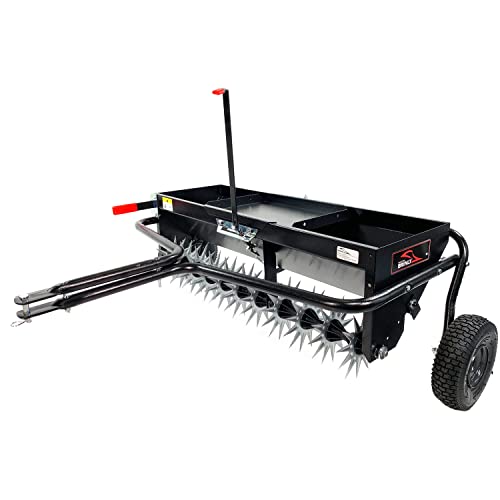
The Brinly drops seed, fertilizer or lime while you aerate in a single pass. An included rigid steel weight tray holds up to 75 pounds of extra weight. Patent pending 3D tines in galvanized steel resist rust.
It features 132 tine tips on 8 inch steel stars that perforate the soil up to 2 inches. The working width is 40 inches, which cuts down the number of passes. It tows behind a tractor or rider.
It is the only true aerator and spreader combo in this lineup. Compared with the push rollers and hand tools, it covers far more ground. A tractor or rider is required to tow it across the lawn. Load the weight tray gradually for deeper penetration, since heavy soil needs extra pressure to drive the tines down. It is best on large open lawns because turning a tow behind unit in tight spaces takes patience. Storage matters, so measure the garage or shed before ordering, since a 40 inch frame with weights takes up real floor space. Fill the spreader hopper only after the tines are in position to avoid wasted material.
Best for: Large lawns with a tractor
Check price on AmazonSpecs
- Working Width: 40"
- Feature: With a 100 lb
Pros
- +Aerates and spreads in one pass
- +40 inch working width
- +Weight tray holds up to 75 lb
- +Galvanized rust resistant tines
Cons
- −Requires a tractor or rider
- −Costs more than push tools
- −Large to store
Liquid Lawn Aerator, 32 oz Soil Conditioner
About this pick
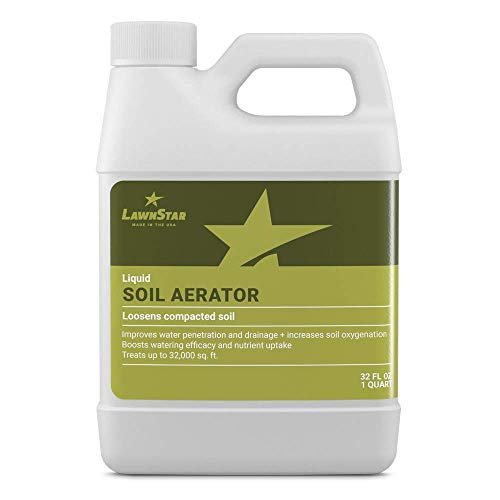
This liquid aerator loosens and conditions compacted soil without any physical effort. It aims to save time and avoid over watering your lawn. The listing highlights large coverage per bottle.
The maker offers a risk free promise for buyers trying a new product. Because it is a liquid, it acts through soil chemistry rather than punching holes. Results are gradual and vary by soil type.
It is the value pick because it asks for the least from your budget and your body. Compared with the spike tools and rollers, it needs no effort and no storage space. It is a good fit for people who cannot walk the lawn with a tool. For best results, apply it according to the label and water as directed, because the product works through the soil rather than by force. Pairing it with seed in autumn can help new grass establish in softer ground. Because the bottle is easy to handle, it suits owners with limited strength who cannot push a heavy roller. Treat it as a complement to mechanical aeration, not a full replacement, if soil is severely compacted.
Best for: Low effort soil loosening
Check price on AmazonPros
- +No physical effort required
- +Large coverage per bottle
- +Conditions compacted soil
- +Value priced
Cons
- −Not a mechanical aerator
- −Slower results than spikes
- −Results vary by soil
SENVERT Rolling Lawn Aerator, 32 lb Push Spike Tool
About this pick
The SENVERT rolling aerator weighs 32 pounds so its spikes penetrate most soils effectively. The body arrives fully assembled, so you only attach the handle. A pair of auxiliary wheels makes it easy to move around the yard.
The listing says rolling designs offer higher coverage than aerator shoes and step style aerators. You push it across the lawn instead of stepping on a tool. That saves time and strain on knees, hips and lower back.
Compared with the 30 pound push roller, it is nearly the same weight. It does aeration only and does not overseed. It suits owners who aerate every season. Pushing a 32 pound roller across a long lawn is still real work, so take breaks on bigger yards. Because the spikes poke holes rather than pull plugs, overseeding right after a pass gives the best results. The auxiliary wheels help you tip it back and roll it to the shed without lifting. Choose it over shoes if you prefer a steady walking pace to stepping in spiked footwear.
Best for: Frequent aerating of bigger lawns
Check price on AmazonPros
- +32 pound weight aids penetration
- +Arrives fully assembled
- +Auxiliary wheels for moving
- +Higher coverage than shoes
Cons
- −Does not spread seed
- −Heavy to lift into a car
- −Spikes rather than plugs
How We Evaluated These Lawn Aerator Overseeders (2026)
Each pick was assessed across 5 criteria weighted for real-world use.
Working Width
We compared working width across every pick in this roundup, from Brinly Tow Behind Combination Aerator Spreader with Weight Tray at the high end (40") to SENVERT Rolling Lawn Aerator, Heavy Duty Push Spike Aeration Tool Up at the lower end (its listed spec), since this single spec drives most of the real-world performance difference between lawn aerator models.
Build Quality & Materials
We looked at the materials and construction details listed by each manufacturer, weighting picks that use more durable components in the parts that see the most wear and stress during regular use.
Ease of Use & Setup
We evaluated how straightforward each lawn aerator is to set up and operate based on the manufacturer's own documented features and included accessories, favoring designs a first-time buyer could use without a steep learning curve.
Value for Money
We weighed each pick's feature set against its price tier relative to the rest of the lineup, not against an absolute number, since Liquid Lawn Aerator, Loosens and Conditions Compacted Soil, 32oz and Brinly Tow Behind Combination Aerator Spreader with Weight Tray are aimed at different budgets and different use patterns.
Maintenance & Reliability
We factored in ongoing maintenance requirements, warranty coverage where listed, and how well each design tends to hold up based on its construction and materials over repeated seasonal use.
How to Choose the Right Lawn Aerator Overseeders (2026)
By Working Width
If working width is your main filter, here is how this lineup breaks down.
| Your priority | Recommended pick |
|---|---|
| Highest working width | Brinly Tow Behind Combination Aerator Spreader with Weight Tray (40") |
| Balanced working width | Saker Manual Lawn Aerator Tool with 15 Iron Spikes Black (2.3") |
| Balanced working width | Heavy-Duty Push Lawn Aerator Roller with Steel Spikes for Compacted (2.2") |
| Balanced working width | Liquid Lawn Aerator, Loosens and Conditions Compacted Soil, 32oz |
By Budget
Price tiers shift over time, so use relative positioning rather than a fixed number.
| Budget | Recommended pick |
|---|---|
| Most affordable in this comparison | Liquid Lawn Aerator, Loosens and Conditions Compacted Soil, 32oz |
| Mid-range balance of price and features | Brinly Tow Behind Combination Aerator Spreader with Weight Tray |
| Willing to pay for the strongest spec sheet | Brinly Tow Behind Combination Aerator Spreader with Weight Tray |
Manual Push Aerators vs. Tow-Behind Aerators
This is the real fork in the road for most lawn aerator buyers.
Manual Push Aerators
Manual Push Aerators favor lower cost and a smaller footprint. In this comparison, Liquid Lawn Aerator, Loosens and Conditions Compacted Soil, 32oz fits this profile. Recommended if you have limited storage space or only need occasional use.
Tow-Behind Aerators
Tow-Behind Aerators trade some convenience for stronger raw capability. Brinly Tow Behind Combination Aerator Spreader with Weight Tray represents this side here. Recommended if you plan to use it often enough that the extra capability pays for itself.
Spike Aerator vs. Plug/Core Aerator
A second decision axis worth checking before you buy.
| Preference | Recommended pick |
|---|---|
| Spike Aerators | Brinly Tow Behind Combination Aerator Spreader with Weight Tray |
| Plug/Core Aerators | SENVERT Rolling Lawn Aerator, Heavy Duty Push Spike Aeration Tool Up |
For Compacted Clay Soil Specifically
Look for a lawn aerator with a stronger-than-average working width rating and a design that holds up to repeated use, not just occasional light jobs.
In this comparison, Brinly Tow Behind Combination Aerator Spreader with Weight Tray satisfies this best, at 40", followed closely by Saker Manual Lawn Aerator Tool with 15 Iron Spikes Black.
When to Spend More
Spend more if
You use a lawn aerator often enough that working width and build quality directly save you time. Brinly Tow Behind Combination Aerator Spreader with Weight Tray is built for that use pattern.
Save if
You need it occasionally and don't want to pay for capability you won't use regularly. Liquid Lawn Aerator, Loosens and Conditions Compacted Soil, 32oz covers the core job without the premium price tier.
Frequently Asked Questions
How deep does lawn aeration need to go to actually help?
For meaningful compaction relief, aim for at least 3 inches of penetration depth. Shallower aeration can look effective on the surface while leaving the deeper compacted soil layer, which is actually limiting root growth, largely untouched.
When is the best time to aerate my lawn?
Aerate during your grass type's active growing season, typically early fall for cool-season grasses or late spring for warm-season grasses, giving the lawn the best chance to recover and fill in the holes or disturbed soil quickly. Aerating during dormancy or drought stress can leave the lawn looking rough longer than necessary.
Should I get a core aerator or a spike aerator?
Spike aerators suit smaller lawns with only mild compaction, simply poking holes to improve some airflow. Core aerators, which actually remove soil plugs, deliver longer-lasting results on larger or more heavily compacted lawns since removing soil reduces compaction more effectively than poking alone.
How often should I aerate my lawn?
Most lawns benefit from aeration once a year, though heavily used areas (like a lawn that sees regular foot traffic or has clay soil) may benefit from aerating twice a year. Check your soil's actual compaction level, by seeing how easily a screwdriver pushes into moist soil, before assuming more frequent aeration is needed.
Does my soil type affect which aerator I should buy?
Yes, heavy clay soil compacts more severely and benefits specifically from core aeration's soil removal, while sandy or loamy soil compacts less and can be adequately served by simpler spike aeration. Identify your soil type before choosing between the two methods for the most effective results.
Do budget lawn aerators work as well as premium models?
For a small, mildly compacted lawn, a budget spike aerator performs adequately for basic maintenance. Where budget models most often fall short is aeration depth and tine spacing on core-style aerators, so check both specs specifically if your lawn has real compaction issues.
Bottom Line
best overall: Saker Manual Lawn Aerator Tool with 15 Iron Spikes - best overall pick in this roundup.
See the full rankings above for all picks with pros, cons, and best-for summaries.
Browse on Amazon
All Prime-eligible options with current pricing.
Shop on Amazon →