6 Best Computer Mice for Arthritis in 2026
Six easy-grip computer mice for stiff or tired hands, compared by vertical angle, trackball control, click effort and connection for lighter daily browsing.


At a Glance
JYKEYMOUT Rechargeable Bluetooth and 2.4G Vertical Mouse
↓ See why we picked itA standard mouse asks a lot of a hand. You pinch it with thumb and little finger, hold the palm flat, click with the index finger, and slide the whole arm across the desk. If your fingers and wrists feel stiff by afternoon, every one of those habits becomes a small chore. The right shape can remove most of them. A tall vertical body lets the hand rest on its side like a handshake, a trackball lets the arm stay parked, and a soft click needs less pressure than a hard snap.
This guide compares six mice chosen for ease of use and comfort, not for gaming speed. The Logitech Lift is the upright design with a 57 degree angle and a thumb rest. The Logitech Ergo M575S is a thumb trackball that never moves across the desk. UGREEN, TECKNET, Anker and JYKEYMOUT round out the field with vertical bodies at different sizes, connection styles and charging methods.
We evaluated each pick from product specifications and buyer feedback patterns, and we looked at grip effort, body size, button layout and how little setup the mouse demands. None of this is medical advice. If hand pain is persistent, an occupational therapist or your doctor can suggest what fits your situation, and the picks below simply give you comfortable, well-built options to try.
6 Criteria to Look For Before Buying a Computer Mice for Arthriti
Key buying criteria so you get the right fit the first time.
Grip effort and body shape
How hard you have to squeeze the mouse matters more than almost any other spec when hands tire easily. A flat, low mouse forces a pinch grip, while a tall upright body lets the whole hand rest against the side. The Logitech Lift stands at 57 degrees and adds a thumb rest, so the thumb supports itself instead of clamping. The Anker and UGREEN also use vertical bodies but lack that rest. Hold any candidate loosely for a minute and see whether your fingers stay relaxed.
Click softness and noise
A button that needs a firm press repeats that effort hundreds of times a day. Quiet or silent click switches usually feel softer because the mechanism cushions the end of the press. The UGREEN lists silent click buttons and the TECKNET lists quiet buttons, which makes both gentler on a tired finger than a standard budget mouse. Try the click yourself when you can, and prefer a light, shallow press. Noise matters too if you share a room.
Moving versus staying still
A regular mouse asks the wrist and arm to travel, while a trackball asks only the thumb to move. If your shoulder or wrist aches from sliding, the Logitech Ergo M575S removes most of that travel and needs only a patch of desk. If your thumb is the tender spot, choose a vertical model like the Lift instead. Decide which joint you want to rest, because swapping one strain for another defeats the purpose.
Size against your palm
A mouse that is too large forces the fingers to stretch, and one that is too small makes them curl. The Lift is made for small to medium hands, while the UGREEN body is larger. Measure from the wrist crease to the tip of the middle finger, and compare it with the listing's guidance. Small hands generally do better with compact bodies. Large hands often prefer the roomier vertical shells, and a good fit is worth more than any feature.
Connection and setup effort
Pairing a mouse should take seconds, not a manual. A 2.4G receiver like the Anker's plugs in and works, while Bluetooth models such as the TECKNET, UGREEN and JYKEYMOUT avoid taking a port but ask you to pair once. Multi-device buttons let one mouse serve several computers. If fiddling with menus is tiring, choose the simplest path, and remember a laptop with only USB-C ports will need a Bluetooth model or an adapter.
Power and upkeep
Batteries are a recurring chore. The Logitech Ergo M575S uses an AA battery, which swaps in seconds but must be bought, while the JYKEYMOUT recharges and needs a cable and a habit of topping up. Pick whichever chore you find easier. Also consider cleaning, since a trackball ball and its sockets collect dust and should be wiped periodically, whereas a vertical mouse needs only a quick wipe of its shell and sensor.
6 Best Computer Mice for Arthritis in 2026
Logitech Lift Vertical Ergonomic Wireless Mouse
About this pick
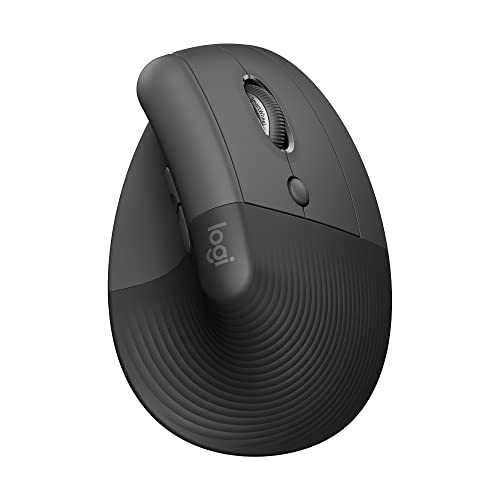
The Lift is the most carefully shaped upright mouse in this group. Its body stands at 57 degrees, so the forearm turns toward a handshake position instead of lying flat with the palm down. The surface has a soft texture that grips lightly, and a thumb rest sits where the thumb naturally lands, which means you do not have to hold the mouse up with a pinch. You can connect through Bluetooth or the included Logi Bolt USB-A receiver.
The maker aims the Lift at small to medium hands, and that matters for comfort. A body that is too tall for a small palm makes the fingers curl and tire, while this one lets the hand settle without stretching. The downside is the learning curve, since an upright mouse takes a few days to feel normal, and it is built for the right hand, so left-handed users should look elsewhere. Expect some practice before clicks feel automatic.
In daily ownership the Lift needs very little attention. There are no cables to untangle, setup is a few seconds, and the shape stays comfortable across long sessions of reading or email. Next to the Logitech Ergo M575S it keeps the familiar motion of sliding across a desk, whereas the trackball stays put. Next to the UGREEN it feels more polished and more compact, which is why it takes the top spot here for most buyers.
Best for: Small to medium right hands that want a relaxed handshake posture with a familiar sliding motion.
Check price on AmazonSpecs
- Angle: 57 degrees
- Connection: Bluetooth or Logi Bolt
- Hand size: Small to medium
Pros
- +Upright 57 degree angle eases forearm twist
- +Thumb rest takes the load off a pinch grip
- +Works over Bluetooth or a USB-A receiver
- +Soft textured surface feels gentle to hold
Cons
- −Right-hand design only
- −Takes a few days to feel natural
- −Too small for very large palms
Logitech Ergo M575S Wireless Trackball Mouse
About this pick
The M575S removes the biggest source of motion in mouse use, which is dragging the whole hand and arm across the desk. You rest your palm on the sculpted shell and roll a ball with your thumb, so the cursor moves while the wrist stays still. The maker says it was developed with ergonomics experts, and the shape supports the hand so the fingers can relax. Three buttons can be customized, and you can pair it over Bluetooth or the included Logi Bolt receiver.
The tradeoff is that thumb control is a different skill. Fine tasks like selecting a single letter feel clumsy for the first week, and some people find the thumb tires if they roll it constantly. It also suits tight desks very well, because the whole device sits in one spot, so it is a smart choice when elbow room is limited. It runs on an AA battery rather than an internal rechargeable cell, which is easy for some buyers and a chore for others.
As an ownership matter, the ball lifts out for cleaning, and dust around it should be wiped off every few weeks. Against the Lift, the Ergo M575S asks for less arm travel but more thumb work. If your shoulders or wrists ache from sliding a mouse, this is the better answer. If your thumb is the sore spot, the vertical designs are the safer bet.
Best for: Anyone whose wrist or arm tires from sliding a mouse around, or who has little desk space.
Check price on AmazonSpecs
- Control: Thumb trackball
- Connection: Bluetooth or Logi Bolt
- Power: AA battery
Pros
- +Hand stays still while the thumb steers
- +Needs only a small patch of desk
- +Three buttons can be customized
- +Connects by Bluetooth or USB receiver
Cons
- −Thumb control takes about a week to learn
- −Uses an AA battery instead of charging
- −Ball needs occasional cleaning
UGREEN Ergonomic Wireless Vertical Mouse
About this pick
UGREEN gives you the vertical handshake shape with quiet clicks, which is a combination that suits people who prefer a light touch. The buttons are described as silent, so each press makes less noise and feels softer than the sharp tick of a budget mouse. There are five buttons, including ones for moving back and forward through web pages, and four DPI steps of 1000, 1600, 2000 and 4000 let you slow the cursor down for careful aiming.
Connection is flexible. Bluetooth and a 2.4G receiver both work, and the mouse can remember up to three devices, so you can move between a laptop and a tablet without re-pairing. The caution is that it is a larger upright body than the Lift, so very small hands may stretch to reach the side button. The finish is also plain, with fewer touches such as a dedicated rest for the thumb.
Ownership is simple, since you charge or replace power as the listing describes and otherwise leave it alone. Compared with the TECKNET, the UGREEN has fewer DPI steps but a cleaner, more compact set of options. That restraint is helpful, because fewer settings mean fewer ways to accidentally change the cursor speed and get confused by it.
Best for: People who want a vertical mouse with soft, quiet clicks and easy device switching.
Check price on AmazonSpecs
- DPI: 1000/1600/2000/4000
- Buttons: Five, silent click
- Devices: Up to 3
Pros
- +Silent click buttons reduce press effort and noise
- +Five buttons include page back and forward
- +Remembers up to three devices
- +Four DPI steps slow the cursor when needed
Cons
- −Body may feel large for small hands
- −No dedicated thumb rest shape
- −Right-hand design only
TECKNET Ergonomic Vertical Wireless Bluetooth Mouse
About this pick
The TECKNET is the vertical option for people who move between several computers during the day. It pairs through Bluetooth and a 2.4GHz USB-A receiver, and one button hops among three devices. Six DPI levels reach as high as 4800, which is far more speed than ordinary browsing needs, but the lower steps are useful because a slower cursor lets you aim without tiny, precise hand motion.
The listing describes the buttons as quiet, so clicks are soft enough for a library or a sleeping household. The compromise is polish. The shell is functional rather than refined, and it lacks the thumb rest and gentle texture of the Lift. Buyers who press hard or hold the mouse tightly may notice the body less supportive over a long day, so test it with a light grip first.
Day to day it is easy to live with. You pair it once, and then a press of the switch button moves it to the next device. Next to the UGREEN it offers more speed steps, and next to the JYKEYMOUT it can reach a third device. If you juggle a desktop, a laptop and a tablet, that extra slot is the reason to pick it.
Best for: People who switch between a desktop, laptop and tablet and want vertical comfort on all of them.
Check price on AmazonSpecs
- Max DPI: 4800
- DPI levels: 6
- Devices: 3
Pros
- +Pairs with three devices by button press
- +Six DPI steps from slow to fast
- +Quiet buttons suit shared rooms
- +Bluetooth or USB-A receiver both supported
Cons
- −Shell is less refined than the Lift
- −Highest DPI is far more than most need
- −No dedicated thumb rest
Anker 2.4G Wireless Vertical Ergonomic Mouse
About this pick
The Anker is the easiest vertical mouse to understand. It uses a 2.4G USB receiver, so there is no Bluetooth pairing to fumble with, and you plug it in and begin. Three DPI choices of 800, 1200 and 1600 are sensible for everyday screens, and the next and previous buttons let you move through web pages without reaching for the keyboard, which cuts down on small hand movements.
Its limits are plain too. It has no Bluetooth, so it needs a free USB-A port, and a laptop that only has USB-C will need an adapter. It talks to just one computer at a time. The shape follows the right-hand vertical idea, but it does not offer the Lift's thumb rest or the multi-device flexibility of the TECKNET, so it is a basic tool rather than a flexible one.
That plainness is its value. A person who uses one desktop, never travels with the mouse and dislikes menus will find the Anker comfortable and uncomplicated. Against the JYKEYMOUT it gives up Bluetooth and a rechargeable battery, but gains a simpler start. Keep the receiver in the port, and the mouse is ready whenever you sit down.
Best for: Single-desktop users who want a vertical mouse that works the moment it is plugged in.
Check price on AmazonSpecs
- Connection: 2.4G USB receiver
- DPI: 800/1200/1600
- Hand: Right
Pros
- +Plug-in receiver needs no pairing
- +Three sensible DPI steps
- +Page back and forward buttons save keyboard trips
- +Vertical body eases forearm twist
Cons
- −No Bluetooth option
- −Needs a free USB-A port
- −Connects to only one computer
JYKEYMOUT Rechargeable Bluetooth and 2.4G Vertical Mouse
About this pick
The JYKEYMOUT combines a rechargeable battery with two connection modes, which removes the small job of changing batteries. One device can run on Bluetooth while another uses the 2.4G receiver, so the mouse serves a laptop and a desktop without re-pairing. DPI steps of 1000, 1200 and 1600 sit in the comfortable range for everyday screens, and the vertical shape follows the handshake posture for the right hand.
The budget shows in the details. The finish is simpler than the Logitech Lift, and there is no dedicated thumb rest or soft touch surface. Since it charges rather than using replaceable cells, you must remember to plug it in now and then, and a dead mouse in the middle of a task is the price of forgetting. Two devices is also one fewer than the TECKNET.
For ownership, charging is occasional and quick to do, and the dual mode makes it handy for someone with one laptop and one desktop. Compared with the Anker it adds Bluetooth and a rechargeable cell, and compared with the Lift it gives up refinement for lower cost. It suits shoppers who want upright comfort without paying for premium touches.
Best for: Budget-minded buyers who want upright comfort, a rechargeable battery and two-device flexibility.
Check price on AmazonSpecs
- Power: Rechargeable
- Modes: Bluetooth plus 2.4G
- DPI: 1000/1200/1600
Pros
- +Rechargeable battery avoids replacement cells
- +Bluetooth and 2.4G modes run side by side
- +Vertical shape suits the right hand
- +Three DPI steps cover everyday use
Cons
- −Needs remembering to charge
- −Plainer finish than premium vertical mice
- −Only two devices supported
How We Evaluated These Computer Mice for Arthritis
Each pick was assessed across 5 criteria weighted for real-world use.
Grip effort
We looked first at how much squeezing each shape demands. Upright bodies, a thumb rest and a trackball all reduce pinching in different ways. The Logitech Lift scored well because its angle and thumb rest work together, while flatter shells would lose points. We read listing details and buyer feedback patterns instead of claiming hands-on bench work, and we treated grip as the leading comfort factor.
Click and scroll softness
Button feel is a repeated action, so we weighed quiet and silent switches. The UGREEN and TECKNET list soft or quiet buttons, which counts in their favor. We also considered scroll wheels and extra buttons that save movement, like back and forward keys on the Anker. A mouse earned credit when it lowered the number of precise motions needed.
Fit and handedness
A comfortable mouse must match the hand. We checked which models state a small to medium fit, such as the Lift, and which are right-hand only. Every vertical pick here serves the right hand, which is a real limit for left-handed readers. The trackball is the more neutral choice in shape, so fit shaped the ranking as much as features did.
Setup and connection
Simple setup is part of ease of use. We compared plug-in receivers, Bluetooth pairing and multi-device switching. The Anker earns praise for a plug-and-play receiver, while the TECKNET leads on three-device switching. We marked down any model that would ask a nervous user to wrestle with settings or hidden dongles.
Lineup positioning
We placed the six picks against each other. The Lift leads on refinement and shape, the Ergo M575S leads on reducing arm travel, the UGREEN leads on quiet clicks, the TECKNET on device count and the JYKEYMOUT on rechargeable value. The Anker is the simplest. Each earns a distinct badge because it excels at something the others do not.
How to Choose the Right Computer Mice for Arthritis
By Where It Hurts
Match the mouse to the part of the hand or arm that feels tired, not to the longest feature list.
| Situation | Pick | Why |
|---|---|---|
| Wrist twists flat on the desk | Logitech Lift Vertical Ergonomic Wireless Mouse | The 57 degree angle turns the forearm toward a handshake. |
| Arm and shoulder tire from sliding | Logitech Ergo M575S Wireless Trackball Mouse | The hand stays still while the thumb moves the ball. |
| Fingers tire from pressing hard | UGREEN Ergonomic Wireless Vertical Mouse | Silent click buttons need a softer press. |
| Grip feels like a constant pinch | Logitech Lift Vertical Ergonomic Wireless Mouse | A thumb rest lets the thumb relax. |
| Neck and elbow feel crowded at the desk | Logitech Ergo M575S Wireless Trackball Mouse | It needs very little desk space to operate. |
By Budget
These tiers are relative, so compare picks within this lineup.
| Tier | Pick | What you get |
|---|---|---|
| Entry | JYKEYMOUT Rechargeable Bluetooth and 2.4G Vertical Mouse | Rechargeable upright comfort with two connection modes. |
| Entry | Anker 2.4G Wireless Vertical Ergonomic Mouse | A plug-in vertical mouse with page back and forward buttons. |
| Mid | UGREEN Ergonomic Wireless Vertical Mouse | Silent clicks plus up to three devices. |
| Mid | TECKNET Ergonomic Vertical Wireless Bluetooth Mouse | Six DPI levels and three-device switching. |
| Premium | Logitech Lift Vertical Ergonomic Wireless Mouse | The most polished upright shape with a thumb rest. |
| Premium | Logitech Ergo M575S Wireless Trackball Mouse | Trackball control with a sculpted, supported palm. |
Vertical Mouse vs Trackball
The two main comfort ideas rest different parts of the hand.
Vertical mouse
A vertical mouse keeps the sliding motion you already know but turns the forearm so the palm faces inward. It lowers wrist twist and is quick to adapt to. The Logitech Lift, UGREEN, TECKNET, Anker and JYKEYMOUT all use this approach. Pick a vertical mouse if the wrist is the problem and you want little relearning.
Trackball
A trackball such as the Logitech Ergo M575S keeps the hand parked and moves the cursor with the thumb. It removes arm travel and needs little desk space, but the thumb works harder and fine aiming takes practice. Pick the trackball if your arm or shoulder tires from sliding, and the vertical models if your thumb is sensitive.
In short, vertical for wrist twist, trackball for arm travel.
By Connection Preference
Choose the pairing style you will actually enjoy using.
| Preference | Pick | Reason |
|---|---|---|
| Plug in and forget | Anker 2.4G Wireless Vertical Ergonomic Mouse | A receiver in the port needs no pairing. |
| Switch among three computers | TECKNET Ergonomic Vertical Wireless Bluetooth Mouse | One button hops between three devices. |
| Laptop and desktop only | JYKEYMOUT Rechargeable Bluetooth and 2.4G Vertical Mouse | Bluetooth and 2.4G modes run side by side. |
| No USB port to spare | Logitech Lift Vertical Ergonomic Wireless Mouse | Bluetooth connects without a receiver. |
| Quiet shared home | UGREEN Ergonomic Wireless Vertical Mouse | Silent click buttons keep the room calm. |
For Long Reading and Email Sessions Specifically
Slow, steady computer use rewards low-effort comfort.
Look for
Choose a shape that supports the hand without a tight pinch, soft clicks, and a slow DPI step so tiny hand motions are enough. A thumb rest or a palm-supported trackball shell helps most, and extra buttons for page navigation save repeated reaching.
In this comparison
The Logitech Lift fits best for most people because the thumb rest and 57 degree angle support the hand through long sessions. Readers whose arm tires from sliding should try the Logitech Ergo M575S instead, and those who value soft clicks should consider the UGREEN.
When to Spend More
| Spend more if | Save if |
|---|---|
| You use the computer for hours daily, which makes the Logitech Lift's thumb rest and soft surface worth the step up. | You browse briefly, so the Anker 2.4G Wireless Vertical Ergonomic Mouse is plenty. |
| Your arm tires from sliding, which justifies the Logitech Ergo M575S trackball. | Your wrist is the only issue, so the JYKEYMOUT covers the vertical benefit for less. |
| You switch between three computers, making the TECKNET's extra slot useful. | You use one desktop, where a plain receiver mouse suffices. |
| You share a quiet room and want the UGREEN's silent buttons. | You work alone with the volume of clicks not a concern. |
Frequently Asked Questions
How do I choose between a vertical mouse and a trackball?
Think about which part of the arm gets tired. A vertical mouse such as the Logitech Lift turns the forearm into a handshake and keeps the familiar sliding motion. A trackball such as the Logitech Ergo M575S keeps the hand still and moves only the thumb. If sliding tires your arm, the trackball helps, and if thumb effort bothers you, go vertical.
Are expensive ergonomic mice worth it?
Often the extra cost buys shape refinement, such as a thumb rest, a soft surface and a better fit for small hands, as the Logitech Lift offers. Cheaper options like the Anker or JYKEYMOUT still deliver the vertical angle. If you use the computer for hours each day, the refinement is easier to justify, and occasional users can save.
How long does it take to get used to a vertical mouse?
Most people feel awkward for a few days and settle in within a week or two. The upright posture changes how you hold the mouse, and fine clicking feels odd at first. Start with short sessions and slow the DPI one step. If it still feels wrong after two weeks, a trackball or a lower-profile shape may suit you better.
Do these mice work for left-handed users?
Every vertical pick here is shaped for the right hand, so left-handed readers should be careful. The Logitech Ergo M575S is the more flexible comfort choice in this group, though you should check the maker's handedness notes in the listing. Left-handers who want a vertical shape should search specifically for left-hand models.
Is a trackball hard to clean?
Not really. The ball on the Logitech Ergo M575S can be lifted out, and a damp cloth wipes dust from the ball and the sockets. Do this every few weeks if you notice the cursor getting sticky. Vertical mice need only a wipe of the shell and a clear sensor window.
Should I choose a rechargeable or battery mouse?
Pick the chore you prefer. A rechargeable model like the JYKEYMOUT avoids buying cells, but you must plug it in occasionally. A battery model like the Logitech Ergo M575S swaps in seconds but needs spare AA cells. Either is fine as long as you keep a simple habit of checking the power.
Can a better mouse treat arthritis?
No, a mouse is a comfort tool, not a treatment. Some people find that a gentler shape and softer clicks make daily computer use easier, but persistent pain deserves a conversation with your doctor or an occupational therapist. They can recommend grips, posture changes and breaks that suit you, and the mice here give you comfortable options to try alongside that advice.
Bottom Line
best overall: Logitech Lift Vertical Ergonomic Wireless Mouse - best overall pick in this roundup.
See the full rankings above for all picks with pros, cons, and best-for summaries.
Browse on Amazon
All Prime-eligible options with current pricing.
Shop on Amazon →