6 Best Bread Makers Under $200 in 2026
Six bread makers at or under $200 with dual heaters, ceramic pans and big capacity, ranked for bakers ready to move past entry-level machines.




At a Glance
Once your budget stretches past the entry tier, bread machines start offering things that genuinely change the loaf: heaters on both sides of the pan, ceramic coatings, larger capacities and automatic dispensers for seeds and nuts. This guide is for the baker who has outgrown a basic starter and wants to know which upgrades are worth chasing.
Every machine here sits at or under the upper cap, so the question is no longer whether it works but how it fits your habits. Do you bake large family loaves, seeded multigrain, or the same white sandwich bread every Sunday? The answer shapes which pick suits you, and we evaluated each one from listing specs and buyer feedback rather than claiming bench trials.
We also keep an eye on diminishing returns. Beyond a certain point, extra programs and bigger pans add weight and counter footprint without improving ordinary bread, so we flag where paying more stops paying off. Read the picks as a ladder: the Amazon Basics and OSIPOTO sit near the simple end, the Cuisinart and KITCHENARM in the middle, and the KBS Pro and Neretva at the automated top.
6 Criteria to Look For Before Buying a Bread Makers Under $200
Key buying criteria so you get the right fit the first time.
Dual heaters and even browning
Single-element machines can leave the sides pale and the top dark, which is why dual heaters matter at this level. Look for heating elements that surround the pan so heat reaches every side. The Neretva uses 360 degree dual heaters and the KBS Pro lists dual heaters at 710W. If your last machine produced uneven crust, this is the first upgrade to prioritize. Pale sides are also a sign that the paddle left unmixed flour in the corners, so even heating and strong kneading usually go together.
Capacity you will actually use
A 3.3 lb pan sounds impressive, but only a big household fills it every week. For most buyers a 2 to 2.2 lb loaf is the right ceiling, and smaller loaves taste better when baked fresh. The Neretva holds 3.3 lb, the KBS Pro 2.2 lb and the Cuisinart up to 2 lb. Choose capacity by how fast your household eats bread.
Dispenser value
An automatic dispenser releases nuts, seeds and fruit after the final knead, so mix-ins stay whole rather than being pulverized. It is useful only if you bake such loaves often. The Neretva and KBS Pro include one. For plain loaves, skipping it, as on the Cuisinart, saves money and cleaning time. Keep seeds and chopped nuts in the sealed hopper only until the knead ends, since sticky fruit can clog the release flap if packed too tightly.
Motor power for variety
A strong motor lets you knead stiff dough, which includes whole wheat, rye and bagel recipes. At this cap the range runs from 550W on the Amazon Basics to 710W on the KBS Pro and 800W on the Neretva. If you only make white sandwich bread, any of them will do, but heavy-grain bakers should stay at 700W or higher.
Controls you can use with flour
Touch panels look sleek but can be unforgiving with damp or floury fingers. Tactile buttons confirm every press and are friendlier for older users. The Cuisinart is the only pick here with raised buttons that stand out as a feature, while the OSIPOTO and KBS Pro use touch controls.
Menu depth versus clarity
Menus range from 12 programs on the Cuisinart to 29 on the KITCHENARM, and neither extreme is automatically better. A shorter menu is faster to learn, while a longer one with a custom cycle offers recipe freedom. Count the entries you would actually use, usually basic, whole wheat, dough, gluten-free and jam, and pick accordingly. The Cuisinart and OSIPOTO sit comfortably below that number, which is why beginners often find them easier to master.
6 Best Bread Makers Under $200 in 2026
Cuisinart Stainless Steel Bread Maker
About this pick
Cuisinart wins here by doing the fundamentals cleanly. The compact stainless steel body houses 12 menu programs, three crust colors and three loaf sizes from 1 to 2 lb, so a household can scale loaves up and down. Beyond bread, the menu handles cakes, pizza dough and other treats.
The feature that sets it apart in this group is its raised, tactile buttons. Where several rivals have moved to touch panels, Cuisinart keeps controls you can feel and press with flour on your fingers. The stainless build feels sturdy on the counter and is easy to wipe down. What is missing is an automatic mix-in dispenser and any deep recipe catalogue, so seeds and fruit must be added by hand.
Compared with the KBS Pro's 17 programs, the 12 here is a tighter menu, which many buyers prefer because every entry is something they will actually use. It is also the quietest-feeling choice for bakers who want a straightforward appliance, though if you crave automation the Neretva at 3.3 lb offers far more.
Best for: Bakers who want tactile buttons and a clean, uncluttered menu.
Check price on AmazonSpecs
- Capacity: Up to 2 lb
- Programs: 12
- Crust colors: Light, medium, dark
- Controls: Physical buttons
Pros
- +Raised buttons give clear tactile feedback
- +Sturdy stainless steel body wipes clean
- +Twelve programs without menu clutter
- +Three sizes and three crust colors
Cons
- −No automatic mix-in dispenser fitted
- −Fewer programs than KBS or KITCHENARM
- −No ceramic pan mentioned in the listing
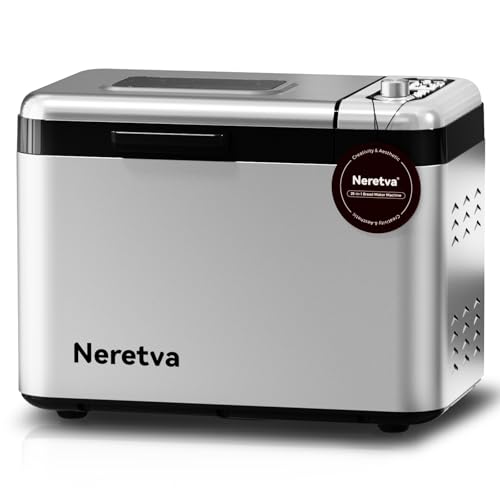
Neretva 3.3LB 15-in-1 Dual Heater Bread Maker
About this pick
Neretva aims at big households and weekend bakers who like to produce several loaves of sandwich bread at once. The headline number is a 3.3 lb capacity, backed by an 800W motor, dual heaters wrapping the pan and a nonstick ceramic pan with two kneading paddles.
The dual paddle setup works the dough more thoroughly than a single blade, and the surrounding heaters help with even browning on larger loaves. An automatic nut dispenser also handles mix-ins, which makes this the most automated option in this lineup. The compromise is size: the pan is the heaviest to lift and wash here, and the machine needs generous shelf space.
At 3.3 lb it holds noticeably more than the Cuisinart at up to 2 lb, and its 800W motor outpowers the KBS Pro at 710W. If you rarely bake above a 2 lb loaf, you are paying in weight and counter room for capacity you will not use. For families that go through a loaf a day, though, it is the sensible pick.
Best for: Large households and bakers who make seeded loaves regularly.
Check price on AmazonSpecs
- Capacity: 3.3 lb
- Programs: 15
- Power: 800W
- Heaters: Dual, 360 degree
Pros
- +3.3 lb capacity is the largest here
- +800W motor and dual heaters brown evenly
- +Two kneading paddles work dough thoroughly
- +Automatic nut dispenser included
Cons
- −Heaviest pan to lift and wash by hand
- −Takes up more counter and shelf space
- −Fewer programs than a 20-in-1 sibling
KBS Pro 710W 2.2LB Stainless Bread Maker
About this pick
If you want the automation of the Neretva in a smaller frame, the KBS Pro is the answer. It offers a 710W motor, a 2.2 lb ceramic pan and paddle, 17 programs and a stainless steel dispenser that releases mix-ins on cue. The maker also ships a recipe set of 53 options written for this machine.
Because the bake chamber is built around convection-style heating, loaves tend to come out with more even color, according to the listing. The tradeoff is a touch panel instead of buttons, a design some bakers dislike in a kitchen where hands are rarely dry. The 2.2 lb size is just above the common 2 lb standard, which gives a tiny bit of extra room without pushing you into the bulk of a 3.3 lb unit.
It costs more to step up to the KBS than to the Cuisinart, but you gain a ceramic pan and a dispenser. Against the KITCHENARM at 29 programs it has fewer presets, yet the dispenser saves a manual step that custom cycles cannot.
Best for: Bakers who want ceramic and dispenser features in a mid-size machine.
Check price on AmazonSpecs
- Motor: 710W
- Capacity: 2.2 lb
- Programs: 17-in-1
- Pan: Ceramic
Pros
- +Ceramic pan and paddle surface
- +Dispenser handles mix-ins automatically
- +710W motor with dual heating elements
- +Includes 53 recipes made for the machine
Cons
- −Touch panel replaces physical buttons
- −Slightly larger than standard 2 lb frame
- −Smaller capacity than the Neretva at 3.3 lb
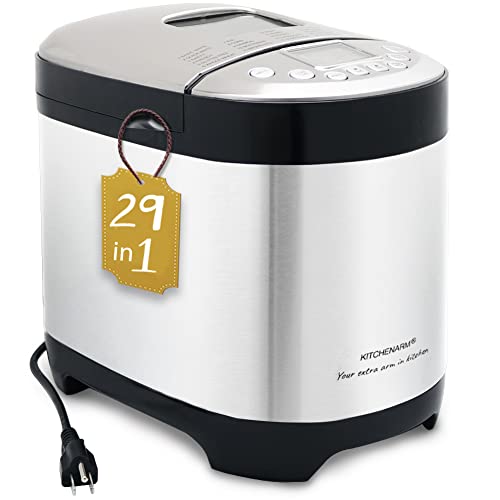
KITCHENARM 29-in-1 Smart Bread Machine
About this pick
KITCHENARM stands out for sheer flexibility. The 29-in-1 menu is the longest in this group, and a Homemade cycle lets you tweak knead and rise times for sourdough-style experiments or unusual flours. A dedicated gluten-free setting means those recipes do not need workarounds.
The one-press feature stores your last menu choice, loaf size and crust, which is useful when you rebake the same loaf every week. Where it falls short is in hardware prestige: the listing does not mention dual heaters, and the maker lacks a long track record compared with Cuisinart. Pan material and long-term durability are therefore less proven.
Stacked against the Cuisinart's 12 programs, you get more than double the menu, but you also need to learn where things are. Against the KBS Pro, you gain custom cycle control and lose the dispenser. It suits tinkerers who value recipe control above brand heritage and who are comfortable adjusting timings.
Best for: Experimental bakers who want to write their own cycles.
Check price on AmazonSpecs
- Programs: 29
- Gluten-free: Dedicated
- Custom: Homemade cycle
- Sizes: Three
Pros
- +Longest menu in the group at 29 programs
- +Custom Homemade cycle for recipe tinkering
- +Dedicated gluten-free setting available
- +Remembers menu, size and crust each time
Cons
- −No dual heaters listed on the product page
- −Less established brand than Cuisinart
- −Menu depth can feel overwhelming at first
OSIPOTO 17-in-1 Stainless Steel Bread Machine
About this pick
OSIPOTO is the clear-view choice. A big window lets you watch the dough rise and brown, so you can intervene if a loaf looks off without lifting the lid and losing heat. It runs 17 automatic programs and supports three loaf sizes and three crust shades, with a stainless steel body for steadiness during kneading.
It also ships with a measuring cup, spoon, spare kneading blade and a recipe book, which keeps early mistakes down. The touch panel is the main complaint, as flour-covered fingers can make it awkward. The pan uses a non-stick coating, not ceramic, so treat it gently.
At the same ceiling as the Cuisinart, it offers five more programs but gives up the raised buttons that many bakers prefer. Compared with the KBS Pro, it lacks the dispenser and the stronger motor, so it makes sense for someone who values visibility and a well-stocked kit over automation.
Best for: Visual bakers who like to monitor the rise and browning.
Check price on AmazonSpecs
- Capacity: 2 lb
- Programs: 17
- Window: Large
- Controls: Touch panel
Pros
- +Largest viewing window in this group
- +Stainless steel body stays stable
- +Seventeen programs, easy to scroll through
- +Spare blade and recipe book included
Cons
- −Touch panel instead of physical buttons
- −Non-stick pan rather than ceramic
- −No automatic dispenser for mix-ins
Amazon Basics 2 Lb Programmable Bread Maker
About this pick
Amazon Basics is the budget-minded choice in a group that skews premium. It delivers a 550W machine with a non-stick pan, an LCD, 14 settings including gluten-free, and an ExpressBake mode that finishes a loaf in under 90 minutes. Support comes through a retailer many shoppers already know.
For weeknight bread, the fast cycle is a practical advantage, though a quick loaf generally has a denser crumb than a slow rise. It lacks loaf-size selection, ceramic coating or dispensing features, and its motor is the weakest here. That matters most for dense doughs such as rye.
Compared with the Neretva at 800W, it is a modest machine, and next to the Cuisinart it has more settings but no tactile buttons advantage. Treat it as the value anchor: if your bread is simple and your priority is easy returns and replacement, it holds its own against more elaborate competitors.
Best for: Simple bakers who want quick loaves and easy retailer support.
Check price on AmazonSpecs
- Power: 550W
- Settings: 14
- Quick cycle: ExpressBake
- Capacity: 2 lb
Pros
- +ExpressBake delivers bread in under 90 minutes
- +Retailer support is simple to reach
- +Gluten-free setting clearly labeled
- +Plain controls need almost no learning
Cons
- −Weakest motor in the group at 550W
- −Only one loaf size is on offer
- −No ceramic pan and no dispenser
How We Evaluated These Bread Makers Under $200
Each pick was assessed across 5 criteria weighted for real-world use.
Heating and motor
We compared the stated wattage and heater layout from each listing. The Neretva at 800W and the KBS Pro at 710W led, while the Amazon Basics at 550W trailed. Dual heaters earned extra credit because they address uneven browning.
Capacity and footprint
We weighed loaf capacity against the space each machine takes. The Neretva's 3.3 lb pan is the largest, the KBS Pro offers 2.2 lb, and the rest cap at 2 lb. Larger pans scored well only when they came with matching motor power.
Pan and body materials
We looked at ceramic versus non-stick coatings and stainless versus plastic bodies. Ceramic pans on the Neretva and KBS Pro scored higher for durability, and the Cuisinart and OSIPOTO earned credit for stainless construction.
Controls and usability
We considered button type, display clarity and the learning curve. The Cuisinart's raised buttons led, the OSIPOTO's window helped, and the KITCHENARM's very long menu was a mixed result.
Upgrade value
Each pick was judged on what it adds over an entry-level machine. The Neretva and KBS Pro bring dispensers and dual heaters, the KITCHENARM brings custom cycles, and the Amazon Basics brings simplicity and easy support. This kept expensive features from dominating the ranking when most bakers would never use them.
How to Choose the Right Bread Makers Under $200
By Baking Style
The way you bake decides which upgrade matters.
| Baking style | Pick | Reason |
|---|---|---|
| Seeded or fruit loaves weekly | KBS Pro 710W | Dispenser releases mix-ins automatically |
| Large family batches | Neretva 3.3LB | 3.3 lb pan feeds a crowd |
| Plain sandwich bread | Cuisinart | 12 simple programs and tactile buttons |
| Recipe experiments | KITCHENARM 29-in-1 | Custom Homemade cycle and long menu |
Match the feature to your habit rather than the largest spec sheet.
By Budget
Within the upper cap, tiers reflect which hardware you gain.
| Tier | Pick | What you gain |
|---|---|---|
| Entry | Amazon Basics 2 Lb | Fast cycle and basic reliability |
| Lower mid | OSIPOTO 17-in-1 | Viewing window and stainless body |
| Upper mid | Cuisinart | Raised buttons and brand backing |
| Premium | Neretva 3.3LB | Big capacity, dual heaters and dispenser |
Tiers are relative placements within the cap and do not state exact amounts.
Dual Heaters vs Single Element
Heater layout shapes crust color more than program count.
Dual or surround heating
Heating elements around the pan let heat reach the sides and top evenly. The Neretva uses 360 degree dual heaters and the KBS Pro lists dual heating at 710W. Choose these for large loaves.
Single element
A single element is simpler and sufficient for small loaves, but may brown the top faster. The Cuisinart, OSIPOTO and Amazon Basics fall here. Pick one if you bake modest 1 to 2 lb loaves.
Larger loaves expose the difference most clearly.
Counter Space and Storage
Bigger machines need more room, so check your shelf.
| Storage situation | Pick | Reason |
|---|---|---|
| Permanent counter spot | Neretva 3.3LB | Large footprint is acceptable if always out |
| Cabinet storage | Cuisinart | Compact stainless body is easier to move |
| Mid-size shelf | KBS Pro 710W | 2.2 lb pan with moderate footprint |
| Light and portable | Amazon Basics 2 Lb | Basic build is simplest to lift |
Pan weight matters too, especially when washing it.
For Whole Grain Baking Specifically
Whole wheat and rye are heavy and demand more from the motor and heater.
Look for
A motor of 700W or more, dual heaters, and a program labeled whole wheat. A ceramic pan helps release dense loaves.
In this comparison
The Neretva at 800W and the KBS Pro at 710W are best suited. The Amazon Basics at 550W will struggle with rye.
Add vital wheat gluten if your whole grain loaves come out dense. Dense loaves also benefit from slightly warm liquids and a rest before baking.
When to Spend More
Some situations justify a higher tier.
| Spend more if | Save if |
|---|---|
| You bake for six or more and want the Neretva at 3.3 lb | You bake for two and a Cuisinart at 2 lb suffices |
| You use mix-ins weekly and want the KBS Pro dispenser | You bake plain white loaves on an Amazon Basics |
| You want ceramic durability for years of use | You rebake occasionally and accept OSIPOTO non-stick |
| You need an 800W motor for rye and heavy grain | You stick with light wheat and sandwich loaves |
Going higher mainly adds capacity and automation, not magic.
Frequently Asked Questions
Which of these is the best all-around bread maker?
The Cuisinart is the safest all-rounder because of its clean 12-program menu, raised buttons and stainless body. If you want automation, the KBS Pro adds a dispenser and ceramic pan. For large batches, the Neretva is better.
Is a 3.3 lb bread maker too big?
It depends on your household. Fresh bread goes stale in a couple of days, so a huge loaf only makes sense for families or for sharing. If you bake for two, a 2 lb machine such as the Cuisinart is easier to store and less wasteful. A second option is to bake a large loaf and freeze half, sliced, which keeps well for a few weeks.
Are dual heaters worth it?
For larger loaves, yes. Surround heating gives more even browning and reduces pale sides. For small loaves in a single-element machine, the difference is modest, so only pay for it if browning has been a past complaint. Another sign you may benefit is a loaf that rises unevenly or leans to one side, which usually points to heat imbalance.
How do I clean a ceramic bread pan?
Let it cool, then wash by hand with warm water and mild soap. Avoid abrasive pads and metal tools, which can chip the coating. Dry fully before the next bake, and remove the paddle first to prevent dough from baking onto the shaft. If dough sticks, soak the pan in warm water for ten minutes rather than scraping it.
Do I really need an automatic nut dispenser?
Only if you often make seeded or fruit loaves. The dispenser drops ingredients at the right moment so they stay whole. If you add mix-ins manually at the beep, a machine without one such as the Cuisinart works fine. Many bakers also find the hopper trickier to clean than the pan itself, which is a fair reason to skip it.
Can I use bread machine yeast and regular yeast interchangeably?
Yes in most cases. Bread machine yeast is finer and designed to work directly in the dry mix, while active dry yeast also works but may rise slightly slower. Keep yeast away from salt and liquids until kneading starts.
Will a stronger motor make better bread?
Only for stiff doughs. A 710W or 800W motor kneads whole grain and rye without straining, but a basic white loaf comes out much the same on 550W. Choose power by the dough you plan to make most often.
Bottom Line
best overall: Cuisinart Stainless Steel Bread Maker - best overall pick in this roundup.
See the full rankings above for all picks with pros, cons, and best-for summaries.
Browse on Amazon
All Prime-eligible options with current pricing.
Shop on Amazon →