6 Best Bread Makers Under $150 in 2026
Six bread machines at or under $150, compared on loaf size, programs, pan coating and controls, so a first-time baker can pick one without overspending.




At a Glance
A bread machine is one of the few kitchen gadgets that can honestly replace a weekly habit. You measure, press a button, and walk away while the machine kneads, rises and bakes. The catch is that cheaper models vary far more than the spec sheets suggest, especially in how forgiving the menu is and how well the pan releases the loaf.
This list stays inside the lower budget cap, and every machine here is a full-size automatic baker, not a toy. What changes between them is the pan material, the motor strength, how many programs you actually need, and whether the controls are buttons or a touch panel. We evaluated each pick on product specs and buyer feedback in the listings rather than claiming hands-on bake tests.
Because pricier siblings exist, we also point out what you give up by staying frugal. In most cases it is an automatic nut dispenser, a ceramic pan or a stronger motor, none of which a first loaf of sandwich bread truly needs.
6 Criteria to Look For Before Buying a Bread Makers Under $150
Key buying criteria so you get the right fit the first time.
Loaf size that matches you
A 2 lb capacity sounds generous, but most households finish a loaf in two days before it dries out. Look for a model with selectable sizes, because a 1 lb loaf suits one or two people. In this lineup the Elite Gourmet, KITCHENARM and KMFurnila all offer three sizes, while the Amazon Basics sticks to one. If you bake for four or more, the KBS Pro at 2.2 lb gives the most headroom.
Motor power for dense dough
Whole wheat, rye and seeded doughs are thick and can stall a weak motor, which leaves unmixed flour in the corners. Under the cap you will see motors from 550W upward, and anything at or above 600W is a safer choice for heavy recipes. The KMFurnila runs 600W at 5000 rpm and the KBS Pro reaches 710W, while the Amazon Basics sits at 550W. White bread is fine on any of them.
Pan coating and cleanup
The pan is the part you wash after every bake, and also the part that wears out first. Ceramic coatings tend to resist scratches and avoid the chemical-coating concerns some buyers have, while standard non-stick is lighter and cheaper to replace. The KBS Pro and KMFurnila use ceramic, and the OSIPOTO and Amazon Basics use non-stick. Never use metal utensils on either type.
Program count versus usefulness
Ten useful programs beat thirty buried ones. Count only the ones you will really use: basic, whole wheat, dough, gluten-free, jam and a quick cycle. The KITCHENARM lists 29 and the Elite Gourmet 19, but the Amazon Basics covers the essentials in 14. A custom cycle, like the KITCHENARM Homemade option, is more valuable than extra cake or yogurt entries.
Touch panel or real buttons
Flour dust and slightly wet fingers do not mix well with touch panels, which can misread or fail to register. Raised buttons give you tactile confirmation and are friendlier for older users or kids helping. Both the OSIPOTO and KBS Pro use touch panels, while the KMFurnila and Amazon Basics stick with physical controls. Test the response in a short video if the listing offers one.
Timer and speed options
A 12-hour delay timer, like the one on the KMFurnila, lets you load ingredients at night, but remember that yeast and dairy should not sit at room temperature for long. A quick-bake option can matter more than a delay timer in practice. The Amazon Basics ExpressBake finishes in under 90 minutes, which is far shorter than a standard cycle of several hours.
6 Best Bread Makers Under $150 in 2026
OSIPOTO 2LB 17-in-1 Bread Machine
About this pick
The OSIPOTO earns the top slot because it removes the small frustrations that make a first bread maker feel intimidating. It offers 17 automatic programs, three loaf sizes and three crust shades, and the box comes with a measuring cup, spoon, spare kneading blade and a recipe book written for this exact machine.
The stainless steel shell feels sturdier than the plastic bodies at the cheapest end of this group, and the large viewing window lets you check the rise without opening the lid. The tradeoff is a touch panel instead of raised buttons, which some users find fussy with floury fingers. The pan is non-stick rather than ceramic, so expect to wipe it gently and replace it eventually.
On the counter it is a mid-sized, boxy machine, so measure your shelf before ordering. Compared with the Elite Gourmet at 19 presets it has fewer menu entries, but its 17 programs are easier to scroll through. Next to the KMFurnila at 600W, the listing gives no motor wattage, so judge it on the starter kit and window instead.
Best for: First-time bakers who want a complete kit and a clear window on the dough.
Check price on AmazonSpecs
- Capacity: Up to 2 lb
- Programs: 17
- Crust shades: 3
- Included: Cup, spoon, blade, recipes
Pros
- +Starter kit saves buying extra tools
- +Seventeen programs without a cluttered menu
- +Large window shows the rise clearly
- +Stainless steel shell looks sturdy
Cons
- −Touch panel is harder with messy hands
- −Standard non-stick pan rather than ceramic
- −Listing gives no motor wattage figure
Elite Gourmet EBM8103M Bread Maker
About this pick
Elite Gourmet builds this machine for people who want lots of options without a heavy appliance. Nineteen one-touch programs cover white, wheat, rye, French, sweet, quick bread, pizza dough, cake and jam, and the loaf-size selector goes from a small 1 lb loaf up to 2 lb. A delay timer lets you load it at night for a morning loaf.
It is the lightest machine in this group, which matters if the bread maker lives in a cabinet and comes out twice a month. The cost is a plainer feel: the housing is lighter plastic, and the smallest loaf setting is a scaled version of the big recipe rather than a purpose-built cycle. The display is functional but small, so scrolling 19 presets takes patience.
Compared with the OSIPOTO's 17 programs, this one gives you two more, and compared with the KITCHENARM at 29 it keeps the menu shorter and less overwhelming. For a couple or a single baker who wants quick access to jam and dough cycles, it is a reasonable value, and its mint finish suits small kitchens that want a splash of color.
Best for: Small households that store the machine away between uses.
Check price on AmazonSpecs
- Loaf sizes: 1, 1.5, 2 lb
- Presets: 19
- Timer: Delay start
- Display: Digital LCD
Pros
- +Nineteen presets including dough and jam
- +Three loaf sizes suit one to four eaters
- +Lightweight body is easy to lift and store
- +Delay timer for overnight loading
Cons
- −Smallest loaf is a scaled recipe
- −Plastic housing feels less solid
- −Small display makes scrolling slow
KITCHENARM 29-in-1 Smart Bread Machine
About this pick
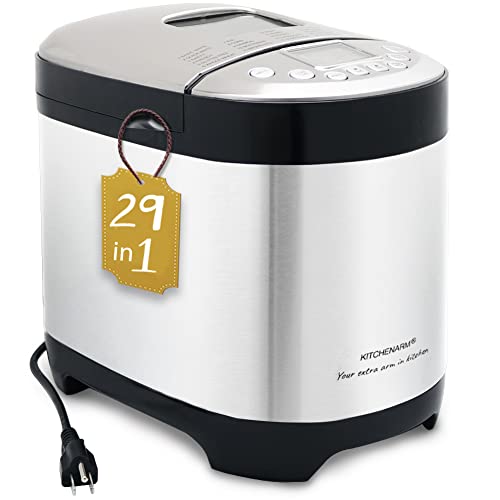
KITCHENARM goes after the baker who gets bored quickly. Twenty-nine built-in programs, a dedicated gluten-free setting and a Homemade cycle that lets you write your own knead, rise and bake timings put it well ahead of every other pick here on flexibility. A one-press feature also saves your menu choice, loaf size and crust color for next time.
That saved-settings trick is the quiet star, because most bakers repeat the same two or three loaves. The downside is that the maker has less of a track record than established kitchen brands, and the listing does not mention dual heaters or a ceramic pan. Support and long-term pan durability are therefore the main unknowns.
If you bake gluten-free regularly, this is the budget pick with the most direct support, since it has a named setting where the Elite Gourmet makes you hunt through presets. Against the Amazon Basics at 14 settings it offers roughly double the menu, though many users will never touch more than a handful of entries. Buy it for the custom cycle, not for the number on the box.
Best for: Experimenters and gluten-free bakers who want a custom cycle.
Check price on AmazonSpecs
- Programs: 29
- Gluten-free: Dedicated setting
- Custom cycle: Homemade
- Sizes: 1, 1.5, 2 lb
Pros
- +Twenty-nine programs cover most recipes
- +Dedicated gluten-free setting on the menu
- +Homemade cycle for custom timings
- +Saves menu, size and crust choices
Cons
- −Newer brand with a thin track record
- −No dual heaters mentioned on the listing
- −Huge menu can feel overwhelming
Amazon Basics 2 Lb Programmable Bread Maker
About this pick
This is the plain, dependable option. It runs at 550W, handles loaves up to 2 lb, and offers 14 settings for bread, dough, gluten-free recipes and jam. Its signature feature is ExpressBake, a shortened cycle that finishes a loaf in under 90 minutes, which is handy when you decide at 4 pm that dinner needs bread.
The straightforward LCD and button layout mean almost no learning curve, and the retailer's own support channel is easier to deal with than a marketplace brand you have never heard of. What you do not get is loaf-size flexibility, a ceramic pan or any kind of nut dispenser, so mix-ins must be added by hand when the machine beeps.
Next to the KMFurnila at 600W, this machine has slightly less motor power and fewer sizing options, but it wins on speed and brand familiarity. It makes the most sense for someone who will bake one reliable white or wheat loaf on repeat and who values a fast option for last-minute bread over a long menu.
Best for: Last-minute bakers who value a fast cycle and easy support.
Check price on AmazonSpecs
- Power: 550W
- Settings: 14
- Fast cycle: ExpressBake
- Capacity: Up to 2 lb
Pros
- +ExpressBake finishes under 90 minutes
- +Familiar retailer brand with simple support
- +Clearly labeled gluten-free setting
- +Basic controls need no learning curve
Cons
- −Only one loaf size to choose from
- −No ceramic pan or mix-in dispenser
- −Fourteen settings is the shortest menu here
KBS Pro 710W 2.2LB Bread Maker
About this pick
The KBS Pro is the machine that makes a spending-more argument inside a frugal cap. Its 710W motor sits above the 600W norm, the pan and paddle use a ceramic coating, and a stainless dispenser releases nuts, seeds or fruit at the right moment so you do not have to hover over the lid. Seventeen programs plus one custom slot and 53 recipes round it out.
Bakers who enjoy seeded multigrain or fruit-and-nut loaves will see the biggest difference, because the dispenser removes the one step most likely to go wrong. The compromise is a touch panel rather than buttons, and a capacity of 2.2 lb that slightly exceeds the standard 2 lb frame, which affects how much dough you can load without crowding.
Compared with the Amazon Basics at 550W it offers about 29 percent more motor power by the numbers, and compared with the KMFurnila at 600W it adds a dispenser. Counter space is slightly more demanding than the others, so check the footprint before buying.
Best for: Bakers who want mix-ins handled automatically without moving up a price class.
Check price on AmazonSpecs
- Motor: 710W
- Capacity: 2.2 lb
- Pan: Ceramic
- Dispenser: Automatic
Pros
- +Automatic dispenser for nuts and fruit
- +710W motor beats the usual 600W
- +Ceramic pan and paddle coating
- +Custom program on top of seventeen
Cons
- −Touch panel instead of real buttons
- −2.2 lb size needs more counter room
- −Most useful only for mix-in loaves
KMFurnila 2LB 600W Bread Maker
About this pick
KMFurnila pairs a ceramic non-stick pan with a 600W permanent magnet motor that spins at 5000 rpm, a combination rarely seen this far down the price ladder. The LED display and plain button controls are described as easier than most, and you still get three loaf sizes, three crust colors and a 12-hour delay timer.
The real appeal is that it behaves like a larger machine without the complexity. A strong motor kneads dense whole wheat dough without straining, and the ceramic coating makes cleanup quicker than a scratched non-stick pan. The listing does not highlight a long program menu or a dispenser, so it lacks the gimmicks of the KBS Pro.
If your priority is buttons you can press by feel, this beats the touch-panel OSIPOTO. Against the Elite Gourmet it offers a stronger motor in exchange for a shorter feature list, which is the right trade for anyone who bakes the same couple of loaves each week and wants durable kneading over a deep recipe catalogue.
Best for: Buyers who want real buttons and a strong motor over menu depth.
Check price on AmazonSpecs
- Motor: 600W
- Speed: 5000 rpm
- Sizes: 3
- Timer: 12 hours
Pros
- +Ceramic pan wipes clean easily
- +600W motor kneads heavy dough well
- +Button controls with an LED display
- +Three sizes and three crust colors
Cons
- −Short list of bonus programs overall
- −No automatic mix-in dispenser at all
- −Lesser-known brand for support
How We Evaluated These Bread Makers Under $150
Each pick was assessed across 5 criteria weighted for real-world use.
Loaf flexibility
We looked at the capacity range and the number of selectable sizes on each listing. Machines that offer 1, 1.5 and 2 lb options, such as the Elite Gourmet and KITCHENARM, scored better for small households. The Amazon Basics scored lower here because it offers one size only.
Motor and heating
Wattage was compared where stated: 550W on the Amazon Basics, 600W on the KMFurnila and 710W on the KBS Pro. We treated a motor above 600W as a meaningful step for dense dough, while acknowledging that white bread needs far less.
Pan and build quality
We reviewed the pan coating, the housing material and any signs in the listing about stainless steel or ceramic. The OSIPOTO's stainless shell and the KMFurnila's ceramic pan led here, and the cheaper plastic housing on the Elite Gourmet scored lower.
Ease of use
Controls, display clarity and menu length decided this score, based on product specs and buyer feedback. Physical buttons and a short, clear menu helped the KMFurnila and Amazon Basics, while the KITCHENARM's 29-entry menu was both a strength and a source of confusion.
Value inside the cap
Every pick was weighed on what it adds beyond the basics, such as the OSIPOTO's starter kit, the KBS Pro's dispenser or the KITCHENARM's custom cycle. Features that only matter to a small group of bakers earned smaller bonuses than ones that help everyone.
How to Choose the Right Bread Makers Under $150
By Household Size
Loaf size drives waste more than any other spec, so start with how many people will eat the bread.
| Situation | Pick | Why |
|---|---|---|
| One or two people | Elite Gourmet EBM8103M | A 1 lb setting keeps loaves fresh before they dry out |
| Family of four | KBS Pro 710W 2.2LB | 2.2 lb capacity gives the biggest loaf in the group |
| Mixed household, varying demand | KMFurnila 2LB 600W | Three sizes and three crust colors adapt to the week |
| Single repeat loaf | Amazon Basics 2 Lb | One size with a fast cycle suits a set routine |
A loaf that is eaten within two days needs no preservatives and tastes better than a larger one left for a week.
By Budget
Spend levels inside the cap map neatly to what you gain.
| Tier | Pick | What you get |
|---|---|---|
| Entry | Elite Gourmet EBM8103M | Wide menu and light body at the lowest outlay |
| Entry to mid | Amazon Basics 2 Lb | Fast cycle and dependable support |
| Mid | OSIPOTO 17-in-1 | Stainless shell and a full starter kit |
| Upper end of the cap | KBS Pro 710W | Ceramic pan and automatic dispenser |
Tiers describe relative position inside the cap, not exact prices, which shift often.
Ceramic Pan vs Standard Non-Stick
Both pan types release bread, but they age differently.
Ceramic coating
Ceramic is a mineral-based coating that resists scratching and does not use a PTFE layer. It suits buyers who want a chemical-free surface and plan to keep the pan for years. Found on the KBS Pro and KMFurnila.
Standard non-stick
Traditional non-stick is lighter and usually cheaper to replace, but it scratches faster if you use a metal tool. It fits casual bakers who treat the pan gently. Found on the OSIPOTO and Amazon Basics.
If you are unsure, choose ceramic and handle it with wooden or silicone tools.
Menu Depth
More programs do not always help, so match menu length to your habits.
| Baker type | Pick | Reason |
|---|---|---|
| Rarely tries new recipes | Amazon Basics 2 Lb | 14 settings cover bread, dough and jam |
| Likes variety | Elite Gourmet EBM8103M | 19 presets include cake and quick bread |
| Wants total control | KITCHENARM 29-in-1 | Custom Homemade cycle and 29 programs |
| Bakes seeded loaves | KBS Pro 710W | 17 programs plus a custom slot and dispenser |
A custom cycle matters more than a long preset list.
For Gluten-Free Baking Specifically
Gluten-free dough is wetter and needs a different knead and rise schedule.
Look for
A named gluten-free setting or a custom cycle, a pan that releases sticky dough, and a delay timer that does not overheat the batter.
In this comparison
The KITCHENARM offers a dedicated gluten-free setting plus a Homemade cycle, and the Amazon Basics also labels a gluten-free setting. The KMFurnila's ceramic pan helps with sticky batter.
Check your recipe's required cycle before buying.
When to Spend More
A higher cap changes a few specific capabilities.
| Spend more if | Save if |
|---|---|
| You bake seeded loaves weekly and want the KBS Pro dispenser | You bake plain white or wheat with an Elite Gourmet |
| You want a stronger motor than the Amazon Basics at 550W | You bake small loaves and rarely knead dense dough |
| You need a ceramic pan from the KMFurnila for the long term | You treat pans carefully and accept the OSIPOTO coating |
| You plan to bake daily for a family | You bake once a week for two |
Higher caps add dual heaters and bigger capacity, not better bread from basic recipes.
Frequently Asked Questions
Which bread maker under this cap is best for a beginner?
The OSIPOTO is the easiest starting point because it ships with a measuring cup, spoon, spare blade and recipe book. Its 17 programs are enough without overwhelming a new baker. If you prefer physical buttons, the KMFurnila is a close second.
Do I need a ceramic pan?
No, but it helps. Ceramic pans resist scratches and suit buyers who want to avoid PTFE coatings. The KBS Pro and KMFurnila use ceramic, while the OSIPOTO and Amazon Basics use standard non-stick, which works fine if you avoid metal utensils.
Are cheaper bread makers worth it compared with spending more?
For standard sandwich loaves, yes. Spending more mostly buys dual heaters, bigger capacity and automatic dispensers. If you rarely add nuts or fruit, the difference is small, and the savings can go toward quality flour and yeast.
How long do these machines last?
Lifespan depends on use and care. The pan and kneading paddle wear first, so wash them by hand and replace them when the coating flakes. Heavy whole wheat dough strains weak motors sooner, which is why a 600W or 710W motor is a safer buy.
Can I make gluten-free bread in all of these?
Several have a gluten-free setting, including the KITCHENARM and Amazon Basics. Others may handle it through a custom cycle or a preset, so check the manual. Gluten-free dough is stickier, so a ceramic pan and gentle cleaning are useful.
Is a bigger loaf size always better?
Not really. A big loaf dries out if only one or two people eat it. A selectable size, as on the Elite Gourmet, lets you bake exactly what you will finish in a couple of days.
What is the biggest mistake new bakers make?
Measuring flour by scoop instead of weight. Packed flour makes dense bread, and loose flour makes a collapsed loaf. Use the measuring tools in the box, or a kitchen scale, and add liquids first so the yeast stays dry until kneading begins.
Bottom Line
best overall: OSIPOTO 2LB 17-in-1 Bread Machine - best overall pick in this roundup.
See the full rankings above for all picks with pros, cons, and best-for summaries.
Browse on Amazon
All Prime-eligible options with current pricing.
Shop on Amazon →