5 Best Bariatric Transfer Boards in 2026
Five higher-capacity transfer boards compared on stated weight limits, length, width, material and handles, with advice to confirm fit with a therapist first.


At a Glance
FinityPro Transfer Board with PU Pad 32 x 10 in
↓ See why we picked itA bariatric transfer board is a board rated for heavier users than a standard model, so the stated weight capacity and the stiffness of the board matter more than any convenience feature. Many standard boards state 300 to 440 pounds, and a user near or above that range should look at a board properly rated for the load and not stretch a standard one. A board is only as safe as its rating, its length and the care taken on both surfaces.
This lineup covers five boards from Vive, Sammons Preston, Urby, DMI and FinityPro. Stated capacities run from 400 pounds on the Urby to 800 pounds on the Vive, and lengths run from 30 inches on the DMI to 36 inches on the Vive. We evaluated each from its product page and listing specifications, comparing capacity, length, width, material and handles. We left out two lower-rated or healthcare-setting slider sheets that are not wheelchair transfer boards.
Heavier users face a greater consequence from any slip, so please learn the technique with a physical or occupational therapist and have a trained helper present. Confirm the stated weight limit with room to spare, and check the board for cracks before every use.
6 Criteria to Look For Before Buying a Bariatric Transfer Board
Key buying criteria so you get the right fit the first time.
Stated weight capacity and margin
The stated capacity is the maximum load the maker rates the board for, and it is the number that defines whether a board is bariatric. Users near or above about 400 pounds should look at a board properly rated for the load and not stretch a standard one. The Vive states 800 pounds, the Sammons Preston 600, the DMI and FinityPro 440 and the Urby 400. Choose a limit comfortably above the user's weight, not just equal to it.
Length and gap coverage
Larger users and wider wheelchairs often need more overlap on each seat. Longer boards bridge more but are harder to carry and slide. The 36 inch Vive reaches furthest, the 35 inch Sammons Preston is close behind, the 32 inch FinityPro sits in the middle and the 30 inch DMI is the shortest. Measure the gap and add several inches of overlap on each end.
Width of the board
A wider board gives a bigger target for the user to sit on and can feel more stable. The FinityPro is 10 inches wide against 8 inches for the DMI and Sammons Preston. The trade-off is bulk, since a wider board needs more clear space between a wheel and a bed edge. The Vive and Urby listings do not state a width, so confirm it on the page.
Construction and thickness
Solid wood, rubberwood and plywood each behave differently under load. The Sammons Preston uses 5/8 inch birch plywood, the DMI uses 1 inch scotch pine, the Urby uses rubberwood and the FinityPro uses 0.7 inch plywood. Thicker boards feel stiffer but create a taller edge. Inspect any board for cracks, lifted layers or chipped coating before each use.
Handles and grip points
Handles let the user or a helper position and carry the board, and a poor handle design can trap fingers. The Vive, Urby and DMI have two cutout handholds, while the Sammons Preston has one vertical and one horizontal slot. The FinityPro adds grab handles and notches for wheels and chair legs. Check that your hands fit without pinching.
Rotating seat or plain board
A rotating seat like the FinityPro's lets a caregiver turn the user before sliding them across. It adds a mechanism and needs training, and the listing is intended for use with a caregiver. Plain boards like the Vive, Sammons Preston and DMI give more predictable control. Ask a physical or occupational therapist which suits the user before choosing.
5 Best Bariatric Transfer Boards in 2026
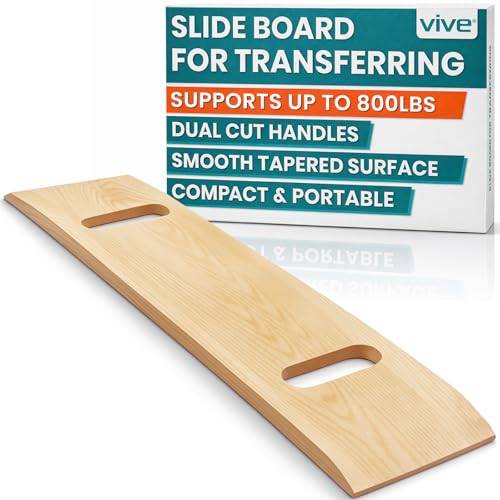
Vive Wood Transfer Board 36 in, 800 lb
About this pick
The Vive states the highest capacity in this lineup, 800 pounds, on a 36 inch board. The listing describes a strong wood body that is sealed to prevent cracks and chips, with a smooth surface that avoids snagging clothing. Two cutaway handholds are gently rounded, and the ends are tapered with rounded corners.
The 36 inch length gives the most reach in the group, which helps with wide gaps and with larger users who need more overlap on each seat. The capacity leaves the widest margin of any board here, so it suits users whose weight sits well above the 400 to 600 pound rating of the others. The listing does not state a width or thickness in the information we reviewed, so confirm those on the product page.
It is the longest board in the comparison, 1 inch longer than the 35 inch Sammons Preston and 4 inches longer than the 32 inch FinityPro, so it takes more room to carry and store. It has no strap, no pad and no turntable, so the seats must be firm and stable. The listing includes a 60 day guarantee. A therapist can confirm whether 36 inches suits your gap.
Best for: Heavier users who need the widest margin on stated capacity and a long reach.
Check price on AmazonSpecs
- Material: Sealed wood
- Length: 36 inches
- Weight capacity: 800 lb
- Handles: 2 cutout handholds
Pros
- +800 lb stated capacity, the highest here
- +36 inch length gives the most reach
- +Sealed wood with rounded corners and tapered ends
- +Two rounded cutout handholds
Cons
- −Width and thickness are not given in the listing
- −Longest board to carry and store
- −No grip layer, strap or turntable
Sammons Preston Bariatric Transfer Board 35 in
About this pick
The Sammons Preston is a bariatric board made from 5/8 inch birch plywood, 35 inches long and 8 inches wide, with a stated capacity of 600 pounds. The listing describes a sealed, coated surface meant for frequent use and names beds, wheelchairs, cars and toilets as places to use it. It includes two hand slots, one vertical and one horizontal.
The two slot orientations are a thoughtful detail, since the vertical slot suits carrying the board and the horizontal one gives leverage during a transfer. Plywood layers resist splitting along the grain, which is a reason this construction is common in rated boards. At 5/8 inches it is thinner than the 1 inch DMI, so the edge step is smaller.
The 600 pound rating sits between the 440 pound DMI and the 800 pound Vive, and it comes in a 35 inch length that is 1 inch shorter than the Vive. It has no turntable or strap, so it is simple to maintain. Inspect the coating for chips or lifted layers over time. A therapist can confirm whether the board length suits your wheelchair and bed.
Best for: Users needing a 600 lb rated board with a slim plywood body and a practical 35 inch length.
Check price on AmazonSpecs
- Material: Birch plywood, sealed and coated
- Size: 35 x 8 x 5/8 inches
- Weight capacity: 600 lb
- Handles: 1 vertical, 1 horizontal slot
Pros
- +600 lb stated capacity
- +35 inch length for wide gaps
- +5/8 inch birch plywood with a sealed coating
- +Two differently oriented hand slots
Cons
- −No strap, pad or turntable
- −Coating needs checking for chips and lifted layers
- −Narrower than the 10 inch FinityPro
Urby Rubberwood Plus Size Transfer Board XXL
About this pick
The Urby is made from real rubberwood and carries a stated capacity of 400 pounds, which is the lowest in this lineup. The listing describes it as wider and longer than average and thicker than a quarter coin, with two cutout handholds and rounded corners. It also mentions a 1 year warranty.
Its rating of 400 pounds sits below the 440 pound DMI and FinityPro, so heavier users should look at the Sammons Preston at 600 or the Vive at 800. The listing does not give exact length or width figures in the information we reviewed, so verify them on the product page before buying. Rubberwood is a dense hardwood with a smooth surface, and the rounded corners reduce the chance of catching clothing.
It is a plain board with no strap, pad or turntable, so it is easy to clean and to inspect. The warranty gives some reassurance on build quality, though the rating is the more important number. Compared with the 30 inch DMI it is described as larger, but compared with the 36 inch Vive it states a far lower limit. A therapist can help decide whether the rating suits your weight with enough margin.
Best for: Users near the middle of the bariatric range who want a hardwood board with a warranty.
Check price on AmazonSpecs
- Material: Rubberwood
- Weight capacity: 400 lb
- Handles: 2 cutout handholds
- Warranty: 1 year
Pros
- +Real rubberwood with a smooth surface
- +Plus size dimensions per the listing
- +Rounded corners and two handholds
- +1 year warranty coverage
Cons
- −400 lb stated capacity is the lowest here
- −Exact length and width are not in the listing
- −No strap, pad or turntable
DMI Wood Transfer Board 30 x 8 x 1 in
About this pick
The DMI is the shortest and most conventional board in this comparison, 30 inches long, 8 inches wide and 1 inch thick, with a stated capacity of 440 pounds. It is made of scotch pine with sanded, sealed surfaces and tapered ends. The listing says it is FSA eligible and names beds, chairs, sofas and commodes among its uses.
The 1 inch thickness gives a stiff body for a seated shift, which is the main reason it belongs on a heavier-user list. It is the right fit for a user whose weight sits comfortably below 440 pounds and who wants a simple, familiar board. A user closer to that limit should step up to the Sammons Preston at 600 pounds or the Vive at 800 pounds.
It is the least expensive board to run, with nothing to adjust, strap or rotate. It is 2 inches shorter than the 32 inch FinityPro and 6 inches shorter than the Vive, so the gap it can span is smaller. Inspect it for cracks and keep it dry. A therapist can confirm whether 440 pounds leaves enough margin for the user.
Best for: Users with a comfortable margin under 440 lb who want a simple, stiff wooden board.
Check price on AmazonSpecs
- Material: Scotch pine, sanded and sealed
- Size: 30 x 8 x 1 inches
- Weight capacity: 440 lb
- Handles: 2 cutout
Pros
- +440 lb stated capacity with a 1 inch body
- +Sanded, sealed pine with tapered ends
- +Two cutout handles
- +FSA eligible per the listing
Cons
- −Shortest board here at 30 inches
- −Limit is well below the 600 and 800 lb options
- −No strap, pad or turntable
FinityPro Transfer Board with PU Pad 32 x 10 in
About this pick
The FinityPro is the widest board here at 10 inches and the only one with a rotating seat. It measures 32 inches long and 0.7 inches thick and states a 440 pound capacity. The listing says the plywood was upgraded in May 2025 to be lighter yet durable, and that the board has notches to fit around wheelchair tires or chair legs, plus grab handles.
The sliding seat rotates 360 degrees and travels along a slot, so a caregiver can turn the user to the desired angle before sliding them across. That suits users who cannot pivot on their own, but it also adds a mechanism and should be learned with a therapist. The extra 2 inches of width over the 8 inch boards gives more seat surface, which many larger users find more secure.
The 440 pound rating matches the DMI, so it is not the pick for the heaviest users, who should look at the Sammons Preston or the Vive. It is 4 inches shorter than the Vive but 2 inches longer than the DMI. Check the seat and slot for smooth movement before each use. A helper should be present for every move.
Best for: Assisted transfers where a wide board and a rotating seat are wanted, within a 440 lb limit.
Check price on AmazonSpecs
- Material: Lighter plywood
- Size: 32 x 10 x 0.7 inches
- Weight capacity: 440 lb
- Seat: 360 degree rotating, PU pad
Pros
- +10 inch width gives a broader seat
- +Rotating seat with a sliding slot
- +Notches fit around wheels and chair legs
- +Lighter plywood at 0.7 inches thick
Cons
- −440 lb capacity is below the 600 and 800 lb boards
- −Seat and slot add a mechanism to inspect
- −Designed for use with a caregiver
How We Evaluated These Bariatric Transfer Boards
Each pick was assessed across 5 criteria weighted for real-world use.
Stated capacity
We compared the weight limit each listing gives, from 400 pounds on the Urby to 800 pounds on the Vive. The Vive and Sammons Preston lead the group, and the DMI and FinityPro share 440 pounds. Boards were ranked by the margin they leave for heavier users.
Length and width
We compared lengths from 30 inches on the DMI to 36 inches on the Vive, and widths of 8 inches on the DMI and Sammons Preston against 10 inches on the FinityPro. Listings that omitted a figure were noted. The Vive leads on reach and the FinityPro on width.
Material and thickness
We compared pine, rubberwood, birch plywood and plywood, and thicknesses from 5/8 inch on the Sammons Preston to 1 inch on the DMI. We looked at sealed finishes and rounded corners. Stiffness was weighed against edge height.
Handles and fit features
We compared cutout handholds, hand slots and the FinityPro's notches for wheels and chair legs. Boards with two differently oriented slots, like the Sammons Preston, scored well for carrying and leverage.
Complexity and supervision
We separated plain boards from the FinityPro, which has a rotating seat and a sliding slot. The Vive, Sammons Preston, Urby and DMI are the simplest to maintain, while the FinityPro needs the most training and a helper.
How to Choose the Right Bariatric Transfer Boards
By User Weight
Choose a stated capacity with room to spare, and confirm the figure on the product page.
| Situation | Pick | Why |
|---|---|---|
| Weight well below 400 lb | Urby Rubberwood Plus Size Transfer Board XXL | 400 lb rating with a hardwood body |
| Weight comfortably below 440 lb | DMI Wood Transfer Board 30 x 8 x 1 in | Stiff 1 inch board at 440 lb |
| Below 440 lb and a helper rotates the user | FinityPro Transfer Board with PU Pad 32 x 10 in | Rotating seat at 440 lb |
| Heavier users needing a larger margin | Sammons Preston Bariatric Transfer Board 35 in | 600 lb stated capacity |
| Heaviest users | Vive Wood Transfer Board 36 in, 800 lb | 800 lb stated capacity |
Do not use a board close to its stated limit.
By Budget
Relative tiers show where each board sits without pricing it.
| Tier | Pick | What you get |
|---|---|---|
| Entry | DMI Wood Transfer Board 30 x 8 x 1 in | Stiff pine board, 440 lb capacity |
| Entry | Urby Rubberwood Plus Size Transfer Board XXL | Rubberwood with a 1 year warranty |
| Mid | FinityPro Transfer Board with PU Pad 32 x 10 in | Wide board with a rotating seat |
| Premium | Sammons Preston Bariatric Transfer Board 35 in | 600 lb birch plywood board |
| Premium | Vive Wood Transfer Board 36 in, 800 lb | 800 lb capacity at 36 inches |
Spend on capacity first, because it is the safety margin.
Plain Board vs Rotating Seat
The seat changes who controls the turn.
Plain board
The user shifts sideways in small steps, with predictable control. The Vive Wood Transfer Board 36 in, 800 lb, Sammons Preston Bariatric Transfer Board 35 in, Urby Rubberwood Plus Size Transfer Board XXL and DMI Wood Transfer Board 30 x 8 x 1 in fall here. Choose a plain board for simple, steady movement.
Rotating seat
A caregiver turns the user on the seat before sliding across. The FinityPro Transfer Board with PU Pad 32 x 10 in falls here. Choose it only after a therapist confirms it suits the user and a helper is present.
Start with a plain board unless a therapist recommends a rotating seat.
By Gap and Wheelchair Width
Larger wheelchairs and wider gaps call for more board.
| Situation | Pick | Reason |
|---|---|---|
| Widest gap | Vive Wood Transfer Board 36 in, 800 lb | 36 inches reaches furthest |
| Wide gap with a thin edge | Sammons Preston Bariatric Transfer Board 35 in | 35 inches and 5/8 inch thickness |
| Wide frame needing a wider seat | FinityPro Transfer Board with PU Pad 32 x 10 in | 10 inch width and wheel notches |
| Standard gap | DMI Wood Transfer Board 30 x 8 x 1 in | 30 inches is enough |
Always leave several inches of overlap on each seat.
For Wheelchair to Bed Specifically
This is the most common bariatric transfer.
Look for
Lock the brakes, remove the footrests and nearest armrest if the chair allows, and level the bed with the seat. Look for a stated capacity well above the user's weight and a length that overlaps both surfaces. A trained helper should be present.
In this comparison
The Sammons Preston Bariatric Transfer Board 35 in gives 600 pounds on a slim body. The Vive Wood Transfer Board 36 in, 800 lb adds more margin. The DMI Wood Transfer Board 30 x 8 x 1 in suits users well under 440 pounds.
Ask a therapist to teach the sequence before first use.
When to Spend More
A higher rating is a margin, not a luxury.
| Spend more if | Save if |
|---|---|
| The user is close to 440 lb and needs the 600 lb Sammons Preston Bariatric Transfer Board 35 in | The user is well below 440 lb and the DMI Wood Transfer Board 30 x 8 x 1 in covers it |
| The user needs the 800 lb Vive Wood Transfer Board 36 in, 800 lb | A 600 lb rating already leaves a wide margin |
| A caregiver needs the rotating FinityPro Transfer Board with PU Pad 32 x 10 in | The user transfers with a plain board and a helper |
| You want a warranty, as with the Urby Rubberwood Plus Size Transfer Board XXL | The rating and fit matter more than the warranty |
Never trade rating margin for convenience.
Frequently Asked Questions
What makes a transfer board bariatric?
A bariatric board carries a stated capacity above what standard boards offer, typically well over 400 pounds. In this lineup the Vive states 800 pounds and the Sammons Preston 600. Boards rated 440 pounds, such as the DMI, are standard models. Always match the rating to the user's weight with margin.
Is a longer board always better for heavier users?
A longer board gives more overlap on each seat, which helps, but it is also harder to carry and slide. The 36 inch Vive reaches furthest, while the 30 inch DMI is easier to handle. Measure the gap and choose the shortest board that leaves several inches of overlap. A therapist can advise.
Can I use a standard board near its limit?
It is safer not to. The DMI states 440 pounds and the Urby 400, and a user close to either number leaves no margin. Choose a board such as the Sammons Preston at 600 pounds or the Vive at 800 pounds. Confirm the stated figure on the product page.
Why does the FinityPro need a helper?
The FinityPro has a rotating seat and a sliding slot, which let a caregiver turn the user before sliding. That adds a mechanism and speed. The listing frames it for use with a caregiver. A therapist can teach the technique.
How do I inspect a wooden board?
Check for cracks, splinters, lifted plywood layers and chipped coating before every use. Wipe it dry and keep it away from long exposure to moisture. Stop using any board that shows damage. The Sammons Preston coating and the DMI's sealed pine both need this check.
Do I need a transfer belt as well?
Many transfers use a gait or transfer belt to help a helper guide the user in small steps. A therapist can advise whether one suits your situation. A board alone does not provide that grip. Use any extra equipment only as instructed.
Can a bariatric board be used alone?
A user with good seated balance and strong upper limbs may transfer independently, but the risk of a fall is greater at higher weights. Learn the technique with a physical or occupational therapist and have a helper present until it is safe. Never assume a rating makes a transfer risk free.
Bottom Line
best overall: Vive Wood Transfer Board 36 in, 800 lb - highest stated capacity pick in this roundup.
See the full rankings above for all picks with pros, cons, and best-for summaries.
Browse on Amazon
All Prime-eligible options with current pricing.
Shop on Amazon →