6 Best Sliding Transfer Boards in 2026
Six sliding transfer boards compared on stated weight limits, length, material, handles and turntables, with notes on learning transfers safely.



At a Glance
A sliding transfer board is a smooth, rigid plank that bridges the gap between two seats, such as a wheelchair and a bed, so a person can shift across in small steps instead of standing. The board does not lift anyone and it does not make a transfer effortless. It removes the need to stand and pivot, and it only works well when the user has a controlled seated posture and the board is positioned correctly.
This lineup covers six boards from DMI, Weybaihe, Sienson, NEDVI, suboton and LOSCHEN. Stated weight limits run from 330 pounds on the Sienson to 500 pounds on the Weybaihe and NEDVI, and lengths run from 24 inches to 35.4 inches. We evaluated each from its product page and listing specifications, comparing material, thickness, handles, grip underneath and whether it adds a rotating seat. We left out duplicate listings of the same board and anything that is not a rigid board.
Transfers carry a real risk of falls and skin injury, so please treat this as a comparison of equipment and not as clinical advice. Ask a physical or occupational therapist to teach the technique, confirm the board length for your gap and check the stated weight limit against the user's weight with room to spare.
6 Criteria to Look For Before Buying a Sliding Transfer Board
Key buying criteria so you get the right fit the first time.
Stated weight capacity and margin
The stated capacity is the maximum load the maker rates the board for, so it is the first number to check. Choose a board whose limit sits comfortably above the user's weight and do not buy one that sits close to it. The Sienson states 330 pounds, the suboton 441 pounds, the DMI 440 pounds and the Weybaihe and NEDVI 500 pounds. If a listing shows conflicting figures, treat that as a reason to ask the seller before you buy.
Board length versus the gap
A board must overlap both seats by enough to stay put, so length depends on the distance between them. The 24 inch Weybaihe suits seats that sit close together, the 29.5 to 31 inch group suits standard wheelchair to bed gaps, and the 35.4 inch Sienson suits wide gaps. Measure the gap at the actual seat heights and add several inches of overlap on each side. A board that barely spans the gap tends to tip when weight shifts to the middle.
Wood versus plastic construction
Wood such as the DMI's scotch pine and the NEDVI's pine is stiff and has a warm, easy glide, but it needs checking for cracks and splinters over time. ABS plastic such as the suboton, Sienson and LOSCHEN wipes clean and has no grain, though a thin plastic board can feel more flexible. The 1 inch DMI is the stiffest option here, while the 0.5 inch suboton is the slimmest. Pick the material that matches your cleaning habits and how firm you want the board to feel.
Thickness and edge height
A thick board creates a lip that the user must slide up and over, which is harder from a low seat. The suboton at 0.5 inches and the Weybaihe at 0.75 inches have the lowest edges, the LOSCHEN is 0.9 inches, and the DMI and NEDVI are 1 inch. Tapered ends reduce the step at the edge. Check that thinner boards still feel firm across the gap.
Handles, grip and slip resistance
Handles let the user or a helper position the board without bending or dragging it. The DMI and Weybaihe have two cutout handles, the NEDVI adds two slots, and the suboton has three handles. The suboton also includes a 10 inch non-slip pad and the Sienson has a grid-textured underside. A board that slides out from under a person is the main hazard, so grip underneath matters as much as glide on top.
Turntable or plain board
A rotating seat, as on the Sienson, NEDVI and LOSCHEN, lets the user turn while seated and may reduce twisting. It also adds speed and moving parts, which raises the need for training and supervision. A plain board such as the DMI or Weybaihe is simpler and offers more predictable control. Learn the technique with a physical or occupational therapist before choosing a turntable model.
6 Best Sliding Transfer Boards in 2026
DMI Wood Transfer Board 30 x 8 x 1 in
About this pick
The DMI is the plain, proven format for a sliding transfer board. It is a 30 by 8 inch plank of scotch pine, a full 1 inch thick, with tapered ends and a sealed surface that the listing says is meant to prevent cracks, chips and snagged clothing. Two cutout handles let the user or a helper grip and reposition the board. The 30 inch length suits the common wheelchair to bed or wheelchair to chair gap, and the 440 pound stated capacity covers most adult users with a margin. A 1 inch thick board is stiff, which matters because a flexing board feels unstable under a seated shift. The trade-off is that the board sits taller than a slim plastic one, so the lip it creates at the edge of a low seat is more noticeable. In daily use it is a bare board with no turntable, no strap and no grip layer underneath, so it relies on the seat surfaces to hold it still. It stores flat behind a door or under a bed. At 30 inches it is longer than the 24 inch Weybaihe and shorter than the 35.4 inch Sienson, which makes it a sensible middle length. Wipe the surface clean and check for splinters or new cracks before each use.
Best for: Users with steady seated balance who want a stiff, straightforward wooden board for standard transfers.
Check price on AmazonSpecs
- Material: Scotch pine, sanded and sealed
- Size: 30 x 8 x 1 inches
- Weight capacity: 440 lb
- Handles: 2 cutout
Pros
- +440 lb stated capacity with a 1 inch thick body
- +30 inch length suits most standard gaps
- +Sanded, sealed finish with tapered ends
- +Two handles for placing and moving the board
Cons
- −No grip layer underneath to hold it in place
- −Thicker edge creates a noticeable lip on low seats
- −Wood needs inspecting for cracks over time
Weybaihe Hardwood Slide Transfer Board 24 in
About this pick
The Weybaihe is a shorter board that still states a 500 pound load capacity, the joint highest in this lineup. It measures 24 by 8 by 0.75 inches and is made of hardwood that the listing describes as polished and sealed so the user glides without scratching skin or clothing. Two cutout handles are shaped to suit different hand sizes. The short length is both its strength and its limit. A 24 inch board is easy to carry in a car footwell or a bag and works well when two seats sit close together, such as a wheelchair beside a commode. It is a poor match for a wide gap, because a short board leaves very little overlap on each seat, and overlap is what keeps the board from tipping. Ownership is simple, since there are no moving parts to loosen or clean around. Because it is 0.75 inches thick it is lighter and lower than the 1 inch DMI, though the listing gives no weight figure. Compared with the 31 inch NEDVI at the same 500 pound rating, it trades reach for portability. Measure your gap before buying and keep at least a few inches of the board resting on each seat.
Best for: Travel and tight spaces where seats sit close together and a high stated capacity is wanted.
Check price on AmazonSpecs
- Material: Hardwood, polished and sealed
- Size: 24 x 8 x 0.75 inches
- Weight capacity: 500 lb
- Handles: 2 cutout
Pros
- +500 lb stated capacity, the joint highest here
- +24 inch length packs into a car or bag
- +Non-latex hardwood with a sealed, polished surface
- +Two handles shaped for different hand sizes
Cons
- −Too short for wider wheelchair to bed gaps
- −No grip layer or strap to hold it still
- −Listing gives no weight figure for the board
Sienson Rotating Turntable Transfer Board 35.4 in
About this pick
The Sienson is the longest board here at 35.4 inches and the only one that pairs that length with a rotating seat. A 360 degree turntable with an EVA anti-slip pad sits on the board so the user can turn their hips while seated and then slide along. The underside has a textured grid meant to grip tile, wood and other surfaces, and the ends are tapered. That length helps bridge wide gaps, such as a wheelchair with large armrest hardware beside a high bed. The cost is the lowest stated capacity in this group, 330 pounds, which is well below the 440 and 500 pound wooden boards. It is made of ABS plastic, so it is easy to wipe clean and has no splinters. The turntable is the part that needs the most care. A rotating seat can spin faster than the user expects, so the first transfers should be practised with a therapist or trained helper, not alone. The turntable also makes the board thicker and bulkier than the slim 0.5 inch suboton, and it takes more room to store. Compared with the 29.5 inch LOSCHEN, it offers 5.9 inches more reach but a lower stated limit than the NEDVI at 500 pounds.
Best for: Wider gaps and users who benefit from a seated pivot, with a lower body weight than the wooden boards require.
Check price on AmazonSpecs
- Material: High-strength ABS plastic
- Length: 35.4 inches
- Weight capacity: 330 lb (150 kg)
- Seat: 360 degree rotating, EVA pad
Pros
- +35.4 inch length for wide gaps
- +Rotating seat with EVA anti-slip pad
- +Grid texture underneath for grip on hard floors
- +Wipe-clean ABS with tapered ends
Cons
- −330 lb stated capacity is the lowest here
- −Spinning seat needs practice and supervision
- −Bulkier to store than a plain board
NEDVI Wooden Slide Board with Pulley Turntable
About this pick
The NEDVI combines a solid pine board with a turntable that rides on a pulley track. It measures 31 by 11 by 1 inches and states a 500 pound capacity, so it pairs the highest rating in this lineup with a rotating seat. The listing also mentions two built-in handles and two fixed slots meant to help with stability. At 11 inches wide it gives more seating surface than the 8 inch boards, which can feel more secure for users who like a wider base. The wider body also means it needs a wider clear space, so check that it fits between a wheelchair wheel and a bed edge. The turntable is the same idea as the Sienson, but the wooden frame carries a higher stated limit, 500 pounds against 330 pounds. Ownership involves a few more parts than a plain board. The pulley track and turntable should be checked for smooth, even movement before each use, and wooden boards should be inspected for cracks and kept dry. It is heavier and bulkier than the Weybaihe at 24 inches, so it suits a fixed home setup more than travel. Have a therapist confirm that a rotating seat suits the user before relying on it.
Best for: Heavier users or those who want a wider seat and a turntable on a wooden frame.
Check price on AmazonSpecs
- Material: Pine wood
- Size: 31 x 11 x 1 inches
- Weight capacity: 500 lb
- Features: 360 degree turntable, pulley track
Pros
- +500 lb stated capacity with a turntable
- +11 inch width gives a broader seat
- +Solid pine with two handles and two slots
- +31 inch length covers many standard gaps
Cons
- −Wider body needs more clearance at the seat
- −More moving parts to inspect than a plain board
- −Heavier and bulkier than the short boards
suboton ABS Transfer Board with Grip Pad 29.5 in
About this pick
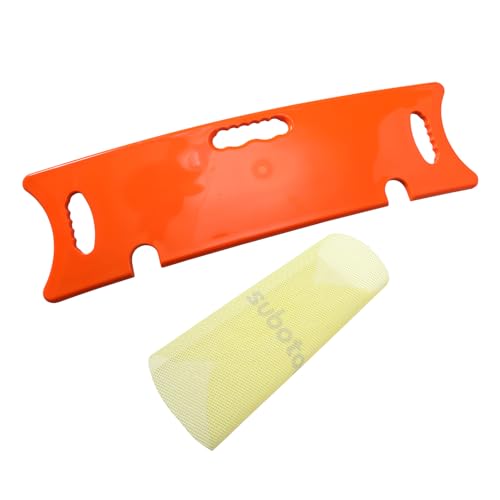
The suboton is a slim plastic board, only 0.5 inches thick, that measures 29.5 by 8 inches and states a 441 pound capacity. It has three built-in handles, tapered ends and side notches meant to reduce catching on edges and armrests. The package also includes a 10 inch round non-slip pad, which adds traction on smooth seat surfaces. The thin profile is its main advantage. A 0.5 inch edge sits lower than the 1 inch DMI or NEDVI, so the step up from a low seat is smaller and easier to slide over. Three handles give more places to grip when repositioning the board, which helps a caregiver and the user. The smooth ABS surface cleans with a wipe and has no grain to splinter. The trade-off is that plastic can feel more flexible than a thick wooden board, so the user should confirm that the board stays firm across the full gap. It is lighter and slimmer than the turntable boards, and it stores flat. At 29.5 inches it is almost the same length as the 29.5 inch LOSCHEN, but without the rotating disc. The listing says to always check placement, and a therapist can teach the safest way to position the grip pad.
Best for: Low seats and users who want a slim board with extra grip and plenty of handles.
Check price on AmazonSpecs
- Material: High-density ABS polymer
- Size: 29.5 x 8 x 0.5 inches
- Weight capacity: 441 lb
- Extras: 10 inch round non-slip pad
Pros
- +Only 0.5 inches thick for a low edge
- +441 lb stated capacity in a light plastic body
- +Three handles and side notches for armrests
- +Includes a 10 inch non-slip pad
Cons
- −Plastic may feel less stiff than thick wood
- −No turntable for seated pivoting
LOSCHEN Slide Transfer Board with Turntable 29.5 in
About this pick
The LOSCHEN is a turntable board at a more manageable length of 29.5 inches, with a width of 8.9 inches and a height of 0.9 inches. The core feature is an integrated 360 degree rotating disc with a textured surface, set on a board whose underside is also built for traction. The listing describes the plastic as burr-free so it does not scratch the user. The disc lets the user turn in one motion, such as from a wheelchair facing a car seat. The listing includes a note to adjust the tightness of the disc to control its sliding speed before use, and it says the product must be used with assistance. We read that as a sign this board belongs in a supervised routine and not in solo use. The listing does not state a weight capacity in the information we reviewed, so confirm the figure on the product page before buying. It is shorter than the 35.4 inch Sienson and a little thicker than the 0.5 inch suboton. It cleans easily and lacks wooden care needs, but the disc adds a mechanism to inspect. A therapist can show you how to set the disc tension and when to leave it locked.
Best for: Supervised transfers where a seated pivot helps and a mid-length plastic board is wanted.
Check price on AmazonSpecs
- Material: High-strength ABS plastic
- Size: 29.5 x 8.9 x 0.9 inches
- Seat: 360 degree rotating disc
- Grip: Textured disc, anti-slip underside
Pros
- +29.5 inch length is easier to store than the Sienson
- +Rotating disc with an adjustable sliding speed
- +Anti-slip surface on disc and underside
- +Burr-free ABS wipes clean easily
Cons
- −Listing states the board must be used with assistance
- −Weight capacity must be confirmed on the page
- −Disc tension needs checking before every use
How We Evaluated These Sliding Transfer Boards
Each pick was assessed across 5 criteria weighted for real-world use.
Stated capacity and honesty of the numbers
We compared the weight limit each listing gives and noted conflicts between title and bullet text. The Weybaihe and NEDVI lead at 500 pounds, the DMI and suboton sit at 440 and 441 pounds, and the Sienson trails at 330 pounds. A board with unclear figures was marked down.
Length and reach
We compared stated lengths from 24 inches on the Weybaihe to 35.4 inches on the Sienson. Boards were judged on how well each length matches a typical gap and how much overlap it leaves on each seat. The Sienson leads on reach and the Weybaihe leads on portability.
Material and edge profile
We compared wood and ABS construction and the thickness of each edge, from the 0.5 inch suboton to the 1 inch DMI and NEDVI. We looked at tapered ends, notches and sealing. The slimmest boards scored higher for low seats, and the stiffest scored higher for firmness.
Grip, handles and stability
We looked at handles, underside traction and any pad or strap the listing mentions. The suboton leads with three handles and a pad, the Sienson with a grid underside and the NEDVI with slots. Boards with no stated grip layer were noted as relying on the seat surface.
Complexity and supervision needs
We separated plain boards from turntable boards, because a rotating seat adds a mechanism and needs training. The DMI and Weybaihe are the simplest, while the Sienson, NEDVI and LOSCHEN are the most involved. The LOSCHEN listing explicitly calls for assistance.
How to Choose the Right Sliding Transfer Boards
By Gap Between the Seats
Measure the horizontal distance between the two seats at the heights you will use, and add several inches of overlap for each end.
| Situation | Pick | Why |
|---|---|---|
| Seats almost touching, such as a commode beside a chair | Weybaihe Hardwood Slide Transfer Board 24 in | 24 inches is enough and it carries easily |
| Standard wheelchair to bed gap | DMI Wood Transfer Board 30 x 8 x 1 in | 30 inches gives a safe overlap |
| Wide gap or large armrest hardware | Sienson Rotating Turntable Transfer Board 35.4 in | 35.4 inches reaches furthest |
| Gap with a wide wheelchair frame | NEDVI Wooden Slide Board with Pulley Turntable | 31 by 11 inch body spans and supports |
| Low seat that needs a small edge step | suboton ABS Transfer Board with Grip Pad 29.5 in | 0.5 inch thickness lowers the lip |
If you cannot get at least a few inches of overlap on each seat, a different board length or a different transfer method is safer.
By Budget
Relative tiers show where each board sits without pricing it.
| Tier | Pick | What you get |
|---|---|---|
| Entry | DMI Wood Transfer Board 30 x 8 x 1 in | Stiff plain wooden board with 440 lb capacity |
| Entry | Weybaihe Hardwood Slide Transfer Board 24 in | Compact board with 500 lb capacity |
| Mid | suboton ABS Transfer Board with Grip Pad 29.5 in | Slim plastic, three handles and a grip pad |
| Mid | LOSCHEN Slide Transfer Board with Turntable 29.5 in | Rotating disc in a mid-length board |
| Premium | NEDVI Wooden Slide Board with Pulley Turntable | 500 lb wooden turntable with a wider seat |
| Premium | Sienson Rotating Turntable Transfer Board 35.4 in | Longest board with rotating seat |
A plain board that suits the user's gap is often a better value than a turntable they do not need.
Plain Board vs Turntable Board
The turntable changes how the user moves across the board and how much supervision is needed.
Plain board
The user shifts sideways in small steps on a flat, smooth surface. Control is predictable and there is little to maintain. The DMI Wood Transfer Board 30 x 8 x 1 in, Weybaihe Hardwood Slide Transfer Board 24 in and suboton ABS Transfer Board with Grip Pad 29.5 in fall here. Choose a plain board if you want simple, steady movement.
Turntable board
A rotating seat lets the user turn while seated, then slide along. It adds a mechanism and can spin faster than expected. The Sienson Rotating Turntable Transfer Board 35.4 in, NEDVI Wooden Slide Board with Pulley Turntable and LOSCHEN Slide Transfer Board with Turntable 29.5 in fall here. Choose a turntable only after a therapist confirms it suits the user.
Start with a plain board unless a therapist recommends a turntable.
By Surface Underneath
Where the board rests affects whether it stays put.
| Surface | Pick | Reason |
|---|---|---|
| Smooth vinyl or leather seat | suboton ABS Transfer Board with Grip Pad 29.5 in | Includes a 10 inch non-slip pad |
| Hard floor next to the seat | Sienson Rotating Turntable Transfer Board 35.4 in | Grid-textured underside grips tile and wood |
| Fabric sofa or cushion | DMI Wood Transfer Board 30 x 8 x 1 in | Stiff 1 inch body spans a soft surface |
| Firm mattress edge | NEDVI Wooden Slide Board with Pulley Turntable | Two slots and 11 inch width add stability |
Soft seats compress under a board, so a stiff board is safer there.
For Wheelchair to Bed Specifically
This is the most common use for a sliding board.
Look for
Lock the wheelchair brakes, move the footrests and armrest out of the way if the chair allows, and match the board length to the gap. Look for a stated capacity well above the user's weight and tapered ends. Ask a therapist to teach the exact sequence.
In this comparison
The DMI Wood Transfer Board 30 x 8 x 1 in is the straightforward choice at 440 pounds. The NEDVI Wooden Slide Board with Pulley Turntable offers 500 pounds and a wider seat. The Weybaihe Hardwood Slide Transfer Board 24 in works only if the bed sits very close to the chair.
The bed height should be level with the chair seat or slightly lower.
When to Spend More
Extra features help some users and are wasted on others.
| Spend more if | Save if |
|---|---|
| The gap is wide and you need the 35.4 inch Sienson Rotating Turntable Transfer Board | The gap is standard and the 30 inch DMI Wood Transfer Board 30 x 8 x 1 in covers it |
| You want 500 lb capacity with a seat, as on the NEDVI Wooden Slide Board with Pulley Turntable | The Weybaihe Hardwood Slide Transfer Board 24 in already gives 500 lb without a mechanism |
| A therapist recommends a rotating disc like the LOSCHEN Slide Transfer Board with Turntable 29.5 in | Plain sliding is working, as on the suboton ABS Transfer Board with Grip Pad 29.5 in |
| You transfer often and want the extra grip of the suboton's three handles and pad | You transfer rarely and a simple board is enough |
Features only help if the user and helper are trained to use them.
Frequently Asked Questions
How do I choose between these sliding transfer boards?
Start with the gap between seats and the user's weight, then check stated capacity. The DMI at 30 inches and 440 pounds suits most standard transfers, and the Weybaihe at 24 inches and 500 pounds suits tight spaces. Choose a turntable board such as the NEDVI only after a therapist advises it. Confirm every dimension on the product page before buying.
Can I use a sliding board alone?
A sliding board suits users with good seated balance and enough upper body control to shift their weight, and many still need a helper. The LOSCHEN listing says it must be used with assistance. A physical or occupational therapist can assess whether solo use is appropriate. If there is any doubt, use a helper.
Does a thicker board mean a stronger board?
Not always, because material and construction matter as well as thickness. The 1 inch DMI states 440 pounds, while the 0.75 inch Weybaihe states 500 pounds. Thicker boards tend to feel stiffer, but they also create a taller lip. Always use the stated capacity as the guide.
How do I keep the board from slipping?
Position it so several inches overlap on each seat and make sure both surfaces are stable. Lock wheelchair brakes and avoid soft cushions that compress. The suboton includes a 10 inch non-slip pad and the Sienson has a textured grid underneath. Check that the board does not shift before the user moves onto it.
Is a turntable board safer than a plain board?
A turntable can reduce twisting, but it also adds speed and a mechanism that must be checked. The LOSCHEN listing tells users to adjust the disc tension before use. A plain board gives more predictable control. A therapist can advise which suits the user.
How should I care for a wooden transfer board?
Wipe it clean and let it dry, and keep it away from long exposure to moisture. Inspect the DMI, Weybaihe or NEDVI for cracks, splinters and loose slots before each use. Stop using any board that shows damage. Plastic boards such as the suboton wipe clean with no grain to splinter.
Are sliding boards a medical device?
They are mobility aids, and some listings mention FSA eligibility, such as the DMI. They do not treat any condition and we make no medical claims. Ask a clinician about the right equipment and technique for your situation. Use the board only as the maker's instructions describe.
Bottom Line
best overall: DMI Wood Transfer Board 30 x 8 x 1 in - best overall pick in this roundup.
See the full rankings above for all picks with pros, cons, and best-for summaries.
Browse on Amazon
All Prime-eligible options with current pricing.
Shop on Amazon →