5 Best 5G Cell Phone Signal Boosters for Cars (2026)
Five 5G cell phone signal boosters for cars and SUVs compared by band support, antenna style and gain, to keep calls and data steadier on daily drives.



At a Glance
A car booster has a simpler job than a home kit, but the details still decide whether you notice a difference. The five picks here range from the Phonetone, which targets bands 12, 13 and 17 and asks for at least two bars outdoors, to the GAGBK and JACOOL kits that list eight bands, 2, 4, 5, 12, 13, 17, 25 and 66.
The weBoost Drive Reach is our top pick because it lists reaching the farthest towers, support for multiple devices and compatibility with all major US carriers, including US Cellular. The HiBoost car kit adds a magnetic roof antenna that installs quickly and a rugged case, which suits a daily driver. The Phonetone is the lowest-cost pick and also the most upfront about who it will not help.
We evaluated these on published specs and buyer feedback, not on road testing, and we note where a listing leaves out gain or band detail. Remember that a booster only strengthens a signal that already reaches your car, so it helps most on routes where service is present but weak.
6 Criteria to Look For Before Buying a 5G Cell Phone Signal Boosters for Cars (2026)
Key buying criteria so you get the right fit the first time.
Confirm your bands first
The Phonetone listing asks you to check that your phone shows band 12, 13 or 17, which is good advice for every booster. The JACOOL and GAGBK kits list eight bands (2, 4, 5, 12, 13, 17, 25 and 66), so they cover more situations. Check your phone's field test mode or carrier info for the bands it uses. A booster that does not support your carrier's main band will not help, however strong its gain.
Outdoor signal still matters
A booster only amplifies a signal that already reaches the car. The Phonetone suggests at least two bars outdoors, which is a realistic starting point. On a route with no signal, even the GAGBK with 65dB gain cannot help. Check your usual routes with a coverage map first.
Gain figures are claims
The GAGBK lists 65dB, but sources quote gain differently: one weBoost-linked source cites about 50dB for vehicle kits, and another cites 63 to 72dB for broadband boosters. With a weak outdoor signal, gain matters most, while with a strong signal, output power matters more. Do not compare gain numbers across sellers as if they were standardized. Use them as a rough guide only.
Antenna type and mounting
The HiBoost car kit uses a magnetic roof antenna that installs quickly, while other kits need a more fixed install. A magnetic mount is convenient for swapping cars but needs a clear flat roof area. The weBoost Drive Reach lists reaching the farthest towers, which depends on antenna placement. Choose the mount that fits your parking and washing habits.
Separation to avoid feedback
If the outside and inside antennas are too close, the booster can feed back and must cut gain or shut off. Required separation is model specific, and a forced lower gain shrinks usable coverage. In a car the distances are short, so follow the maker's placement guidance carefully. Keep the in-car antenna away from the roof antenna cable.
Approvals and carrier compatibility
Look for an FCC ID and network protection wording on any booster you buy. The weBoost Drive Reach lists all US carriers including US Cellular, while the HiBoost lists all major carriers. If you use a smaller carrier, check that it is named. Uncertified boosters can interfere with towers.
5 Best 5G Cell Phone Signal Boosters for Cars (2026)
weBoost Drive Reach for Cars and Trucks
About this pick
The weBoost Drive Reach is a car and truck booster that lists reaching the farthest cell towers and boosting signal for multiple devices. It is compatible with all US carriers, including Verizon, AT&T, T-Mobile and US Cellular, and it supports the latest 5G technology.
The listing is short on technical specifics, with no gain figure and no band list in the brief. That is its main weakness against the GAGBK and JACOOL kits, which spell out their bands. In exchange you get a recognized brand and a kit designed for ordinary cars, not just large off-road vehicles.
Installation is the standard routine of an outside antenna, a cable and an in-car booster. It sits in the higher price tier alongside the HiBoost, so you are paying mostly for the name and the support. Compared with the Phonetone, it is far less specific about bands but much broader about carriers.
Best for: Drivers who want a recognized brand that works across carriers
Check price on AmazonSpecs
- Network: 5G support listed
- Carriers: Verizon, AT&T, T-Mobile, US Cellular
- Devices: Multiple devices
- Vehicles: Cars and trucks
Pros
- +Compatible with all major US carriers including US Cellular
- +Reaches far towers and supports multiple devices
- +5G support listed
- +Built for cars and trucks
Cons
- −No gain figure or band list in the brief
- −Higher price tier than several rivals
- −Thin technical detail in the listing
HiBoost Cell Phone Signal Booster for Cars and SUVs
About this pick
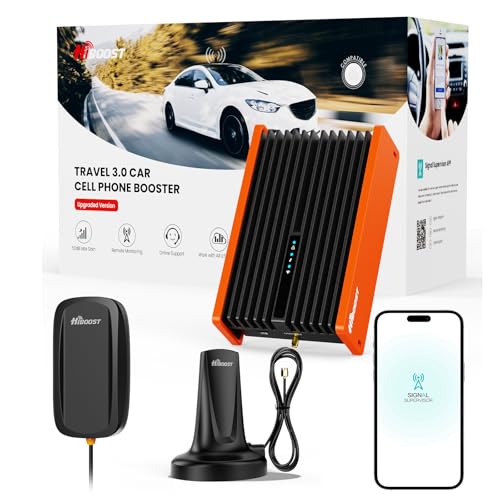
The HiBoost Booster for Cars and SUVs is built for everyday commuting, with a magnetic outdoor antenna that installs quickly on the vehicle roof. It boosts 5G and 4G LTE signals in weak areas, and the rugged metal booster comes with a protective silicone cover. The listing focuses on sedans and daily driving environments, which makes it a better match for a commuter than for an overland truck.
The magnetic mount is the key convenience, since you can move it between vehicles or remove it when washing the car. The tradeoff is price, as it sits in the premium tier, and the brief gives no gain figure. It lists all major carriers.
The installation is simpler than a fixed roof mount and suits renters or people who swap cars. Compared with the weBoost Drive Reach, it offers a specific antenna design and a protective case, but less breadth on carrier naming. Against the GAGBK 8-band kit, it costs more but gives a quicker setup.
Best for: Commuters who want a quick-mount antenna on a sedan or SUV
Check price on AmazonSpecs
- Antenna: Magnetic outdoor roof antenna
- Case: Rugged metal with silicone cover
- Network: 5G and 4G LTE
- Use: Cars, sedans, daily driving
Pros
- +Magnetic roof antenna installs quickly
- +Supports all major carriers
- +Rugged metal case with a silicone cover
- +Built for daily car use
Cons
- −Premium price tier
- −No gain figure listed in the brief
- −Magnetic mount needs a clear flat roof area
GAGBK 65dB 8-Band Car Cell Booster
About this pick
The GAGBK Car Cell Booster lists a 65dB high gain and eight bands (2, 4, 5, 12, 13, 17, 25 and 66), a rare pairing of strong amplification and wide coverage in this price range. It supports 5G and 4G LTE for all US carriers and fits cars, trucks, RVs, vans and SUVs. For a driver on routes with patchy signal, those two numbers are the most useful in the guide.
The usual caution applies: the gain is a seller figure, and the generic listing text offers little on the antenna. It sits in the upper-middle price tier, so you are paying more than for the Phonetone but less than for the weBoost. The listing talks about fewer dropped calls and faster data.
Install is the standard antenna, cable and booster routine, with no special mount in the brief. Compared with the JACOOL, which lists the same eight bands, it adds a 65dB gain claim, while the JACOOL gives none. Against the HiBoost, it has no magnetic mount but gives more band detail.
Best for: Drivers who want a high gain claim and wide band support together
Check price on AmazonSpecs
- Gain: 65dB (listed)
- Bands: 2, 4, 5, 12, 13, 17, 25, 66
- Network: 5G and 4G LTE
- Vehicles: Car, truck, RV, van, SUV
Pros
- +65dB gain is the highest listed in this guide
- +Eight listed bands cover many carriers
- +Works with cars, trucks, RVs and SUVs
- +5G and 4G LTE listed
Cons
- −Gain is a seller claim, not an independent result
- −Generic listing with little antenna detail
- −Upper-middle price tier
JACOOL 8-Band Vehicle Cell Booster
About this pick
The JACOOL Vehicle Cell Booster lists eight frequency bands, 2, 4, 5, 12, 13, 17, 25 and 66, and supports 5G and 4G LTE for multiple devices. It works with all major US networks and targets cars, trucks and RVs. The band coverage is as wide as the GAGBK's at a lower price tier, which is its main attraction.
The listing leans toward larger vehicles and remote travel, so a small car owner may be buying more kit than needed. There is also no gain figure in the brief, which makes it hard to compare with the GAGBK's 65dB claim. It is a sensible pick if you want broad band coverage without paying premium prices.
Setup follows the usual antenna, cable and booster arrangement. Compared with the Phonetone, it covers far more bands but costs more. Against the weBoost, it gives specifics at a lower cost, but without that brand's name.
Best for: Drivers who want wide band coverage at a mid-range cost
Check price on AmazonSpecs
- Bands: 2, 4, 5, 12, 13, 17, 25, 66
- Network: 5G and 4G LTE
- Devices: Multiple phones and devices
- Vehicles: Car, truck, RV, off-road
Pros
- +Eight listed bands match the widest in the guide
- +Supports all major US networks
- +Handles multiple devices
- +Lower cost than the GAGBK
Cons
- −Larger-vehicle focus for a car buyer
- −No gain figure in the brief
- −Less-known brand
Phonetone Vehicle Cell Booster, Bands 12/13/17
About this pick
The Phonetone Vehicle Cell Booster supports bands 12, 13 and 17 and boosts 5G, 4G LTE data and VoLTE for cars, SUVs and trucks. Its listing is refreshingly direct about limits: it asks you to confirm your phone shows band 12, 13 or 17 and that you receive at least two bars of signal outdoors. That candor is rare and helps you avoid a bad purchase.
The narrow band list is the tradeoff, as it will not help phones that rely on other bands. In exchange, it is the lowest-cost pick in this guide. If your carrier uses the 700MHz bands, it can be a very efficient choice.
Install is the standard outside antenna, cable and in-car unit. Compared with the JACOOL and GAGBK, it covers three bands instead of eight, so it is a narrower tool. Against the weBoost, it is less flexible but much cheaper.
Best for: Budget buyers whose phones use bands 12, 13 or 17
Check price on AmazonSpecs
- Bands: 12, 13, 17
- Network: 5G, 4G LTE data and VoLTE
- Pre-purchase check: Phone must show band 12, 13 or 17
- Signal need: At least 2 bars outdoors
Pros
- +Lowest cost of the five picks
- +Clear pre-purchase checks for bands and signal
- +Supports 5G, 4G LTE data and VoLTE
- +Fits cars, SUVs and trucks
Cons
- −Only three bands listed
- −Needs at least two bars outdoors to help
- −Less useful on carriers that rely on higher bands
How We Evaluated These 5G Cell Phone Signal Boosters for Cars (2026)
Each pick was assessed across 5 criteria weighted for real-world use.
Band coverage
The GAGBK and JACOOL list eight bands, the Phonetone lists three, and the weBoost and HiBoost list none in the brief. Picks with clear band lists scored higher. Transparency about bands matters for avoiding a bad purchase.
Gain and signal strength
The GAGBK lists 65dB, the highest figure here, while the other picks give no number. We treated gain as a seller claim. A listed gain helps compare picks but does not guarantee results. We scored higher where gain was clearly stated.
Antenna and mounting
We looked at antenna design, with the HiBoost magnetic roof antenna scoring best for quick installs. Picks with generic mounting detail scored lower. The strongest pick for flexibility is the HiBoost and the most basic is the Phonetone. Mounting matters for commuters who swap cars.
Carrier compatibility and honesty
The weBoost lists all US carriers including US Cellular, and the Phonetone is candid about its limits. We scored listings that clearly state compatibility higher. Vague claims lost points. This criterion protects buyers from mismatched purchases.
Value across the lineup
The Phonetone is the lowest-cost pick, while the weBoost and HiBoost sit in the higher tier. The JACOOL offers wide band coverage at a mid-range cost. Value is highest when the kit matches your phone's bands.
How to Choose the Right 5G Cell Phone Signal Boosters for Cars (2026)
By Driving Pattern
Match the kit to how you drive.
| Driving pattern | Recommended pick |
|---|---|
| Daily commute in a sedan or SUV | HiBoost Cell Phone Signal Booster for Cars and SUVs |
| Mixed carriers in one household | weBoost Drive Reach for Cars and Trucks |
| Patchy signal on long routes | GAGBK 65dB 8-Band Car Cell Booster |
| Crossing regions and carriers | JACOOL 8-Band Vehicle Cell Booster |
| Phone uses bands 12, 13 or 17 | Phonetone Vehicle Cell Booster, Bands 12/13/17 |
By Budget
| Budget tier | Recommended pick |
|---|---|
| Lowest-cost pick | Phonetone Vehicle Cell Booster, Bands 12/13/17 |
| Low to mid | JACOOL 8-Band Vehicle Cell Booster |
| Upper mid-range | GAGBK 65dB 8-Band Car Cell Booster |
| Premium | HiBoost Cell Phone Signal Booster for Cars and SUVs |
| Premium, name-brand | weBoost Drive Reach for Cars and Trucks |
Wide Bands vs Focused Bands
More bands cover more phones, but cost more.
Wide bands
The GAGBK and JACOOL list eight bands, 2, 4, 5, 12, 13, 17, 25 and 66, which helps across carriers and regions.
Focused bands
The Phonetone lists only bands 12, 13 and 17, which is cheaper but useless if your phone uses other bands.
Recommendation
Pick the GAGBK or JACOOL if you are unsure of your bands, and the Phonetone if you have confirmed bands 12, 13 or 17.
By Mounting Preference
A magnetic antenna is quicker, a fixed one is steadier.
| Preference | Recommended pick |
|---|---|
| Quick magnetic roof antenna | HiBoost Cell Phone Signal Booster for Cars and SUVs |
| Brand support and flexible kit | weBoost Drive Reach for Cars and Trucks |
| Wide bands, standard install | JACOOL 8-Band Vehicle Cell Booster |
| High gain, standard install | GAGBK 65dB 8-Band Car Cell Booster |
For Highway Calls Specifically
Look for
A booster that keeps calls steady in weak areas, with a gain figure and band list you can check. Make sure you have at least some outdoor signal.
In this comparison
The GAGBK 65dB kit pairs the highest gain claim with eight bands. The weBoost Drive Reach lists reaching the farthest towers.
When to Spend More
Spend more if
You want a recognized brand or a quick magnetic antenna, since the weBoost Drive Reach and HiBoost car kit cost more but are simpler to live with.
Save if
Your phone uses bands 12, 13 or 17, since the Phonetone costs the least. Save with the JACOOL if you want wide bands cheaply.
Frequently Asked Questions
How do I choose between the GAGBK and the JACOOL?
Both list eight bands, 2, 4, 5, 12, 13, 17, 25 and 66. The GAGBK adds a 65dB gain claim, while the JACOOL costs less and gives no gain figure. Pick the GAGBK for weak-signal routes and the JACOOL for value.
Will a booster help if I have no service?
No. A booster only amplifies a signal that already reaches the car. The Phonetone asks for at least two bars outdoors. Check coverage along your route first.
Is a magnetic antenna as good as a fixed one?
The HiBoost magnetic roof antenna installs quickly and provides stronger reception than a phone alone. A fixed mount can be steadier, but the magnetic type is easier to move between cars. Choose based on convenience.
Do 5G labels mean faster speeds?
Not always. Many 5G signals ride on existing 4G bands, so band support matters more than the label. Check that the booster covers your phone's bands, as the GAGBK and JACOOL list eight.
Are car boosters legal?
Consumer boosters should carry an FCC ID and network protection wording. Uncertified boosters can interfere with towers. Check the listing before buying.
Is the premium weBoost worth the extra cost?
It depends on whether you value brand support and carrier breadth. The weBoost Drive Reach lists all US carriers, but gives no band or gain figures in the brief. The JACOOL and GAGBK offer more specifics for less.
Bottom Line
best overall: weBoost Drive Reach for Cars and Trucks - best overall pick in this roundup.
See the full rankings above for all picks with pros, cons, and best-for summaries.
Browse on Amazon
All Prime-eligible options with current pricing.
Shop on Amazon →