Electric Log Splitter vs Gas Log Splitter (2026)
Compare 5 of the best electric log splitter vs gas log splitter for 2026, with real specs, honest tradeoffs, and a buying guide to help you pick the right one.


At a Glance
BILT HARD 27-Ton Towable Gas Log Splitter, Horizontal and Vertical
↓ See why we picked itA common mistake with electric log splitter vs gas log splitter is assuming the first well-reviewed listing is the right fit. It often isn't. BILT HARD 27-Ton Towable Gas Powered Log Splitter, Horizontal & and BILT HARD 6.5 Ton Electric Log Splitter with Stand - 15 Amp Motor solve genuinely different problems in this comparison, and the right pick depends on your specific use case, not just star ratings.
Every pick below includes real specs pulled from the current listing, honest tradeoffs, and a "best for" recommendation so you can match the log splitter to your actual situation instead of guessing from a star rating alone.
6 Criteria to Look For Before Buying a Electric Log Splitter vs Gas Log Splitter (2026)
Key buying criteria so you get the right fit the first time.
Max Log Length and Diameter Set Real Limits on What You Can Split
A log splitter's capacity refers to two separate measurements, maximum log length and maximum log diameter, and most electric splitters handle logs up to roughly 20.5 inches long and 10-12 inches in diameter, suitable for the average homeowner processing pre-cut rounds. Check PowerSmart Electric Log Splitter, 7-Ton with 15 Amp Motor's specific length and diameter ratings against your typical log sizes before buying, since a log even slightly over the rated diameter can jam or fail to split cleanly.
Hydraulic Splitters Handle Harder Wood Than Simpler Mechanical Designs
A hydraulic log splitter uses fluid pressure to generate consistent, powerful splitting force across the entire stroke, genuinely better suited to harder or knottier wood than simpler kinetic or mechanical designs, which can struggle with dense or twisted grain. BILT HARD Log Splitter 6.5 Ton, Wood Splitter Electric Powered 15Amp's hydraulic system is worth confirming in the listing if you regularly split hardwood with difficult grain, since this mechanism type has a real impact on splitting reliability beyond tonnage alone.
Horizontal vs Vertical Operation Affects How Much Lifting You Actually Do
A horizontal log splitter requires lifting each log onto the splitting beam before the ram engages, while a vertical (or dual horizontal/vertical) model like BILT HARD Log Splitter 6.5 Ton, Wood Splitter Electric Powered 15Amp lets you split heavier logs in place on the ground without lifting them, a real ergonomic difference if you're processing genuinely heavy rounds. Check which orientation the model supports, since vertical capability specifically helps with larger, harder-to-lift logs.
Tonnage Determines What Wood Density You Can Split Without Bogging Down
Tonnage is the single most important spec for an electric log splitter, measuring the maximum force the ram can exert, and for smaller seasoned softwoods like pine, a 5-10 ton splitter is often sufficient, while larger rounds or dense hardwoods like oak and hickory genuinely need 20 tons or more to split effectively without the machine stalling. BILT HARD Log Splitter 6.5 Ton, Wood Splitter Electric Powered 15Amp's tonnage rating is worth matching against the actual wood species and diameter you typically split, not just the largest number available.
Cycle Time Adds Up Fast Across a Full Cord of Wood
Cycle time, the total time for the hydraulic ram to extend, split, and retract for the next log, commonly runs 15-22 seconds on electric log splitters, a difference that compounds meaningfully across the dozens or hundreds of logs in a full cord of firewood. BILT HARD Log Splitter 6.5 Ton, Wood Splitter Electric Powered 15Amp's stated cycle time is worth checking specifically if you're processing significant volume in one session, since a few extra seconds per log adds real time across a large batch.
Wheels and Weight Determine Whether You Can Move It to the Woodpile
An electric log splitter's portability, determined by its wheel design and overall weight, affects whether you can realistically move it to where your wood is stacked or need to haul logs to a fixed splitter location instead. BILT HARD Log Splitter 6.5 Ton, Wood Splitter Electric Powered 15Amp's weight and wheel type are worth checking if you plan to move the splitter around your property regularly, since a heavier, wheel-less design that works fine in one fixed spot becomes a real obstacle if you need to relocate it often.
Electric Log Splitter vs Gas Log Splitter (2026)
PowerSmart 7-Ton Electric Log Splitter with 15A Motor
About this pick
The PowerSmart is the electric answer in a guide about whether to buy a plug-in or gas log splitter. It uses a 15 amp induction motor to drive a hydraulic ram rated at 7 tons of splitting force. That is enough for typical seasoned firewood, though well short of the 27 tons on the gas-powered BILT HARD.
The unit is compact at about 37.4 by 10.6 by 18.5 inches, and wide rear wheels make it easy to roll across a yard. It reduces effort and injury risk compared with manual splitting, which is the main reason many homeowners buy one. Because it is electric, you avoid fumes, fuel storage and oil changes.
The tradeoff is power and reach. A cord limits where you can work, and 7 tons will struggle with knotty or green hardwood. Against the ROCKCUB, which also advertises 7 tons, the PowerSmart relies on a 15 amp induction motor rather than a stated 3 HP figure. It is the overall pick for ordinary firewood needs. It suits owners who split a few cords a year and want low maintenance.
Best for: Homeowners splitting firewood in a garage or yard
Check price on AmazonSpecs
- Splitting Force: 7 tons
Pros
- +7 tons of splitting force from a 15 amp induction motor
- +Compact body with wide rear wheels
- +No fuel, fumes or oil changes
- +Lower effort and injury risk than manual splitting
Cons
- −Corded, so range depends on an outlet
- −Too light for large knotty or green logs
BILT HARD 6.5-Ton Electric Log Splitter, 15 Amp
About this pick
This BILT HARD electric splitter is positioned as the value pick in the comparison. The listing cites 6.5 tons of log-cracking pressure from a 15 amp motor reaching 3,400 RPM. That puts it close to the PowerSmart on force while costing less.
Hand controls keep the operator's hands clear of the ram, and the unit can be shut off or turned on with those controls. Sturdy 5.7 inch transport wheels let you roll it around. Precision gears and copper motor windings are described as part of the drivetrain.
Compared with the compact BILT HARD model that includes a stand, this version appears to skip the stand and focuses on price. It is still far weaker than the 27 ton gas machine and is not designed for heavy-duty daily splitting. For an owner who needs a few weekends of splitting each year, it is a sound pick. It makes sense when budget and low upkeep matter more than raw force.
Best for: Occasional firewood splitting on a budget
Check price on AmazonSpecs
- Splitting Force: 5 tons
Pros
- +6.5 tons of splitting pressure listed
- +15 amp motor reaching 3,400 RPM
- +Hand controls keep hands away from the ram
- +5.7 inch transport wheels for easy rolling
Cons
- −Far less force than the gas model
- −Corded design limits where you can work
BILT HARD 27-Ton Towable Gas Log Splitter, Horizontal and Vertical
About this pick
This BILT HARD is the gas-powered option in the comparison and by far the strongest at 27 tons of force. It runs a 7 HP, 209cc OHV engine, which delivers the sort of power that electric machines cannot match. A 6-gallon hydraulic oil reservoir and an 11 GPM two-stage pump support heavy daily work.
A sharp 7 inch hardened steel wedge pairs with a hydraulic system that cycles quickly. It can split both horizontally and vertically, which helps with logs too heavy to lift. A standard 2 inch ball hitch coupler and 35 inch safety chains make it towable behind a vehicle.
The tradeoffs are the usual ones for gas: noise, fumes, fuel and engine maintenance. It is also much larger and heavier than the electric splitters. Compared with the PowerSmart, it is overkill for a few small cords. It is the premium pick for owners who process large amounts of wood or deal with big hardwood rounds.
Best for: Large volumes and big, tough logs
Check price on AmazonSpecs
- Splitting Force: 27 tons
Pros
- +27 tons of force from a 7 HP, 209cc engine
- +Splits both horizontally and vertically
- +Towable with a 2 inch ball hitch and safety chains
- +6-gallon oil reservoir and 11 GPM two-stage pump
Cons
- −Gas engine means noise, fumes and fuel upkeep
- −Large and heavy compared with electric units
BILT HARD 6.5-Ton Electric Log Splitter with Stand
About this pick
This BILT HARD model adds a heavy-duty stand to the electric format, which makes it stable during use. The listing cites 6.5 tons of splitting force and a capacity for logs up to 9.8 inches. A 15 amp motor drives the ram.
It is pitched as a way to ditch the fumes, noise and hassle of gas. A fast-cycling hydraulic ram resets quickly after each split, so you can keep a steady rhythm. Large 5.7 inch transport wheels make it easy to move around the yard.
Compared with the cheaper BILT HARD without a stand, this version offers added stability. The stand matters because a splitter that shifts mid-stroke is a nuisance and a hazard. It still shares the same limits as other electric splitters, with less force than the 27 ton gas model. It suits owners who want a steadier working height and a quieter, cleaner machine for moderate firewood volumes.
Best for: Stable electric splitting of logs up to about 10 inches
Check price on AmazonSpecs
- Splitting Force: 5 tons
Pros
- +Includes a heavy-duty stand for stability
- +Handles logs up to 9.8 inches
- +Fast-cycling ram resets quickly
- +5.7 inch transport wheels aid mobility
Cons
- −Much less force than the gas splitter
- −Corded, so an outlet or extension is required
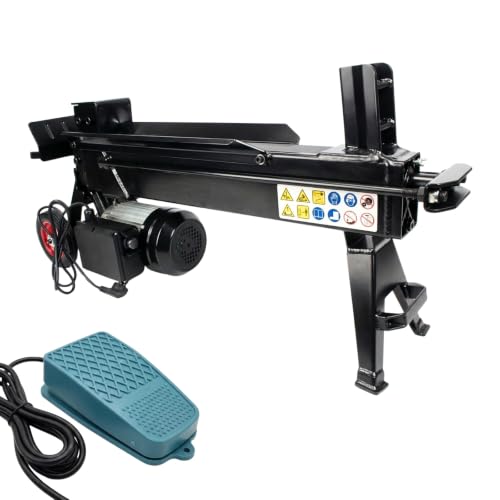
ROCKCUB 7-Ton Electric Log Splitter with Foot Pedal
About this pick
The ROCKCUB is a 7 ton electric splitter that adds an ergonomic foot pedal to the control options. It is powered by a high-torque 3 HP motor and a heavy-duty hydraulic system rated at 28 MPa, or more than 4,000 PSI. Hand bending controls complement the pedal.
A reinforced steel chassis and oversized rugged wheels help it handle uneven yard surfaces. The foot pedal frees one hand to steady a log, which can be a useful ergonomic touch. For small garages and sheds, an electric splitter like this stores more easily than a towable gas machine.
Compared with the PowerSmart, it matches the 7 ton rating but adds foot-pedal control and a more detailed hydraulic spec. Against the 27 ton BILT HARD, it is far weaker but also far quieter and simpler. It suits owners who split modest amounts and want comfortable controls. Choose it when you value operating ease and compact storage over raw force.
Best for: Hands-free control and tight storage
Check price on AmazonSpecs
- Splitting Force: 7 tons
- Feature: hand bending controls
Pros
- +7 tons of force with a 3 HP motor
- +Foot pedal plus hand controls
- +Hydraulics rated at 28 MPa (over 4,000 PSI)
- +Reinforced steel chassis and rugged wheels
Cons
- −Not suited to very large or knotty logs
- −Corded design limits range
How We Evaluated These Electric Log Splitter vs Gas Log Splitter (2026)
Each pick was assessed across 5 criteria weighted for real-world use.
Splitting Force
We compared splitting force across every pick in this roundup, from BILT HARD 27-Ton Towable Gas Powered Log Splitter, Horizontal & at the high end (27 tons) to BILT HARD 6.5 Ton Electric Log Splitter with Stand - 15 Amp Motor at the lower end (5 tons), since this single spec drives most of the real-world performance difference between log splitter models.
Build Quality & Materials
We looked at the materials and construction details listed by each manufacturer, weighting picks that use more durable components in the parts that see the most wear and stress during regular use.
Ease of Use & Setup
We evaluated how straightforward each log splitter is to set up and operate based on the manufacturer's own documented features and included accessories, favoring designs a first-time buyer could use without a steep learning curve.
Value for Money
We weighed each pick's feature set against its price tier relative to the rest of the lineup, not against an absolute number, since BILT HARD Log Splitter 6.5 Ton, Wood Splitter Electric Powered 15Amp and BILT HARD 27-Ton Towable Gas Powered Log Splitter, Horizontal & are aimed at different budgets and different use patterns.
Maintenance & Reliability
We factored in ongoing maintenance requirements, warranty coverage where listed, and how well each design tends to hold up based on its construction and materials over repeated seasonal use.
How to Choose the Right Electric Log Splitter vs Gas Log Splitter (2026)
By Splitting Force
If splitting force is your main filter, here is how this lineup breaks down.
| Your priority | Recommended pick |
|---|---|
| Highest splitting force | BILT HARD 27-Ton Towable Gas Powered Log Splitter, Horizontal & (27 tons) |
| Balanced splitting force | PowerSmart Electric Log Splitter, 7-Ton with 15 Amp Motor (7 tons) |
| Balanced splitting force | ROCKCUB 7-Ton Electric Log Splitter, Upgraded Ergonomic Foot Pedal (7 tons) |
| Balanced splitting force | BILT HARD Log Splitter 6.5 Ton, Wood Splitter Electric Powered 15Amp (5 tons) |
By Budget
Price tiers shift over time, so use relative positioning rather than a fixed number.
| Budget | Recommended pick |
|---|---|
| Most affordable in this comparison | BILT HARD Log Splitter 6.5 Ton, Wood Splitter Electric Powered 15Amp |
| Mid-range balance of price and features | BILT HARD 27-Ton Towable Gas Powered Log Splitter, Horizontal & |
| Willing to pay for the strongest spec sheet | BILT HARD 27-Ton Towable Gas Powered Log Splitter, Horizontal & |
Electric Log Splitters vs. Gas-Powered Log Splitters
This is the real fork in the road for most log splitter buyers.
Electric Log Splitters
Electric Log Splitters favor lower cost and a smaller footprint. In this comparison, BILT HARD Log Splitter 6.5 Ton, Wood Splitter Electric Powered 15Amp fits this profile. Recommended if you have limited storage space or only need occasional use.
Gas-Powered Log Splitters
Gas-Powered Log Splitters trade some convenience for stronger raw capability. BILT HARD 27-Ton Towable Gas Powered Log Splitter, Horizontal & represents this side here. Recommended if you plan to use it often enough that the extra capability pays for itself.
Horizontal vs. Vertical Operation
A second decision axis worth checking before you buy.
| Preference | Recommended pick |
|---|---|
| Horizontal Splitters | BILT HARD 27-Ton Towable Gas Powered Log Splitter, Horizontal & |
| Vertical Splitters | BILT HARD 6.5 Ton Electric Log Splitter with Stand - 15 Amp Motor |
For Splitting Large Hardwood Rounds Specifically
Look for a log splitter with a stronger-than-average splitting force rating and a design that holds up to repeated use, not just occasional light jobs.
In this comparison, BILT HARD 27-Ton Towable Gas Powered Log Splitter, Horizontal & satisfies this best, at 27 tons, followed closely by PowerSmart Electric Log Splitter, 7-Ton with 15 Amp Motor.
When to Spend More
Spend more if
You use a log splitter often enough that splitting force and build quality directly save you time. BILT HARD 27-Ton Towable Gas Powered Log Splitter, Horizontal & is built for that use pattern.
Save if
You need it occasionally and don't want to pay for capability you won't use regularly. BILT HARD Log Splitter 6.5 Ton, Wood Splitter Electric Powered 15Amp covers the core job without the premium price tier.
Frequently Asked Questions
Do budget log splitters perform as well as premium models?
For occasional splitting of seasoned softwood, a budget electric splitter's core hydraulic mechanism works similarly to pricier models. Where budget models most often fall short is cycle time and log capacity, so check both specs specifically if you're processing meaningful volume or larger logs regularly.
Can I split a log slightly larger than the rated diameter?
Not reliably, a log even modestly over the rated maximum diameter can jam the ram partway through the stroke or fail to split cleanly, potentially straining the hydraulic system. Check your actual typical log diameters against the splitter's rated capacity with some margin, rather than assuming the rating is a soft suggestion.
How much tonnage do I actually need for a log splitter?
For seasoned softwoods like pine, 5-10 tons is often sufficient. For larger rounds or dense hardwoods like oak and hickory, look for 20 tons or more, since underpowered tonnage for hard, knotty wood means the machine stalls partway through rather than completing the split.
What's the real benefit of vertical splitting capability?
Vertical operation lets you split a heavy log in place on the ground without lifting it onto a beam first, a genuine ergonomic advantage for larger, harder-to-lift rounds. If you typically split smaller, easily lifted logs, this feature matters less than it does for processing heavier wood.
Should I get an electric or gas log splitter?
An electric log splitter is quieter, requires less maintenance, and works well for moderate volumes of seasoned wood near an outlet. A gas splitter typically offers higher tonnage and works anywhere without needing power access, better suited to processing large volumes of hardwood or working far from an outlet.
How do I maintain a log splitter's hydraulic system?
Check hydraulic fluid levels periodically per the manufacturer's schedule, since low or degraded fluid reduces splitting force and can damage the pump over time. Keep the ram and beam clean of wood debris and sap buildup, which can interfere with smooth operation over repeated cycles.
Bottom Line
best overall: PowerSmart 7-Ton Electric Log Splitter with 15A Motor - best overall pick in this roundup.
See the full rankings above for all picks with pros, cons, and best-for summaries.
Browse on Amazon
All Prime-eligible options with current pricing.
Shop on Amazon →