5 Best TV Speakers for Hearing Loss in 2026
Five TV speakers and neckband systems compared on dialogue clarity, left and right volume, latency, Auracast and setup for viewers who struggle with speech.




At a Glance
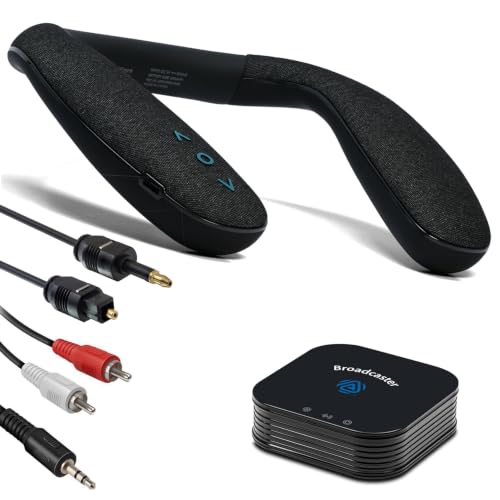
HomeSpot BA210 v2 Auracast Transmitter with JY538 Neckband Speaker
↓ See why we picked itWhen TV dialogue is hard to follow, turning the volume up for the whole room rarely solves it and often annoys everyone else. A separate speaker that puts sound closer to the listener, or that boosts the voice range specifically, can make a real difference in how easy a show is to follow. The speakers in this guide approach the problem in four different ways: a room speaker, a near-ear speaker, neckband speakers and an Auracast broadcast system.
We compared five distinct models: the ChairSpeaker CS3 near-ear speaker, the Evinof 2.4GHz speaker, the HomeSpot BA210 v2 Auracast transmitter with a JY538 neckband speaker, the LARKSOUND Handy room speaker and the LARKSOUND Wearable neckband. We evaluated each on listing specs and buyer feedback themes, looking at voice modes, left and right volume, wireless link and setup. None of these is a hearing aid or a medical device, and none treats hearing loss.
If you use hearing aids, check your model's wireless features before assuming any of these will connect to it.
6 Criteria to Look For Before Buying a TV Speakers for Hearing Loss
Key buying criteria so you get the right fit the first time.
Voice enhancement and EQ
Speech sits mostly in the 1 to 4 kHz range, so a mode that lifts that band beats a general volume boost. The Evinof has TV voice enhancement, the LARKSOUND models list Voice Enhancement among three EQ modes, and the CS3 is described as voice enhancing. Bass-heavy presets bury voices, so keep them off for dialogue. Test the mode at your usual volume. Some viewers find that the voice mode makes music in a show sound thin, which is a fair trade for clearer words. Switch to the General mode on the LARKSOUND for movies with big soundtracks, and back to Voice Enhancement for news and dramas where dialogue carries the story.
Left and right volume
Separate left and right volume lets you set each side differently, which can help when your ears hear differently. The LARKSOUND Wearable lists L/R volume control, while the room speakers and the CS3 do not state it. This is a comfort and clarity feature, not a medical treatment. Check the product page for the exact control layout. On the other pick types, the volume knob changes both ears equally, so uneven hearing is handled only by room placement. If you are not sure whether your ears differ, a quick listen test with the TV balance setting can tell you before you buy.
Latency and wireless link
Lip-sync drift hurts speech comprehension. The Evinof uses a 2.4GHz RF link listed as zero-latency, the HomeSpot lists Bluetooth 5.3 with aptX Adaptive and Low Latency codecs, and the LARKSOUND models avoid Bluetooth pairing. Standard Bluetooth often adds 100 to 250 milliseconds. Prefer a TV-specific link. aptX Adaptive and Low Latency codecs only help if both the transmitter and the receiver support them, which is true in the HomeSpot pair but not guaranteed for other earbuds. Cabled paths such as the CS3's RCA or optical connection have no wireless delay to worry about.
Private versus shared sound
Decide whether others should hear the speaker. The CS3 aims at one listener, the neckbands create a private zone, and the Evinof and Handy fill the room. The HomeSpot with Auracast can feed several receivers. Private sound keeps the room quiet at night. The neckbands also keep a person's chair-side table clear, while the CS3 occupies space beside the head. If your partner sleeps early, a private option lets you keep watching without a volume compromise.
Hearing aid compatibility
Do not assume any speaker connects to your hearing aids. The HomeSpot listing names hearing aids as an example of Auracast receivers, but the hearing aid itself must support Auracast. Contact the maker or your audiologist for compatibility. The others list no hearing aid connection. Even then, an Auracast link depends on the transmitter, the receiver and any firmware, so ask the maker which models are verified. Treat hearing aid streaming as a separate question from TV speaker clarity.
Setup and wearing comfort
Fewer steps and light weight matter most. The LARKSOUND models are plug and play, the HomeSpot kit is pre-paired and the CS3 includes cables. For neckbands, check weight and clamping force in photos and reviews. A device that is uncomfortable will not be used. The HomeSpot's 50 hour listed playback means fewer charging chores than a speaker you must remember to charge each night. Unverified wearing comfort is the biggest unknown across the neckbands, so keep the return window in mind.
5 Best TV Speakers for Hearing Loss in 2026
ChairSpeaker CS3 Wireless TV Speakers
About this pick
The ChairSpeaker CS3 puts a speaker beside your head and focuses the sound toward you, so you hear dialogue clearly at a volume the rest of the room can live with. The listing includes both RCA and digital optical cables and says it works with most TVs and with Smart TV apps. The title describes it as voice enhancing, aimed at viewers who find dialogue hard to follow.
A near-ear speaker works on distance. Sound from a speaker a foot or two from your head is louder at your ear than the same sound from across the room, without raising the room volume. The tradeoff is that sound is aimed at one listener, and it has the highest price rank in this guide.
In ownership terms the included cables cover most TVs, so setup is mostly plugging in. Compared with the Evinof, which fills a wider area, the CS3 serves one chair. Against the LARKSOUND Wearable neckband, it does not require wearing anything.
Best for: A viewer who wants clearer dialogue without wearing anything.
Check price on AmazonSpecs
- Design: Near-ear speaker beside your head
- Cables: RCA and digital optical included
- Use: Most TVs and Smart TV apps
Pros
- +Near-ear design puts sound closer to you
- +RCA and optical cables included
- +Works with most TVs and Smart TV apps
- +No wearable required
Cons
- −Highest price rank of the five
- −Sound is aimed at one listener
Evinof 2.4G Wireless TV Speaker
About this pick
The Evinof pairs a small speaker with a 2.4GHz wireless link that the listing calls zero-latency, plus a dedicated TV mode with voice enhancement technology. A separate Bluetooth mode lets you play music from a phone. The listing rates the wireless range at 100 feet.
The RF link matters for speech comprehension. Standard Bluetooth often adds roughly 100 to 250 milliseconds of delay, and a voice that trails the picture makes lip reading cues unreliable. The tradeoff is that the speaker spreads sound across a room rather than aiming it at you, and you should confirm which TV outputs the base accepts.
In ownership terms it is a low-priced, single-box speaker you can set beside your chair. It has the lowest price rank in this guide. Compared with the CS3, it is cheaper but less focused, and against the HomeSpot system, it needs no neckband.
Best for: Households that want a low-lag speaker everyone can hear.
Check price on AmazonSpecs
- Wireless link: 2.4GHz, listed zero-latency
- Range: 100 ft
- Modes: TV mode and Bluetooth mode
Pros
- +2.4GHz link listed as zero latency
- +TV voice enhancement mode
- +100 ft listed range
- +Lowest price rank of the five
Cons
- −Spreads sound across the room
- −Base station inputs need checking
HomeSpot BA210 v2 Auracast Transmitter with JY538 Neckband Speaker
About this pick
The HomeSpot kit pairs the BA210 v2 transmitter with a JY538 neckband speaker, pre-paired for instant setup. The transmitter can broadcast through Auracast to unlimited Auracast devices, and the listing names the JY538, Galaxy Buds and hearing aids as examples. It supports Bluetooth 5.3 with aptX Adaptive, Low Latency and HD codecs and lists up to 50 hours of playback.
Auracast is the unusual feature. It lets one transmitter feed several receivers, so two people can listen at their own volume. The tradeoff is that a hearing aid must itself support Auracast to receive it, and the listing gives hearing aids only as an example, so check your model with its maker first.
In ownership terms the neckband sits on your shoulders and the long battery means infrequent charging. It sits in the lower price ranks. Compared with the LARKSOUND Wearable, it offers a modern wireless link but a more technical setup concept. Against the Evinof, it is private rather than shared.
Best for: Households where two people want separate volumes through Auracast receivers.
Check price on AmazonSpecs
- Broadcast: Auracast to unlimited receivers
- Bluetooth: 5.3 with aptX Adaptive, Low Latency, HD
- Battery: Up to 50 hours playback
Pros
- +Auracast broadcast to multiple receivers
- +Pre-paired transmitter and neckband
- +aptX Adaptive low latency codecs
- +50 hour listed playback
Cons
- −Hearing aid compatibility must be confirmed
- −More technical than plug and play
LARKSOUND Handy TV Speaker for Elderly
About this pick
The LARKSOUND Handy is a plug and play speaker that needs no Bluetooth and offers three sound modes named Noise Reduction, Voice Enhancement and General. Its built-in voice enhancement isolates and amplifies voices while reducing background noise. A sturdy carry handle moves the lightweight speaker between rooms, and a headphone jack allows private listening.
The named modes are useful because the label tells you what the button does. Voice Enhancement is the one to use for dialogue, and Noise Reduction targets background sound. The tradeoff is that it connects by cable and spreads sound across the room, and you should check the product page for the cable and input details.
In ownership terms it is among the easiest to learn here. It sits mid-price. Compared with the LARKSOUND Wearable, it shares the modes but shares sound with the room, and against the CS3, it lacks near-ear focus.
Best for: Viewers who want clearly named modes and no pairing.
Check price on AmazonSpecs
- Setup: Plug and play, no Bluetooth
- Modes: Noise Reduction, Voice Enhancement, General
- Extras: Headphone jack, carry handle
Pros
- +Plug and play with no Bluetooth
- +Voice Enhancement and Noise Reduction modes
- +Headphone jack for private listening
- +Carry handle for moving rooms
Cons
- −Cable connection limits placement
- −Sound spreads across the room
LARKSOUND Wearable TV Speaker for Elderly
About this pick
The LARKSOUND Wearable is a lightweight neckband that rests on your shoulders and creates a private audio zone near your ears. A plug and play transmitter avoids Bluetooth pairing and remote controls, and the neckband has left and right volume control and three EQ modes. Built-in voice enhancement isolates and amplifies voices while reducing background noise.
The left and right volume controls are the distinguishing feature here. If one ear hears differently from the other, setting each side separately can make speech easier to follow. The tradeoff is that you wear it, so comfort over a long film matters, and the listings give no battery figure, so check the product page.
In ownership terms the transmitter sits beside the TV and the neckband rides on your shoulders. It shares a mid price rank with the Handy. Compared with the HomeSpot neckband, it avoids pairing but lacks Auracast. Against the CS3, it is wearable instead of placed.
Best for: Viewers who want a private neckband with separate left and right volume.
Check price on AmazonSpecs
- Design: Lightweight neckband on the shoulders
- Controls: Separate left and right volume
- Setup: Plug and play transmitter, no pairing
Pros
- +Separate left and right volume control
- +Plug and play transmitter
- +Voice enhancement and three EQ modes
- +Private audio zone near the ears
Cons
- −Must be worn for the whole show
- −Battery life needs checking on the page
How We Evaluated These TV Speakers for Hearing Loss
Each pick was assessed across 5 criteria weighted for real-world use.
Speech features
We compared the Evinof voice mode, the LARKSOUND voice enhancement and noise reduction modes and the CS3 voice-enhancing design. We did not claim medical outcomes. Features were taken from the listings. The LARKSOUND pair share the same named modes, so the choice between them is mostly room speaker versus neckband. We recorded each speech feature as a maker claim, because no listing offers objective speech scores.
Wireless link and lag
We compared the Evinof 2.4GHz link, the HomeSpot Bluetooth 5.3 with low latency codecs and the LARKSOUND no-pairing approach. Latency claims are maker claims, not measurements. Drift counts against comprehension. The LARKSOUND Wearable avoids pairing entirely through its transmitter, which also means there is no Bluetooth latency step to evaluate.
Private listening
We looked at near-ear, neckband and Auracast options against room speakers. The HomeSpot and LARKSOUND Wearable were credited for privacy. Wearing comfort was noted as unverified. The CS3 earned partial credit because it needs no wearable, while the neckbands earned full privacy credit at the cost of wearing comfort risk.
Controls and setup
We counted steps, with the LARKSOUND plug and play, the HomeSpot pre-pairing and the CS3 included cables. Left and right volume on the Wearable was recorded as a control advantage. Missing details were flagged. A tidy cable plan also counted, since the CS3 uses RCA or optical wires and the LARKSOUND Handy uses a cable to the TV.
Lineup positioning
The CS3 leads on near-ear focus, the Evinof on low lag and price, the HomeSpot on Auracast, the Handy on simplicity and the Wearable on L/R volume. Scores come from specs and buyer feedback, not hands-on measurement.
How to Choose the Right TV Speakers for Hearing Loss
By Listening Setup
How you listen decides the form.
| Situation | Pick | Reason |
|---|---|---|
| Sitting in one chair | ChairSpeaker CS3 Wireless TV Speakers | Near-ear sound beside your head |
| Whole family watching | Evinof 2.4G Wireless TV Speaker | Room speaker with low-lag link |
| Different volume per ear | LARKSOUND Wearable TV Speaker for Elderly | Separate left and right volume |
| Two people at different volumes | HomeSpot BA210 v2 Auracast Transmitter with JY538 Neckband Speaker | Auracast broadcast to multiple receivers |
| Fewest steps | LARKSOUND Handy TV Speaker for Elderly | Plug and play with named modes |
Test comfort and clarity before deciding, and keep the return window open. The CS3 and neckbands feel different in daily use than their listings suggest.
By Budget
Relative tiers from price ranks.
| Tier | Pick | What you get |
|---|---|---|
| Entry | Evinof 2.4G Wireless TV Speaker | RF link and voice mode |
| Entry to mid | HomeSpot BA210 v2 Auracast Transmitter with JY538 Neckband Speaker | Auracast and 50 hour playback |
| Mid | LARKSOUND Handy TV Speaker for Elderly | Plug and play room speaker |
| Mid | LARKSOUND Wearable TV Speaker for Elderly | Neckband with L/R volume |
| Premium | ChairSpeaker CS3 Wireless TV Speakers | Near-ear speaker with cables |
Tiers are relative to this lineup and not dollar figures.
Room Speaker vs Wearable or Near-Ear
Where the sound source sits.
Room speaker
A room speaker serves everyone but needs higher volume. The Evinof and the LARKSOUND Handy fall here. Pick it for shared viewing. The Evinof's 100 feet of listed range also lets the speaker follow you to another room, and the Handy's carry handle does the same on foot.
Wearable or near-ear
A neckband or near-ear speaker puts sound close to you at a lower room volume. The CS3, the LARKSOUND Wearable and the HomeSpot neckband fall here. Pick it for private listening. The HomeSpot neckband and the LARKSOUND Wearable differ in setup: Auracast and Bluetooth 5.3 on one, a plug and play transmitter on the other.
Choose shared for family, close for private.
Secondary Axis: Wireless Link
How sound travels to you.
| Link | Pick | Why |
|---|---|---|
| 2.4GHz RF | Evinof 2.4G Wireless TV Speaker | Listed zero-latency |
| Auracast and low latency Bluetooth | HomeSpot BA210 v2 Auracast Transmitter with JY538 Neckband Speaker | aptX Adaptive and Low Latency |
| No pairing transmitter | LARKSOUND Wearable TV Speaker for Elderly | Plug and play |
| Cable | ChairSpeaker CS3 Wireless TV Speakers | RCA and optical included |
Check your TV outputs first, since an optical-only TV limits which transmitters you can use, and confirm what each base unit includes.
For Easier Dialogue Specifically
Clarity, controls and setup.
Look for
A voice mode, a low-lag link and controls you can read. Avoid heavy bass presets.
In this comparison
The Evinof, LARKSOUND models and CS3 list voice features. The Wearable adds separate left and right volume.
None of these replaces advice from a hearing professional. If the TV is hard to follow at any volume, a checkup is the right next step.
When to Spend More
| Spend more if | Save if |
|---|---|
| You want near-ear focus, as on the CS3 | A room speaker like the Evinof is enough |
| You want L/R volume, as on the Wearable | Both ears are similar |
| You want Auracast, as on the HomeSpot | You only need a plug and play speaker |
| You want clearly named modes, as on the Handy | You are comfortable with a TV mode switch |
Frequently Asked Questions
Will these speakers treat hearing loss?
No. They are convenience products that can make dialogue easier to follow by adding voice modes or moving sound closer to you. They do not treat or correct hearing loss. If speech remains hard to follow at a comfortable volume, speak with a hearing professional.
Do these work with hearing aids?
Only the HomeSpot kit names hearing aids, as an example of an Auracast receiver, and your hearing aid must itself support Auracast. The other four list no hearing aid connection. Confirm compatibility with the maker of your aids before buying. Your audiologist can also tell you whether a TV streamer from your hearing aid maker would suit you better.
What does left and right volume do?
It lets you set each side separately, as the LARKSOUND Wearable allows. That can help when your ears hear differently from each other. It is a comfort and clarity feature rather than a treatment. If both ears are similar, you may never touch the balance. Check the product page for how the controls are labeled.
Is a neckband comfortable for a whole movie?
That depends on weight and fit, which listings only partly show. Check product photos and buyer feedback on the product page, and try wearing it for a full show during the return window. A speaker you take off after twenty minutes is not helping.
Why is lip sync important for understanding speech?
Voices that trail the picture force your brain to match two signals, and speech becomes more tiring to follow. Standard Bluetooth often adds about 100 to 250 milliseconds of delay. The Evinof RF link and the HomeSpot low latency codecs aim to reduce it.
Which is easiest to set up?
The LARKSOUND models are plug and play with no Bluetooth pairing, and the HomeSpot kit is pre-paired. The CS3 includes RCA and optical cables so most TVs need no extra purchase. The Evinof needs its base connected and its TV output confirmed. Keep the pairing instructions in a drawer near the TV in case you need to reset it later.
Can two people listen at different volumes?
The HomeSpot Auracast transmitter can broadcast to multiple Auracast devices, so each listener can set their own volume on their own receiver. Otherwise the CS3 or a neckband gives one person a close sound source while the room stays at a lower volume. Check that your hearing aids support Auracast before relying on this route.
Bottom Line
best overall: ChairSpeaker CS3 Wireless TV Speakers - best near-ear speaker pick in this roundup.
See the full rankings above for all picks with pros, cons, and best-for summaries.
Browse on Amazon
All Prime-eligible options with current pricing.
Shop on Amazon →