6 Best Wi-Fi Extenders for Google Fiber in 2026
Six Wi-Fi extenders and one mesh option for a Google Fiber home, compared on bandwidth, Wi-Fi generation and setup so a fast connection reaches every room.



At a Glance
A fiber connection can be very fast at the box and still disappoint in a back bedroom, because the last stretch is wireless and walls do not care how quick the line is. That mismatch is the main reason Google Fiber households start looking at extenders. The bottleneck is no longer the plan but the radio link across the house.
This matters for how you shop. A quick fiber plan exposes the limits of a modest repeater, since a unit that halves throughput on every hop can turn a very fast line into something ordinary. So the picks below lean on higher bandwidth, newer standards and a guide to when a mesh pair makes more sense than a repeater.
We evaluated six options based on product specs and buyer feedback, comparing bandwidth, coverage ratings, generation and setup. Every one pairs with your router over standard Wi-Fi, though no extender can add speed beyond what your plan delivers.
6 Criteria to Look For Before Buying a Wi-Fi Extenders for Google Fiber
Key buying criteria so you get the right fit the first time.
Compare bandwidth to your plan
A fiber plan can outrun a modest extender, so check that the repeater's rated bandwidth is meaningfully above what you pay for. The TP-Link AX3000 lists 3 Gbps and the RE550 lists 1.9 Gbps, while the NETGEAR EX5000 and TP-Link RE315 sit at 1.2 Gbps. Because a repeater halves throughput on its second hop in many setups, headroom matters more than for slower plans. If your plan is near a gigabit, favor the first two. Do the arithmetic on the 5 GHz band rather than the combined figure, since that is the band that carries the fast traffic. A unit rated well below your plan is not broken, it simply caps what the far room can reach.
Consider mesh over a repeater
A repeater adds a hop and often a second network name, while a mesh system presents one name and hands devices off for you. The Google Nest Wifi pair has one unit plug into the modem and the other extend it. Choose mesh when three or more rooms struggle. Choose a single extender when only one corner is affected, since it is a smaller change. Mesh nodes also tend to be easier to move later if you rearrange furniture or rooms. Keep in mind that the Nest Wifi listing here gives no bandwidth or square footage, so judge it by layout rather than by numbers.
Match the Wi-Fi generation
A Wi-Fi 6 extender helps only with a Wi-Fi 6 router and devices. The AX3000 offers the newer standard, while the RE550, EX5000, EX6120 and RE315 are Wi-Fi 5. If your router is older, buying the newer standard is wasted money. Read the label on your router to see which side of the line you are on. Phones from the last few years usually handle Wi-Fi 6, but many smart TVs and older laptops do not. Count how many of your busiest devices can use it before paying for the AX3000.
Plan the placement carefully
Put the extender about halfway between the router and the weak room, where the signal is still strong. A unit placed inside the dead zone only repeats a weak signal and shrinks the gain. Coverage ratings such as 2100 square feet for the RE550 or 2400 for the AX3000 assume open space. In a house with several walls, plan on a smaller effective area. A quick check is to stand at the planned spot and confirm your phone still shows a strong signal from the router. If it shows only one or two bars, move closer before pairing.
Think about wired backhaul
The best way to keep a fast plan fast is to feed the second access point by cable, which removes the radio hop. Few of these picks mention a port, so check the listing before you count on one. If a cable run exists, a mesh or access point setup beats any repeater. Without one, pick the highest-bandwidth extender your budget allows. Thin flat cables can run along baseboards or under rugs without drilling. Even a short wired link between a desktop and a nearby access point can free the wireless airtime for everyone else.
Know what setup involves
The NETGEAR EX5000 and EX6120 offer the Nighthawk app and WPS, while the TP-Link models use WPS or a browser. A mesh pair like the Nest Wifi has its own flow and replaces your router. Decide whether you want to add a box or rebuild the network. Either way, keep the original router powered until the new setup is confirmed working. Write down your network name and password first so every device can rejoin in minutes. Setting the new network to reuse the old name is the quickest way to avoid reconnecting each gadget by hand.
6 Best Wi-Fi Extenders for Google Fiber in 2026
TP-Link AX3000 Wi-Fi 6 Dual-Band Extender
About this pick
Of everything here, the AX3000 does the most justice to a fast fiber line. TP-Link lists 3 Gbps of total dual-band bandwidth with up to 2404 Mbps on the fastest band, which leaves real room when a repeater has to split its radio between the router link and your devices. Two high-gain directional antennas with beamforming steer the signal toward the gadgets that need it, and the rated reach is up to 2400 square feet.
It is the priciest tier of extender in this lineup, and its advantages require a Wi-Fi 6 router and devices to show up. If your gear is older, the numbers go partly to waste, and since it is still a repeater the second hop cuts into throughput. No extender replaces a wired backhaul for a gigabit connection, so set expectations accordingly.
In daily life it behaves like a set-and-forget wall unit. It reaches farther than the RE550 at 2100 square feet and offers 1.1 Gbps more listed bandwidth, and it dwarfs the 1.2 Gbps of the NETGEAR EX5000. TP-Link also references its CISA cybersecurity commitment, a pleasant bit of reassurance on a device that will carry your whole household's traffic.
Best for: Fiber homes with Wi-Fi 6 gear that want the most headroom.
Check price on AmazonSpecs
- Standard: Wi-Fi 6 AX3000
- Total bandwidth: 3 Gbps
- Top band speed: 2404 Mbps
- Listed coverage: 2400 sq ft
Pros
- +3 Gbps total leaves headroom for fast plans
- +Up to 2404 Mbps on the top band
- +Beamforming directional antennas
- +2400 sq ft listed coverage
Cons
- −Benefits need a Wi-Fi 6 router and devices
- −Highest tier among the extenders
- −Repeater hop still limits peak speed
TP-Link AC1900 RE550 Range Extender
About this pick
The RE550 is the sensible choice if your router and most devices are Wi-Fi 5. It lists 1.9 Gbps of total bandwidth, three adjustable external antennas and coverage up to 2100 square feet. That much capacity gives a quicker plan more room to breathe than a basic AC1200 unit would.
It has two weaknesses for a fiber home. Wi-Fi 5 caps what newer devices can negotiate, and a single repeater still shares one radio pair between router link and clients. If your plan is far faster than the extender, expect the far room to run well below the line speed.
Placement and aiming decide most of the result here, and the three antennas let you fine tune. It outperforms the TP-Link RE315 at 1500 square feet and 1.2 Gbps on both reach and bandwidth, and it undercuts the AX3000 only on generation. Buyers with a conventional Wi-Fi 5 gateway and a long, narrow house will find it the most balanced unit in the group.
Best for: A Wi-Fi 5 home with a long layout and a quick plan.
Check price on AmazonSpecs
- Standard: AC1900 Wi-Fi 5
- Total bandwidth: 1.9 Gbps
- Antennas: 3 adjustable external
- Listed coverage: 2100 sq ft
Pros
- +1.9 Gbps total on the Wi-Fi 5 standard
- +Three antennas aimable down a hallway
- +2100 sq ft listed coverage
- +Works with any Wi-Fi router
Cons
- −Wi-Fi 5 limits newer devices
- −Repeater hop still costs throughput
- −Large body for a wall socket
Google Nest Wifi 2-Pack Mesh System
About this pick
This pick is a different animal: a two-piece mesh system whose second unit extends the first. Google describes one router plugging into the provider modem to create the network while the other unit extends it, covering the home under a single name. That arrangement avoids the second network and the manual handoff that traditional repeaters create.
The tradeoff is that you replace your router rather than add a small box. It is a larger change than plugging in an extender, and the listing for this product gives no bandwidth or square footage to compare. It also uses a different setup flow from WPS, so it appeals to people who like a system, not a quick fix.
Ownership is calmer once it is running, because devices roam between the two units without you doing anything. Compared with the TP-Link AX3000, which adds one hop to an existing router, the Nest system rebuilds the network around two cooperating units. It is the right answer when several rooms need coverage, and overkill when a single dead corner is the whole problem.
Best for: Homes with several weak rooms that want one seamless network.
Check price on AmazonSpecs
- Pack contents: 2 units
- Roles: Router plus extending point
- Type: Mesh Wi-Fi system
- Connects to: Your provider modem
Pros
- +Single network name across the home
- +Second unit extends the first
- +Built to replace the router, not add to it
- +Scales with extra units later
Cons
- −Replaces your router rather than adding to it
- −No bandwidth or coverage figures listed
- −More setup than a simple extender
NETGEAR EX5000 AC1200 WiFi Extender
About this pick
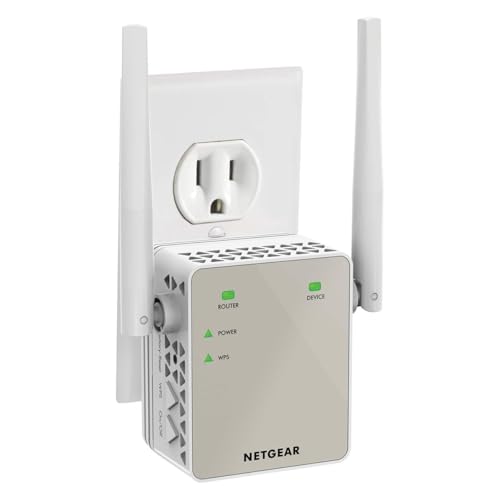
NETGEAR's EX5000 is easy to start with, either by pressing WPS on both devices or by following the Nighthawk app. It is a Wi-Fi 5 dual-band unit rated at 1.2 Gbps and up to 1500 square feet, aimed at bedrooms, a garage or a basement. For a household that just wants a weak room fixed, it is a calm and capable answer.
It is not built for squeezing every megabit from a fast plan. At 1.2 Gbps total, its ceiling is far below the AX3000, and a quick fiber line will outrun it on the far side of the house. The app is a convenience, but it does not change that limit.
Once installed it needs nothing. Compared with the EX6120 it appears to offer the same headline numbers, and compared with the RE315 at the same 1.2 Gbps it trades two aimable antennas for the guided app. It makes the most sense for homes where the plan is moderate and the priority is not having to think about the network.
Best for: Moderate plans where an easy install matters more than peak speed.
Check price on AmazonSpecs
- Standard: Wi-Fi 5 AC1200
- Total bandwidth: 1.2 Gbps
- Listed coverage: 1500 sq ft
- Setup: WPS or Nighthawk app
Pros
- +App-guided or WPS pairing
- +1.2 Gbps across two bands
- +Reaches bedrooms, garages and basements
- +Established brand for support
Cons
- −Ceiling too low for the fastest plans
- −No adjustable antennas
- −Wi-Fi 5 only
NETGEAR EX6120 AC1200 WiFi Extender
About this pick
The EX6120 is NETGEAR's other AC1200 option, with the same stated 1.2 Gbps and 1500 square feet of reach. Like its sibling it targets dead zones in bedrooms, garages and basements, and it pairs through WPS or the guided Nighthawk app. Its listing describes the speed as spread across the bands for streaming, calls and everyday browsing.
The issue is that nothing in the listing separates it from the EX5000. Buyers should treat the two as near twins and pick whichever is easier to find. It shares the same limits, which are a Wi-Fi 5 radio, no stated wired port and a ceiling well below a premium unit.
Use it where the gap is small and the plan is ordinary. Against the AX3000 it gives up almost two Gbps of listed bandwidth, and against the RE550 it lacks the third antenna and 600 square feet. The EX6120 is a fine choice when it is the one in stock, and a poor choice if you hoped it would do something its siblings cannot.
Best for: A straightforward small-home fix when it is the one available.
Check price on AmazonSpecs
- Standard: Wi-Fi 5 AC1200
- Total bandwidth: 1.2 Gbps
- Listed coverage: 1500 sq ft
- Setup: WPS or Nighthawk app
Pros
- +Same 1.2 Gbps and 1500 sq ft as its sibling
- +Nighthawk app and WPS options
- +Trusted brand and common availability
- +Targets bedrooms and basements
Cons
- −Listing shows no advantage over the EX5000
- −Wi-Fi 5 only with a modest ceiling
- −No stated Ethernet port
TP-Link AC1200 RE315 Dual Band Extender
About this pick
The RE315 is the budget-minded compact member of the group. It lists 1.2 Gbps in total with 867 Mbps on 5 GHz, two adjustable external antennas and Adaptive Path Selection to find a cleaner path to the router. Rated reach is up to 1500 square feet.
Its limits show most clearly on a quick fiber plan. At 867 Mbps on 5 GHz it cannot keep up with a gigabit line, and the repeater hop trims that further. It makes sense when your main goal is stability in one room, not peak numbers.
Setup uses WPS or a browser and rarely takes long. It offers aimable antennas that the NETGEAR EX5000 lacks, while giving up the app, and it sits far below the AX3000 on bandwidth. Choose it if the weak area is small and you accept that the far room will not match the speed at the router.
Best for: One small problem room where steadiness beats top speed.
Check price on AmazonSpecs
- Standard: AC1200 Wi-Fi 5
- 5 GHz speed: 867 Mbps
- Listed coverage: 1500 sq ft
- Antennas: 2 adjustable external
Pros
- +Two aimable antennas at a compact size
- +867 Mbps on 5 GHz
- +Adaptive Path Selection routing
- +Easy pairing with WPS
Cons
- −Cannot match a gigabit line's speed
- −Only 1500 sq ft rated
- −Wi-Fi 5 only
How We Evaluated These Wi-Fi Extenders for Google Fiber
Each pick was assessed across 5 criteria weighted for real-world use.
Bandwidth headroom for fast plans
We ranked the picks by listed total bandwidth because a repeater loses throughput on its second hop. The AX3000 leads at 3 Gbps, the RE550 follows at 1.9 Gbps, and the AC1200 units sit at 1.2 Gbps. Mesh bandwidth was not stated for the Nest Wifi, so we noted it separately.
Generation and device fit
We looked at Wi-Fi 5 against Wi-Fi 6 and asked whether a typical household could use the extra capability. The AX3000 is the lone Wi-Fi 6 extender here. Value meant matching the standard to the router, not buying the newest label.
Coverage and antennas
We read rated coverage and antenna design, treating both as best-case. The AX3000 lists 2400 square feet, the RE550 2100 with three antennas, and the AC1200 units 1500. Directional or adjustable antennas earned extra credit for placement control.
Setup and ownership
We compared WPS, app and browser setup, plus whether the product asks you to replace your router. The EX5000 and EX6120 offer the app, the TP-Link units rely on WPS or a browser, and the Nest Wifi rebuilds the network. Simplicity was weighed against capability.
Lineup positioning
We placed each pick against its siblings. The AX3000 leads on capacity, the RE550 on Wi-Fi 5 reach, the Nest Wifi on whole-home coverage, the NETGEAR pair on easy setup and the RE315 on compact value. Pricing and popularity were not factors.
How to Choose the Right Wi-Fi Extenders for Google Fiber
By Plan Speed
A faster plan needs a stronger extender, or the repeater becomes the bottleneck.
| Plan situation | Pick | Reason |
|---|---|---|
| Very fast plan, Wi-Fi 6 gear | TP-Link AX3000 Extender | 3 Gbps total and up to 2404 Mbps |
| Fast plan, Wi-Fi 5 gear | TP-Link AC1900 RE550 | 1.9 Gbps total, three antennas |
| Moderate plan, easy setup | NETGEAR EX5000 | 1.2 Gbps with the Nighthawk app |
| Moderate plan, small gap | TP-Link AC1200 RE315 | 867 Mbps on 5 GHz in 1500 sq ft |
| Several rooms need coverage | Google Nest Wifi 2-Pack | Mesh with one network name |
A repeater cannot exceed its own rated speed, however fast the plan is.
By Budget
Relative tiers help you place each option without chasing figures.
| Tier | Pick | What you get |
|---|---|---|
| Entry | TP-Link AC1200 RE315 | Compact Wi-Fi 5 repeater |
| Entry to mid | NETGEAR EX6120 | AC1200 with app option |
| Mid | NETGEAR EX5000 | AC1200 with guided setup |
| Upper mid | TP-Link AC1900 RE550 | 1.9 Gbps and three antennas |
| Premium | TP-Link AX3000 Extender | Wi-Fi 6 and 3 Gbps |
| Premium | Google Nest Wifi 2-Pack | Two-unit mesh system |
Mesh sits higher than a single extender, but it replaces rather than adds, so weigh it against the router you would retire. Premium here means capability, not a guarantee of better results in a small home.
Extender vs Mesh
The two approaches solve the problem differently.
Extender side
An extender repeats the signal of your existing router from a second spot. The TP-Link AX3000, RE550, RE315 and both NETGEAR models are on this side. It suits one or two weak rooms and a small change.
Mesh side
A mesh system replaces the router with cooperating units sharing one network name. The Google Nest Wifi 2-Pack is the pick here, with one unit on the modem and the other extending it. It suits larger homes and several dead zones.
One weak room points to an extender, while several point to mesh.
By Wi-Fi Generation
The standard of your router decides how much a newer extender can help.
| Your router | Pick | Reason |
|---|---|---|
| Wi-Fi 6 router | TP-Link AX3000 Extender | Newer radio matches the router |
| Wi-Fi 5 router, big house | TP-Link AC1900 RE550 | Most Wi-Fi 5 bandwidth in the group |
| Wi-Fi 5 router, small house | NETGEAR EX6120 | 1.2 Gbps in 1500 sq ft |
| Unsure of the standard | NETGEAR EX5000 | Guided app helps with setup |
| Planning a router replacement | Google Nest Wifi 2-Pack | Replaces rather than adds |
Check the label on the router before buying.
For Fiber Homes Specifically
A quick fiber line changes what you should look for.
Look for
Look for high total bandwidth, a newer standard if your gear supports it, and a wired backhaul option when possible. Avoid treating a modest extender as a way to extract full line speed in a faraway room.
In this comparison
The TP-Link AX3000 at 3 Gbps and the RE550 at 1.9 Gbps carry the most headroom, while the Google Nest Wifi 2-Pack avoids the repeater hop with its two-unit design. The AC1200 models suit moderate plans.
Run a speed check near the router and in the far room to see the gap before and after.
When to Spend More
Some upgrades pay off only for certain homes.
| Spend more if | Save if |
|---|---|
| You have a fast plan and Wi-Fi 6 gear that suits the TP-Link AX3000 | Your plan is moderate and the RE315 at 867 Mbps on 5 GHz is enough |
| Your house is long and the RE550 at 2100 sq ft is needed | One bedroom is weak and the NETGEAR EX6120 covers it |
| Several rooms are dead and the Nest Wifi 2-Pack fits | One corner is weak and an extender fixes it |
| Many devices stream at once | Mostly browsing and calls |
A wired backhaul often outperforms any amount of spending on repeaters.
Frequently Asked Questions
Does a Google Fiber setup need a special extender?
Standalone extenders connect to your router over normal Wi-Fi, so they work with the router you already have. Some provider-branded pods only pair with the provider's own equipment, which is a different category. The picks here follow the universal approach, and the Google Nest Wifi is a separate mesh option. Check your router's Wi-Fi standard before choosing.
Will an extender slow down my fast fiber connection?
A repeater can reduce throughput in the far room because it uses the same radio to talk to the router and to your devices. A unit with more bandwidth, like the AX3000 at 3 Gbps, loses less in practice. Placement halfway to the dead zone also helps. For the fastest result, a wired link or a mesh pair avoids the penalty.
Should I choose an extender or the Nest Wifi mesh?
Choose an extender when only one or two rooms struggle and you want to keep your router. Choose the Google Nest Wifi 2-Pack when several rooms are weak and you want one network name with automatic handoff. The mesh option replaces your router instead of adding to it. That makes it a bigger change but a smoother result. Households that stream on several floors usually notice the difference first. Small apartments rarely need it.
Is Wi-Fi 6 worth it for an extender?
Only if your router and devices support it. The AX3000 is the one Wi-Fi 6 extender here, and it lists up to 2404 Mbps on its fastest band. Behind a Wi-Fi 5 router, most of that goes unused. Match the extender to the router you own.
Can an extender increase my internet speed?
No, it improves coverage and not the speed of the plan itself. TP-Link says this directly on its listings. In a far room you get a steadier signal, but the plan's speed is still the ceiling. If speeds are low everywhere, look at the plan or router first. Restarting the router and modem before blaming the extender solves more problems than most people expect. Compare a wired speed check with a wireless one to see where the loss happens.
Where should I put the extender?
Place it about halfway between the router and the weak room, in a spot where the signal is still strong. Putting it inside the dead zone only repeats a weak signal. Keep it clear of microwaves and large metal objects. The two NETGEAR models and the TP-Link units all pair by WPS or an app.
Are the two NETGEAR models different?
In the listings we reviewed, the EX5000 and EX6120 both quote 1.2 Gbps and 1500 square feet with the same description. Treat them as close siblings and pick the one that is easiest to get. Neither offers a stated advantage over the other. The TP-Link RE550 is the step up if you need more reach.
Bottom Line
best overall: TP-Link AX3000 Wi-Fi 6 Dual-Band Extender - best overall pick in this roundup.
See the full rankings above for all picks with pros, cons, and best-for summaries.
Browse on Amazon
All Prime-eligible options with current pricing.
Shop on Amazon →