6 Best Weekly Automatic Pill Dispensers (2026)
Six weekly pill dispensers compared on alarms, locks, app support and how easy they are to refill, from basic stackable boxes to fingerprint models.



At a Glance
Senyerkare Automatic Pill Dispenser with Top Key Lock
↓ See why we picked itA weekly routine is the most common way people manage pills, and it pairs naturally with a Sunday refill ritual. The trouble is that the term covers very different machines. Some picks here are true automatic dispensers with alarms and locks, like the EziMedPil, Senyerkare and Betife, while others, like the MEDca, are manual stackable boxes that simply sort four daily doses for seven days.
The spread is large. The Betife offers 31 slots, fingerprint unlock and custom voice reminders, the Senyerkare supports up to 9 customizable daily alerts with a top-panel lock, the Windtrace gives 28 large compartments with a loud alarm and flashing light, and the Daviky and MEDca sit at the budget end.
We evaluated each model based on product specs and buyer feedback, thinking about adults roughly 55 to 70 and the family members who set things up. The key questions were who gets alerted, how the lock opens, and how painful the weekly refill is. If you do not need an alarm at all, the manual MEDca may be enough, but most households benefit from at least a sound and light reminder.
6 Criteria to Look For Before Buying a Weekly Automatic Pill Dispensers (2026)
Key buying criteria so you get the right fit the first time.
Alerts that match the schedule
Match the alert count to the real regimen. The Senyerkare supports up to nine customizable daily alerts where many dispensers limit you to six, the Windtrace uses six dosage rings, and the Betife provides three standard tones plus custom voice. If you only take pills twice a day, nine alerts is overkill and will clutter programming. A good rule is to count your daily dose times and pick a unit with at least one spare.
Lock access without flipping
Rear locks require turning the unit over, which is a common spill point. The EziMedPil and Senyerkare put the key lock on top, and the Betife offers press-to-open with a fingerprint option. Lock types include key, PIN and fingerprint, and a mechanical override helps caregivers in an emergency. Prefer the top lock for simplicity, and the Betife only when security and personalization are real priorities.
App value versus smartphone reality
App-dependent features such as fingerprint control and push alerts lose roughly half their value if the user has no smartphone. The Betife and Daviky lean on apps, while the EziMedPil, Senyerkare and Windtrace function on their own. Wi-Fi pairing is a recurring complaint across reviews. Ask who will actually open the app before paying for it.
Sound plus light, not sound alone
A single beep is easy to ignore. The Windtrace pairs a loud alarm with a flashing blue light, and the EziMedPil and Senyerkare use sound and light together. For someone with mild hearing loss, a combined alert is the safer rule of thumb. In a small apartment, check that volume is adjustable so the Windtrace alarm does not become a nuisance.
Weekly refill ergonomics
You will open the lid at least once a week, so grip matters. The EziMedPil has a curved lid, the Betife a press-to-open design, and the Windtrace a removable tray. The MEDca's removable lid and stackable trays make filling quick but offer no security. Plan for a ten minute session at a well-lit table, and test with your real pills.
Power backup and storage
Ask what happens during a power cut. Some units have no rechargeable battery and need cell swaps about every 60 days, and USB cords can be knocked loose. Store manual boxes like the MEDca in a cool, dry place, since bathroom humidity can reach 100 percent at times. Keep spare batteries with the dispenser and check the alarm monthly.
6 Best Weekly Automatic Pill Dispensers (2026)
EziMedPil 28-Day Automatic Pill Dispenser
About this pick
The EziMedPil earns the top spot because it fixes the small irritations that make dispensers annoying every Sunday. The lock sits on top, and one key also secures the battery cover, so you never have to flip a loaded machine to get at a rear keyhole. Dual sound and light alerts prompt the user at each dose time.
The ergonomic curved lid improves grip and makes flipping easier for stiff hands, which matters for a weekly fill where you handle the lid fourteen or more times. It is a standalone unit without a listed app, so oversight means a phone call or a visit. The key itself becomes a thing to keep track of, and a lost key turns into a real inconvenience.
For a weekly routine you use only a quarter of the 28-day capacity, so you gain headroom for mid-month changes. Against the Senyerkare it has fewer daily alerts but a simpler layout, and against the Betife it skips fingerprint and voice features in exchange for lower complexity. It is the safest recommendation for most families.
Best for: Most households that want a reliable lock and easy weekly refills
Check price on AmazonSpecs
- Lock: Top lock with one key
- Alerts: Sound and light
- Lid: Curved ergonomic flip
- Capacity: 28 days
Pros
- +Top lock keeps the unit upright during refills
- +One key covers lock and battery cover
- +Curved lid helps stiff or arthritic hands
- +Sound and light alerts at every dose
Cons
- −No app for remote family check-ins
- −Key must be stored where it can be found
- −Alert customization is limited versus Senyerkare
Senyerkare Automatic Pill Dispenser with Top Key Lock
About this pick
The Senyerkare is aimed at people whose regimen does not fit a neat morning-and-night pattern. It supports up to nine customizable daily alerts, where many dispensers limit you to six, which helps with medication that has to be spread across the day. Its four-button interface uses symbol markings so programming is closer to a guided process than a menu hunt.
The lock is on the top panel, which means a caregiver can use a key without turning the unit upside down, a feature shared with the EziMedPil. It lacks an app in the specs we saw, so family members cannot see logs remotely. Learning the four-button workflow still takes a few minutes, but the symbols reduce the chance of setting the wrong time.
Compared with the Windtrace, it offers more alert flexibility but a less forceful alarm. Compared with the EziMedPil, it is better for busy schedules and slightly more fiddly for a simple one. Pick it when your pill day is complicated.
Best for: People with many daily doses who want clear, symbol-based programming
Check price on AmazonSpecs
- Daily alerts: Up to 9
- Lock: Top-panel key lock
- Controls: 4 buttons with symbols
- Alerts: Sound and light
Pros
- +Up to nine customizable daily alerts
- +Top panel lock avoids flipping the unit
- +Four buttons with symbols simplify setup
- +Sound and light reminders for each dose
Cons
- −No remote caregiver view in the listing
- −More alerts means more setup time
- −Programming still needs a patient first session
Betife 31-Slot Fingerprint Pill Dispenser
About this pick
The Betife is the feature-rich premium option. It offers 31 slots, a press-to-open design that avoids lifting the whole unit, and fingerprint unlocking backed by a mechanical option. Beyond three standard alarm tones, you can record custom voice reminders, which is a warm touch if a family member records the message.
The press-to-open approach is friendly to arthritic hands, and the lock is genuinely secure for homes with grandchildren or a risk of overuse. The tradeoff is complexity: a fingerprint sensor and app support add steps that a technology-averse user may not appreciate. App-dependent features lose roughly half their value if the user has no smartphone.
For a weekly fill you will only use seven days of the 31 slots, so the capacity is more than you need unless you plan to stretch to monthly. Against the EziMedPil, it adds security and voice but costs more. Against the Senyerkare, it trades alert count for access features. Choose it when security and personalization are priorities.
Best for: Homes that want fingerprint security and personal voice reminders
Check price on AmazonSpecs
- Slots: 31
- Unlock: Fingerprint plus mechanical
- Access: Press-to-open design
- Reminders: 3 tones plus custom voice
Pros
- +Fingerprint unlock with a mechanical backup
- +Press-to-open avoids lifting the unit
- +Custom voice recordings plus three tones
- +31 slots leave room to move to monthly use
Cons
- −App and fingerprint add setup complexity
- −Features lose value without a smartphone
Windtrace 28-Slot Automatic Pill Dispenser
About this pick
The Windtrace takes a blunt approach: a loud alarm and a bright flashing blue light so the dose time cannot be missed. That suits a person who sleeps through softer tones or has some hearing loss. The 28 large compartments are meant for bigger tablets and supplements, and the tray is removable and made of food grade material per the listing.
It has a built-in lock and a mix-proof, kid-proof design according to the listing, which covers the basics. What it lacks is an app and spoken setup help, so a first-time programmer has to learn it from the manual. The alarm can also be too loud for a small apartment, which is a real consideration if you share walls.
For a weekly fill, the removable tray lets you load at a table instead of over the machine. Against the Daviky it is more of a full dispenser, and against the EziMedPil it is louder but less refined in the lock and lid. It is a good mid-priced pick when volume matters.
Best for: Heavy sleepers or anyone with mild hearing loss
Check price on AmazonSpecs
- Slots: 28 large compartments
- Alarm: Loud with flashing blue light
- Tray: Removable, food grade
- Lock: Built-in lock
Pros
- +Loud alarm with bright flashing light
- +Large compartments suit bigger tablets
- +Removable tray makes weekly fill easier
- +Built-in lock keeps pills secure
Cons
- −No app and no spoken setup help
- −Alarm may be too loud in small spaces
- −Fewer alert options than Senyerkare
Daviky Smart Pill Organizer with App
About this pick
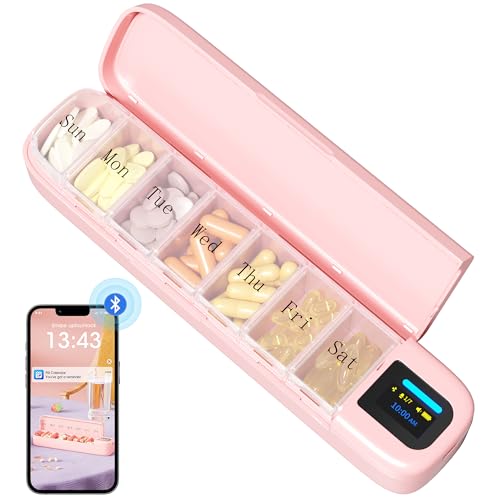
The Daviky sits between a manual box and a full dispenser. It is a 7-day pill case with app-based smart reminders, so it prompts you without the bulk of a carousel machine. The lid opens and closes smoothly, which is pitched as a relief for stubborn lids.
Its compact weekly format makes it the portable pick, and it is easier to take on a trip than any of the carousel dispensers here. The tradeoff is that it does not rotate or lock the way the EziMedPil or Betife do, so the user decides whether to take a dose. Because reminders rely on an app, a person without a smartphone gets little from it.
Compared with the MEDca, it adds reminders for a small step up in price. Compared with the Windtrace, it gives up the loud alarm and large compartments in favor of portability. Choose it for a traveling retiree who is comfortable with a phone.
Best for: Active retirees who travel and use a smartphone
Check price on AmazonSpecs
- Format: 7-day weekly case
- Reminders: Smart alerts with app
- Portability: Travel pill case
- Access: Smooth open and close
Pros
- +Compact 7-day case travels easily
- +App reminders add a nudge
- +Lid opens and closes smoothly
Cons
- −No rotating carousel or dispense lock
- −Reminders depend on a smartphone
- −Listing gives few capacity details
MEDca Weekly Pill Organizer, 4 Times a Day
About this pick
The MEDca is the lowest-cost pick and the only purely manual one. It uses seven stackable compartments, each color-coded for a day, with four sections for morning, noon, evening and bedtime. The top lid is removable so you can stack the trays in order of the week.
It makes sense for someone who is reliable about taking pills and only needs sorting help. There is no alarm, no lock and no log, so it does not solve forgetting. Guidance also advises storing pills in cool, dry places, so keep the stack in a bedroom drawer rather than a bathroom where humidity can spike.
Against the Daviky, it lacks reminders but is simpler and cheaper, and against any carousel dispenser here it is much less secure. It is a sensible add-on for a household that already uses a phone alarm. Treat it as the foundation, not the safety net.
Best for: Reliable pill takers who only need weekly sorting
Check price on AmazonSpecs
- Format: 7 stackable compartments
- Doses: Morning, noon, evening, bedtime
- Day labels: Color for each day
- Lid: Removable flip-top
Pros
- +Seven color-coded stackable days
- +Four doses a day covered per tray
- +Lowest cost among these six
- +Removable lid speeds up weekly fill
Cons
- −No alarm, lock or missed-dose logging
- −Stacked trays take more shelf space
- −Not suited to forgetful users
How We Evaluated These Weekly Automatic Pill Dispensers (2026)
Each pick was assessed across 5 criteria weighted for real-world use.
Alert quality
We compared alarm volume, light cues and the number of daily alerts. The Senyerkare leads on flexibility with up to nine, while the MEDca has no alert at all. Sound plus light combinations scored higher than tone alone. Scores come from specs and buyer feedback, not bench measurement.
Lock and security
We weighed how each model restricts access and how a caregiver can get in. The Betife with fingerprint plus mechanical backup is the strongest, and the MEDca with no lock is the most basic. Top-mounted key locks on the EziMedPil and Senyerkare earned credit for avoiding spills. Kid-proof claims were treated as listing statements.
Weekly refill effort
Because this guide targets weekly routines, refill effort carried heavy weight. The EziMedPil curved lid, the Windtrace removable tray and the MEDca removable top all scored well. We noted that a larger carousel adds counter footprint without helping a seven-day fill. Setup time for dose schedules was also counted.
Caregiver oversight
We checked whether a relative can follow doses. The Betife and Daviky use app features, but remote oversight is limited compared with a true Wi-Fi unit. Standalone units were not penalized unless they promised more than they delivered. Nothing here replaces supervision for advanced cognitive decline.
Value across tiers
A pick scored well if its extras solved a real problem rather than adding menus. The Windtrace and EziMedPil rose here because they cover the essentials without app dependence.
How to Choose the Right Weekly Automatic Pill Dispensers (2026)
By Weekly Routine
Start with how complicated your pill day is.
| Scenario | Recommended pick |
|---|---|
| Simple twice-a-day schedule, wants reliability | EziMedPil 28-Day Automatic Pill Dispenser |
| Many doses spread across the day | Senyerkare Automatic Pill Dispenser with Top Key Lock |
| Wants fingerprint security and voice prompts | Betife 31-Slot Fingerprint Pill Dispenser |
| Hard of hearing | Windtrace 28-Slot Automatic Pill Dispenser |
| Travels often with a smartphone | Daviky Smart Pill Organizer with App |
| Reliable, just needs sorting | MEDca Weekly Pill Organizer, 4 Times a Day |
By Budget
| Budget tier | Recommended pick |
|---|---|
| Lowest-cost pick | MEDca Weekly Pill Organizer, 4 Times a Day |
| Low-cost with app | Daviky Smart Pill Organizer with App |
| Lower mid-range | Windtrace 28-Slot Automatic Pill Dispenser |
| Mid-range | EziMedPil 28-Day Automatic Pill Dispenser |
| Upper mid-range | Senyerkare Automatic Pill Dispenser with Top Key Lock |
| Premium | Betife 31-Slot Fingerprint Pill Dispenser |
Automatic Dispenser vs Manual Box
The core question is whether you need an alarm and a lock.
Automatic
The EziMedPil, Senyerkare, Betife and Windtrace sound alerts, lock pills away and rotate to the right slot. They suit anyone who forgets doses or risks doubling up. The tradeoff is cost and more to program.
Manual
The MEDca and, to a degree, the Daviky leave timing to the user. They are cheap and portable, but they depend on a phone alarm or habit.
Recommendation
Choose the EziMedPil if forgetting is a concern, and the MEDca only if you already take pills reliably.
By Lock and Access Style
The way a unit opens affects safety and daily comfort.
| Preference | Recommended pick |
|---|---|
| Key lock on top, no flipping | EziMedPil 28-Day Automatic Pill Dispenser |
| Top key lock plus many alerts | Senyerkare Automatic Pill Dispenser with Top Key Lock |
| Fingerprint access | Betife 31-Slot Fingerprint Pill Dispenser |
| Simple built-in lock | Windtrace 28-Slot Automatic Pill Dispenser |
| No lock needed | MEDca Weekly Pill Organizer, 4 Times a Day |
For Arthritic Hands Specifically
Look for
A curved or press-to-open lid, controls with large symbols, and a refill method that does not require lifting the machine. Avoid lids that need a pinch and twist.
In this comparison
The EziMedPil curved lid and the Betife press-to-open design fit best. The Senyerkare four-button symbol panel helps with programming as well.
When to Spend More
Spend more if
Security matters (Betife), the schedule has many daily times (Senyerkare), or a lock and lid that save you effort every Sunday are worth it (EziMedPil).
Save if
You take pills reliably or already use a phone alarm. The MEDca and Daviky cover the sorting job at lower cost.
Frequently Asked Questions
Is a weekly automatic dispenser better than a manual box?
If forgetting a dose is the problem, yes. An automatic unit such as the EziMedPil sounds an alert and locks pills away until the next dose time. A manual box like the MEDca only helps you sort. Many people pair a manual box with a phone alarm as a cheaper compromise.
How much should I spend?
Start with the lowest-cost MEDca if you only need sorting. Move to the Windtrace or EziMedPil if you need alarms and a lock. The Betife and Senyerkare are worth the higher tier only if you will use fingerprint access or many daily alerts.
How often should I check or clean it?
Wipe the tray weekly at refill time and keep the unit in a cool, dry bedroom rather than a bathroom, where humidity can reach 100 percent at times. Check batteries monthly and replace cells about every 60 days if the model is battery powered. Remove the tray if the unit allows it, as the Windtrace does.
Do I need Wi-Fi for these?
Not for any of the dispensers in this guide to sound alarms. The Betife and Daviky use app features, which may rely on a phone. Remote caregiver alerts generally need Wi-Fi and a stable home network. If you want remote monitoring, look at a Wi-Fi model in a related guide.
Can I put all my medications in one?
Check with a pharmacist first. Guidance advises against moving pills to unlabeled containers unless storage conditions are suitable, and some humidity-sensitive drugs should stay in original bottles. Test-fill with your real pills to confirm they fit.
Will a dispenser help with dementia?
It can reduce missed and double doses, but it does not replace supervision for advanced dementia. A lock and loud alert, like the Windtrace offers, help, yet a caregiver should still check in. Ask the prescriber which device fits.
What if the power goes out?
Some units lack a rechargeable battery and need cell swaps about every 60 days, and USB cords can be knocked loose. Keep spare batteries beside the unit and test the alarm unplugged. Manual boxes like the MEDca are unaffected.
Bottom Line
best overall: EziMedPil 28-Day Automatic Pill Dispenser - best overall pick in this roundup.
See the full rankings above for all picks with pros, cons, and best-for summaries.
Browse on Amazon
All Prime-eligible options with current pricing.
Shop on Amazon →