6 Best Walking Canes Under $50 in 2026
Six walking canes at the top of the budget range compared on quad and pivot bases, stated capacity, height range and comfort, with what more spend adds.




At a Glance
At the top of the budget range a walking cane has room for real design choices, and the choices here are less about looks than about how the cane meets the floor and how it sits in the hand. This is the tier where you can pick a conventional quad base, a patented pivoting foot or a molded wide handle, or choose to keep it simple with a light offset cane. Spending more does not guarantee a better fit, so the sensible approach is to match the feature to your actual problem.
This lineup covers six canes from PELEGON, HurryCane, Rehand, Medline, DMI and Comfkey. They include a 2.1 lb quad cane with a 300 lb stated rating, a 4.25 inch SteadiGrip pivot, a four-prong rotating foot with a wide handle, and three lighter single-tip canes that show what extra spend does and does not add. We evaluated each on the specs printed on its product page, with attention to stated capacity and to the gaps in each listing.
A cane is support equipment, so fit and technique come before features. Check the stated weight limit against the user, set the handle at a relaxed wrist height, and ask a physical therapist or clinician to confirm the cane type, hand side and technique, especially after surgery or when steadiness has changed. Nothing here is medical advice or a claim of medical benefit.
6 Criteria to Look For Before Buying a Walking Canes Under $50
Key buying criteria so you get the right fit the first time.
Stated weight capacity
Among these six, only the PELEGON and Medline state 300 lb and the DMI 250 lb, while the HurryCane, Rehand and Comfkey state none. Choose a limit comfortably above the user's weight, since a cane takes extra load when pushing up from a seat. A missing rating is a good reason to ask the seller or choose a cane that states one. A clinician can advise if you are near a limit.
Base type
A fixed four-prong base like the PELEGON's is steady on flat floors and has no joint to wear. A pivoting foot like the HurryCane's 4.25 inch SteadiGrip or the Rehand's rotating foot follows angled ground better. A single tip, as on the Medline, DMI and Comfkey, is lightest but will not stand by itself. A therapist can advise which suits your gait.
Height range and fit
A common guide is to set the handle near wrist-crease height with a gentle elbow bend, and a clinician should confirm the final setting. The PELEGON spans 29.5 to 38.4 inches, the Medline 29 to 38, the DMI 30 to 39 and the HurryCane 30.5 to 37.5. The Comfkey covers only 33 to 37 inches. Check both ends against your own measurement, not only the middle.
Handle shape and material
The Rehand uses a longer, wider soft TPR handle, the Medline and DMI use offset grips, the HurryCane a T handle and the Comfkey a contour grip. A wide grip spreads contact over more of the palm, while an offset grip keeps the shaft under the hand. Match the handle to your hand and any wrist sensitivity. A therapist can advise if comfort is a concern.
Weight and folding
The Medline is under 1 lb and the DMI 12 oz, while the PELEGON is 2.1 lb. The HurryCane folds to 13.7 inches and the Comfkey uses five snap-out sections. A heavier cane can feel more planted but is harder to carry, and folding canes need a lock check before every use. Choose by routine and strength.
What more spend adds
Compared with cheaper tiers, this band adds quad and pivoting bases and sometimes a travel bag. It does not guarantee a stated rating, as three listings here show. Pay for a rating, a base or a handle you will actually use. If you do not need those, a simple Medline is enough.
6 Best Walking Canes Under $50 in 2026
PELEGON Quad Cane, 300 lb
About this pick
The PELEGON is the cane in this group that gives you the most for your attention: a four-prong base that stands on its own, a stated 300 lb capacity and a 29.5 to 38.4 inch range that is the widest here. Each prong has an anti-slip rubber tip, and the listed weight is 2.1 lb. The maker says the medium-sized base suits smooth indoor floors and most flat outdoor surfaces.
A quad base is a different kind of aid from the single tips on the Medline or DMI. It stays upright beside a chair and spreads support across four points, at the cost of bulk and less comfort on stairs. The listing says the 300 lb figure comes from lab testing, which is a claim from the maker and not an independent certificate.
In ownership, check the four tips and the height pin, and replace the rubber when the tread smooths out. It does not fold, so it is less portable than the HurryCane at 13.7 inches folded. Compared with the Medline, it adds a standing base and a wider range but weighs more. For someone who wants a conventional quad cane with a clear rating, it is the best all-round pick.
Best for: Users who want a conventional standing quad cane with a clear 300 lb rating and a wide range.
Check price on AmazonSpecs
- Base: Four-prong, medium
- Height range: 29.5 to 38.4 in
- Stated capacity: 300 lb
- Weight: 2.1 lb
Pros
- +Widest range here at 29.5 to 38.4 inches
- +States a 300 lb capacity
- +Four prongs with rubber tips stand on their own
- +Reaches both shorter and taller users
Cons
- −At 2.1 lb it is heavier than the single-tip canes
- −Does not fold for travel
- −Base does not pivot on slopes
HurryCane Freedom Edition Foldable Cane
About this pick
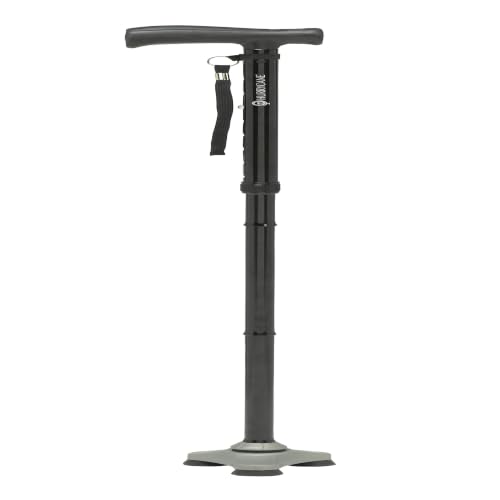
The HurryCane puts its effort into the foot. A 4.25 inch SteadiGrip base with a WhisperFlex pivoting design gives three-point contact and lets the cane stand independently. The shaft adjusts from 30.5 to 37.5 inches and the cane collapses to 13.7 inches for travel.
The handle is a T shape, and the listing ties the product to Drive Medical, a recognized maker of mobility products. The page does not state a weight capacity, which is the key caution, because the PELEGON states 300 lb and the cane is a fold-and-pivot design with more moving parts. A pivot keeps the foot flatter on angled ground but also adds a joint that can loosen.
Ownership centers on the fold lock and the pivot, so check both periodically. It is the most portable standing cane in this group, and the PELEGON is the more conventional choice. Compared with the Rehand's rotating four-prong foot, it uses three-point contact on a slightly wider base. For people who want a folding cane that stands up on its own, it is a distinctive pick once you confirm the rating.
Best for: Travelers who want a folding cane with a pivoting standing foot, after confirming capacity.
Check price on AmazonSpecs
- Base: SteadiGrip, 4.25 in, three-point
- Height range: 30.5 to 37.5 in
- Folded length: 13.7 in
- Handle: T handle
Pros
- +4.25 inch pivoting base stands on its own
- +Folds to 13.7 inches
- +30.5 to 37.5 inch range
- +Pivot keeps contact on uneven ground
Cons
- −Weight capacity is not stated
- −Pivot and fold add parts to inspect
- −T handle gives less palm area than the Rehand's grip
Rehand Folding Self-Standing Pivot Cane
About this pick
The Rehand combines a four-pronged rotating foot with a handle that is longer and wider than a typical T grip. The wide handle uses soft TPR material to spread contact over the palm, and a nylon strap goes on the wrist. The foot has non-slip pads and lets the cane rest upright instead of leaning against a wall.
The stick adjusts in eight one-inch steps with a shaft range of about 31 to 38 inches, which the page ties to users from 5 ft to 6 ft 5 in. It folds in seconds with a hook-and-loop tape and fits into a briefcase or wheelchair bag, and a travel bag is included. The listing does not state a weight capacity, so confirm it before buying.
In use, the rotating foot helps on angled ground but adds a joint to inspect. Compared with the PELEGON's fixed four-prong base, it tilts to follow the surface, and compared with the HurryCane's T handle it offers more palm area. For people who put handle comfort first and will verify the rating, it is a well-considered design.
Best for: Users who want a wide soft handle and a rotating standing foot, after confirming capacity.
Check price on AmazonSpecs
- Base: 4-prong rotating, non-slip pads
- Settings: Eight, one-inch steps
- Shaft range: 31 to 38 in
- Fits: 5 ft to 6 ft 5 in
Pros
- +Longer, wider handle spreads palm contact
- +Four-pronged rotating foot stands on its own
- +Eight one-inch height steps
- +Travel bag included
Cons
- −Weight capacity is not stated
- −Rotating foot adds a joint to inspect
- −Shaft starts at about 31 inches
Medline Aluminum Offset Walking Cane
About this pick
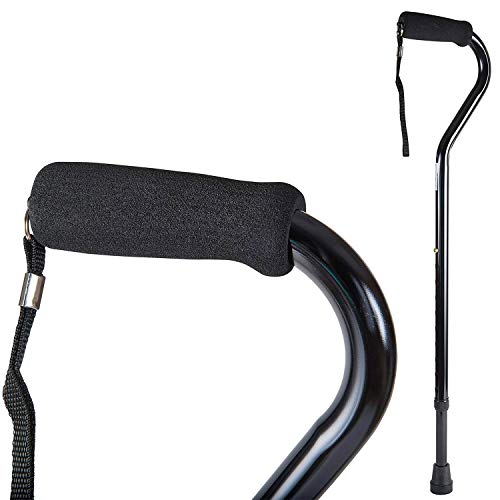
The Medline is what you buy when you do not need a base to do anything clever. It is an aluminum cane listed at under 1 lb with a foam offset handle, a wrist strap and a rubber pad on the bottom. The height runs from 29 to 38 inches and the stated capacity is 300 lb.
At the top of the budget range, it is also the reminder that more spend does not automatically mean a better cane. It states the same 300 lb as the PELEGON in far less weight, and its 29 inch low end matches nearly everything else here. What it lacks is a standing base and a fold.
Day to day, set the height, confirm the push button and check the rubber pad. Compared with the DMI at 12 oz and 250 lb, it states more capacity and a lower low end. For anyone who wants a dependable single-tip cane with a clear rating, it remains the benchmark.
Best for: Users who want a dependable single-tip cane with a clear 300 lb rating and a low 29 inch setting.
Check price on AmazonSpecs
- Handle: Offset, foam
- Height range: 29 to 38 in
- Stated capacity: 300 lb
- Weight: Under 1 lb
Pros
- +Low end of 29 inches
- +States a 300 lb capacity
- +Listed under 1 lb
- +Foam offset grip with a strap
Cons
- −Does not stand on its own
- −Does not fold
- −No pivot or shock-absorbing features
DMI Adjustable Offset Walking Cane
About this pick
The DMI is a light offset cane with the tallest range in this group, adjusting from 30 to 39 inches in one-inch steps. It weighs a listed 12 oz, has a locking ring that the maker says stops rattling and comes with a soft offset handle and a wrist strap. The stated capacity is 250 lb.
The 39 inch ceiling helps taller users who run out of height on cooler 36 or 38 inch canes, while the 250 lb rating is lower than the PELEGON's and the Medline's 300 lb. It does not fold and does not stand on its own, so it is a simple cane in the same family as the Medline.
Ownership is simple: set the height, tighten the ring and check the tip. Compared with the Comfkey, it states a capacity and has an offset handle, and compared with the HurryCane it is far simpler. For tall, lighter users who want a quiet shaft, it is a good value.
Best for: Taller, lighter users who want a quiet offset cane with a 39 inch top.
Check price on AmazonSpecs
- Height range: 30 to 39 in, one-inch steps
- Weight: 12 oz
- Stated capacity: 250 lb
- Handle: Soft offset with strap
Pros
- +39 inch top is the tallest here
- +Locking ring stops rattling
- +Listed at 12 oz
- +States a 250 lb capacity
Cons
- −250 lb capacity is below the 300 lb canes
- −Does not fold or stand on its own
- −30 inch minimum is high for shorter users
Comfkey Folding Aluminum Walking Stick
About this pick
The Comfkey is a five-section folding aluminum walking stick whose sections snap out automatically, with a brass collar, a contour grip and a removable hand strap. The adjustment runs from 33 to 37 inches, and the listing frames it for travel, camping and hiking as well as everyday walking. The base is non-slip rubber with extra wear resistance.
It is the least medical-looking cane in this group, which some buyers prefer. The listing does not state a weight capacity, so confirm it before relying on the stick, and the five sections mean five joints to check. The 33 to 37 inch range is narrower than the Medline's 29 to 38 inches.
Ownership is simple: snap the sections out, confirm they lock and check the rubber tip. Compared with the HurryCane, it has no standing foot, and compared with the PELEGON it states no rating. For a stylish folding stick used occasionally, it is a fine choice.
Best for: Occasional users who want a stylish folding stick for travel and outings.
Check price on AmazonSpecs
- Sections: Five, snap out automatically
- Height range: 33 to 37 in
- Detail: Brass collar
- Grip: Contour with removable strap
Pros
- +Sections snap out automatically
- +Brass collar and removable strap
- +Contour grip and wear-resistant rubber base
- +Folds for bags and luggage
Cons
- −Weight capacity is not stated
- −Five sections add joints to check
- −33 to 37 inch range is narrow
How We Evaluated These Walking Canes Under $50
Each pick was assessed across 5 criteria weighted for real-world use.
Stated capacity and rating clarity
We recorded each weight limit as printed. The PELEGON and Medline state 300 lb, the DMI 250 lb, and the HurryCane, Rehand and Comfkey state none. We treated clear ratings as a plus.
Base design
We compared a fixed four-prong base on the PELEGON, a 4.25 inch pivot on the HurryCane, a rotating foot on the Rehand and single tips on the Medline, DMI and Comfkey. We noted joints that add inspection work.
Height range and fit
We compared adjustment ranges. The PELEGON spans 29.5 to 38.4 inches, the Medline 29 to 38 inches and the DMI 30 to 39 inches. Final fit is something a clinician should confirm.
Handle comfort and portability
We looked at handle shape and fold size, from the Rehand's wide TPR grip to the HurryCane's 13.7 inch fold and the Comfkey's five-section stick.
Value positioning
We placed each cane by buyer. The PELEGON is the conventional quad, the HurryCane the folding pivot, the Rehand the handle pick, the Medline the simple cane, the DMI the tall option and the Comfkey the stylish folder. Scores reflect specs, not hands-on use.
How to Choose the Right Walking Canes Under $50
By Stated Capacity
Capacity is the first filter because it sets a hard limit.
| Situation | Pick | Why |
|---|---|---|
| Needs 300 lb with a standing base | PELEGON Quad Cane, 300 lb | States 300 lb on a four-prong base. |
| Needs 300 lb, single tip | Medline Aluminum Offset Walking Cane | States 300 lb at 29 to 38 inches. |
| Lighter user, tall | DMI Adjustable Offset Walking Cane | States 250 lb with a 39 inch top. |
| Rating not stated, folding pivot | HurryCane Freedom Edition Foldable Cane | Confirm capacity with the seller. |
| Rating not stated, wide handle | Rehand Folding Self-Standing Pivot Cane | Confirm capacity with the seller. |
Choose a limit well above the user's weight and confirm with a clinician.
By Budget
Relative tiers show what added spend gets inside this band.
| Tier | Pick | What you get |
|---|---|---|
| Entry | Medline Aluminum Offset Walking Cane | A simple cane with a clear 300 lb rating. |
| Entry to mid | DMI Adjustable Offset Walking Cane | A taller range and a locking ring. |
| Mid | Comfkey Folding Aluminum Walking Stick | A stylish five-section folder. |
| Mid to premium | PELEGON Quad Cane, 300 lb | A conventional quad with the widest range. |
| Premium | HurryCane Freedom Edition Foldable Cane | A folding pivoting foot. |
Tier placement reflects relative listing positioning within the budget and may change, so check the current product page.
Standing Base vs Single Tip
A standing base changes what happens when you let go.
Standing base
A standing base lets the cane stay upright beside a chair. The PELEGON uses a fixed four-prong base, the HurryCane a 4.25 inch pivot and the Rehand a rotating foot. Choose one if bending to pick up a cane is a daily annoyance, and ask a clinician whether it gives enough support.
Single tip
A single tip is light and simple, but the cane leans or falls when you let go. The Medline, DMI and Comfkey use single tips. Choose one if you rarely put the cane down and want the lightest foot.
A standing base is not the same as a wide quad cane.
By Height Fit
Height range separates similar canes.
| Need | Pick | Detail |
|---|---|---|
| Widest range | PELEGON Quad Cane, 300 lb | 29.5 to 38.4 inches. |
| Shorter user | Medline Aluminum Offset Walking Cane | Low end of 29 inches. |
| Taller user | DMI Adjustable Offset Walking Cane | Tops out at 39 inches. |
| Fine steps | Rehand Folding Self-Standing Pivot Cane | Eight one-inch steps. |
Check both ends of the range against your measurement.
For Travel and Outings Specifically
Outings favor a cane that folds and stays upright.
Look for
A secure fold, a standing foot and a stated rating above your weight. A travel bag is a useful extra.
In this comparison
The HurryCane folds to 13.7 inches and the Rehand includes a travel bag, while the Comfkey is a five-section folder. Have a clinician confirm your technique.
A cane does not replace help on difficult terrain.
When to Spend More
A step up often buys a base or a handle.
| Spend more if | Save if |
|---|---|
| You want the PELEGON's standing quad base | A single tip like the Medline is fine |
| You want the HurryCane's folding pivot | A fixed shaft is enough for you |
| You want the Rehand's wide handle | A standard grip is comfortable |
| You are tall and need the DMI's 39 inch top | 37 to 38 inches is enough |
Always check the stated capacity and height range before buying.
Frequently Asked Questions
What does the top of the budget range add?
It adds quad and pivoting bases, wider handles and sometimes travel bags. It does not guarantee a stated rating, as the HurryCane, Rehand and Comfkey show. If you do not need those features, a simple cane is enough.
What weight limit should I choose?
Pick a stated limit comfortably above the user's weight. The PELEGON and Medline state 300 lb and the DMI 250 lb, while three listings state none. A cane takes extra load when pushing up from a seat. Ask a clinician if you are near a limit.
How do I set the height correctly?
A common guide is to stand relaxed and set the handle near wrist-crease height, leaving a gentle bend in the elbow. Ranges run from 29 inches on the Medline to 39 inches on the DMI. Make sure the lock is fully engaged. A therapist can confirm the final setting.
Is a pivoting foot better than a fixed quad?
Neither is automatically better. A pivot follows slopes but adds a joint that can wear, while a fixed quad such as the PELEGON's is steady on flat floors. A therapist can say which suits your gait. Inspect any pivot regularly for looseness.
Which hand holds the cane?
A cane is generally held in the hand opposite the weaker leg, though you should confirm this with a physical therapist or clinician. The wrong side can reduce stability. Most standard handles work in either hand.
Can I use a quad cane on stairs?
It depends on the person and the stairs. A wide base may not fit a tread and technique varies with strength and gait. A therapist should demonstrate stair technique before you rely on a quad cane there.
How often should I replace the feet or tip?
Check the tip or feet every few weeks and replace them when the tread looks smooth, cracked or uneven. A worn foot loses traction and can slip. Inspect any pivot joint for looseness at the same time.
Bottom Line
best overall: PELEGON Quad Cane, 300 lb - best overall pick in this roundup.
See the full rankings above for all picks with pros, cons, and best-for summaries.
Browse on Amazon
All Prime-eligible options with current pricing.
Shop on Amazon →