5 Best Ultrasonic Cleaners for Rust Removal in 2026
We compared five ultrasonic cleaners for rust and workshop grime on tank size, heating, frequency and basket design, with honest limits on what rust needs.


At a Glance
Rust is where most buyers expect ultrasonic cleaners to do the most, and where the marketing runs furthest ahead of the physics. Cavitation bubbles are excellent at lifting oil, flux, wax and loose scale out of threads and crevices. Rust is an oxide that is chemically bonded to the metal, so water alone only loosens the flaky surface layer, and a real rust job usually pairs the machine with a rust-removal solution.
We evaluated five ultrasonic cleaners based on product specs and buyer feedback, concentrating on what helps a workshop restoration: tank capacity, heater power, frequency, basket design and how easy each is to fill and drain. The lineup spans a heated 3 L workshop tank to a 600 ml jewelry tub and a portable wand that works in a bucket.
Use the picks as a starting point, then work through the criteria and decision tables to match a machine to the parts you actually need to restore.
6 Criteria to Look For Before Buying a Ultrasonic Cleaners for Rust Removal
Key buying criteria so you get the right fit the first time.
Know What Ultrasonics Can't Do
Rust is iron oxide bonded to the metal, and cavitation bubbles lift dirt rather than dissolve oxide. Plain water in a machine like the Magnasonic will loosen flaking scale and oily grime but leave the underlying rust intact. The Magnasonic listing even notes it does not remove tarnish, which is the same kind of chemical change. Plan on a rust-removal solution as part of the process, and treat the machine as the thing that moves that solution into threads and crevices.
Heater Power and Tank Warmth
Warm fluid helps a rust-removal solution work faster, so a heater is the single most useful feature for this job. The VEVOR 3L Enhanced offers a 200W heater up to 80 C, while the CREWORKS offers up to 100W across 68 to 176 F. The VisiClean maker advises against hot water entirely, and the Magnasonic and the wand have no heater listed. If rust is your main use, shortlist the VEVOR first.
Tank Size Versus Your Parts
Rust jobs tend to involve tools, hardware and engine parts that are bigger than jewelry. A 3 L tank, as on the VEVOR and CREWORKS, holds hand tools and small engine pieces, while the 800 ml VisiClean and 600 ml Magnasonic suit screws, small fasteners and light hardware. If a part is longer than the tank, no amount of power will help. The 60 kHz wand is the exception, since it works in any bucket you can find.
Frequency and Cavitation Strength
Lower frequency produces larger, more aggressive bubbles, and higher frequency produces smaller, gentler ones. The VEVOR runs at 40 kHz with 120W from two transducers, the Magnasonic and VisiClean run at 42,000 Hz, and the wand runs at 60 kHz. For tough soils, 40 kHz is the better direction. For delicate, pitted or plated items, the higher frequencies are safer.
Solution and Tank Compatibility
Putting an acidic or corrosive rust remover directly into a stainless tank can harm the tank over time, and some makers warn against it. Many people clean in a separate beaker or container placed in the water bath. Check each manual, because the VisiClean maker already limits water temperature and run time. The wand avoids the question because you supply the container.
Timer Length and Repeat Cycles
Most home units cap a run at around 30 minutes, which is the case for the VEVOR 3L and CREWORKS timers. The VisiClean maker says not to exceed 30 minutes and the Magnasonic uses preset cycles. Heavily rusted parts are normally done in several rounds, with a fresh solution and a brush check in between. Do not treat the timer limit as a defect; it protects small units from overheating.
5 Best Ultrasonic Cleaners for Rust Removal in 2026
VEVOR 3L Enhanced Ultrasonic Cleaner with Heater
About this pick
The VEVOR 3L is the strongest all-round machine in this guide for workshop restoration. It runs at 40 kHz with 120W of ultrasonic power from two transducers, which is the standard general-purpose range for parts. A 200W heater takes the bath to 80 C, and the 304 stainless tank holds 3 L, enough for a set of hand tools or a small engine part.
Heat is the real advantage for rust projects, because warmed fluid helps a rust-removal solution work faster and loosens grease that hides rust beneath it. The tradeoff is size and effort: it needs counter space, a place to drain 3 L, and sensible care when heat and chemicals are involved. The maker says it is also rated for CE, FCC and RoHS, and it has anti-slide feet, a portable handle and a stainless lid.
Daily ownership is simple, fill, set the time and temperature on the digital controls, run, and lift out the parts. The timer tops out at 30 minutes, so heavily rusted parts need several rounds. At 3 L it holds far more than the Magnasonic at 600 ml, and its 200W heater is stronger than the CREWORKS at up to 100W of heating.
Best for: Workshop users who restore tools and small metal parts and want heat plus a roomy tank.
Check price on AmazonSpecs
- Tank: 3 L, 304 stainless steel
- Frequency: 40 kHz
- Ultrasonic power: 120W, 2 transducers
- Heating: 200W, 0-80 C
- Timer: 0-30 minutes
Pros
- +A 200W heater reaches 80 C so rust solutions and grease loosen faster
- +The 3 L tank holds hand tools and small engine parts in one batch
- +Two transducers at 120W give the strongest cavitation here at 40 kHz
- +The 304 stainless tank resists corrosion and has anti-slide feet
Cons
- −The 30 minute timer means heavily rusted parts need several rounds
- −It is bulky and you need a drain plan for 3 L of used fluid each time
- −Ultrasonics alone will not remove tight rust without a solution
CREWORKS 3L Digital Ultrasonic Cleaner
About this pick
The CREWORKS is a 3 L digital cleaner with a stainless steel tank and basket, up to 100W of heating and a temperature range from 68 to 176 F. The maker says it removes rust, tarnish and other stains from jewelry, utensils and similar items, and it describes an intuitive push-button panel with a timer up to 30 minutes. Inset handles, non-skid rubber feet and two built-in fuses round out the practical design.
It is a lower-powered choice for rust than the VEVOR, with half the heating wattage, and the listing does not give an ultrasonic frequency or wattage. That is a gap, because frequency and power drive how aggressively the bath works. It is also a more consumer-friendly machine, so it suits lighter restoration, such as old kitchen utensils, hardware and small hand tools.
Ownership is easy thanks to the inset handles and the stainless basket, which keeps parts off the tank floor. It matches the VEVOR 3L on capacity, but the heater is weaker, so warming a full 3 L bath takes longer. Against the VisiClean at 800 ml it holds almost four times as much fluid.
Best for: Home restorers with kitchenware, hardware and small tools who want a roomy 3 L tank.
Check price on AmazonSpecs
- Tank: 3 L (0.8 gal), 304 stainless
- Heating: Up to 100W
- Temperature: 68-176 F
- Timer: Up to 30 minutes
- Safety: Two built-in fuses
Pros
- +The 3 L tank holds utensils, hardware and small tools together
- +Heating runs from 68 to 176 F so you can warm a rust solution
- +A stainless basket keeps parts off the tank floor and is easy to lift
- +Inset handles, rubber feet and two fuses add handling and safety
Cons
- −Up to 100W of heating is half the VEVOR 3L, so a full bath warms slowly
- −The listing gives no ultrasonic frequency or power figure to compare
- −A 30 minute timer cap means stubborn rust needs several repeated cycles
Portable 60kHz Ultrasonic Cleaner Wand
About this pick
This wand takes a different approach: instead of a fixed tank, you place the ultrasonic head in a sink, basin or bucket and let it work on whatever fits. The listing says it runs at 60 kHz, mentions removing stains and rust from metal parts, and adds an automatic timer plus leakage protection. The container is yours, so size is limited only by what you can fill.
The tradeoff is power. At 60 kHz the bubbles are smaller and gentler than the 40 kHz VEVOR, which suits delicate items but is the wrong direction for tough rust. The listing gives no wattage and no heater, so heated cleaning is not part of the package. It is best thought of as a convenient way to rinse bulky or awkward pieces rather than a restoration machine.
In use it is storage friendly, with no tank to empty and no big base. Compared with the fixed 3 L VEVOR tank, it handles larger items but cannot hold a heated, controlled bath. Use it for light surface cleaning, or for bulky pieces that will not fit anywhere else.
Best for: People who need to clean bulky items in a bucket and accept gentler, unheated cleaning.
Check price on AmazonSpecs
- Type: Portable immersion wand
- Frequency: 60 kHz
- Container: Sink, basin or bucket
- Timer: Automatic timer
- Safety: Leakage protection
Pros
- +Works in any sink, basin or bucket, so item size is not capped
- +An automatic timer lets you start a cycle and walk away from the sink
- +Leakage protection and waterproof materials add a safety margin
- +No fixed tank to empty or store, so it is easy to put away afterward
Cons
- −At 60 kHz the bubbles are gentler, which suits rust less than 40 kHz
- −No heater is listed, so warm cleaning is not an option with this wand
- −No power figure is given, so its strength is hard to compare fairly
Magnasonic 20oz Stainless Steel Ultrasonic Cleaner
About this pick
The Magnasonic is a compact 600 ml cleaner that runs at 42,000 Hz and offers five cycles on a digital display. Its listing names tools, coins and automotive parts alongside jewelry and eyeglasses, so it is a multipurpose household machine. A basket is included, and the stainless tank is described as anti-corrosion and scratch-free.
The tradeoff for rust is clear. At 42,000 Hz and 600 ml it is aimed at everyday grime, and it has no heater. The maker also says it does not remove tarnish, which is a chemical change like rust, so it will not dissolve oxidation by itself. It can lift loose scale and oily dirt from small hardware, screws and cutlery, but a seized, heavily rusted part is beyond it.
As an owner you fill it with tap water, pick a cycle and lift out the basket, with no controls to learn. It holds a fraction of what the 3 L VEVOR does, which makes it a better fit for small parts such as screws and fasteners. Next to the VisiClean at 800 ml, it is slightly smaller and lacks the second transducer.
Best for: Light rust spots on small hardware, with the machine doubling for jewelry and glasses.
Check price on AmazonSpecs
- Frequency: 42,000 Hz
- Tank: 20 oz (600 ml) stainless steel
- Cycles: 5 preset modes
- Controls: Digital timer and display
- Basket: Included
Pros
- +Five preset cycles remove the usual guesswork about how long to run it
- +The stainless tank resists corrosion and will not scratch parts
- +The included basket protects both the tank floor and the items inside
- +Compact enough to leave on a shelf and use for jewelry as well
Cons
- −No heater is included, so warmed rust solutions are not an option here
- −The maker states it does not remove tarnish, which applies to rust
- −The 600 ml tank cannot take hand tools or larger engine parts at all
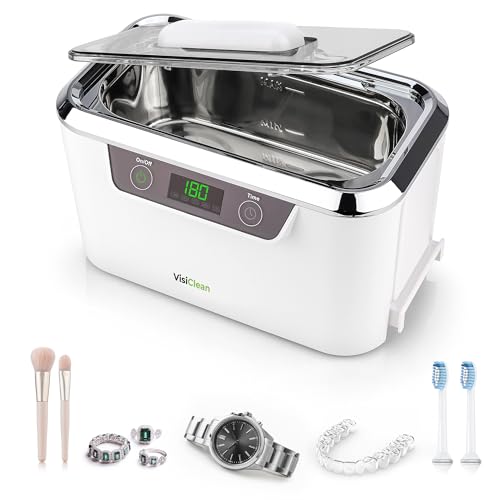
VisiClean 800 ml Dual Transducer Ultrasonic Cleaner
About this pick
The VisiClean pairs 42,000 Hz output with two transducers and an 800 ml (27 oz) stainless tank, plus a cooling fan, touch controls and five presets. The lid is removable and non-hinged, and the power cord detaches, which makes filling and storage easier. The maker lists jewelry, glasses, dentures, CPAP parts and coins as the target items.
It has a caution built in: the maker advises against hot water and against running more than 30 minutes at a time. That rules out a heated rust solution, and it means the machine is a general cleaner rather than a restoration tool. The dual transducers add some power, but at 42,000 Hz the cleaning is on the gentler side compared with 40 kHz units.
It is easy to live with, fill with cool water, choose a preset and let it run. For rust it will help with loose flaking on small parts and oily grime, but not with deep corrosion. It holds 800 ml, which is less than a third of the CREWORKS at 3 L, but it takes much less space and needs no drain setup.
Best for: Households that clean jewelry and glasses and want occasional help with light rust on small parts.
Check price on AmazonSpecs
- Frequency: 42,000 Hz
- Tank: 800 ml (27 oz) stainless steel
- Transducers: 2
- Presets: 5
- Cooling: Built-in fan
Pros
- +Dual transducers add power while staying at the gentler 42,000 Hz
- +A removable lid and detachable cord make filling and storage easy
- +The 800 ml stainless tank is roomier than most home-sized tubs
- +A built-in cooling fan helps the unit during repeated short cleaning cycles
Cons
- −The maker advises against hot water, so heated rust solutions are out
- −It should not run beyond 30 minutes, so heavy jobs need rest breaks
- −Not built for tools or any parts larger than the small 800 ml tank
How We Evaluated These Ultrasonic Cleaners for Rust Removal
Each pick was assessed across 5 criteria weighted for real-world use.
Heating and bath control
We looked at whether each machine can warm its bath and how well. The VEVOR 3L Enhanced leads with a 200W heater to 80 C, the CREWORKS offers up to 100W, and the VisiClean advises cool water only. Warmth matters most when a solution does the chemical work.
Cavitation strength
We compared frequency, ultrasonic wattage and transducer count where the listings give them. The VEVOR is the clear lead at 40 kHz, 120W and two transducers. The Magnasonic and VisiClean sit at 42,000 Hz, and the wand's 60 kHz is gentlest.
Tank capacity and fit
Workshop parts are bigger than jewelry. We rated tank volume and whether a basket is included, from the 3 L VEVOR and CREWORKS to the 800 ml VisiClean and 600 ml Magnasonic, with the wand outside the tank limit.
Honesty about rust
We read each listing against what ultrasonics can physically do. Claims about rust removal were treated as dependent on a solution and on part condition, and we scored machines on how well they support that process rather than on a promise.
Ownership and handling
We considered handles, rubber feet, lids, baskets and cooling. The CREWORKS has inset handles and fuses, the VisiClean has a detachable cord and fan, and the VEVOR has a portable handle. We based this on product specs and buyer feedback, not lab measurement.
How to Choose the Right Ultrasonic Cleaners for Rust Removal
By Rust Condition
How bad the rust is decides how much machine and chemistry you need.
| Situation | Pick | Reason |
|---|---|---|
| Heavy rust on hand tools | VEVOR 3L Enhanced Ultrasonic Cleaner with Heater | 200W heating to 80 C and 120W at 40 kHz |
| Moderate rust on utensils and hardware | CREWORKS 3L Digital Ultrasonic Cleaner | A 3 L tank with up to 100W heating |
| Light surface spots on screws | Magnasonic 20oz Stainless Steel Ultrasonic Cleaner | Five cycles at 42,000 Hz for small hardware |
| Flaky scale and oily grime on small parts | VisiClean 800 ml Dual Transducer Ultrasonic Cleaner | Two transducers with an 800 ml tank |
| An item too large for any tank | Portable 60kHz Ultrasonic Cleaner Wand | Works in a bucket or basin of your choosing |
Whatever the machine, serious rust needs a rust-removal solution in the process.
By Budget
Tiers are relative to this lineup.
| Tier | Pick | What you get |
|---|---|---|
| Entry | Magnasonic 20oz Stainless Steel Ultrasonic Cleaner | A compact 600 ml tub for small hardware |
| Entry | Portable 60kHz Ultrasonic Cleaner Wand | No tank and the flexibility of any container |
| Mid | VisiClean 800 ml Dual Transducer Ultrasonic Cleaner | Dual transducers in a roomier home tub |
| Mid | CREWORKS 3L Digital Ultrasonic Cleaner | A 3 L tank with moderate heating |
| Premium | VEVOR 3L Enhanced Ultrasonic Cleaner with Heater | The strongest heater and ultrasonic power here |
Spend where it counts for rust: heater and tank size, not presets.
Fixed Tank vs Portable Wand
These two designs solve the rust problem in very different ways.
Fixed tank
A tank holds a controlled bath, which allows a heater, a basket and a repeatable cycle. The VEVOR 3L Enhanced, CREWORKS 3L, Magnasonic and VisiClean all work this way. The cavitation is concentrated and consistent, but items must fit inside.
Portable wand
The Portable 60kHz Ultrasonic Cleaner Wand sits in a container you supply, so size is limited by the bucket. The cost is a higher 60 kHz frequency, no listed heater and less controlled cleaning. Pick a tank for restoration and the wand for bulky rinsing.
Frequent restoration work: a tank. Occasional oversized rinsing: the wand.
By Part Size
Part size sets your tank limit before any other feature does.
| Part size | Pick | Reason |
|---|---|---|
| Screws, nuts and small fasteners | Magnasonic 20oz Stainless Steel Ultrasonic Cleaner | The 600 ml basket is enough for small hardware |
| Small tools and a few parts at once | VisiClean 800 ml Dual Transducer Ultrasonic Cleaner | 800 ml with two transducers |
| Pliers, wrenches and carburetor bodies | VEVOR 3L Enhanced Ultrasonic Cleaner with Heater | 3 L holds several parts at 80 C |
| Kitchen utensils and mixed hardware | CREWORKS 3L Digital Ultrasonic Cleaner | A 3 L tank with a stainless basket |
| Anything larger than a 3 L tank | Portable 60kHz Ultrasonic Cleaner Wand | The only pick without a fixed tank limit |
For Tool Restoration Specifically
Tools bring oil, paint and rust together, so the order of operations matters.
Look for
A heater that reaches at least the 80 C range, a 3 L or larger tank, a basket that keeps tools off the floor, and a 30 minute timer that you can repeat. Degrease first, because oil shields rust from the solution. Rinse and dry tools immediately so they do not flash-rust.
In this comparison
The VEVOR 3L Enhanced Ultrasonic Cleaner with Heater is the closest match with its 200W heater and 120W at 40 kHz. The CREWORKS 3L Digital Ultrasonic Cleaner is a lower-powered alternative with a similar tank. The smaller tubs suit fasteners, not wrenches.
Dry and oil restored steel promptly, since clean bare metal rusts again fast.
When to Spend More
Upgrade only when your work justifies the heater and tank.
| Spend more if | Save if |
|---|---|
| You restore tools weekly, so the VEVOR 3L Enhanced Ultrasonic Cleaner with Heater 200W heater pays back | You have a few screws to clean, so the Magnasonic 20oz Stainless Steel Ultrasonic Cleaner is enough |
| You need 3 L of capacity for utensils and hardware, so the CREWORKS 3L Digital Ultrasonic Cleaner fits | You mostly clean jewelry, so the VisiClean 800 ml Dual Transducer Ultrasonic Cleaner covers it |
| You want repeatable timed cycles on mixed parts, so a fixed tank like the VEVOR is worth it | You clean oversized pieces rarely, so the Portable 60kHz Ultrasonic Cleaner Wand is enough |
Frequently Asked Questions
Can an ultrasonic cleaner remove rust with just water?
Only the loose, flaking surface layer. Rust is iron oxide that is chemically bonded to the metal, so cavitation in plain water mostly lifts dirt and scale. For real rust removal you pair the machine with a rust-removal solution. Treat the ultrasonic cleaner as the delivery system that gets the solution into threads and crevices.
Which machine here is best for tools?
The VEVOR 3L Enhanced is the strongest, with a 200W heater to 80 C, 120W of ultrasonic power at 40 kHz and a 3 L stainless tank. The CREWORKS 3L is a lower-powered alternative with up to 100W of heating. The smaller tubs are better for fasteners and light hardware. Choose by the largest part you plan to clean.
Is it safe to put rust remover directly in the tank?
Not always. Acidic or aggressive rust removers can harm a stainless tank over time, and some makers advise against them. A common approach is to use a separate container in a water bath. Check your machine's manual first, since the VisiClean maker already limits water temperature and run time.
Will an ultrasonic cleaner damage good metal under the rust?
Cavitation is generally safe on sound steel, but pitted, plated or painted parts can lose coating at lower frequencies. Higher frequencies such as the 42,000 Hz Magnasonic or the 60 kHz wand are gentler. Test one part before running a whole batch. Remember that removing rust shows the pitting that was already there.
Why does my part rust again right after cleaning?
Bare steel with its oxide layer and any protective oil removed rusts quickly in humid air. Rinse and dry parts immediately, then coat them with oil or a protective finish. This is a property of the metal, not a fault of the machine.
Do I need a heater?
For rust projects it is the most useful single feature, because warmth speeds up a rust solution. The VEVOR 3L Enhanced and CREWORKS 3L have heaters, while the Magnasonic, wand and VisiClean do not, and the VisiClean maker advises against hot water. If you only want a light clean of small hardware, a heater is optional.
How long should a rust cycle run?
Most home units cap at 30 minutes, which is the timer range on the VEVOR and CREWORKS. Heavily rusted parts typically need several rounds with fresh solution and a check in between. Do not run small units continuously, because they warm up and can overheat.
Bottom Line
best overall: VEVOR 3L Enhanced Ultrasonic Cleaner with Heater - best overall pick in this roundup.
See the full rankings above for all picks with pros, cons, and best-for summaries.
Browse on Amazon
All Prime-eligible options with current pricing.
Shop on Amazon →