6 Best Ultrasonic Cleaners for Carburetors in 2026
We compared three ultrasonic machines and three carburetor cleaning solutions on tank size, heating, controls and dilution for easy home garage use.




At a Glance
Sylvan Hills 1 Gal Ultrasonic Carburetor and Parts Cleaner
↓ See why we picked itCarburetors collect varnish, gum and fine grit in jets and passages that a brush and a spray can never fully reach, and chasing that grime by hand is fiddly, messy work. An ultrasonic cleaner does the reaching for you, using cavitation bubbles to work through those passages while the parts soak, so your effort goes into the rebuild rather than the scrubbing.
The category is tricky because a good result needs two things, a tank and a solution. We evaluated six products based on product specs and buyer feedback: three machines running from a 3 L bench unit up to a 6.5 L heated tank, and three concentrates that range from a 16 oz-per-gallon mix to a 1:250 ultra concentrate. Together they cover everything from a single small-engine carb to a shelf full of mower and generator parts.
Use the picks as a starting point, then work through the criteria and decision tables to match tank size, heat and solution to the parts you actually clean.
6 Criteria to Look For Before Buying a Ultrasonic Cleaners for Carburetor
Key buying criteria so you get the right fit the first time.
Machine plus solution
A carburetor job needs both a tank and a chemistry, and buying only one leaves you stuck. The FOHERE, CREWORKS and MNTNCO are machines, while the Qucship, Tillbrook and Sylvan Hills are concentrates that do nothing without one. Plain water in a tank loosens light dust, but varnish and gum respond far better to a detergent made for engine metals. If you already own a machine, put your money into a dedicated solution like the Tillbrook at 8 gallons per bottle. If you own neither, the CREWORKS at 3 L paired with the 1 gallon Sylvan Hills makes a complete, long-lasting setup.
Tank size for your parts
Measure your longest carburetor before buying, and leave about an inch of clearance so the part sits fully under the liquid in the basket. A single motorcycle or small-engine carb fits comfortably in about 3 L, while multi-barrel automotive carbs, manifolds and long parts need 6 L or more. The CREWORKS holds 3 L, the MNTNCO's tank measures 11.81 by 6.1 by 5.91 inches, and the FOHERE holds 6.5 L. Cleaning big parts in stages in a small tank is possible, but it doubles the time and wears out the solution faster.
Heat and timer control
Warm solution cuts varnish and fuel residue faster than cold, so a heater earns its place on a carburetor machine. Look for an adjustable temperature and a timer long enough for repeated soak cycles, since 30 minutes is the common ceiling here. The FOHERE pairs a 200W heater with a 176°F maximum set in 1°F steps, while the CREWORKS offers up to 100W across 68 to 176°F. Higher wattage warms a full tank faster, so a 6.5 L tank at 200W is far more practical than a weak heater on a big load.
Concentration and cost per tank
Concentrate strength decides how long a bottle lasts, and it varies enormously across this lineup. For a 6.5 L tank like the FOHERE, the Tillbrook at 16 oz per gallon needs roughly 27 oz per fill, the Qucship needs roughly 24 oz, and the Sylvan Hills at 1:250 needs under 1 oz. That gap matters if you clean parts every weekend, but it hardly matters if you rebuild one carburetor a year. Weigh how often you clean against how much measuring effort you will tolerate before choosing a very high dilution.
Material compatibility
Check what the label lists as safe before you drop a part in. The Qucship names aluminum, copper, zinc, iron, steel, magnesium, alloys, brass and plastic parts, and the Sylvan Hills lists aluminum, brass, copper and steel. Rubber gaskets, O-rings and fuel-sensitive seals are commonly pulled before cleaning, because they are not meant to sit in hot cleaning fluid. When a part mixes metals and plastics, run it cool and short rather than hot and long.
Controls and ease of use
Easy controls matter most for people who clean only a few times a year and forget the settings. The MNTNCO has touch controls, an auto mode and an ECO mode that the listing says saves up to 47% power, while the FOHERE has an LED panel with 1°F temperature steps and a side faucet for draining. The CREWORKS uses simple push buttons with a temperature range of 68 to 176°F. Pick the machine whose panel you would be comfortable operating without the manual.
6 Best Ultrasonic Cleaners for Carburetors in 2026
FOHERE 6.5L Heated Stainless Ultrasonic Cleaner
About this pick
The FOHERE is the most capable machine here and the one that best fits a whole carburetor. It has a 6.5 L (1.7 gallon) 304 stainless steel tank, 180W of ultrasonic output from three 60W transducers, and a 200W heater that you can set up to 176°F in 1°F steps. A digital panel handles a 0 to 30 minute timer, and a side faucet lets you drain the tank without lifting it.
The power and heat are what make it right for varnish and baked-on fuel residue, but they come with tradeoffs. It is a bigger, heavier unit than the 3 L CREWORKS, and it needs bench space plus a place to put 6.5 L of used solution. The listing also recommends preheating for high-temperature jobs, so a cleaning session is not instant. Parts with rubber or plastic pieces still attached should stay out of hot solution.
Day to day, you fill the tank with diluted solution, preheat, load a basket and run a cycle of up to 30 minutes. The faucet makes emptying and filtering used fluid far easier than tipping a full tank. Against the CREWORKS at up to 100W of heating, it doubles the heater output at 200W, and the MNTNCO listing leans on mode names where the FOHERE gives firm wattage figures.
Best for: Home mechanics who clean whole carburetors, manifolds or batches of small-engine parts.
Check price on AmazonSpecs
- Tank: 6.5 L (1.7 gal), 304 stainless steel
- Ultrasonic power: 180W (three 60W transducers)
- Heater: 200W, up to 176°F in 1°F steps
- Timer: 0 to 30 minutes
- Drainage: Side faucet
Pros
- +Three 60W transducers deliver 180W for stubborn varnish and gum
- +The 200W heater reaches 176°F and can be set in precise 1°F steps
- +A 6.5 L stainless tank holds a full carburetor and several small parts
- +The side faucet drains used solution without lifting a full tank
Cons
- −It is the bulkiest unit here and needs dedicated bench space
- −Preheating adds waiting time before a high-temperature cleaning run
- −Draining and disposing of 6.5 L of solution makes small jobs a chore
CREWORKS 3L Digital Ultrasonic Cleaner with Heater
About this pick
The CREWORKS is the mid-size option, a 3 L (0.8 gallon) digital machine with a 304 stainless steel tank and basket and up to 100W of heating. You set a temperature from 68 to 176°F and a timer up to 30 minutes with push-button controls. It is sized for a carburetor body, jets and a handful of small parts at one time.
The tank is less than half the 6.5 L of the FOHERE, so a multi-barrel automotive carb or long parts may need cleaning in stages. Heating at up to 100W is also gentler than the FOHERE's 200W, which means a longer warm-up and slower work on heavy varnish. On the plus side, it is simpler and more compact. The listing talks mostly about jewelry and household items, so you supply the carburetor solution yourself.
Non-skid rubber feet keep it steady, inset handles make it easy to carry to the bench, and two built-in fuses add electrical protection. After a job you empty the tank and rinse the basket. Next to the MNTNCO it gives you a clearly stated 100W heater and 304 steel throughout, and against the 6.5 L FOHERE it saves bench space at the cost of capacity.
Best for: Hobbyists cleaning one or two motorcycle or small-engine carburetors at a time.
Check price on AmazonSpecs
- Tank: 3 L (0.8 gal), 304 stainless steel
- Heating: Up to 100W
- Temperature: 68 to 176°F
- Timer: Up to 30 minutes
- Protection: Two built-in fuses
Pros
- +A 3 L tank fits a carburetor body, jets and small parts in one load
- +Adjustable heat runs from 68 to 176°F, with a timer up to 30 minutes
- +Both tank and basket are 304 stainless steel built for repeated use
- +Inset handles and non-skid feet make it steady and easy to move
Cons
- −Up to 100W of heat is slower than the FOHERE on heavy varnish
- −A 3 L tank can force large or long parts to be cleaned in stages
- −The listing focuses on jewelry, so you must choose your own solution
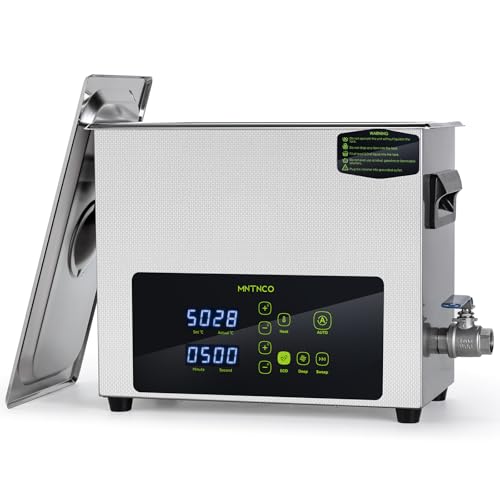
MNTNCO Touch Control Ultrasonic Cleaner with ECO Mode
About this pick
The MNTNCO is the easiest machine here to operate. It uses touch controls, an auto mode that starts with one touch, a sweep mode, a deep mode and an ECO mode that the listing says can cut power use by up to 47%. The inner tank measures 11.81 by 6.1 by 5.91 inches, long enough to lay a carburetor down flat, and a carrying handle helps with moving it.
The tradeoff is information. The listing leans on mode names rather than wattage or tank volume, so you cannot compare its cleaning power with the FOHERE's 180W on paper. It also promotes jewelry and general cleaning more than engine work, which means you will want a dedicated solution such as the Tillbrook or the Qucship. Heating is listed as a feature, but no temperature range appears in the bullets we reviewed.
Setup follows the steps in the listing: open the lid, add solution, lower the basket into the tank, power on and pick a mode. The auto mode removes the guesswork for a first-time user. Against the CREWORKS, which has a clearly stated 68 to 176°F range, the MNTNCO gives you more preset logic but fewer hard numbers to plan around.
Best for: First-time users who want one-touch modes and a tank long enough for a carburetor.
Check price on AmazonSpecs
- Controls: Touch panel
- Modes: Auto, sweep, deep and ECO
- Energy saving: ECO mode, up to 47%
- Tank size: 11.81 x 6.1 x 5.91 in
- Handling: Ergonomic carrying handle
Pros
- +Touch controls and a one-touch auto mode make a first run simple
- +Sweep, deep and ECO modes add choice without a complicated menu
- +ECO mode is listed as saving up to 47% of power use on lighter jobs
- +An 11.81 inch long tank lets a carburetor lie flat in the basket
Cons
- −The listing gives no wattage or tank volume to compare with the others
- −No temperature range is shown in the feature list we reviewed
- −It is marketed for general cleaning, not engine parts specifically
Qucship 8X Ultrasonic Carburetor Cleaner, 128 oz
About this pick
The Qucship 128 oz jug is a dedicated engine-parts concentrate. Its 8X formula turns 1 gallon of concentrate into 9 gallons of working solution, and the maker aims it at carburetors, fuel injectors, generators, oil pans and pistons. It is listed as safe for aluminum, copper, zinc, iron, steel, magnesium, alloys, brass, plastic parts and coins.
Because it covers so many materials, it is a forgiving choice if your shop sees mixed parts. The tradeoff is that you still need a machine, and you should follow the label for dilution and soak time rather than guessing. A jug this size also suits regular use, and an occasional user may never finish it. Mixing a full tank from scratch every time is the main chore.
Ownership is simple: dilute into the tank, run the cycle, and replace the solution once it turns dark and dirty. Used solution should be disposed of according to local rules. Against the Tillbrook, which mixes at 16 oz per gallon, the Qucship is in a similar strength class, while the Sylvan Hills at up to 200 gallons per gallon of concentrate is far more concentrated.
Best for: Garage users with mixed metal parts who clean carburetors and engine pieces regularly.
Check price on AmazonSpecs
- Size: 128 oz (1 gallon) concentrate
- Yield: Up to 9 gallons of solution
- Strength: 8X concentrate
- Targets: Carburetors, injectors, oil pans, pistons
- Metals: Aluminum, copper, zinc, iron, steel, magnesium, brass
Pros
- +One gallon of concentrate makes up to 9 gallons of working solution
- +Aimed at carburetors, injectors, pistons, oil pans and generator parts
- +Listed as suitable for aluminum, brass, steel, zinc, copper and more
- +The 8X concentrate stores compactly compared with ready-mixed fluid
Cons
- −A 128 oz jug is more than an occasional user is likely to finish
- −Less concentrated than the Sylvan Hills, so it goes through a tank faster
- −It does nothing without a machine, so a tank must be bought separately
Tillbrook Ultrasonic Cleaner Solution, Makes 8 Gallons
About this pick
The Tillbrook is a US-made concentrate aimed squarely at carburetors, injection parts and other metals. It is described as removing dirt, varnish and gums, and the listing calls the formula free of unnecessary harsh chemicals. Mixing is simple: 2 cups (16 oz) of concentrate per gallon, and the product makes 8 gallons in total.
That ratio is easy to measure with a kitchen cup, which suits a beginner. The tradeoff is dilution, because at 16 oz per gallon a 6.5 L tank like the FOHERE uses roughly 27 oz per fill, so heavy users go through a bottle much faster than with the Sylvan Hills. The listing says it works with an ultrasonic machine to reach cracks, crevices and blind holes, so it is not meant as a soak-only cleaner.
Plan to dilute into the tank, run the cycle, filter or replace the fluid as it darkens, and rinse parts with clean water before drying. Next to the Qucship at 9 gallons from 1 gallon of concentrate, it is a close match for strength, but it states the mix ratio more plainly. The Sylvan Hills at 1:250 is the better pick if you want to stretch one bottle across many seasons.
Best for: Beginners who want a clearly stated mix ratio for carburetor and injector cleaning.
Check price on AmazonSpecs
- Yield: Makes 8 gallons
- Mix ratio: 2 cups (16 oz) per gallon
- Origin: Made in USA
- Targets: Dirt, varnish, gums, contaminants
- Parts: Carburetors, valves, injection parts
Pros
- +The 2 cups per gallon ratio is easy to measure with a kitchen cup
- +Made in the USA and aimed directly at carburetors and injection parts
- +Targets varnish, gums and dirt in cracks, crevices and blind holes
- +A clear 8 gallon yield makes it easy to plan how many tanks you get
Cons
- −At 16 oz per gallon it is used up much faster than the Sylvan Hills
- −A large tank like the 6.5 L FOHERE takes roughly 27 oz per fill
- −It needs an ultrasonic machine and is not a soak-only cleaner
Sylvan Hills 1 Gal Ultrasonic Carburetor and Parts Cleaner
About this pick
The Sylvan Hills 1 gallon bottle is the value-per-use leader. It mixes at 1:250 with water, and the listing says one gallon of concentrate makes up to 200 gallons of cleaning fluid. It is made and bottled in the USA, is described as free of harsh fumes and corrosive additives, and suits aluminum, brass, copper, steel and other automotive metals.
Dilution is the catch. At 1:250 you measure very small amounts into a full tank, so a marked cup or measuring syringe is worth having. The listing frames it for DIYers, hobby mechanics and engine rebuilders and advises replacing the mixture when it is visibly dirty. For a heavily varnished carburetor you may want a longer soak or warmer fluid, so follow the label.
Ownership is cheap and light on storage because a single bottle lasts for years of regular use. After cleaning, rinse parts and dry them with a microfiber cloth. Compared with the Tillbrook at 16 oz per gallon, the Sylvan Hills uses a tiny fraction per tank, and against the Qucship at 9 gallons per jug it is the better choice if you clean often.
Best for: Frequent cleaners who want one bottle to last across many tanks of solution.
Check price on AmazonSpecs
- Size: 1 gallon concentrate
- Mix ratio: 1:250 with water
- Yield: Up to 200 gallons
- Metals: Aluminum, brass, copper, steel
- Origin: Made in USA
Pros
- +The 1:250 mix stretches one gallon into up to 200 gallons of fluid
- +A 6.5 L tank needs less than 1 oz of concentrate per fill at that ratio
- +Listed as suitable for aluminum, brass, copper and steel parts
- +Made in the USA and described as free of harsh fumes and corrosives
Cons
- −A 1:250 ratio demands careful measuring of very small amounts
- −Heavily varnished parts may need a longer soak than a stronger mix
- −It is only a solution, so you still need a separate ultrasonic machine
How We Evaluated These Ultrasonic Cleaners for Carburetors
Each pick was assessed across 5 criteria weighted for real-world use.
Cleaning capacity and power
We compared tank volume, stated wattage and transducer count across the three machines. The FOHERE leads with a 6.5 L tank and 180W from three 60W transducers, the CREWORKS holds 3 L, and the MNTNCO publishes tank dimensions but no wattage. We treated all figures as manufacturer claims and weighed them against buyer feedback.
Heating and controls
We looked at heater output, temperature range, timer length and how simple the panel is. The FOHERE leads with a 200W heater to 176°F in 1°F steps, the CREWORKS offers up to 100W across 68 to 176°F, and the MNTNCO leads on one-touch simplicity. Timers of 0 to 30 minutes were treated as the working norm.
Solution strength and dilution
We compared yield and mix ratio across the three concentrates. The Sylvan Hills leads with up to 200 gallons at 1:250, the Qucship makes up to 9 gallons from 1 gallon, and the Tillbrook makes 8 gallons at 16 oz per gallon. A clear, easy-to-measure ratio earned credit alongside raw yield.
Material compatibility and safety
We checked which metals and materials each solution lists as safe and what the makers say about fumes and corrosives. The Qucship has the broadest list, including magnesium and plastic parts, while the Sylvan Hills and Tillbrook focus on automotive metals. We also weighed guidance about heat limits and removing rubber parts.
Ownership and storage
We considered footprint, handling, draining and how long a bottle lasts. The FOHERE adds a side faucet but needs the most bench space, the CREWORKS and MNTNCO have carrying handles, and the Sylvan Hills lasts longest per bottle. We did not rank on price figures, only on what each model offers for its class.
How to Choose the Right Ultrasonic Cleaners for Carburetors
By What You Need to Buy
Match the pick to what is already on your workbench.
| Situation | Best pick | Why |
|---|---|---|
| No machine, and you clean whole carburetors | FOHERE 6.5L Heated Stainless Ultrasonic Cleaner | The 6.5 L tank, 180W output and 200W heater handle full-size carbs. |
| One small-engine carb at a time | CREWORKS 3L Digital Ultrasonic Cleaner with Heater | A 3 L tank and up to 100W heat suit single carbs and jets. |
| You want the simplest operation | MNTNCO Touch Control Ultrasonic Cleaner with ECO Mode | Touch controls and a one-touch auto mode need no learning. |
| You own a machine and want an easy ratio | Tillbrook Ultrasonic Cleaner Solution, Makes 8 Gallons | Mixing at 2 cups per gallon is easy to measure. |
| You own a machine and clean often | Sylvan Hills 1 Gal Ultrasonic Carburetor and Parts Cleaner | At 1:250 one gallon makes up to 200 gallons. |
Solutions only work with a machine, so count both when you plan a purchase.
By Budget
These tiers are relative and based on what each product offers for its class.
| Tier | Pick | What you get |
|---|---|---|
| Entry | Sylvan Hills 1 Gal Ultrasonic Carburetor and Parts Cleaner | A concentrate that stretches to up to 200 gallons. |
| Entry to mid | Tillbrook Ultrasonic Cleaner Solution, Makes 8 Gallons | A US-made formula with a plain 16 oz per gallon ratio. |
| Mid | Qucship 8X Ultrasonic Carburetor Cleaner, 128 oz | A 1 gallon jug that makes up to 9 gallons for engine parts. |
| Mid to premium | CREWORKS 3L Digital Ultrasonic Cleaner with Heater | A 3 L stainless machine with 68 to 176°F control. |
| Premium | FOHERE 6.5L Heated Stainless Ultrasonic Cleaner | A 6.5 L tank, 180W output, 200W heater and drain faucet. |
The MNTNCO sits in the mid tier, trading published numbers for simple touch modes.
Large Tank vs Compact Tank
Tank size changes what fits, how much solution you mix and where the machine lives.
Large tank (6.5 L)
A large heated tank takes a whole carburetor, a manifold or a batch of small parts, and warms with a stronger heater, but it needs bench space and more solution per fill. The FOHERE at 6.5 L and 200W is the pick on this side. Choose it if you rebuild carbs for several engines, and skip it if you clean one small-engine carb each season.
Compact tank (about 3 L)
A smaller tank uses less solution, stores more easily and heats with a gentler element, but it limits part length and load size. The CREWORKS at 3 L and up to 100W and the MNTNCO with an 11.81 inch long tank fall here. Choose this side for motorcycle, mower and generator carbs.
Pick the compact tank for single carbs, and the large tank only if parts will not fit.
By Solution Strength
Dilution decides how long a bottle lasts and how much measuring you do.
| Mix style | Pick | Best for |
|---|---|---|
| 1:250 ultra concentrate | Sylvan Hills 1 Gal Ultrasonic Carburetor and Parts Cleaner | Frequent cleaners who can measure small amounts. |
| 8X concentrate, 1 gallon to 9 gallons | Qucship 8X Ultrasonic Carburetor Cleaner, 128 oz | Mixed metal parts and regular engine work. |
| 2 cups per gallon, 8 gallons total | Tillbrook Ultrasonic Cleaner Solution, Makes 8 Gallons | Beginners who want an easy-to-read ratio. |
| Solution plus heat for heavy varnish | FOHERE 6.5L Heated Stainless Ultrasonic Cleaner | The 200W heater helps the solution work faster. |
| Solution on a gentler cycle | CREWORKS 3L Digital Ultrasonic Cleaner with Heater | Lower heat suits mixed metal and plastic parts. |
Always follow the label for dilution, and replace the solution when it is visibly dirty.
For Carburetors Specifically
Carburetors combine fine jets, brass fittings, aluminum bodies and soft seals, so the setup matters.
Look for
A tank long enough to submerge the whole body, a solution that lists aluminum and brass as safe, a heater that can be set below its maximum, and a timer of up to 30 minutes. Remove rubber gaskets and O-rings first, and rinse parts with clean water afterward.
In this comparison
The FOHERE at 6.5 L and 200W is the strongest machine, the CREWORKS at 3 L suits single carbs, and the Tillbrook, Qucship and Sylvan Hills all name carburetors or engine parts. The Qucship lists aluminum, brass and magnesium among its safe metals.
Dry parts promptly after rinsing so bare metal does not flash-rust.
When to Spend More
Upgrade only when a feature solves a real annoyance.
| Spend more if | Save if |
|---|---|
| You clean full-size carbs or manifolds, choose the FOHERE with its 6.5 L tank. | You clean only one small carb, where the 3 L CREWORKS is enough. |
| You want strong heat for varnish, choose the FOHERE at 200W. | You mostly clean light dust, where the CREWORKS at up to 100W will do. |
| You clean every month, choose the Sylvan Hills at up to 200 gallons. | You clean once a year, where the Tillbrook's 8 gallons is plenty. |
| You work with mixed metals and plastic parts, choose the Qucship. | You only clean aluminum and brass, where the Sylvan Hills suffices. |
A machine you use for every rebuild beats a bigger one that sits in the corner.
Frequently Asked Questions
Which setup is best for most people cleaning a carburetor?
For a single carburetor, the CREWORKS at 3 L with a dedicated solution such as the Tillbrook is the simplest complete setup. If you clean several engines or larger parts, the FOHERE at 6.5 L with a 200W heater gives you more room and faster warming. If you already own a machine, just buy the solution that suits how often you clean.
Can I use plain water in an ultrasonic cleaner for carburetors?
Water alone removes light dust, but varnish, gum and baked-on fuel residue need a detergent made for engine metals. Concentrates like the Qucship, Tillbrook and Sylvan Hills are designed for exactly that job. Mix them as the label says rather than adding extra, since stronger is not always better.
How much solution does a tank really use?
It depends on the strength of the concentrate. In a 6.5 L tank like the FOHERE, the Tillbrook at 16 oz per gallon needs roughly 27 oz, the Qucship needs roughly 24 oz, and the Sylvan Hills at 1:250 needs under 1 oz. If you clean often, a higher dilution saves a lot over a season.
Is hot solution always better for carburetors?
Not always. Heat speeds up work on varnish and fuel residue, and the FOHERE heats up to 176°F with a 200W element. But hot fluid is hard on rubber, some plastics and glued parts, so pull those off first or run cool and short. The CREWORKS lets you set a lower temperature within 68 to 176°F for gentler jobs.
Do I need to take the carburetor apart first?
Yes, in most cases. Removing the float, gaskets, O-rings and any rubber or fuel-sensitive pieces lets the solution reach jets and passages and protects the soft parts. Loosely disassembled metal bodies, jets and screws can then go in the basket together. Keep a note or photo of the layout so reassembly is straightforward.
How do I keep the machine and solution in good shape?
Replace the solution when it looks dirty, as the Sylvan Hills listing advises, and empty and dry the tank after each session. Use a basket so parts do not sit on the tank floor. Rinse cleaned parts with clean water and dry them promptly, and dispose of used fluid according to your local rules.
Is a jewelry ultrasonic cleaner fine for carburetors?
A small jewelry tub is usually too small and too light on power for a carburetor body. The CREWORKS at 3 L and the FOHERE at 6.5 L are far better matched, and the MNTNCO's 11.81 inch tank is long enough to lay a carb flat. A common misconception is that any ultrasonic cleaner will do, but tank size and solution choice make the biggest difference.
Bottom Line
best overall: FOHERE 6.5L Heated Stainless Ultrasonic Cleaner - best overall pick in this roundup.
See the full rankings above for all picks with pros, cons, and best-for summaries.
Browse on Amazon
All Prime-eligible options with current pricing.
Shop on Amazon →