6 Best Stainless Steel Mandoline Slicers in 2026
Six stainless steel mandoline slicers compared on blade handling, stability and guard design, with picks for dial control, Japanese edges and safety.


At a Glance
A stainless steel mandoline turns a pile of potatoes, cucumbers or onions into even slices in a fraction of the time a knife needs. It is also one of the sharpest tools in a home kitchen, so the real question is less about speed and more about how well the design keeps your fingers away from the edge.
We evaluated six models based on product specs and buyer feedback, looking at blade material, how thickness is changed, what sits between your hand and the food, and whether the base stays put on a counter. The lineup runs from a dial-driven Gramercy with twelve settings to a hand-forged style Japanese slicer with no moving parts at all.
Every pick below is explained in plain terms, with the tradeoffs spelled out. Use the decision tables near the end to match a slicer to how often you cook, how much counter space you have and how comfortable you are around an open blade.
6 Criteria to Look For Before Buying a Stainless Steel Mandoline Slicer
Key buying criteria so you get the right fit the first time.
Blade steel and edge retention
A mandoline blade does the same cut hundreds of times, so edge retention matters more than the first-day sharpness. Look for named stainless grades and a smooth, evenly ground edge, because a dull blade forces you to push harder, which is exactly when slips happen. The Gramercy lists a 4CR15 stainless blade, while the IPPINKA relies on Sanjo metalworking and a double edge. If you slice daily, pay attention to a hardness claim, and plan to hand wash all blades rather than putting them in a dishwasher.
How thickness gets changed
There are three common systems: a dial, interchangeable blades and no adjustment at all. A dial such as the Gramercy's twelve settings avoids handling a bare blade, which is safer for most people. The Bron Coucke uses swappable blades for 38 cuts, which gives variety but requires careful handling. A rule of thumb is to choose a dial if you slice weekly, and swappable blades only if you want specialty cuts such as waffle or fine julienne.
Guard, holder and gloves
The guard is the single most important safety feature, and a bad one is worse than none because it encourages false confidence. Check that the holder actually grips round items, and that you will use it to the final millimeter. The Medove includes both a hand guard and cut-resistant gloves, the Bron Coucke has a pusher with a carriage, and the SupMaKin encloses blades inside the shell. For firm vegetables, a glove plus guard is a sensible combination, and for small ends it is better to stop and eat the scrap.
Stability on the counter
A slicer that moves mid-stroke is a hazard, so look for anti-slip feet, a wide base or a design that braces against a bowl. The Gramercy has anti-slip feet and a substantial body, which is one reason it ranks first. The Medove's long 16.5 inch platform gives a stable run when rested on a damp cloth or mat. Place a thin, damp towel under any flat slicer, and keep the work surface dry around the base.
Size and storage footprint
A slicer you cannot store easily gets left in a cabinet and never used. Measure your drawer before buying, because the Medove at 16.5 inches long will not fit in a short drawer. The IPPINKA has no legs or dial, so it slides into a narrow slot, while the SupMaKin Pro needs a shelf for its container. A storage plan matters for safety too, since a blade rattling loose in a drawer is how accidents happen.
Cleaning and material mix
Starchy and sticky foods dry quickly onto blades, so rinse right after slicing. Fewer crevices means faster cleaning, which favors the IPPINKA and Medove over multi-part tools like the OXO with its many cut styles. Plastic shells, as on the SupMaKin, are lighter, but all-steel construction usually lasts longer. Use a brush or running water, never a sponge held against the blade edge, and dry the tool before storing it.
6 Best Stainless Steel Mandoline Slicers in 2026
Gramercy Mandoline Slicer, 12 Settings
About this pick
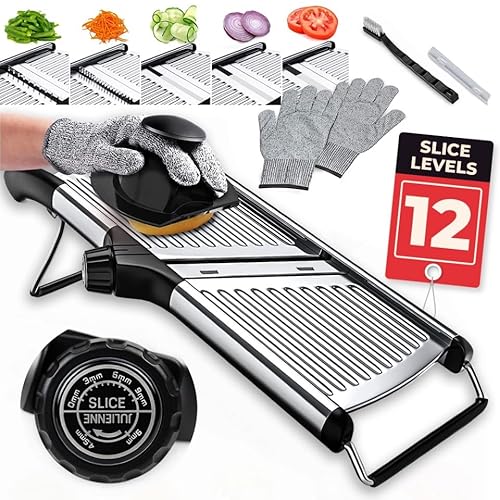
The Gramercy is built around a thickness dial that moves from paper-thin to thick-cut through twelve settings. A rotating blade cylinder switches between cutting styles, so you are not digging loose inserts out of a drawer. The blade is listed as professional 4CR15 stainless steel, a grade chosen for holding an edge.
The tradeoff is size. It takes more counter and cabinet room than a handheld slicer, and the open blade still deserves respect, so a holder or glove is a sensible habit. A larger body also means more surfaces to rinse after slicing something sticky like tomato or onion.
In daily use the anti-slip feet keep the base from creeping while you push, which matters when you are slicing a whole bag of potatoes. Compared with the Medove at six settings, the Gramercy offers double the thickness choices, and compared with the IPPINKA it asks far less technique from your wrist. Wash it by hand with a brush and store it with the blade surface covered or facing the wall.
Best for: Cooks who want many thickness choices from one stable, dial-controlled tool.
Check price on AmazonSpecs
- Slice settings: 12
- Blade steel: 4CR15 stainless
- Thickness control: Built-in dial
- Base: Anti-slip feet
Pros
- +Thickness dial offers twelve settings in one tool
- +Rotating cylinder skips risky blade swaps
- +Anti-slip feet keep the base from creeping
- +Pro-grade 4CR15 blade holds a sharp edge
Cons
- −Takes more counter and cabinet space than handhelds
- −Open blade needs extra care and a holder
- −Larger tool has more surfaces to clean
IPPINKA Japanese Double-Edged Slicer
About this pick
The IPPINKA is a simple, single-piece stainless slicer made in Sanjo, Japan, a town known for metalwork. Its double-edged blade cuts on both the push and the pull stroke, so you waste no motion going back and forth. The blade is angled, which the listing says lets you slice thinly at speed with less clogging.
There is no dial, no cylinder and no folding legs, which is exactly the appeal for people who dislike gadgets with many parts. The cost of that simplicity is that you set thickness by technique and pressure, not by turning a knob. You also get no built-in guard, so a cut-resistant glove or a food holder is close to essential.
This is the easiest slicer to rinse and the easiest to tuck into a drawer, but it asks more of your wrist than the Gramercy with its dial. Compared with the OXO and its 21 cuts, the IPPINKA does one job, thin slices, and does it with a very light tool. Treat it as a fast, skilled-hand slicer for cabbage, cucumber and radish rather than a beginner tool.
Best for: Confident cooks who want a minimal, light tool for fast thin slicing.
Check price on AmazonSpecs
- Origin: Sanjo, Japan
- Blade: Double-edged
- Motion: Push or pull
- Material: Stainless steel
Pros
- +Double edge cuts on both push and pull strokes
- +Angled blade clears slices with less clogging
- +Made in Sanjo, Japan from stainless steel
- +No moving parts, so rinsing takes seconds
Cons
- −No built-in guard, so a glove or holder is needed
- −Thickness depends on hand pressure, not a dial
- −Narrow range of cuts compared with dial models
Medove Stainless Steel Mandoline, 6 Settings
About this pick
The Medove packs a stainless blade, six thickness settings and a long 16.5 by 5 inch platform into a straightforward flat-bed slicer. The included hand guard and cut-resistant gloves are the headline here, because a safety kit in the box means you actually use the safe method from the first day. A simple back-and-forth motion does the work, and the six settings range from paper thin to chunky.
The long platform gives your hand a generous run for big items like cucumbers and zucchini. The flip side is storage length, since a platform of that size does not slide into a narrow drawer as easily as the IPPINKA. Six settings are enough for most households, though they are fewer than the twelve on the Gramercy.
Assembly is minimal, and cleanup is a rinse and a brush. Buyers who are nervous about blades will like that the glove is a given rather than a separate purchase. Keep the guard on every pass, even for the last small piece of vegetable, because that is where slips tend to happen.
Best for: Safety-minded home cooks who want a guard and gloves in the box.
Check price on AmazonSpecs
- Thickness settings: 6
- Platform: 16.5 x 5 in
- Safety kit: Hand guard and gloves
- Blade: Stainless steel
Pros
- +Cut-resistant gloves and hand guard come included
- +Long 16.5 x 5 inch platform suits big vegetables
- +Six thickness settings from thin to chunky
- +Simple back-and-forth motion is easy to learn
Cons
- −Long platform needs a roomy drawer or hook
- −Fewer thickness settings than the twelve-setting Gramercy
- −Guard must be used on every pass to help
OXO Steel Chef's Mandoline 2.0
About this pick
The OXO Steel Chef's Mandoline 2.0 is the variety leader in this group, offering up to 21 different cuts. That list covers straight, crinkle and waffle slices in a range of thicknesses, along with thin julienne strips and French fries. The straight blade handles firm produce like apples and potatoes without much fuss.
Variety brings complexity. More cut styles means more settings to learn and more parts to rinse, so it suits someone who will actually make waffle fries and crinkle pickles. If you only ever cut cucumbers and onions, the cut count is unused capacity that you still store.
It is a step up in kitchen ambition compared with the plain IPPINKA, and it is more flexible than the Medove with six thickness settings. Read the manual once, learn how the settings lock, and keep the guard on during every slice. Rinse promptly after cutting potatoes so starch does not dry into the grooves.
Best for: Cooks who want crinkle, waffle, julienne and fry cuts from one tool.
Check price on AmazonSpecs
- Cut styles: Up to 21
- Cut types: Straight, crinkle, waffle
- Extras: Julienne and fries
- Material: Stainless steel
Pros
- +Makes up to 21 different cuts from one tool
- +Crinkle and waffle cuts work on firm vegetables
- +Straight blade slices apples and potatoes cleanly
- +Julienne and fry settings extend its use
Cons
- −More settings to learn than a basic slicer
- −More parts to rinse after starchy vegetables
- −Unused cut styles still take storage space
Louis Tellier Bron Coucke Chef's Mandoline
About this pick
The Bron Coucke is a professional-style stainless mandoline with a carriage that holds food and a pusher that keeps fingers away from the blades. It ships with an interchangeable two-sided blade set with 38 cuts, and one side is listed as giving a 3 millimeter cut. That is the most blade choice in this group, aimed at cooks who treat slicing as a regular, serious task.
The flexibility has a price in handling. Swapping blades means touching sharp steel, so this is not the pick for someone who wants a closed system, and the blades need a safe place to live between uses. The carriage and guard do a good job of protecting your hand during the cut itself.
Compared with the Gramercy, which changes thickness with a dial, the Bron Coucke changes by swapping blades, which is slower but suits specialty cuts. Compared with the Medove, it asks for more setup and rewards more skill. Always use the pusher right to the end of the stroke.
Best for: Experienced cooks who want a professional carriage and many blade choices.
Check price on AmazonSpecs
- Blade set: Two-sided, 38 cuts
- Base cut: 3 mm on one side
- Safety: Pusher and guard
- Style: Carriage design
Pros
- +Interchangeable two-sided set gives 38 cut options
- +Pusher and guard keep fingers clear of blades
- +One side gives a 3 millimeter cut
- +Carriage design holds food steady during slicing
Cons
- −Blade swaps mean handling bare sharp edges
- −Spare blades need safe, separate storage
- −More setup time than a dial-based slicer
SupMaKin Safe Mandoline Slicer Pro
About this pick
The SupMaKin Pro takes a different approach, enclosing stainless steel blades inside an ABS shell. A 3.9 by 4.7 inch feed port takes larger pieces of food, and an auto-rebound handle springs back after each push. The container catches the cut pieces, so one pass fills the bowl instead of scattering slices across the counter.
Because the blades are inside, your fingers never meet the edge during use, which is the strongest safety story in this lineup. The compromise is bulk, since it is larger than a flat slicer in both the cabinet and on the counter. The listing does not state a thickness range, so check the current details before buying if exact slice width matters to you.
This is the pick for batch prep, such as coleslaw for a crowd, where the Medove would require far more strokes. It is not a precision tool like the Bron Coucke, and the plastic shell means it is a hybrid rather than all steel. Rinse the interior promptly and let it dry open.
Best for: People prepping large batches who want blades enclosed away from fingers.
Check price on AmazonSpecs
- Feed port: 3.9 x 4.7 in
- Shell: ABS plastic
- Blades: Stainless steel, inside
- Handle: Auto-rebound
Pros
- +Feed port listed at 3.9 x 4.7 inches
- +Handle rebounds automatically after each push
- +Rust-resistant stainless blades sit inside the shell
- +Container holds more cut food per pass
Cons
- −Bulkier on the counter and in the cabinet
- −Listing does not state a thickness range
How We Evaluated These Stainless Steel Mandoline Slicers
Each pick was assessed across 5 criteria weighted for real-world use.
Blade and cutting quality
We compared blade materials and edge design, such as the Gramercy's 4CR15 steel and the IPPINKA's double edge. Each pick was assessed on the quality of cut that its blade type should produce on firm and soft produce. Listed cut ranges, such as the OXO's 21 cuts and the Bron Coucke's 38, informed how versatile each slicer is.
Safety design
Safety carried the most weight in this guide. We looked at guards, pushers, gloves and enclosed blades, noting that the Medove includes gloves and the SupMaKin encloses its blades. Picks with no guard at all, such as the IPPINKA, were scored with that caveat clearly stated.
Stability and handling
We evaluated feet, base width and platform length, because a slicer that moves is dangerous. The Gramercy's anti-slip feet and the Medove's long platform lead here. Ease of the stroke, including the SupMaKin's auto-rebound handle, was also considered.
Adjustability and range
Lineup positioning is clear: the Bron Coucke leads on blade choices at 38 cuts, the OXO on cut styles at up to 21, and the Gramercy on simple dial control at twelve settings. The IPPINKA offers the least range and the lightest tool. We scored how easily a cook can reach each setting without risk.
Cleaning and storage
We looked at how many parts each slicer has and how large it is when put away. The IPPINKA scores best for fast rinsing and tight storage, while the bulkier SupMaKin and OXO score lower. Material mix, steel against ABS shell, also informed expected durability.
How to Choose the Right Stainless Steel Mandoline Slicers
By Safety Priority
How much protection you want around the blade is the first decision, so match your comfort level to the design.
| Situation | Pick | Why |
|---|---|---|
| You want blades enclosed | SupMaKin Safe Mandoline Slicer Pro | Stainless blades sit inside the ABS shell and a pusher-style handle feeds food through |
| You want gloves in the box | Medove Stainless Steel Mandoline, 6 Settings | Hand guard and cut-resistant gloves come included |
| You want a carriage and pusher | Louis Tellier Bron Coucke Chef's Mandoline | Carriage design keeps hands away from the 38-cut blade set |
| You want minimal blade handling | Gramercy Mandoline Slicer, 12 Settings | Dial changes thickness so no blade swapping is needed |
| You are confident with a bare blade | IPPINKA Japanese Double-Edged Slicer | Light single-piece tool, best used with your own glove |
Whatever you buy, add a cut-resistant glove if the slicer lacks one, and stop slicing when the piece gets small.
By Budget
Tiers are relative, so compare listings for current pricing before you buy.
| Tier | Pick | What you get |
|---|---|---|
| Entry | IPPINKA Japanese Double-Edged Slicer | Simple metal slicer with no extras or settings |
| Entry to mid | Medove Stainless Steel Mandoline, 6 Settings | Six settings plus gloves and a hand guard |
| Mid | SupMaKin Safe Mandoline Slicer Pro | Enclosed blades and a container for large batches |
| Mid to premium | Gramercy Mandoline Slicer, 12 Settings | Twelve-setting dial with a 4CR15 blade |
| Premium | Louis Tellier Bron Coucke Chef's Mandoline | Professional carriage with a 38-cut blade set |
Paying more usually buys range and build, not a safer experience, so check the guard before the price tier.
Dial Control vs Swappable Blades
These are two real mechanisms for changing the cut, and each suits a different cook.
Dial and built-in settings
A dial moves the cutting plane up or down, so you never touch the blade. The Gramercy with twelve settings and the Medove with six use this approach, and the OXO builds its cut styles into the body. Pick this side if you slice often and want fewer chances to cut yourself.
Interchangeable blades
Swappable blades give specialty cuts a dial cannot match, but each swap exposes steel. The Bron Coucke, with its two-sided 38 cut set, is the clear example here. Pick this side only if you will use the extra cuts and have a safe storage spot for spare blades.
If you cannot name three cuts you would use, a dial slicer is the better fit.
By Counter and Drawer Space
The footprint decides whether the tool gets used, so measure before you commit.
| Space situation | Pick | Reason |
|---|---|---|
| Narrow drawer | IPPINKA Japanese Double-Edged Slicer | Single flat piece with nothing to fold or detach |
| Long drawer or wall hook | Medove Stainless Steel Mandoline, 6 Settings | 16.5 inch platform needs room but stores flat |
| Dedicated shelf | SupMaKin Safe Mandoline Slicer Pro | Container and shell take cabinet volume |
| Standing counter tool | Gramercy Mandoline Slicer, 12 Settings | Larger body with legs, best left accessible |
| Mixed kitchen use | OXO Steel Chef's Mandoline 2.0 | Cut variety justifies a permanent spot |
A tool stored near the cutting board gets used safely more often than one hidden at the back.
For Weekly Vegetable Prep Specifically
Regular prep of cucumbers, potatoes and onions has its own demands.
Look for
A stable base, a guard you will really use and a quick-rinse design. Even thickness across a whole potato matters more than the number of settings. Settings you never use only add cleaning time.
In this comparison
The Gramercy with its dial and anti-slip feet is the steadiest weekly tool, and the SupMaKin Pro is better for big batches at 3.9 x 4.7 inches. The Medove is the best pick if you also want gloves included, and the IPPINKA suits quick thin slices.
Soft tomatoes are better sliced with a serrated knife than forced across any blade.
When to Spend More
Premium tools earn their cost only when you use the features they add.
| Spend more if | Save if |
|---|---|
| You will use waffle, crinkle and fry cuts, choose the OXO Steel Chef's Mandoline 2.0 | You only slice cucumbers and onions, the IPPINKA is enough |
| You cook for a crowd, the SupMaKin Pro container saves repeated strokes | You slice for one or two people, the Medove is plenty |
| You want twelve settings and a steady base, the Gramercy rewards frequent use | You slice a few times a month, a six-setting tool is enough |
| You want a professional blade set, the Bron Coucke offers 38 cuts | You never swap blades, skip the extra steel to store |
Spend on safety features first, then on range.
Frequently Asked Questions
Which stainless steel mandoline is the safest?
The SupMaKin Pro encloses its blades inside the shell, so fingers never meet the edge during slicing. The Medove is a close second because it includes a hand guard and cut-resistant gloves. Open-blade models like the IPPINKA are fine for experienced cooks but need your own glove.
Is a dial better than interchangeable blades?
For most people, yes. A dial like the one on the Gramercy changes thickness without exposing steel, which cuts the number of risky handling moments. Interchangeable sets such as the Bron Coucke's 38 cuts are better for cooks who want specialty shapes and have safe storage.
How should I clean a mandoline blade?
Rinse right after use so starch and juice do not dry on the edge. Use a brush and running water, and never wipe a sponge toward the blade. Dry the slicer before storing, and keep the blade covered or facing a wall.
Do I still need a glove if the slicer has a guard?
A glove is cheap insurance, especially for the last inch of a vegetable where guards grip poorly. The Medove includes gloves, which makes that choice easy. Even with a glove, stop when the piece is too small to hold steady.
Is stainless steel always better than plastic parts?
Steel blades and decks resist corrosion and keep an edge, which is why every pick here uses stainless steel for cutting. A plastic shell, as on the SupMaKin Pro, can be a benefit because it encloses the blades and keeps weight down. Look at how the pieces are joined, not just the material.
Will a mandoline work on soft foods like tomatoes?
It can, but only with a very sharp blade and a light touch. Forcing a soft tomato across any blade crushes it and tempts your hand to push harder. Firm produce such as cucumbers, potatoes and cabbage is the better target.
How do I stop a mandoline moving on the counter?
Anti-slip feet help, as on the Gramercy, but a damp towel under the base adds grip to any slicer. Work on a dry, level surface and keep the stroke short and steady. If the tool still shifts, switch to a bowl-braced or enclosed design.
Bottom Line
best overall: Gramercy Mandoline Slicer, 12 Settings - best overall pick in this roundup.
See the full rankings above for all picks with pros, cons, and best-for summaries.
Browse on Amazon
All Prime-eligible options with current pricing.
Shop on Amazon →