5 Best Stainless Steel Dish Racks (2026)
Five stainless steel dish racks compared on rust resistance, sink fit, drainage and capacity, with picks for small counters, over-sink use and busy kitchens.

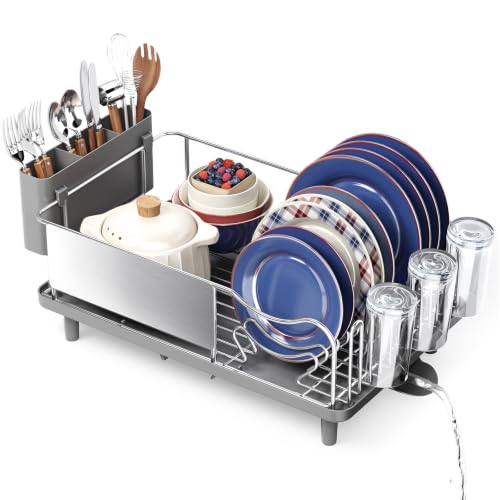


At a Glance
Stainless steel is the material most buyers want in a dish rack because it resists the rust that plagues coated wire. Even so, two racks marked stainless can behave very differently. The Godboat and SNTD expandable racks both call out 304 stainless, the KINGRACK describes premium rustproof stainless steel, and the Sakugi uses stainless in a compact 15.6 by 12 inch frame.
The range here runs from the Sakugi at the lowest cost tier, holding 6 plates, to the JASIWAY, which works over or in the sink and has supporting bars that extend from 15.5 to 23.2 inches. The SNTD expandable rack flexes from 15.2 to 22.1 inches, and the Godboat adds a 9 inch auto-drain spout and a four in one storage layout. Material is the starting point, but fit and drainage decide daily happiness.
We evaluated these racks from product specs and buyer feedback, paying attention to the details a stainless label hides: drip tray material, coatings on the wires, how the rack drains and how much counter it takes. The How to Choose section pairs counter size, sink type and household size with a named model.
6 Criteria to Look For Before Buying a Stainless Steel Dish Racks (2026)
Key buying criteria so you get the right fit the first time.
304 stainless versus coated wire
Coated steel is cheaper, but a chipped coating lets moisture reach the metal and cause rust, while stainless resists corrosion better and costs more. The Godboat and SNTD expandable call out 304 stainless, and the SNTD adds black anti-rust coated wires, so it is not stainless throughout. Check what exactly is stainless: rails, wires, or just the frame. A rack that is fully 304 will outlast a mixed one if you keep it wet daily.
Drainage design
A tilted rack, drainage spout or drip tray moves water off, and a removable drip tray is easier to clean. The Godboat uses a 9 inch spout, the SNTD expandable has an angled tray with a large outlet, and the KINGRACK uses an auto-drain design. The JASIWAY avoids the problem by sitting over the sink. Prefer a rack whose tray lifts out so you can rinse mold-prone corners.
Sizing and expansion
Measure counter or sink space including spouts and any upper tiers. The SNTD expandable spans 15.2 to 22.1 inches, the JASIWAY bars span 15.5 to 23.2 inches, and the KINGRACK is a fixed 16.9 by 12.4 inches. Expandable racks are friendlier if you may move or rearrange the kitchen. Fixed racks are simpler and often more rigid.
Capacity and household size
One or two people can use a compact rack, but families need tiers or dividers for pots. The Sakugi holds 6 plates, the KINGRACK holds plates, bowls and pots with a utensil area, and the Godboat's four in one layout is the most organized. Too little capacity leads to stacking wet dishes, which slows drying and may promote bacterial growth. Choose by the load you wash in an evening, not by the size of the box.
Cutlery and cup organization
Removable cutlery holders make cleaning easier and help prevent mold. The KINGRACK includes a built-in cutlery holder and cup area, the Godboat adds a knife and fork holder, and the JASIWAY has a cup and utensil holder. Without one, spoons end up in a pile that never dries properly. A holder that detaches is a hygiene upgrade worth paying for.
Ease of cleaning and shape
Rounded contours with few tight corners and crevices resist mold and clean more easily. The Sakugi's simple layout is the easiest to wipe, while the Godboat's multiple compartments take longer. Rinse and dry the rack weekly regardless of material. If you can lift it with one hand when it is empty, you are more likely to clean it.
5 Best Stainless Steel Dish Racks (2026)
SNTD Expandable Stainless Steel Dish Rack
About this pick
The SNTD expandable rack is the all-rounder because it adapts to different kitchens without losing its stainless core. Its width flexes from 15.2 to 22.1 inches, so it fits a small counter now and a larger one later. The guardrails are 304 stainless, the wires carry a black anti-rust coating, and the drip tray is a fingerprint resistant PP tray with a large water outlet.
The tradeoff is that not every part is stainless. The coated wires are only as rust resistant as their coating, so chips matter, and the plastic tray needs regular rinsing. The expanded form also takes more counter than a fixed compact rack like the Sakugi.
In practice the drip tray angle and large outlet keep water from pooling, which is the feature that separates it from cheaper fixed racks. Compared with the JASIWAY it is a counter rack first, whereas the JASIWAY is designed to straddle a sink. Compared with the KINGRACK, it offers a width range rather than a single footprint. Pull the tray out weekly and rinse it, and expand or contract the rack to match the load.
Best for: Buyers who want a stainless rack that adapts as needs change
Check price on AmazonSpecs
- Width range: 15.2 to 22.1 in
- Guardrails: 304 stainless steel
- Wires: Black anti-rust coating
- Drip tray: PP, fingerprint resistant, angled
Pros
- +Expands from 15.2 to 22.1 in to fit different counters
- +304 stainless guardrails resist corrosion
- +Angled tray with large outlet drains well
- +Fingerprint resistant tray stays tidy
Cons
- −Coated wires can chip over years of use
- −Takes more room when fully expanded
KINGRACK Stainless Steel Dish Drying Rack
About this pick
The KINGRACK is the most well rounded fixed-size stainless rack in this group. It measures 16.9 by 12.4 inches, is built from rustproof stainless steel, and pairs a large drying area with a built-in cutlery holder and cup organization. An auto-drain design sends water toward the sink so the counter does not become a puddle.
Its limitation is a fixed footprint. Unlike the SNTD expandable or the JASIWAY, it cannot stretch to match a sink, so you need a counter that fits 16.9 by 12.4 inches. The listing says it holds plates, bowls, pots and pans at once, but a big family will still run out of space before a two tier rack does.
For day to day use it is easy to like because the cutlery holder keeps forks and spoons upright and separate. Compared with the Godboat, it is plainer but a little lighter on features, and compared with the Sakugi, it gives you much more drying surface. Rinse the holder and drainboard weekly and let the whole unit air dry between loads.
Best for: Everyday kitchens wanting stainless, utensil storage and auto-drain
Check price on AmazonSpecs
- Footprint: 16.9 x 12.4 in
- Material: Rustproof stainless steel
- Organization: Cutlery holder and cup area
- Drainage: Auto-drain design
Pros
- +Rustproof stainless frame built to last
- +Built-in cutlery and cup organization
- +Auto-drain design protects the counter
- +Large drying area holds plates and pots
Cons
- −Fixed footprint cannot adapt to tight counters
- −Less capacity than a two tier model
Godboat 304 Stainless Steel Dish Drying Rack
About this pick
The Godboat is the feature leader in this lineup. It is made of 304 stainless steel, and its auto-drain system uses a 9 inch spout so water travels from the rack into the sink instead of across the counter. The four in one storage layout adds a knife and fork holder and other organizers, so you can keep the entire dish station in one place.
The tradeoff is complexity and cost. It sits at the premium end of this roundup, and the extra compartments mean more surfaces to wipe than the plain Sakugi. A long spout also needs a clear path to the sink, so make sure nothing sits in the way.
It is a good fit for people who value organization, since cutlery and knives have a designated place. Compared with the KINGRACK, it adds a longer spout and a more modular layout. Compared with the SNTD expandable, it trades adaptability for a built in organization system. Take the pieces apart for a weekly wash, and dry them thoroughly before reassembling.
Best for: Cooks who want one organized station with a long drain spout
Check price on AmazonSpecs
- Material: 304 stainless steel
- Spout: 9 in auto-drain to sink
- Layout: 4 in 1 smart storage
- Extras: Cutlery, knife and fork holder
Pros
- +304 stainless frame resists rust and corrosion
- +9 in spout aims water into the sink
- +4 in 1 layout stores cutlery and knives
- +Large capacity for a home kitchen
Cons
- −Premium cost within this roundup
- −More compartments mean more cleaning
JASIWAY Expandable In-Sink Dish Rack
About this pick
The JASIWAY is the answer for kitchens with almost no free counter. It can be used over the sink or in the sink, with supporting bars that extend from 15.5 to 23.2 inches. Its footprint is only 15.5 by 11 by 4.8 inches, which the listing describes as a minimal profile, and it includes a cup and utensil holder.
The tradeoff is that an over the sink rack ties up the basin while dishes dry. If you need the sink for food prep during the drying period, the rack is in the way, and a shallow sink may limit tall items. Water also drips back into the sink, which is good for the counter but means you rinse the basin more often.
For tiny apartments or galley kitchens, it eliminates counter clutter entirely, and it will fit compact double bowl sinks. Compared with the SNTD expandable rack, it uses sink space instead of counter space. Compared with the Sakugi, it adjusts to the sink, whereas the Sakugi has a fixed footprint. Extend the bars to match the sink, check they are seated, and then load.
Best for: Small apartments, galley kitchens and double bowl sinks
Check price on AmazonSpecs
- Modes: Over sink or in sink
- Support bars: 15.5 to 23.2 in
- Size: 15.5 x 11 x 4.8 in
- Extras: Cup and utensil holder
Pros
- +Dual mode works over or inside the sink
- +Support bars adjust to fit many sink widths
- +Frees up counter space completely
- +Compact profile with cup and utensil holder
Cons
- −Ties up the sink while dishes dry
- −Shallow depth limits tall items
Sakugi Compact Stainless Steel Dish Rack
About this pick
The Sakugi is the entry point into stainless steel dish racks. It measures about 12 by 15.5 inches and holds 6 plates plus other items, which is enough for a single person or a couple. The listing describes the stainless as free of rust and deformation, and a drainboard directs excess water away.
The tradeoff is capacity. Compared with the KINGRACK's larger footprint and cutlery area, the Sakugi gives you a minimal layout and few extras. It is also a fixed size, so it cannot adapt to a bigger counter or a wider sink the way the JASIWAY or SNTD expandable can.
That simplicity is its strength for people who do not want extra parts to clean. It sits at the lowest cost tier in this comparison, so it is a reasonable choice for a first rack, a vacation home or a kitchen where dishes are washed one meal at a time. Compared with the Godboat, it offers a fraction of the organization, but also a fraction of the price. Wipe the drainboard weekly and let the rack air dry.
Best for: Singles, couples and anyone buying a first stainless rack
Check price on AmazonSpecs
- Footprint: 15.6 x 12 in
- Capacity: 6 plates plus other items
- Material: Stainless steel
- Position: Lowest-cost pick here
Pros
- +Lowest cost tier among the stainless picks
- +Compact 12 by 15.5 in footprint saves space
- +Stainless frame free of rust and deformation
- +Simple layout is easy to clean
Cons
- −Only 6 plates, so large loads must be done in batches
- −Fixed size cannot adjust to your counter
How We Evaluated These Stainless Steel Dish Racks (2026)
Each pick was assessed across 5 criteria weighted for real-world use.
Material and corrosion
We reviewed what each listing states about stainless steel versus coated wire. The Godboat and SNTD expandable lead because they name 304 stainless, while the KINGRACK and Sakugi are described more generally as stainless. We scored mixed-material racks lower for any coated component that could chip.
Drainage and tray design
We compared spout length, tray angle and whether the tray can be removed. The Godboat's 9 inch spout and the SNTD expandable's angled tray with a large outlet scored best. The Sakugi scored lowest because the listing details less about its drainage.
Fit and flexibility
We checked how well each rack adapts to different counters and sinks. The JASIWAY and SNTD expandable earned top marks for adjustability, while the fixed Sakugi and KINGRACK scored lower for flexibility but higher for rigidity. Fit matters because a rack that does not suit your counter or sink will not be used well, however good the steel is.
Capacity and organization
We compared stated plate counts and utensil provisions. The Godboat and KINGRACK scored highest for storage options, with the Sakugi at the most basic end holding 6 plates. Capacity was weighed against footprint so large racks were not rewarded for taking space.
Cleaning and everyday ease
We considered removable parts, crevices and the effort to wash weekly. The Sakugi's simple build and the SNTD's lift-out tray scored well, while the Godboat's many compartments cost it a little. The best all-around pick, the SNTD expandable, balances the two.
How to Choose the Right Stainless Steel Dish Racks (2026)
By Counter and Sink Setup
Space decides more than any other factor with stainless racks.
| Your situation | Best pick |
|---|---|
| Counter that may change or grow | SNTD Expandable Stainless Rack |
| Fixed counter with room for 16.9 x 12.4 in | KINGRACK Stainless Rack |
| Almost no counter, double bowl sink | JASIWAY Expandable In-Sink Rack |
| Want one organized station | Godboat 304 Stainless Rack |
| Small counter, one or two people | Sakugi Compact Rack |
By Budget
| Budget tier | Best pick |
|---|---|
| Lowest-cost pick | Sakugi Compact Rack |
| Low to mid-range | JASIWAY In-Sink Rack |
| Mid-range | SNTD Expandable Rack |
| Upper mid-range | KINGRACK Stainless Rack |
| Premium | Godboat 304 Stainless Rack |
Counter Rack vs In-Sink Rack
Counter rack
The SNTD expandable, KINGRACK, Godboat and Sakugi sit on the counter and drain into the sink through a tray or spout. They keep the sink free for cooking.
In-sink or over-sink rack
The JASIWAY uses the basin and keeps the counter clear, but it occupies the sink. It is best in compact kitchens.
Recommendation
Choose a counter rack if you use the sink often, and the JASIWAY only if counter space is the bigger constraint.
Fixed Size vs Expandable
| Preference | Best pick |
|---|---|
| I want a rigid, fixed footprint | KINGRACK Stainless Rack |
| I want the cheapest fixed footprint | Sakugi Compact Rack |
| I want counter width to adjust | SNTD Expandable Stainless Rack |
| I want sink width to adjust | JASIWAY Expandable In-Sink Rack |
For Rust Prevention Specifically
Look for
Fully stainless construction, not just a stainless frame with coated wire, plus a lift-out tray so moisture does not sit against metal.
In this comparison
The Godboat is the clearest 304 stainless build with a modular, lift-apart layout. The SNTD expandable uses 304 guardrails but adds coated wires, so keep an eye on the coating.
When to Spend More
Spend more if
You want the Godboat's long spout and organization, the KINGRACK's built in utensil area or the SNTD expandable's flexibility and 304 guardrails.
Save if
You wash for one or two people. The Sakugi covers 6 plates in stainless at the lowest tier, and the JASIWAY solves tight space at a modest premium.
Frequently Asked Questions
Is the SNTD expandable better than the KINGRACK?
It depends on how much your kitchen may change. The SNTD expandable adjusts from 15.2 to 22.1 inches and has an angled tray. The KINGRACK has a fixed 16.9 by 12.4 inch footprint with a built-in utensil area. Pick the SNTD for flexibility and the KINGRACK for a steady, simple layout.
How much should I spend on a stainless steel dish rack?
You can get stainless at the lowest tier with the Sakugi. Premium racks like the Godboat add a long spout and modular storage. Spend more if you need organization or adjustability, and save if your load is small.
Will stainless steel racks still get water spots or rust?
Stainless resists corrosion but can show spots, especially in hard water. Coated wires or painted parts can chip and rust. Dry the rack regularly and wipe any visible deposits with a vinegar solution if you wish.
Is 304 stainless really better than other stainless?
304 is a common, corrosion resistant grade used on the Godboat and SNTD expandable. Listings that only say stainless steel may be fine, but they give less detail. Prefer a named grade when you can find it, and still inspect welds and coatings.
What is the difference between over-sink and counter racks?
Counter racks like the KINGRACK drain into the sink through a tray or spout. The JASIWAY sits over or in the sink, which frees the counter but takes the basin. Choose based on whether counter space or sink access is scarcer.
How do I keep a stainless dish rack from growing mold?
Remove the tray and cutlery holder and wash them weekly with warm soapy water. Empty standing water from spouts and channels each day. Let the rack air dry fully between loads.
Bottom Line
best overall: SNTD Expandable Stainless Steel Dish Rack - best overall pick in this roundup.
See the full rankings above for all picks with pros, cons, and best-for summaries.
Browse on Amazon
All Prime-eligible options with current pricing.
Shop on Amazon →