Best Robot Vacuums Under $400
We compared eight current robot vacuums priced under $400 on suction power, self-empty dock availability, mopping ability.


At a Glance
Shark AV2501S AI Ultra Robot Vacuum with Matrix Clean and 30-Day Capacity Self Empty Base
↓ See why we picked itroborock Q7 L5 Robot Vacuum and Mop Combo, 8,000Pa Suction
↓ See why we picked itThis tier sits between our Under $300 guide, where self-emptying docks are rare and mapping is often basic, and our Under $500 guide, where multi-floor mapping, obstacle avoidance cameras, and combo mop-and-vacuum stations become standard. Under $400 is the breakpoint where self-empty docks stop being a luxury and start showing up on a meaningful share of models, even if not every one here includes one.
We evaluated eight current models rather than color variants of the same machine, and focused on what actually changes daily use at this price: suction strength in Pa, whether mopping is included and how it is handled, whether a self-empty base is part of the package, and what a realistic first year of bags, mop pads, and filters costs on top of the sticker price.
6 Criteria to Look For Before Buying a Robot Vacuums Under $400
Key buying criteria so you get the right fit the first time.
What's typically included at this tier vs cheaper models
Below $200, vacuum-only models with basic navigation are common, as seen with the ILIFE V2 here. Between $200 and $400, combined vacuum-and-mop functionality becomes standard, and self-empty bases start appearing on a meaningful share of models rather than being rare. Getting this wrong is one of the more common reasons a robot vacuums purchase disappoints once it actually arrives, since what's typically included at this tier vs cheaper models affects real day-to-day use in a way marketing photos and bullet points don't always make obvious. Before buying, check the specific listing's stated details on what's typically included at this tier vs cheaper models rather than assuming every robot vacuums in this comparison handles it the same way, since this is exactly the kind of detail that varies more than buyers expect within the same price range.
Self-empty dock prevalence at this price point
Three of the eight models in this comparison include a self-empty base, up from being nearly absent under $200. Full wash-and-empty omni stations, like the DEEBOT T50 PRO Omni here, are still the exception rather than the rule at this tier and tend to sit near the top of the price range. This is the kind of detail that looks minor in a spec list but shapes how satisfied you actually are with a robot vacuums weeks after buying, since self-empty dock prevalence at this price point plays out differently in daily use than it does on paper. Read the product listing and recent reviews specifically for mentions of self-empty dock prevalence at this price point, since this detail is often understated in the bullet points but shows up clearly once real buyers have used the robot vacuums for a while.
Suction tier expectations
Rated suction in this comparison ranges from roughly 5,200Pa to 10,000Pa. Models in the 8,000 to 10,000Pa range generally handle carpet and pet hair with fewer passes, while models under 6,000Pa are usually adequate for hard floors and light carpet but may need repeat passes on thicker rugs. Buyers who skip past suction tier expectations tend to be the ones leaving disappointed reviews later, not because the robot vacuums was defective, but because this specific detail didn't match what they actually needed. Compare how each robot vacuums in this roundup actually handles suction tier expectations rather than assuming they're interchangeable on this point, since the listings here differ on it more than the headline specs suggest.
Realistic first-year consumable costs
Beyond the machine price, expect replacement mop pads, side brushes, and filters, along with dust bags for self-empty models. A reasonable estimate for typical use is $40 to $80 per year in consumables, more if the model uses proprietary parts rather than universal-fit accessories. Realistic first-year consumable costs is easy to overlook next to flashier specs, but it's frequently the difference between a robot vacuums that fits your routine and one that quietly becomes a hassle. Confirm the exact detail on realistic first-year consumable costs directly from the current listing before ordering, since this is one of the more common places where two similarly priced robot vacuums options genuinely diverge.
Tradeoffs vs the next tier up
Models above $400 typically add multi-floor map storage, obstacle avoidance cameras, and more consistent app reliability across firmware updates. Buyers who need precise no-go zones around cables or pet bowls may find the mapping in this under-$400 tier serviceable but less refined. Getting this wrong is one of the more common reasons a robot vacuums purchase disappoints once it actually arrives, since tradeoffs vs the next tier up affects real day-to-day use in a way marketing photos and bullet points don't always make obvious. Before buying, check the specific listing's stated details on tradeoffs vs the next tier up rather than assuming every robot vacuums in this comparison handles it the same way, since this is exactly the kind of detail that varies more than buyers expect within the same price range.
Rating and review volume as a reliability signal
Established models with a longer market history, like the eufy 11S MAX or Shark AV2501S in this comparison, tend to carry a deeper base of owner feedback than newer entrants. That does not make a newer model worse, but it does mean less accumulated data on long-term reliability. This is the kind of detail that looks minor in a spec list but shapes how satisfied you actually are with a robot vacuums weeks after buying, since rating and review volume as a reliability signal plays out differently in daily use than it does on paper. Read the product listing and recent reviews specifically for mentions of rating and review volume as a reliability signal, since this detail is often understated in the bullet points but shows up clearly once real buyers have used the robot vacuums for a while.
Best Robot Vacuums Under $400
ECOVACS DEEBOT T50 PRO Omni Robot Vacuum and Mop
About this pick
The DEEBOT T50 PRO Omni pairs a genuine self-empty, self-wash station with a body slim enough to get under most low-clearance furniture, which is a combination that is not always available at this price. That slim profile means it reaches areas taller robots skip entirely, while the omni station handles both dirt disposal and mop pad washing without owner intervention.
Value-wise, it undercuts several less-equipped models in this comparison while still including the full docking station most buyers associate with a higher tier. Reviewers who buy it are generally doing so specifically for the low-profile design paired with hands-off maintenance.
Best for: Buyers who want a full self-empty and self-wash station without paying near the $400 ceiling for it.
Check price on AmazonSpecs
- Feature 1: 3.19in ultra-slim body
- Feature 2: Omni self-empty and wash station
- Feature 3: Vacuum and mop combo
- Connectivity: App mapping and control
Pros
- +Full self-empty and self-wash omni station included at this price
- +Ultra-slim 3.19in body fits under more furniture than most competitors
- +Combines vacuum and mop in one pass
Cons
- −Fewer total reviews than some longer-running competitors in this comparison
- −Omni stations require occasional clean-water tank refills and waste-tank emptying
roborock Q10 S5+ Robot Vacuum and Mop, 10,000Pa Suction
About this pick
The Q10 S5+ leads this comparison on rated suction power at 10,000Pa, which is a meaningful jump over the 5,000 to 8,000Pa range most competitors here list. That extra suction pull matters most on carpet and for pet hair, where lower-suction models tend to need more passes to fully clear debris.
It pairs that suction with combined vacuum and mop functionality and standard app-based scheduling, positioning it as the pick for households that prioritize raw cleaning power over extra dock features.
Best for: Carpeted homes or pet owners who want the strongest rated suction in this price range.
Check price on AmazonSpecs
- Suction Power: 10,000Pa suction
- Mopping: Vacuum and mop combo
- Connectivity: App and voice control
- Feature 4: Self-charging
Pros
- +Highest rated suction power in this comparison
- +Vacuum and mop combo in one unit
- +Competitive price for its suction tier
Cons
- −No self-empty base included at this price point
- −Fewer accumulated reviews than more established models here
Shark AV2501S AI Ultra Robot Vacuum with Matrix Clean and 30-Day Capacity Self Empty Base
About this pick
The AV2501S is one of the more established self-empty models in this comparison, with a base rated to hold roughly a month of debris and a HEPA filter for households sensitive to dust. Home mapping and Matrix Clean navigation aim to reduce missed spots and repeated passes over the same area.
As a longer-running model in the Shark lineup, it benefits from a deeper track record than some of the newer entrants here, which is worth weighing against its slightly higher price relative to bare-bones combo units.
Best for: Buyers who specifically want a proven, bagless self-empty base with HEPA filtration.
Check price on AmazonSpecs
- Capacity: 30-day capacity HEPA self-empty base
- Connectivity: Home mapping
- Navigation: Matrix Clean navigation
- Collection: Bagless base
Pros
- +30-day capacity bagless HEPA self-empty base
- +Longer market track record than several competitors here
- +Home mapping with Matrix Clean navigation
Cons
- −No mopping function included
- −Bagless base still needs periodic manual cleaning of the bin itself
Tikom Robot Vacuum and Mop with Self-Emptying Base
About this pick
This Tikom model brings a self-emptying base down to just over $200, which is the lowest price for that feature in this comparison. It pairs the base with combined vacuum and mop cleaning, covering the two features buyers most commonly want at this tier without pushing toward the $400 ceiling.
As a newer entrant from a budget-focused brand, it has a smaller review history than the Shark or eufy models here, so buyers prioritizing a long track record may want to weigh that against the price savings.
Best for: Buyers who want a self-emptying base and mopping but do not want to spend near $300 for it.
Check price on AmazonSpecs
- Feature 1: Self-emptying base
- Mopping: Vacuum and mop combo
- Connectivity: App control
- Feature 4: Auto self-charge
Pros
- +Lowest price for a self-emptying base in this comparison
- +Vacuum and mop combo included
- +Straightforward app-based scheduling
Cons
- −Shorter review history than more established brands here
- −Suction is not rated as high as the top suction picks in this comparison
eufy 11S MAX Robot Vacuum Cleaner, Super Thin, Quiet
About this pick
The 11S MAX is built around a slim, quiet design rather than a feature checklist, which makes it a fit for apartments or homes where low noise and getting under furniture matter more than a self-empty dock or mopping. It skips mopping and advanced mapping entirely to keep both price and noise down.
As one of the longer-running models in eufy's lineup, it carries a deeper base of owner feedback than most of the newer combo units in this comparison, which is useful for buyers who weigh review history heavily.
Best for: Small apartments or noise-sensitive households that do not need mopping or a self-empty base.
Check price on AmazonSpecs
- Feature 1: Super-slim profile
- Feature 2: Quiet operation
- Feature 3: Self-charging
- Mopping: No mopping function
Pros
- +Slim profile fits under low furniture
- +Quieter operation than most combo units in this comparison
- +Established, longer-running model with a deep review history
Cons
- −No mopping function
- −No self-empty base or advanced mapping
roborock Q7 L5 Robot Vacuum and Mop Combo, 8,000Pa Suction
About this pick
The Q7 L5 sits below its Q10 S5+ sibling on rated suction, at 8,000Pa instead of 10,000Pa, but comes in at roughly half the price. For households without heavy carpet or major pet hair, that suction level is generally sufficient for daily hard-floor and light-carpet cleaning.
It keeps the vacuum and mop combo functionality and standard app scheduling of the pricier Q10 S5+, making it the value pick within the roborock lineup in this comparison.
Best for: Buyers who want a roborock combo unit without paying for the highest suction tier.
Check price on AmazonSpecs
- Suction Power: 8,000Pa suction
- Mopping: Vacuum and mop combo
- Connectivity: App and voice control
- Feature 4: Self-charging
Pros
- +Vacuum and mop combo at a lower price than the Q10 S5+
- +Still a strong rated suction level for daily cleaning
- +App and voice control included
Cons
- −Lower rated suction than the top suction pick in this comparison
- −No self-empty base at this price
ROPVACNIC Robot Vacuum and Mop Combo, 5200Pa Suction
About this pick
The ROPVACNIC combo brings vacuum and mop functionality to a lower price point than most of the branded options in this comparison, with 5,200Pa of rated suction aimed at everyday hard-floor and light-carpet upkeep rather than deep-carpet or heavy pet hair situations.
As a newer, less established brand, it has a smaller current review base than eufy, Shark, or roborock, so buyers who weigh brand track record heavily should factor that into the lower price.
Best for: Budget-focused buyers who want basic vacuum and mop combo functionality without a name-brand premium.
Check price on AmazonSpecs
- Suction Power: 5,200Pa suction
- Mopping: Vacuum and mop combo
- Connectivity: App control
- Feature 4: Auto self-charge
Pros
- +Lower price than most vacuum and mop combos in this comparison
- +Combines vacuuming and mopping in one unit
- +Simple app-based scheduling
Cons
- −Lower rated suction than the higher-suction picks in this comparison
- −Smaller review base than more established brands here
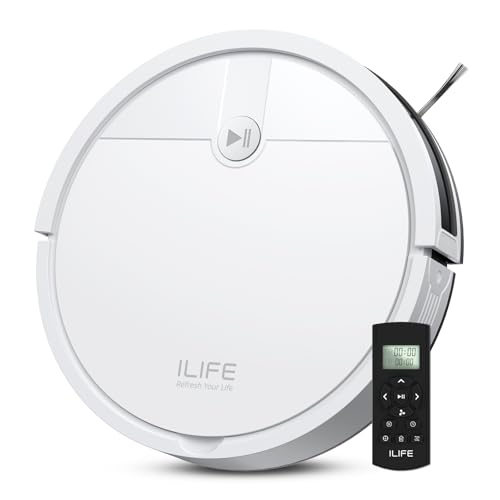
ILIFE V2 Robot Vacuum Cleaner, Tangle-Free Suction
About this pick
The ILIFE V2 skips mopping, mapping, and any self-empty base to focus purely on vacuum-only cleaning at the lowest price in this comparison. Its tangle-free suction inlet is aimed specifically at long hair and pet fur that tend to wrap around the brush roll on cheaper units.
For buyers who only need a basic daily vacuum pass and do not care about mopping or advanced navigation, it covers the core function at well under half the price of the self-empty models in this guide.
Best for: Buyers who want a straightforward daily vacuum-only robot at the lowest price in this comparison.
Check price on AmazonSpecs
- Suction Power: Tangle-free suction inlet
- Feature 2: Vacuum-only
- Feature 3: Self-charging
- Connectivity: App control
Pros
- +Lowest price in this comparison
- +Tangle-free inlet designed for pet hair and long hair
- +Simple app control without a steep learning curve
Cons
- −No mopping function
- −No self-empty base or advanced room mapping
How We Evaluated These Robot Vacuums Under $400
Each pick was assessed across 5 criteria weighted for real-world use.
Price ceiling verification
We confirmed each model's current listed price fell under the $400 ceiling for this guide before including it, since prices on robot vacuums shift frequently.
Suction power and cleaning mode
We compared rated suction in Pa where available, and noted which models combine vacuuming with mopping versus offering vacuum-only cleaning.
Self-empty and maintenance features
We checked which models include a self-empty base, whether it also washes mop pads, and how that changes ongoing maintenance versus manual-empty models.
Review volume and brand track record
We factored in current review counts and how long each model has been on the market as a signal of accumulated real-world reliability data, while being clear that we did not independently test these units.
Ownership cost beyond the sticker price
We estimated realistic annual consumable costs, including mop pads, filters, and dust bags, so the true first-year cost is visible alongside the upfront price.
How to Choose the Right Robot Vacuums Under $400
By Budget Within This Tier
Even under the shared $400 ceiling, prices in this comparison span nearly $220, so where you land matters.
| Budget | Recommended Pick |
|---|---|
| Under $100 | ILIFE V2 |
| $100 to $200 | eufy 11S MAX or roborock Q7 L5 |
| $200 to $300 | Tikom Self-Emptying or ECOVACS DEEBOT T50 PRO Omni |
By Cleaning Need
Match the model to what you actually need cleaned, not just the highest suction number available.
| Need | Recommended Pick |
|---|---|
| Heavy carpet or pet hair | roborock Q10 S5+ |
| Hard floors and light carpet only | ILIFE V2 or ROPVACNIC |
| Vacuum and mop in one pass | roborock Q7 L5 or ECOVACS DEEBOT T50 PRO Omni |
| Hands-off emptying and mop washing | ECOVACS DEEBOT T50 PRO Omni |
Self-Empty Base vs Manual Empty
Self-empty base
Reduces how often you touch the bin, in some cases down to roughly once a month. The Shark AV2501S, Tikom self-emptying model, and DEEBOT T50 PRO Omni here all include one, at a price premium over manual-empty models.
Manual empty
Lower purchase price and one less mechanical component to maintain, but requires emptying the bin after most or every cleaning run. The roborock Q7 L5, ROPVACNIC, eufy 11S MAX, and ILIFE V2 in this comparison are all manual-empty.
If a self-empty base matters to you, budget closer to $220 and up based on this comparison.
Vacuum-Only vs Vacuum-and-Mop Combo
Vacuum-only
Simpler mechanism and generally the lowest price, as with the ILIFE V2 and eufy 11S MAX here. A reasonable choice if you already mop separately or have mostly carpeted floors.
Vacuum-and-mop combo
Handles both in one pass, which most models in this comparison now offer. Mopping is generally light maintenance mopping rather than a deep scrub, so stubborn stains may still need manual attention.
Annual Consumable Cost Estimate
Based on typical replacement schedules for mop pads, side brushes, filters, and dust bags on self-empty models.
| Model type | Approx. Annual Consumable Cost | Notes |
|---|---|---|
| Vacuum-only, manual empty | ~$25 to $45/year | Mainly filters and side brushes |
| Vacuum-and-mop combo | ~$40 to $65/year | Adds mop pad replacements |
| Self-empty with mop wash station | ~$50 to $80/year | Adds dust bags and cleaning solution |
Universal-fit accessories from third-party sellers can lower these costs compared to buying only from the original brand.
When to Spend More Than $400
Spend more if
You need precise no-go zone mapping around cables or pet bowls, multi-floor map storage, or camera-based obstacle avoidance. Those features are more consistently reliable above this tier.
Stay under $400 if
You want solid daily vacuuming, light mopping, and optionally a self-empty base without paying for mapping precision most households will not fully use.
Frequently Asked Questions
Do all robot vacuums under $400 include a self-empty base?
No. In this comparison, three of the eight models include a self-empty base (the Shark AV2501S, the Tikom self-emptying model, and the ECOVACS DEEBOT T50 PRO Omni), while the rest require manually emptying the bin after cleaning runs.
Is mopping on a combo robot vacuum as good as mopping by hand?
Generally not for stubborn or dried-on stains. Combo models like those in this comparison apply light, consistent maintenance mopping across a pass, which is useful for daily upkeep but is not a substitute for occasional manual deep mopping.
How much suction do I actually need?
For hard floors and light carpet, models in the 5,000 to 6,000Pa range in this comparison, like the ROPVACNIC or ILIFE V2, are generally sufficient. For thicker carpet or heavy pet hair, models rated 8,000Pa and above, like the roborock Q10 S5+ or Q7 L5, tend to need fewer repeat passes.
What should I budget for consumables in the first year?
Expect roughly $25 to $80 per year depending on model type, covering side brushes, filters, mop pads on combo units, and dust bags on self-empty models. Combo and self-empty models sit at the higher end of that range.
What's the main thing I give up by staying under $400 instead of moving to the next tier?
Mapping precision and obstacle avoidance are usually the biggest gaps. Models above $400 more consistently offer camera-based obstacle detection and multi-floor map storage, features that are less common or less refined on the models in this comparison.
Are newer, less established brands like Tikom or ROPVACNIC worth the lower price?
They can be, especially if the core features (suction level, mopping, self-empty base) match your needs. The tradeoff is a smaller accumulated review history compared to longer-running brands like eufy or Shark, so there is less real-world data on long-term reliability.
Bottom Line
best overall: ECOVACS DEEBOT T50 PRO Omni Robot Vacuum and Mop - best overall pick in this roundup.
See the full rankings above for all picks with pros, cons, and best-for summaries.
Browse on Amazon
All Prime-eligible options with current pricing.
Shop on Amazon →