6 Best Quad Canes in 2026
Six self-standing quad canes compared by base size, stated weight limit, height range and handle shape, with fit tips to confirm with your clinician.


At a Glance
A quad cane swaps the single rubber tip of a regular cane for four small feet on a molded or welded base, so the cane can stand upright beside a chair, a bed or a kitchen counter. That one change is why people shop for them: no more bending to retrieve a cane that slid to the floor, and a wider footprint under the hand on smooth indoor floors. It also brings trade-offs in weight, bulk and stair handling that single-point canes do not have.
This lineup covers six quad canes from Medline, PELEGON, WHLICKS, KINGGEAR, Rehand and KMINA. They span a 1.1 lb folding aluminum model to a steel-frame cane with a stated 350 lb rating, and the handles range from soft foam to a hard polypropylene grip with a soft overlay. We evaluated each one on the specs and details printed on its product page, including base size, adjustment range, stated capacity and handle shape.
A cane is a piece of support equipment, so fit matters more than any feature list. Always check the stated weight limit against the user, set the handle height with a relaxed arm, and ask a physical therapist or clinician to confirm the cane type, hand side and technique, especially after surgery, an injury or a noticeable change in steadiness. Nothing here is medical advice or a claim of medical benefit.
6 Criteria to Look For Before Buying a Quad Cane
Key buying criteria so you get the right fit the first time.
Base size and footprint
The base is the defining feature of a quad cane, and its width decides how stable the cane feels and where it fits. A small base like the Medline's keeps a tight footprint for hallways and chair clearances, while large bases such as the PELEGON and WHLICKS spread support across a wider area at the cost of bulk. The KINGGEAR sits in between with a 4.3 inch base that still stands on its own. Measure your tightest route, such as a bathroom door or kitchen aisle, before choosing a large base. A physical therapist can advise whether small or large suits your gait.
Stated weight capacity
Most standard adult quad canes state a 300 lb limit, and heavier-duty models state 350 lb or more. In this lineup the Medline, PELEGON and KINGGEAR all list 300 lb, while the WHLICKS and KMINA list 350 lb. Choose a cane whose stated limit is comfortably above the user's weight, since a cane also takes dynamic loads when pushing up from a chair. The Rehand does not state a capacity on its listing, so confirm it with the seller before buying. If the user is near any listed limit, ask a clinician about a bariatric model.
Height range and fit
A common guide is to set the handle near wrist-crease height with a relaxed standing posture, leaving a gentle elbow bend while walking. The Medline reaches 29 inches and the PELEGON 29.5 inches, which suits shorter users, while the PELEGON goes up to 38.4 inches for taller ones. The KINGGEAR stops at 36 inches, which is why its page states a 4 ft 9 in to 6 ft 1 in fit. Check the lowest and highest settings against your own measurement rather than relying on the middle of the range. Have a clinician confirm the final height.
Handle shape and grip
A handle that feels fine for a five minute test can ache after a long walk, so shape matters. Foam handles like the Medline's cushion the palm, the KINGGEAR's EVA grip is also offset to sit over the shaft, and the Rehand uses a longer, wider hard-and-soft grip to spread contact. Look for a handle that matches your hand size and any wrist or hand sensitivity, and consider a strap or wider grip if grip strength is limited. If hand discomfort is an issue, a therapist may suggest a specific handle type.
Weight and folding
Quad canes weigh more than single-point canes because of the base, and the spread here is wide. The KINGGEAR is listed at 1.1 lb and folds, the PELEGON is 2.1 lb and fixed, and the steel KMINA will be heavier than the aluminum models. A lighter cane is easier to carry up steps and into a car, but a heavier one can feel more planted. Folding adds convenience for travel but also adds joints to check for a firm lock before every use.
Tips, base wear and surfaces
Quad bases work best on flat, firm surfaces, and thick grass, gravel or deep carpet can tilt the base so only some feet touch. Each foot wears over time, and worn or cracked rubber loses traction, so inspect all four tips regularly. The PELEGON and WHLICKS put anti-slip rubber on every prong, the KMINA lists anti-slip ferrules, and the Rehand's molded base uses larger foot pads. Replace tips when the tread smooths out, and avoid relying on a quad base on stairs without guidance from a therapist.
6 Best Quad Canes in 2026
Medline Aluminum Quad Cane, Small Base
About this pick
The Medline is the plainest cane in this group and that is its strength. It is a lightweight aluminum shaft with four feet on a small base, a foam handle and a rubber pad underneath, adjusting from 29 to 38 inches. The page states a 300 lb capacity, which matches what most standard adult quad canes list. The small base is the part that makes it a sensible first quad cane.
A small base takes less floor space, so it clears door thresholds, chair legs and crowded hallways more easily than a wide base. The trade-off is a smaller stability footprint, which is why Medline itself sells a large-base version for people who want more steadiness at a slower pace. The 29 inch low end is also the shortest in this lineup, which helps shorter users who cannot get a good fit from canes that start at 31 inches.
In daily ownership it is simple. There is nothing to fold, no strap and no unusual handle shape, so the main job is setting the height pin and checking the rubber feet for wear every few weeks. Compared with the WHLICKS at 350 lb, it gives up some rated capacity, and compared with the KINGGEAR at 1.1 lb it is not built for travel. If the goal is a dependable everyday indoor cane with a compact footprint, this is the most straightforward choice.
Best for: Indoor use in tight spaces where a compact base matters more than maximum rated capacity.
Check price on AmazonSpecs
- Base: Small, four feet
- Height range: 29 to 38 in
- Stated capacity: 300 lb
- Handle: Foam
Pros
- +Small base fits narrow hallways and chair clearances
- +Wide 29 to 38 inch range suits shorter users
- +Foam handle is familiar and easy to grip
- +Stated 300 lb capacity covers most adults
Cons
- −Smaller footprint gives less stability than large bases
- −Not foldable for travel or bag storage
- −Capacity below the 350 lb canes in this list
PELEGON Quad Cane, Large Base
About this pick
PELEGON builds this cane around a large four-pronged base with an anti-slip rubber tip on each prong. The adjustment range runs from 29.5 to 38.4 inches, the widest top end among the 300 lb canes here, and the page lists a weight of 2.1 lb. The maker describes the base as suited to smooth floors and uneven pavement alike, though any quad base is easier to control on flat ground.
The large footprint is what you are paying for. It sits more broadly under the hand than the small base on the Medline at 29 to 38 inches, which suits someone who walks slowly and wants the cane to settle firmly with each step. That extra width can catch on furniture and will not fit on a standard stair tread without turning the cane sideways, so it is a better match for flat indoor routes and level sidewalks than for stair-heavy homes.
Day to day it behaves like a standard adjustable aluminum cane. You set the push-button height, check that all four tips touch the floor together, and swap tips when they wear smooth. At 2.1 lb it is roughly double the weight of the KINGGEAR at 1.1 lb, so it feels more planted but less carry-friendly. The listing ties its 300 lb rating to the maker's own testing, so a clinician should confirm fit if the user is near that limit.
Best for: Slow, steady walking on flat surfaces where a wide, planted base is the priority.
Check price on AmazonSpecs
- Base: Large, four prongs
- Height range: 29.5 to 38.4 in
- Stated capacity: 300 lb
- Weight: 2.1 lb
Pros
- +Large base spreads support across a wide footprint
- +Tallest top height at 38.4 inches among 300 lb canes
- +Each prong carries its own anti-slip rubber tip
- +Listed at 2.1 lb, light for a large base
Cons
- −Wide base is awkward on stairs and tight spaces
- −Does not fold, so it is bulky to pack
- −Rating comes from the maker, not independent testing
WHLICKS Heavy Duty Quad Cane, 350 lb
About this pick
The WHLICKS is the pick for anyone who wants more rated headroom than the standard 300 lb. The listing states a 350 lb capacity and points to a 1.5 mm thick aircraft-grade aluminum tube, which the maker calls nearly double that of ordinary canes. It adjusts from 31 to 38 inches and states a fit for users from 5 ft to 6 ft 5 in, with a large four-pronged base and rubber tips on every prong.
The maker highlights the offset base shape as a way to reduce tripping, and the cane is described as self-standing beside a chair, bed or counter. That makes it useful as a rising aid from a seat, though the push-up force should always go through a properly locked height setting. The 31 inch minimum means shorter users may run out of adjustment, where the Medline at 29 inches and PELEGON at 29.5 inches reach lower.
Ownership is straightforward: set the height, confirm the pin is fully through the hole, and keep the tips clean and unworn. Thicker tubing adds some weight, so expect it to feel heavier than the KINGGEAR at 1.1 lb. Compared with the KMINA, which also states 350 lb but uses a steel frame, this one stays in aluminum, so it is the lighter option of the two high-capacity picks. Anyone near the rated limit should still have a clinician confirm the cane suits their needs.
Best for: Larger or heavier adults who want a stated 350 lb rating in an aluminum frame.
Check price on AmazonSpecs
- Stated capacity: 350 lb
- Tube wall: 1.5 mm aluminum
- Height range: 31 to 38 in
- Fits: 5 ft 0 in to 6 ft 5 in
Pros
- +States 350 lb capacity, above the 300 lb standard
- +Thick 1.5 mm tube wall adds rigidity
- +Fit stated for 5 ft to 6 ft 5 in users
- +Self-standing beside a chair, bed or counter
Cons
- −31 inch minimum is too tall for some shorter users
- −Thicker tubing makes it heavier than folding canes
- −Large base is awkward on narrow stair treads
KINGGEAR Folding Self-Standing Quad Cane
About this pick
The KINGGEAR is the lightest cane here at 1.1 lb and the only one built to collapse in seconds, with a hook-and-loop strap on the shaft to hold it folded. It adjusts from 31 to 36 inches in six one-inch steps with a push-button lock, which the page maps to users from 4 ft 9 in to 6 ft 1 in. The maker states a 300 lb capacity and a lifetime guarantee.
Its handle is an offset EVA foam grip, which keeps the shaft centered under the palm and cushions the hand. The base is quoted at 4.3 inches wide, noticeably more compact than the large bases on the PELEGON and WHLICKS, so it behaves more like a small-base cane while still standing on its own. The 36 inch top height is the lowest ceiling in the group, so tall users above the stated 6 ft 1 in range should look elsewhere.
For owners who travel or move between rooms and a car, the fold is the main benefit. The shaft shortens enough to ride in a bag or on the back seat, which the fixed-length Medline cannot do. The trade-off is more joints and a hinge to keep clean, and a folding cane should be checked for a fully locked, rattle-free shaft before each use. At 1.1 lb it feels airy beside the 2.1 lb PELEGON, so some users may prefer a heavier, more planted cane.
Best for: Travel, car trips and bag storage where a light folding quad cane matters most.
Check price on AmazonSpecs
- Weight: 1.1 lb
- Height range: 31 to 36 in, six settings
- Stated capacity: 300 lb
- Base width: 4.3 in
Pros
- +Lightest in the group at 1.1 lb
- +Folds with a hook-and-loop strap for carrying
- +Offset EVA handle cushions the palm
- +Compact 4.3 inch base still stands on its own
Cons
- −Top height of 36 inches excludes taller users
- −More joints to inspect than a fixed-shaft cane
- −Light weight feels less planted than heavier canes
Rehand Folding Quad Cane, Molded Base
About this pick
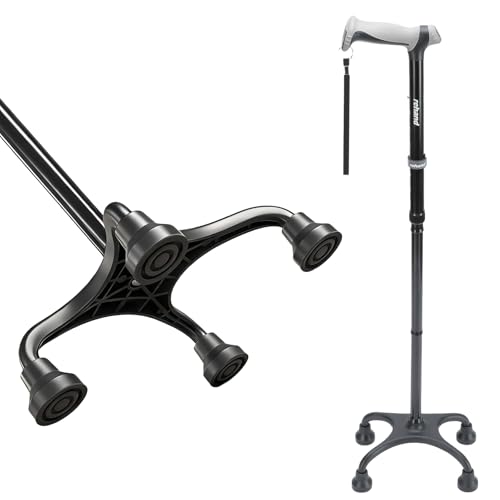
Rehand takes a different route on the handle and the base. The base is molded in one piece rather than welded, which the maker says avoids the loose-foot wobble of traditional welded bases, and the rubber foot pads are larger to increase ground contact. The shaft adjusts from 31 to 38 inches in eight one-inch settings, and the page states a fit for users from 5 ft to 6 ft 5 in.
The handle combines a hard polypropylene core for firm support with a soft TPR overlay, and it is longer and wider than a standard foam grip to spread palm contact. Some users find a firmer, wider handle easier on the hand than soft foam, while others prefer the foam on the Medline, so this is worth trying in person if possible. The cane can be turned for right or left hand use and folds down to about 16 inches with a tie strap.
The listing does not state a weight capacity, so the buyer should check the product page before relying on it, unlike the 300 lb Medline and KINGGEAR or the 350 lb WHLICKS. That gap is the main reason this is not the top pick for anyone near a typical limit. For people who want a folding quad with eight height steps and a distinctive grip, it is a well-considered option, but confirm the rating with the maker first.
Best for: Users who want a wide hard-and-soft handle and a one-piece molded base in a folding cane.
Check price on AmazonSpecs
- Base: Molded, larger rubber pads
- Shaft range: 31 to 38 in, eight settings
- Fits: 5 ft to 6 ft 5 in
- Folded length: 16 in
Pros
- +Molded one-piece base avoids welded-joint wobble
- +Eight one-inch steps allow a close height fit
- +Wide handle spreads contact across the palm
- +Folds to about 16 inches with a tie strap
Cons
- −Weight capacity is not stated on the listing
- −Hard handle feels firmer than foam grips
- −Shaft starts at 31 inches, tall for small users
KMINA Steel Quad Cane, 350 lb
About this pick
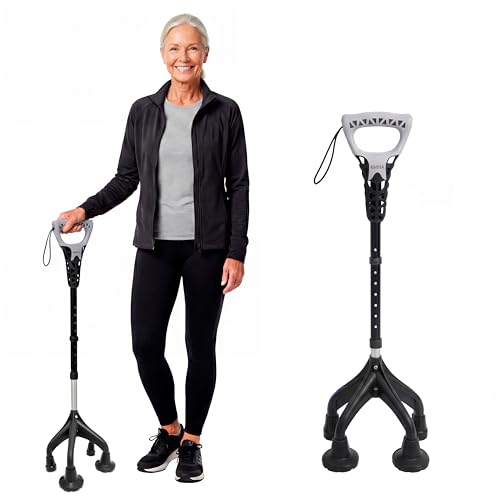
The KMINA is the one steel-frame cane in this set, and the page states a 350 lb capacity with anti-slip ferrules on each prong. The maker calls the design patented and engineered in Europe, and describes an anatomical handle meant to ease pressure on the hand and wrist. It is height adjustable and works in either hand, though the listing does not state a specific height range.
Steel brings strength and a planted feel at the cost of weight. It will be heavier than the aluminum Medline and WHLICKS, which matters if the user lifts the cane often or climbs stairs with it. The wide four-prong base provides a large, steady contact patch, similar in spirit to the PELEGON, and is aimed at users who want maximum steadiness on all surfaces.
Because the height range is not spelled out, check the product page or ask the seller before buying, especially for very short or very tall users, where the WHLICKS at 5 ft to 6 ft 5 in and Rehand at the same range are clearer. As with any heavy-duty cane, a clinician should confirm that the cane type and handle suit the user. For a durable steel option with a clear 350 lb rating, it fills a gap the aluminum canes leave open.
Best for: Users who prefer a steel frame and a stated 350 lb rating over the lightest possible weight.
Check price on AmazonSpecs
- Frame: Steel
- Stated capacity: 350 lb
- Base: Wide, four prongs
- Hand: Right or left
Pros
- +Steel frame feels solid underfoot
- +States 350 lb capacity
- +Anatomical handle aims to ease hand pressure
- +Works in either hand
Cons
- −Heavier than the aluminum canes in this lineup
- −Height range is not spelled out on the listing
- −Does not fold for travel
How We Evaluated These Quad Canes
Each pick was assessed across 5 criteria weighted for real-world use.
Base design and stability features
We compared the size, shape and construction of each base as described on the product page. The Medline offers a small base, the PELEGON and WHLICKS offer large ones, the KINGGEAR quotes a 4.3 inch width, and the Rehand uses a molded one-piece base. We weighed claims about self-standing behavior against how the base would likely suit different rooms.
Stated capacity and fit range
We recorded each stated weight limit and height range exactly as listed. The WHLICKS and KMINA lead at 350 lb, the Medline, PELEGON and KINGGEAR list 300 lb, and the Rehand lists no capacity. Height ranges were checked against the 5 ft to 6 ft 5 in claims where given.
Handle and comfort
We looked at handle material and shape, since a good cane handle can reduce fatigue over a long walk. The Medline uses foam, the KINGGEAR an offset EVA grip, and the Rehand a hard and soft combination. These are described as the listings describe them, based on specs and buyer feedback rather than personal use.
Weight, frame and portability
We compared frame materials and listed weights, from the KINGGEAR at 1.1 lb to the PELEGON at 2.1 lb and the steel KMINA. Folding ability and carry strap were counted as practical advantages for travel. We also noted the folded size where the listing gave one, such as the Rehand at 16 inches.
Value and overall lineup positioning
We ranked how each cane fits its likely buyer. The Medline leads for simple indoor use, the PELEGON for a wide base, the WHLICKS and KMINA for higher rated capacity, the KINGGEAR for travel, and the Rehand for handle design. We then checked for gaps in the information on each listing.
How to Choose the Right Quad Canes
By Walking Environment
Where the cane is used most often decides how much base you want.
| Situation | Pick | Why |
|---|---|---|
| Narrow hallways and small bathrooms | Medline Aluminum Quad Cane, Small Base | The small base clears tight spaces and chair legs more easily than a wide base. |
| Long flat indoor routes and level sidewalks | PELEGON Quad Cane, Large Base | The large base gives a wide footprint at 29.5 to 38.4 inches. |
| Frequent car trips and travel | KINGGEAR Folding Self-Standing Quad Cane | At 1.1 lb and foldable, it packs into a bag or back seat. |
| Mixed home use with a firm sit-to-stand base | WHLICKS Heavy Duty Quad Cane, 350 lb | Stated 350 lb capacity and a thick 1.5 mm tube suit repeated rising. |
| Heavy-duty steel preference | KMINA Steel Quad Cane, 350 lb | Steel frame with a stated 350 lb capacity. |
A physical therapist can confirm which base size suits your gait and home layout.
By Budget
Relative tiers help match spend to need without relying on current pricing.
| Tier | Pick | What you get |
|---|---|---|
| Entry | Medline Aluminum Quad Cane, Small Base | A straightforward 300 lb aluminum cane with a foam handle and small base. |
| Entry to mid | KINGGEAR Folding Self-Standing Quad Cane | Folding and 1.1 lb with a lifetime guarantee stated by the maker. |
| Mid | PELEGON Quad Cane, Large Base | Large base and a tall 38.4 inch top height at 2.1 lb. |
| Mid to premium | Rehand Folding Quad Cane, Molded Base | Molded one-piece base, eight settings and a wide hard-and-soft handle. |
| Premium | WHLICKS Heavy Duty Quad Cane, 350 lb | Highest stated aluminum capacity with a thick tube wall. |
Tier placement is based on relative listing positioning and may shift, so check the current product page.
Small Base vs Large Base
The base size trades maneuverability for steadiness.
Small base
A small base keeps the footprint compact so the cane moves faster through doorways, around furniture and into a car. It gives less side-to-side stability than a large base. Picks in this camp are the Medline Small Base at 29 to 38 inches and the KINGGEAR, whose 4.3 inch base is compact. Choose this side if your rooms are tight and your pace is brisk.
Large base
A large base spreads support wider so the cane settles more firmly with each step, at the cost of bulk and stair clearance. Picks here include the PELEGON at 29.5 to 38.4 inches, the WHLICKS at 350 lb and the KMINA. Choose this side if you walk slowly on flat ground and want the broadest footprint. A therapist can confirm which side fits.
If you need both, a compact base with a firm handle often covers most daily needs.
By Handle Preference
Handle comfort is the second decision after base size.
| Preference | Pick | Detail |
|---|---|---|
| Soft cushioned grip | Medline Aluminum Quad Cane, Small Base | Foam handle, familiar and easy to hold. |
| Offset grip over the shaft | KINGGEAR Folding Self-Standing Quad Cane | EVA foam offset handle that centers the shaft under the palm. |
| Wide, firm palm support | Rehand Folding Quad Cane, Molded Base | Longer, wider hard PP handle with a soft TPR overlay. |
| Anatomical grip for the wrist | KMINA Steel Quad Cane, 350 lb | Ergonomic handle aimed at easing hand and wrist pressure. |
Hold the cane at the correct height before deciding, because handle comfort changes with posture.
For Sit-to-Stand Support Specifically
Rising from a chair is where a self-standing cane helps most, but a cane is not a substitute for a grab bar or a clinician's advice.
Look for
A base that stands on its own, a height pin that locks fully, and a stated capacity above the user's weight. Large, steady bases and rated capacity matter most here, along with a handle that fits the hand when pushing down. Never push up on a cane with a loose or partly locked pin.
In this comparison
The WHLICKS at 350 lb and KMINA at 350 lb are the highest rated for repeated loading, and the PELEGON offers a wide stable base. The Medline at 300 lb is compact beside a chair, and the KINGGEAR stands on its own but is light at 1.1 lb. Have a clinician confirm sit-to-stand technique.
A cane should not replace a grab bar or hands-on assistance when rising is difficult.
When to Spend More
A little extra can buy a clearer rating or a better fit.
| Spend more if | Save if |
|---|---|
| You are near 300 lb and want a stated 350 lb rating such as the WHLICKS or KMINA | You are well under 300 lb and the Medline's stated 300 lb covers you |
| You travel often and want the foldable 1.1 lb KINGGEAR | You mostly stay home and a fixed-shaft cane suits you |
| You need a tall setting up to 38.4 inches like the PELEGON | You are an average height and 29 to 38 inches from the Medline fits |
| You want a molded base and eight settings like the Rehand | A basic base and a standard foam handle are enough |
Always check the stated capacity and fit before buying.
Frequently Asked Questions
How do I choose between a quad cane and a regular cane?
A quad cane stands on its own and gives a wider contact area than a single-point cane. It is also heavier and bulkier, and it can be harder on stairs. A single-point cane is lighter and easier to maneuver but asks more of your own balance. A physical therapist can advise which type suits your needs.
Which base size should I pick?
A small base such as the Medline keeps a tight footprint for narrow spaces and a quicker pace. A large base such as the PELEGON or WHLICKS spreads support wider for slower, steadier walking on flat ground. Large bases can be too wide for a standard stair tread. Measure your tightest doorway before choosing.
What weight limit should I look for?
Most standard adult quad canes state 300 lb, and heavier-duty models state 350 lb or more. Pick one whose stated limit sits comfortably above the user's weight. The Medline, PELEGON and KINGGEAR list 300 lb, the WHLICKS and KMINA list 350 lb, and the Rehand does not state one. Ask a clinician about bariatric options if you are near any limit.
How do I set the right height?
A common guide is to stand relaxed and set the handle at about wrist-crease height, so your elbow has a gentle bend when you walk. Adjustable ranges here run from 29 inches on the Medline to 38.4 inches on the PELEGON. A therapist can check height and hand side in a few minutes. Make sure the height pin clicks fully into place.
Which hand should hold the cane, and how should the base face?
A cane is generally held in the hand opposite the weaker leg, and a quad base usually sits with its flat side toward the body. Some canes let you rotate the base to match the hand. Your clinician or physical therapist should confirm both for your situation. Right or left hand use is possible on the Rehand, KMINA and others.
Can I use a quad cane on stairs?
It depends on the person and the stairs. A wide base may not fit a standard tread and may need to be turned sideways, and technique varies with gait and strength. Where there is a handrail, many people hold it with the other hand. A physical therapist should demonstrate stair technique before you rely on a quad cane there.
How long do quad cane tips last?
Rubber feet wear with use and with the surfaces you walk on. Check all four for smooth tread or cracks every few weeks and replace worn tips. A cane with uneven tips can rock or slide. The PELEGON and WHLICKS use anti-slip rubber on each prong, and replacement tips are widely available.
Bottom Line
best overall: Medline Aluminum Quad Cane, Small Base - best overall pick in this roundup.
See the full rankings above for all picks with pros, cons, and best-for summaries.
Browse on Amazon
All Prime-eligible options with current pricing.
Shop on Amazon →