6 Best Portable Chargers Under $30 (2026)
Six budget power banks compared on capacity, charging speed, built-in cables and airline rules, so you can pick a charger you will actually carry every day.



At a Glance
Power banks at this budget cover a surprisingly wide range. The Miady magnetic bank is a 5000mAh slab about the size of a credit card, the Szfakuer, citicr and both VRURC models are 10000mAh packs, and the IAPOS jumps to 40000mAh. That spread means two shoppers can both search for a cheap portable charger and need completely different products.
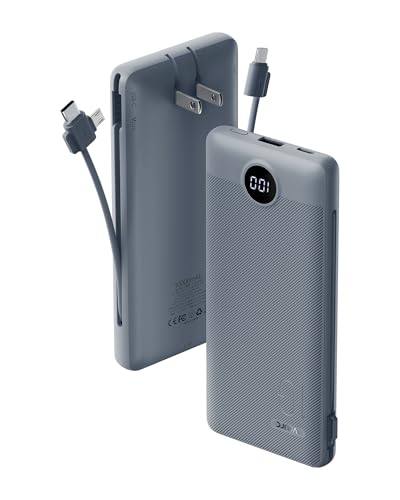
The second split is cables. The citicr and the VRURC wall plug model fold the cord and even the wall plug into the body, the VRURC lanyard model carries four built-in cables, while the Szfakuer relies on your own USB-C cable. For anyone who has ever reached for a charger and found no cord, built-in cables are worth more than extra milliamp hours.
We ranked these six by how easy they are to carry, how many cables you still need to bring, and how much real charging they add per day. Capacity is explained in watt-hours so you can see why the IAPOS behaves like a different class of product than the 10000mAh packs, and each pick is tied to the kind of buyer it fits best.
6 Criteria to Look For Before Buying a Portable Chargers Under $30 (2026)
Key buying criteria so you get the right fit the first time.
Capacity in watt-hours, not mAh
A power bank's mAh number only makes sense when paired with voltage, and the clearer measure is watt-hours, roughly mAh divided by 1000 times 3.6 to 3.7 volts. On that scale the Szfakuer's 10000mAh is about 37 Wh, the Miady's 5000mAh is about 18.5 Wh and the IAPOS's 40000mAh is around 148 Wh. Airlines allow 100 Wh or less in the cabin without approval and require approval from 100 to 160 Wh, so the IAPOS is the one pick here that needs a conversation with the airline. Always look for a printed Wh rating on the case, because security may confiscate a bank that has none.
Real usable output
Rated capacity is never the same as delivered capacity. Independent measurements put usable output around 77 to 83 percent of the rating, since some energy is lost as heat and in voltage conversion. That means the Szfakuer's 37 Wh behaves more like roughly 30 Wh in daily use, which is closer to two phone charges than three. When comparing the citicr with the VRURC lanyard model, treat the listed 2.5 to 4 phone charges as a ceiling rather than a promise.
Charging speed in watts
USB-C PD 3.0 can range from 18 to 100 W, while typical USB-A ports deliver only about 5 to 12 W. The Szfakuer and IAPOS both advertise 22 to 22.5W outputs, which refill a phone quickly, while the VRURC lanyard model's 2.4A USB-C is more of an overnight tool and the Miady's 5W wireless is the slowest of all. A short, quality cable loses less power than a long thin one, so built-in cables on the citicr help preserve its quoted speed. If you charge while out and about, aim for 20W or more.
Built-in cables versus bring your own
Built-in cables on the citicr and both VRURC models remove the single most common reason a power bank fails you, which is a missing cord. The cost is that a frayed built-in cable cannot be replaced, so the bank's life becomes tied to that one wire. The Szfakuer relies on your own USB-C cable, which is cheaper to replace but easier to forget. For older users who want one grab-and-go object, built-in cables are usually the better choice.
Size, weight and where it will live
A power bank you leave at home is worth nothing, so match the size to the way you carry. The Miady at 0.55 inches thin and the Szfakuer at 0.63 inches and 8.11 ounces both fit a pocket, while the IAPOS is a bag or car item. Think about the weight in a handbag over a whole day, because 8 ounces feels very different from a heavy 40000mAh pack. Choose the smallest bank that covers a full day for your phone.
Safety marks and protections
Look for UL or FCC marks and built-in protection against overcharge and short circuit, which are the baseline safeguards on a lithium pack. Cheap unbranded banks sometimes overstate capacity and skimp on protection, so take marketing claims with a grain of salt. Among these six, treat all capacity numbers as seller claims and keep the bank out of hot cars. Replace any bank that swells, gets unusually hot or smells of chemicals.
6 Best Portable Chargers Under $30 (2026)
Szfakuer 10000mAh Slim Power Bank
About this pick
The Szfakuer is the most balanced bank in this lineup because nothing about it asks you to compromise. It is a 10000mAh pack that measures just 0.63 inches thick and weighs 8.11 ounces, so it slides into a jacket pocket or a purse without a bulge. The USB-C port works as both input and output and supports PD3.0 and QC4+ at up to 22.5W, which is the fast end of what this budget reaches. The tradeoff is that there are no built-in cables, so you must carry your own USB-C cord. Three outputs (two USB-A and one USB-C) let you charge a phone, earbuds and a tablet together, although the listing only provides a single USB-C input for refilling the bank. If you tend to forget cords, the citicr or the VRURC models are the safer purchase. In daily ownership this is the easiest kind of power bank to live with. There is nothing to unfold and no cable to snag, and a 10000mAh pack holds roughly 37 watt-hours, which is comfortably inside the 100 Wh cabin limit for flights. Compared with the Miady magnetic pick it is about twice the capacity and far faster than the Miady's 5W wireless pad, and compared with the IAPOS it is a fraction of the weight.
Best for: Everyday carry buyers who already own a good USB-C cable and want the best balance of speed and size.
Check price on AmazonSpecs
- Capacity: 10000mAh
- Fast charging: 22.5W USB-C PD3.0 and QC4+
- Ports: 2 USB-A plus 1 USB-C
- Size: 0.63 in thick, 8.11 oz
Pros
- +Thin 0.63 inch body slips into a pocket
- +22.5W USB-C output is quick for the class
- +Three outputs charge several devices at once
- +USB-C input and output on a single port
Cons
- −No built-in cable, so bring your own cord
- −Only one USB-C input for recharging the bank
citicr 10000mAh PD20W Power Bank
About this pick
The citicr is built for people who never want to hunt for an extra cord or a wall adapter. It carries one built-in iOS cable and one built-in USB-C cable, plus a fold-out AC plug on the body of the bank itself. That means a single object can both charge your phone and plug directly into a wall outlet to refill, which is rare at this budget. The listing advertises PD20W and 22.5W fast charging with pass-through charging and an LED indicator. Three output ports let it feed up to five connections including the two built-in cables. The tradeoff is bulk: the folding plug and cable housing make it thicker and heavier than the slim Szfakuer, and built-in cables cannot be swapped if one wears out. For a senior or a parent buying for a senior, that all-in-one simplicity is the point, because one grab covers almost every phone. Setup is nothing more than flipping out the plug to recharge overnight. Next to the VRURC wall plug model it offers the same self-contained idea with fast charging called out more clearly, and next to the Szfakuer it trades slimness for convenience.
Best for: Anyone who wants one device that charges iPhone or Android and recharges from the wall without extra gear.
Check price on AmazonSpecs
- Capacity: 10000mAh
- Fast charging: PD20W and 22.5W
- Cables: 1 iOS plus 1 USB-C built in
- Recharging: Fold-out AC wall plug
Pros
- +Fold-out plug recharges straight from a wall outlet
- +Pass-through charging while the bank refills
- +LED display shows remaining charge
Cons
- −Thicker body than the slim bank-only models
- −Built-in cables cannot be replaced if they fray
VRURC 10000mAh Power Bank with 4 Built-In Cables
About this pick
The VRURC lanyard bank is the pick for households where nobody uses the same phone. Built-in Micro USB and USB-C cables cover older and newer Android devices, and the listing counts five total outputs so it can feed a phone, an older tablet and earbuds in one sitting. A lanyard point makes it easy to hang from a bag handle so it does not get lost at the bottom. The USB-C in and out port is rated for 2.4A fast charging, which is slower than the 22.5W banks above. That is fine for overnight top ups and for light use, but it will feel patient if you want a quick boost while walking out the door. Cable length is short, and like all built-in designs a frayed cord cannot be replaced. In practice this is the most flexible bank for a family drawer or a travel bag shared between several people. You never need to pack a charging cable, which removes the most common reason a power bank is useless. Compared with the citicr it covers more connector types, while the citicr wins on speed and wall recharging.
Best for: Families or travelers who juggle older Micro USB gear and newer USB-C devices.
Check price on AmazonSpecs
- Capacity: 10000mAh
- Cables: 4 built in, incl. Micro USB and USB-C
- Outputs: 5 charging options
- USB-C port: In and out, 2.4A
Pros
- +Four built-in cables cover most connectors
- +Five outputs charge several devices together
- +Lanyard keeps it from sinking into a bag
- +USB-C works for charging and recharging
Cons
- −2.4A USB-C is slower than the 22.5W picks
- −Built-in cables cannot be swapped if damaged
VRURC 10000mAh Power Bank with AC Wall Plug
About this pick
This VRURC model leans fully into the all-in-one idea, with a built-in wall plug, built-in Micro USB and Type-C cables, and additional data cables for other connectors. Because the plug is part of the body, you recharge it by sliding it into an outlet and never need a separate wall adapter. The listing estimates 2.5 to 4 phone charges from the 10000mAh cell. It costs the most of the six, and that extra cost buys convenience rather than raw speed or capacity. The housing is bulkier than a thin bank because the plug and cable storage all sit inside it, so it will not disappear into a slim pocket. If your priority is carrying less hardware in total, that bulk is a fair trade. Ownership is simple: plug it in overnight, throw it in the bag, and use whichever cable is already attached. For a travel kit it replaces both a power brick and a cord. Compared with the citicr it carries a similar concept with older connector coverage, while the Szfakuer remains the better choice if pocket size matters most.
Best for: Travelers who want a single piece of gear that replaces the wall charger and the cord.
Check price on AmazonSpecs
- Capacity: 10000mAh
- Recharging: Integrated AC wall plug
- Cables: Micro USB and Type-C built in
- Estimated use: 2.5 to 4 phone charges
Pros
- +Wall plug built into the body for easy refills
- +Micro USB and Type-C cables already attached
- +Extra data cables cover other connectors
- +Estimated 2.5 to 4 phone charges per cycle
Cons
- −Highest cost tier of the six
- −Bulkier than slim bank-only designs
IAPOS 40000mAh 22.5W Power Bank
About this pick
The IAPOS is the only pack here that is built for multi-day trips rather than a day out. Its 40000mAh cell is four times the size of the 10000mAh banks, and it pairs a 22.5W USB-A output with a 22W USB-C output so two fast-charging ports can run together. The listing also supplies a USB-C cable. That capacity comes with weight and airline considerations. At roughly 148 watt-hours it falls into the 100 to 160 Wh tier that needs airline approval, and security may ask for a printed Wh rating. It is also too heavy and thick to treat as pocket gear, so it suits a car, a camping bag or a home outage kit. If your goal is to keep a tablet, a phone and a pair of earbuds running for several days, nothing else here matches it. Recharging a bank this large takes a long time, so plan to plug it in overnight. Compared with the Szfakuer it adds much more capacity at the cost of portability, and compared with the Miady magnetic bank it sits at the opposite end of the size spectrum.
Best for: Campers, drivers and outage planners who want days of power from a single pack.
Check price on AmazonSpecs
- Capacity: 40000mAh
- USB-A output: 22.5W
- USB-C output: 22W PD
- Charges at once: 3 devices
Pros
- +40000mAh holds days of phone charging
- +Two ports deliver fast 22W class output
- +Charges three devices at the same time
- +USB-C cable included in the listing
Cons
- −Heavy and thick, not a pocket carry
- −Needs airline approval in the 100 to 160 Wh tier
Miady 5000mAh Magnetic Power Bank
About this pick
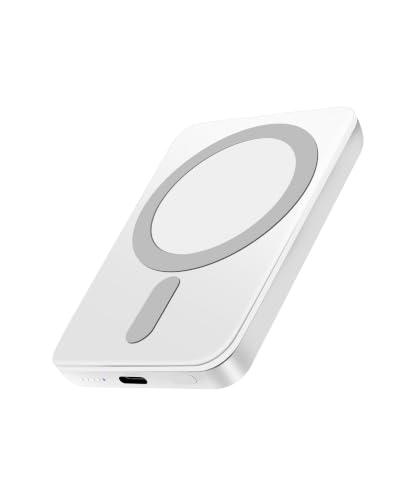
The Miady is the smallest and cheapest option here, and it solves one specific problem: a charger that stays stuck to the back of your phone. A strong magnetic pad holds it in place while it charges wirelessly at 5W, so there is no cable to trip over. At 0.55 inches thick and about the size of a credit card, it is the easiest pick to tuck into a pocket. The tradeoff is speed and capacity. At 5000mAh it holds only about 18.5 watt-hours, so it gives roughly one top up for a typical phone, and 5W wireless is far slower than the 22.5W wired banks. Magnetic hold also depends on the phone and case, so a thick non-magnetic case will weaken the grip. For emergency top ups during a walk or a dinner it is plenty, and the five indicator lights, each worth 25 percent, make remaining charge easy to read. It is also the lowest cost entry, so it makes a good second bank for a coat pocket. Compared with the Szfakuer it gives up half the capacity and most of the speed in exchange for a cable-free, slimmer experience.
Best for: iPhone owners who want a slim, cable-free top up they can leave attached to the phone.
Check price on AmazonSpecs
- Capacity: 5000mAh
- Wireless charging: 5W magnetic pad
- Thickness: 0.55 in, credit card size
- Indicator: 5 lights, 25% each
Pros
- +Magnet keeps it attached while it charges
- +Credit card sized and only 0.55 inches thin
- +Five lights make the charge level easy to read
- +Lowest cost tier of the six
Cons
- −5000mAh gives about one phone charge
- −5W wireless is slow and case dependent
How We Evaluated These Portable Chargers Under $30 (2026)
Each pick was assessed across 5 criteria weighted for real-world use.
Capacity and flight legality
We converted each pick's listed mAh into approximate watt-hours so a 5000mAh Miady, a 10000mAh Szfakuer and a 40000mAh IAPOS could be compared on one scale. We then checked each against the 100 Wh cabin tier and flagged the IAPOS as needing approval. Packs that land well inside the limit scored higher for travel use.
Charging speed
We looked at the stated wattage on every output, separating 22 to 22.5W fast ports from the 2.4A VRURC USB-C and the 5W Miady wireless pad. A pick scored well if its fastest port is genuinely quick for a phone. We also considered whether a fast port is shared when multiple devices are connected.
Cables and convenience
We counted built-in cables and recharging options, since a missing cord is the top failure for a power bank. The citicr and the VRURC wall plug model stood out for combining cables with an AC plug, while the Szfakuer relied on your own USB-C cord. Replaceability of cables was weighed as a durability risk.
Portability and everyday carry
We compared thickness and weight, from the 0.55 inch Miady to the heavy IAPOS, and asked which picks realistically live in a pocket versus a bag. Bulky builds with folding plugs were scored for convenience but marked down for carry size. The strongest pick for carry was the Szfakuer and the most basic in capacity was the Miady.
Value at this budget
We judged each pick by what the buyer gets relative to the other five, such as the IAPOS giving four times the capacity of the 10000mAh packs or the citicr bundling cables and a plug. Based on product specs and buyer feedback signals, the strongest value is the Szfakuer for most people and the IAPOS for pure capacity. No pick was favored because of paid placement.
How to Choose the Right Portable Chargers Under $30 (2026)
By Primary Use
Match the bank to the situation that drains your phone fastest.
| Scenario | Recommended pick |
|---|---|
| Daily commute and errands | Szfakuer 10000mAh Slim Power Bank |
| You always forget cables | citicr 10000mAh PD20W Power Bank |
| Shared by a mixed Android and iPhone family | VRURC 10000mAh Power Bank with 4 Built-In Cables |
| Camping, road trips or outage backup | IAPOS 40000mAh 22.5W Power Bank |
| Emergency top up that stays on your phone | Miady 5000mAh Magnetic Power Bank |
By Budget
| Budget tier | Recommended pick |
|---|---|
| Lowest cost | Miady 5000mAh Magnetic Power Bank |
| Low to mid | Szfakuer 10000mAh Slim Power Bank |
| Mid-range | IAPOS 40000mAh 22.5W Power Bank |
| Upper mid | citicr 10000mAh PD20W Power Bank |
| Premium | VRURC 10000mAh Power Bank with AC Wall Plug |
Slim Pocket Bank vs High Capacity Pack
The core tradeoff is how much you want to carry versus how long you want to last.
Slim pocket bank
The Szfakuer, the Miady and the citicr stay under or near 10000mAh, fit in a pocket or purse and clear airline cabin rules. They give one to two days of phone charging and recharge fast. The Szfakuer is the pick for most people in this group.
High capacity pack
The IAPOS at 40000mAh holds roughly 148 Wh, which runs for days and charges three devices, but it is heavy, slow to refill and needs airline approval. Choose it only if you often go without a wall outlet.
Recommendation
Pick the Szfakuer for daily carry and the IAPOS for trips where no outlet is available.
Built-In Cables vs Bring Your Own Cable
This decides how much hardware you pack.
| Preference | Recommended pick |
|---|---|
| Never carry a separate cord | citicr 10000mAh PD20W Power Bank |
| Cover Micro USB and USB-C together | VRURC 10000mAh Power Bank with 4 Built-In Cables |
| Replace the wall adapter too | VRURC 10000mAh Power Bank with AC Wall Plug |
| Prefer a swappable USB-C cord | Szfakuer 10000mAh Slim Power Bank |
| Wireless only, no cord | Miady 5000mAh Magnetic Power Bank |
For Flying and Travel Specifically
Look for
Choose a bank at or under 100 Wh and carry it in your cabin bag, never in checked luggage. A printed Wh rating helps at security, and 10000mAh at about 37 Wh is an easy fit for every airline tier.
In this comparison
The Szfakuer, the citicr and both VRURC models all sit well under 100 Wh, and the Miady is smaller still. The IAPOS at roughly 148 Wh needs airline approval, so skip it for flights unless you have cleared it.
When to Spend More
Spend more if
You want built-in cables and a wall plug in one body, which means the citicr or the VRURC wall plug model. You also benefit from spending more if you need extra capacity for multi-day use, where the IAPOS is the strongest value.
Save if
You only need a one-day top up, in which case the Miady or the Szfakuer cover it. Save on the Szfakuer if you already own USB-C cables and do not need a wall plug.
Frequently Asked Questions
How do I choose between a 10000mAh and a 40000mAh power bank?
A 10000mAh bank such as the Szfakuer holds about 37 Wh, which is enough for roughly two phone charges and easily carried in a pocket. A 40000mAh bank like the IAPOS holds around 148 Wh, which runs for days but is heavy and needs airline approval. If you mostly charge during a normal day, choose 10000mAh, and only go larger for camping, long trips or outage backup.
Is a cheap power bank worth buying?
At this budget you can get a reliable everyday bank, but you should treat capacity claims as seller figures and look for safety protections. The Szfakuer and citicr both emphasize fast charging and protections in their listings, which is what matters most. Skipping the very cheapest and brand-unclear options is usually a good idea.
How long does a power bank last before it wears out?
Lithium cells lose capacity with every charge cycle, and cheap banks tend to fade sooner. Keep the bank out of hot cars and avoid draining it to zero daily to extend its life. Built-in cables on the citicr and VRURC can also become the weak point if they fray, so inspect them regularly.
Does a bigger mAh number always charge my phone more times?
Not exactly, because usable output is only about 77 to 83 percent of the rating. A 10000mAh bank like the Szfakuer gives roughly 30 Wh in practice, which is around two phone charges rather than three. Charging speed and phone battery size also change the count, so use listed estimates as a ceiling.
Can I take these power banks on a plane?
Yes, but carry them in your cabin bag, not checked luggage. Banks at or under 100 Wh, such as the Szfakuer, citicr, VRURC models and Miady, are allowed without approval. The IAPOS at roughly 148 Wh sits in the 100 to 160 Wh tier that needs airline approval, and security may ask to see a printed Wh rating.
Is wireless magnetic charging as good as a cable?
It is more convenient but slower and less efficient. The Miady charges at 5W wirelessly, while the Szfakuer delivers up to 22.5W by cable, so a cable fills a phone several times faster. Magnetic hold also depends on the phone and case, so a thick non-magnetic case weakens the grip.
Should I buy two small banks or one big one?
Two smaller banks give redundancy and let you share, which is why many buyers prefer a pair of 10000mAh packs to one huge pack. One large bank like the IAPOS is simpler to charge but heavier and harder to fly with. For daily carry, one slim bank such as the Szfakuer is often enough.
Bottom Line
best overall: Szfakuer 10000mAh Slim Power Bank - best overall pick in this roundup.
See the full rankings above for all picks with pros, cons, and best-for summaries.
Browse on Amazon
All Prime-eligible options with current pricing.
Shop on Amazon →