6 Best PIR Motion Sensor Lights in 2026
Six PIR motion sensor lights compared, from screw-in bulbs and socket adapters to ceiling fixtures and outdoor floodlights, with range and setup notes.


At a Glance
PIR stands for passive infrared, and it is the sensor behind most motion lights sold today. It does not send out a signal. It watches for the change in heat that a person, car or animal creates as it moves across its field of view. That design is cheap, reliable and low on power, which is why it appears in everything from a small screw-in bulb to a hardwired outdoor floodlight.
Because the sensor technology is shared, the differences between products come down to form factor, range, mounting height and how much control you have over timing and darkness. A bulb swaps into an existing socket in seconds, a socket adapter turns any lamp holder into a sensing fixture, a ceiling light covers a closet, and a floodlight guards a yard. We evaluated these six on product specs and buyer feedback, paying special attention to the detection ranges, hold-time controls and light output each one lists.
The sections after the picks explain how to match a sensor to a space, because a PIR light that is mounted wrong will feel unreliable even when it works perfectly.
6 Criteria to Look For Before Buying a PIR Motion Sensor Light
Key buying criteria so you get the right fit the first time.
Detection range and height
A PIR sensor only works inside the cone its lens projects, so the range number and the mounting height belong together. The GREENIC lists a 10 to 13 ft range with a 6.8 to 8 ft mounting height, the Torkase lists 8 to 16 ft, and the slochi lists a 3 to 4 m range from a 2 to 3 m mount. Mount a sensor much lower or higher than its stated window and the pattern changes, sometimes leaving a blind spot at your feet. Always match the range to the longest distance you expect someone to approach from. If you need a wide approach, favor the Torkase or the ShineSeed with its 180° arc.
Detection angle and coverage
Angle decides whether the sensor sees movement across a wall or only beneath the fixture. The slochi is rated for 120°, the ShineSeed for 180°, and a bulb such as the Torkase depends on how the socket is pointed. A wider arc catches more but also catches more nuisances, like passing cars or branches. For a porch with a defined path, aim for 120° or 180° and avoid pointing at a road. For a closet, a narrow downward cone is fine.
Timing and hold-time control
How long the light stays on after the last movement affects both comfort and electricity. The slochi offers 3 hold times and 3 sensor modes, the ECOELER has an adjustable delay with a countdown, and the Taigeguang adapter has a time button. A very short hold plunges a slow walker back into the dark, while a very long one defeats the point of motion sensing. For a hallway or closet where you linger, favor a longer delay. For a quick garage pass, a short delay is enough, and fixed-timing bulbs like the Torkase leave that choice to the manufacturer.
Light output and tone
Lumens measure how much light is produced, and tone, measured in kelvins, decides how it feels. The ShineSeed produces 5500 lumens at 5000K, the slochi 1500 lumens with selectable 3000K, 4000K or 6500K, and the GREENIC 800 lumens at 5000K. Daylight tones read as crisp and security-oriented, while 3000K feels warm and domestic. If the light will be seen from a bedroom, prefer a warm option such as the ECOELER or slochi. For a driveway, a cooler 5000K output makes faces and edges easier to see.
Installation difficulty
How much work a light needs before it works should shape the purchase. A bulb like the Torkase or GREENIC screws into an existing socket in seconds, the Taigeguang adapter adds one more step, and the slochi, ECOELER and ShineSeed need to be mounted and wired. Hardwiring a flood or ceiling disc is straightforward for an electrician but not a casual task. If you rent or want to avoid electrical work, stick with bulbs or the adapter. Plan on professional help for the ShineSeed.
Weather rating and placement
Outdoor exposure demands more than an indoor fixture offers. The ShineSeed is IP65 rated against water, and the GREENIC is described as suitable for outdoor and indoor sockets, but the Taigeguang adapter is indoor only. A fixture used outdoors still needs a covered, dry socket if it is a bulb. Check the rating before placing a light where rain or snow will reach it. Placing an indoor-only adapter on a porch is the most common failure.
6 Best PIR Motion Sensor Lights in 2026
Torkase E26 PIR Motion Sensor Light Bulb
About this pick
The Torkase turns an ordinary E26 socket into a motion-activated fixture with no wiring. The bulb puts out 1100 lumens, which the listing equates to a 100W traditional bulb, and its PIR sensor reacts to movement within 8 to 16 ft. A dusk-to-dawn function keeps it dark during the day and lets the sensor work after sunset. It is aimed at entries, garages and porches where you want bright light the moment someone approaches.
The bulb's brightness is its main advantage, but the sensor is built into the bulb body, so the sensing direction follows how the socket points. A bulb in a ceiling can that points down covers a circle under the fixture, while one in a sideways wall sconce covers a different arc. The bulb also holds no adjustments for hold time or sensitivity, as far as the listing says, so you accept its defaults.
Setup takes as long as changing a bulb. At 1100 lumens it is 300 lumens above the GREENIC at 800 lumens, and its 8 to 16 ft range is wider than the GREENIC's 10 to 13 ft. The tradeoff is that you replace the whole bulb if the sensor ever fails, unlike the Taigeguang socket adapter which keeps the bulb separate.
Best for: Porches, garages and entries where bright light is wanted the instant someone arrives.
Check price on AmazonSpecs
- Brightness: 1100 lumens
- Equivalent: 100W bulb
- Detection: 8-16 ft
- Base: E26
Pros
- +1100 lumens rivals a 100W traditional bulb
- +Screws into an existing E26 socket in seconds
- +8-16 ft range covers a typical front entry
- +Dusk-to-dawn operation saves daytime power
Cons
- −Sensor and bulb are one part, so both are replaced
- −No stated control over hold time or sensitivity
- −Sensing direction is tied to the socket orientation
GREENIC 9W A19 PIR Motion Sensor Light Bulb
About this pick
The GREENIC is a 9W A19 bulb with an 800 lumen output and a 5000K daylight tone, equal to a 60W traditional bulb. Its PIR sensor detects movement within 10 to 13 ft, and the listing specifies a detection height range of 6.8 to 8 ft. A photocell keeps the LED off in daylight so the sensor only wakes up in dim conditions. It is rated for both outdoor and indoor sockets according to the product title.
The height spec is the detail most buyers miss. Mount the bulb well below 6.8 ft or far above 8 ft and the sensing pattern shifts, so a low fixture beside a door may behave differently than a ceiling socket. The bulb also needs to sit within its stated range of the walking path, which is narrower than the Torkase's 8 to 16 ft. The cool daylight tone is crisp but can feel stark in a hallway.
In daily use it behaves like a standard bulb that happens to know when to turn on. At 800 lumens it is bright enough for a stoop or a laundry room, though the Torkase at 1100 lumens will throw light further across a driveway. Choose the GREENIC when you want a middle brightness and a published mounting-height window to plan against.
Best for: Stoops, laundry rooms and carports where a moderate daylight-tone bulb is enough.
Check price on AmazonSpecs
- Power: 9W
- Brightness: 800 lumens, 5000K
- Range: 10-13 ft
- Mounting height: 6.8-8 ft
Pros
- +Published mounting height of 6.8-8 ft helps planning
- +800 lumens at 9W is bright and efficient
- +Photocell stops the bulb from triggering in daylight
- +Fits standard A19 sockets indoors or outdoors
Cons
- −10-13 ft range is shorter than the Torkase
- −5000K tone is cool and stark indoors
- −Sensor accuracy depends on staying in the height window
ECOELER 16W PIR Motion Sensor Ceiling Light
About this pick
The ECOELER is a 16W flush-mount disc light that doubles as an occupancy sensor. It offers three selectable color temperatures, 3000K warm white, 4000K cool white and 5000K daylight, and an adjustable time delay with a countdown feature. A light sensor holds it off in daylight, and the fixture detects motion only from dusk to dawn unless you arrange for darkness. Because it is a ceiling unit, the sensor looks down from above rather than across a room.
The benefit is control. You choose how long the light stays on after the last movement and which tone suits the room, so a closet can be warm and a laundry room can be daylight. The limit is installation, since a flush-mount fixture needs to be mounted and connected rather than screwed in like a bulb, and the sensing coverage is whatever the disc's field allows.
Compared with the slochi at 15W and 1500 lumens, the ECOELER draws a little more power and states no lumen figure in the listing, but it gives you a countdown for the delay. Against the bulb options, it replaces the fixture instead of using it. It suits a hallway or a utility room where a permanent ceiling light with tunable behavior is better than a bulb.
Best for: Closets, hallways and utility rooms that need a tunable ceiling light with a timer.
Check price on AmazonSpecs
- Power: 16W
- Color temps: 3000K, 4000K, 5000K
- Timer: Adjustable delay with countdown
- Type: Flush mount occupancy light
Pros
- +Three color temperatures for different rooms
- +Adjustable time delay with a countdown display
- +Light sensor prevents daytime activation
- +Flush-mount profile sits neatly on the ceiling
Cons
- −Needs mounting and wiring, not just a screw-in swap
- −No lumen figure is given in the product listing
- −Ceiling sensing covers a downward cone only
slochi 15W Hardwired PIR Closet Ceiling Light
About this pick
The slochi is a 7 inch hardwired ceiling light delivering 15W and 1500 lumens, which is the strongest indoor output among the fixtures here. Its PIR sensor covers a 120° angle with a 3 to 4 m detection range when mounted at 2 to 3 m. A button selects between 3000K, 4000K and 6500K color temperatures. Three sensor modes and three hold times let you set how long it stays lit.
The three modes include an always-on option, a daylight-off option and a nighttime-only option according to the listing, which makes it flexible for a pantry, closet or garage. The mounting-height window of 2 to 3 m is lower than a typical high ceiling, so it suits standard rooms. Its range of 3 to 4 m is modest, so it fits a closet or small room better than a long corridor.
Ownership involves a one-time hardwire connection, then nothing but occasional dusting. At 1500 lumens it far outshines the ECOELER's undefined output and is steadier than any bulb on a pull cord. If you want an indoor ceiling light with lots of output and clear sensing numbers, this is the one to compare first.
Best for: Pantries, closets and small utility rooms that need a lot of ceiling light.
Check price on AmazonSpecs
- Output: 15W, 1500 lumens
- Detection: 120°, 3-4 m range
- Mount height: 2-3 m
- Color temps: 3000K, 4000K, 6500K
Pros
- +1500 lumens is bright for a small room or closet
- +Published 120° angle and 3-4 m range
- +Three hold times for different household routines
- +Three color temperatures from one fixture
Cons
- −Hardwired, so installation is not a swap-in
- −3-4 m range limits it to small spaces and closets
- −Ideal mounting height is a narrow 2-3 m window
ShineSeed 45W 5500LM Dual-Head PIR Flood Light
About this pick
The ShineSeed is a hardwired dual-head floodlight with 45W of LED power and 5500 lumens in a 5000K daylight tone. Its PIR sensor has a 180° detection arc and offers adjustable controls, and the housing is rated IP65 against water. Four modes cover motion sensing, three daily modes and a test mode used while installing and aiming the unit. It is designed for driveways, garages and yard edges.
Two heads let you aim light in two directions, such as a walkway and a side gate. The 180° sensing arc is the widest in this lineup, so it can pick up movement across an entire front of a house, which also raises the chance of nuisance triggers from passing cars or branches. The test mode matters because it lets you set up the light and confirm coverage before you leave the ladder.
Installation is the main commitment, since a hardwired flood needs outdoor-rated wiring. Compared with the Torkase at 1100 lumens, the ShineSeed produces five times the light and is built for the weather. For security and wide-area lighting, it is a different class of product from the bulbs, and it suits those who can handle or hire a hardwired install.
Best for: Driveways, garages and yard perimeters that need wide, weatherproof, bright coverage.
Check price on AmazonSpecs
- Output: 45W, 5500 lumens
- Color temp: 5000K
- Detection: 180° PIR
- Rating: IP65 waterproof
Pros
- +5500 lumens lights a large outdoor area
- +180° detection arc covers a wide front yard
- +IP65 rating suits rain and snow exposure
- +Test mode helps aim and confirm coverage
Cons
- −Hardwired install is not a job for beginners
- −Wide arc can trigger on passing road traffic
- −5000K output is stark near bedroom windows
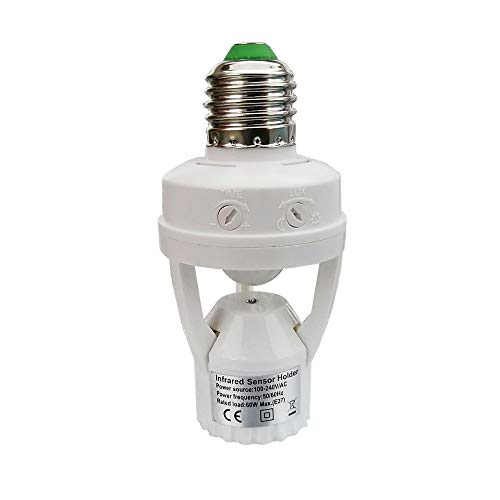
Taigeguang E26/E27 PIR Motion Sensor Light Socket
About this pick
The Taigeguang is not a bulb. It is a socket adapter that screws into a lamp holder and then accepts your own E26 or E27 bulb, turning it into a motion-activated light. It senses the infrared energy that people give off and can tell day from night. Two adjustments, including a time button, let you tune how long the bulb stays lit.
Because you supply the bulb, you pick the brightness and the tone you want, including a warm LED for a hallway or a brighter one for a basement. The tradeoff is that it adds a chunky adapter to the fixture, which can make a shaded lamp fit awkwardly or protrude from a recessed can. It is also rated for indoor use only, so keep it away from porches.
Setup is as simple as the Torkase or GREENIC, but the failure mode differs: if the sensor dies, you replace only the adapter and keep the bulb. It has no lumen rating of its own to compare, since that comes from whichever bulb you choose. This pick suits anyone who already owns good bulbs and just wants them to respond to motion.
Best for: Indoor lamp holders where you want to reuse your own bulb and add motion control.
Check price on AmazonSpecs
- Base: E26/E27 screw-in
- Controls: Time button plus second adjustment
- Detection basis: Human infrared energy
- Use: Indoor only
Pros
- +Works with any E26 or E27 bulb you supply
- +Time and light adjustments are accessible by button
- +Sensor swap leaves the bulb untouched
- +Needs no wiring work beyond the screw base
Cons
- −Adapter adds length that may not fit shades
- −Indoor use only, so it cannot go on porches
- −Brightness depends entirely on your own bulb
How We Evaluated These PIR Motion Sensor Lights
Each pick was assessed across 5 criteria weighted for real-world use.
Sensor spec transparency
We evaluated how clearly each product states its PIR range, angle and mounting height, since PIR performance depends on those numbers. The GREENIC, slochi and ShineSeed publish usable figures, while the ECOELER and Taigeguang publish fewer. A product that tells you where to mount it earns more trust. Where numbers were missing we avoided guessing.
Control over timing
We looked at how much you can tune how long the light stays on. The slochi offers 3 hold times, the ECOELER offers an adjustable delay with a countdown, the ShineSeed has multiple modes, and the Taigeguang has a time button. The Torkase and GREENIC offer fewer visible controls. More adjustment gave a pick a higher score.
Light output and tone
We compared lumens and color tone across the lineup. The ShineSeed leads at 5500 lumens, the slochi follows at 1500, the Torkase offers 1100, and the GREENIC offers 800. Fixtures with selectable color temperature, such as the ECOELER and slochi, were credited for fitting both bedrooms and utility spaces.
Installation effort
We weighed how much work each product asks before it lights up. Bulbs and the adapter take minutes, while the ceiling lights and the floodlight require hardwiring. Buyer feedback about confusing instructions or fit problems counted against a pick. Easier installs scored higher for general households.
Lineup positioning
The ShineSeed leads on output and weatherproofing, the slochi leads on indoor brightness and published sensing numbers, the ECOELER leads on tunable delay with a countdown, and the Torkase leads on bulb brightness. The GREENIC offers a clear height window at moderate brightness, and the Taigeguang leads on flexibility since you provide the bulb. These strengths differ so much that the badges reflect different jobs.
How to Choose the Right PIR Motion Sensor Lights
By Where the Sensor Will Sit
PIR works best when the mounting position matches the sensor's design, so start with the location.
| Location | Pick | Why |
|---|---|---|
| Front porch socket | Torkase E26 PIR Motion Sensor Light Bulb | 1100 lumens and an 8-16 ft range cover an entry |
| Stoop or carport at 7 ft | GREENIC 9W A19 PIR Motion Sensor Light Bulb | Listed mounting height of 6.8-8 ft matches |
| Small closet or pantry ceiling | slochi 15W Hardwired PIR Closet Ceiling Light | 3-4 m range from a 2-3 m mount suits a small room |
| Hallway ceiling needing a timer | ECOELER 16W PIR Motion Sensor Ceiling Light | Adjustable delay with countdown |
| Driveway or side yard | ShineSeed 45W 5500LM Dual-Head PIR Flood Light | 180° arc and 5500 lumens for wide ground |
Measure your actual ceiling or wall height before buying, because the sensing pattern is built around a specific mounting range.
By Budget
Rather than chase figures, think about relative tiers and what extra effort each one carries.
| Tier | Pick | What you get |
|---|---|---|
| Entry | GREENIC 9W A19 PIR Motion Sensor Light Bulb | A bulb with a published height window |
| Entry | Taigeguang E26/E27 PIR Motion Sensor Light Socket | An adapter that reuses your own bulb |
| Mid | Torkase E26 PIR Motion Sensor Light Bulb | 1100 lumens, still a no-wiring swap |
| Mid | ECOELER 16W PIR Motion Sensor Ceiling Light | Tunable delay and three color temperatures |
| Premium | slochi 15W Hardwired PIR Closet Ceiling Light | 1500 lumens with three modes and three hold times |
| Premium | ShineSeed 45W 5500LM Dual-Head PIR Flood Light | 5500 lumens, IP65 and a 180° arc |
Fixtures that need wiring may add installation cost beyond the product itself, so factor that in for the slochi, ECOELER and ShineSeed.
Bulb or Socket Adapter vs Fixture
The two approaches differ in what you replace and what you keep when something goes wrong.
Bulb or adapter
A bulb or socket adapter drops into a socket you already have, so installation is near instant and renters can use it. The sensor and light source may be one unit in a bulb, so a failure means replacing both, while the Taigeguang adapter keeps the bulb separate. The Torkase (1100 lumens, 8-16 ft), GREENIC (800 lumens, 10-13 ft) and Taigeguang (E26/E27) belong here. Choose this if you want quick results with no electrical work.
Dedicated fixture
A fixture combines lens, sensor, housing and light into one purpose-built unit, so the controls are richer. The slochi (1500 lumens, 3 hold times), ECOELER (adjustable delay, 3 color temperatures) and ShineSeed (5500 lumens, IP65) all follow this model. They take installation effort but offer better aiming, timing and weather resistance. Choose a fixture if you want control over behavior or need serious output.
If you are unsure, begin with a bulb for a trial, then move to a fixture where you find the bulb's limits.
By Control Over Behavior
How much you can adjust the light's behavior matters if the household has different routines.
| Need | Pick | Reason |
|---|---|---|
| Several hold times to choose from | slochi 15W Hardwired PIR Closet Ceiling Light | 3 hold times and 3 sensor modes |
| Delay with a visible countdown | ECOELER 16W PIR Motion Sensor Ceiling Light | Adjustable time delay with countdown |
| Test and setup modes for aiming | ShineSeed 45W 5500LM Dual-Head PIR Flood Light | Includes an installation test mode |
| Simple buttons on a reusable adapter | Taigeguang E26/E27 PIR Motion Sensor Light Socket | Time button and second adjustment |
| No settings, just plug and go | Torkase E26 PIR Motion Sensor Light Bulb | Minimal controls on the bulb |
More controls help only if someone will use them, so a fixed bulb can be the better choice for a low-fuss household.
For Outdoor Security Lighting Specifically
Outdoor use raises the stakes for weather, brightness and nuisance triggers.
Look for
A weather rating such as IP65, enough lumens to light faces at the distance you care about, and a sensing arc that crosses the approach path. Plan for 3000 to 5500 lumens for a driveway and a sensor range near 40 ft or more for a long approach. Choose a fixture with a test mode so you can aim it properly.
In this comparison
The ShineSeed (5500 lumens, 180°, IP65) is the full outdoor solution. The Torkase (1100 lumens, 8-16 ft) and GREENIC (800 lumens, 10-13 ft) suit a covered porch socket. The Taigeguang adapter is indoor only, and the slochi and ECOELER are ceiling lights meant for indoor rooms.
Aim the sensor across the approach path, not straight at it, because PIR picks up crossing motion sooner than head-on motion.
When to Spend More
A higher-tier product earns its place in specific situations. Otherwise a simple bulb is enough.
| Spend more if | Save if |
|---|---|
| You need wide outdoor coverage and the ShineSeed's 5500 lumens and 180° arc | A covered porch only needs the Torkase's 1100 lumens |
| You want the slochi's three hold times and 1500 lumens in a pantry | A GREENIC bulb at 800 lumens is plenty for the space |
| You want the ECOELER's countdown delay and three tones in a hallway | A Taigeguang adapter with your own warm bulb suffices |
| You plan to hire an electrician anyway for a hardwired job | You rent and cannot modify wiring, so a bulb is the sensible route |
Spend on fixtures where you will use their controls daily, and keep the rest simple.
Frequently Asked Questions
What does PIR mean on a motion sensor light?
PIR stands for passive infrared, which means the sensor detects heat changes rather than sending out a signal. A person walking across its field changes the infrared pattern and triggers the light. That is why it can miss someone standing perfectly still. It also cannot see through glass, so a sensor behind a window will not detect people outside.
How do I choose between a bulb and a hardwired fixture?
Think about how much control and output you need. A bulb such as the Torkase at 1100 lumens or the GREENIC at 800 lumens swaps in with no wiring. A fixture such as the slochi at 1500 lumens or the ShineSeed at 5500 lumens offers more adjustment and better aiming but needs installation. If you rent or want a trial, start with a bulb.
Why does my PIR light seem to trigger late when I walk toward it?
PIR sensors respond best to movement that crosses their field rather than movement coming straight at them. Walking directly toward the lens produces a smaller change in heat pattern, so the trigger comes later. Angling the sensor across the walking path fixes this for most people. A wider arc like the ShineSeed's 180° also helps.
Can I use a motion sensor bulb in any fixture?
Not always. The bulb's sensor needs a clear view, so an enclosed globe or a deep recessed can may block it. The GREENIC also lists a 6.8 to 8 ft mounting height to work as designed. Check the base type, E26 here, and look at how the socket points before buying.
Do PIR lights need much maintenance?
Very little. Most issues are dust on the lens or a change in the surroundings, like a new branch that causes false triggers. Wipe the lens occasionally and recheck the aim. For a bulb like the Torkase, a failure means replacing the whole part, whereas a socket adapter like the Taigeguang keeps your bulb.
Will pets or passing cars set off my outdoor light?
They can. A wide arc such as the ShineSeed's 180° can trigger on anything warm and moving, including animals and cars on a nearby road. Lower the sensitivity if the light offers it, and aim the sensor away from the street. A test mode helps you check coverage before you finalize the position.
Are these safe to leave in a bedroom or hallway at night?
They are, as long as the tone and brightness are appropriate. A 5000K, 5500 lumen floodlight is wrong for a bedroom, while a warm 3000K setting on the slochi or ECOELER is gentler. Avoid pointing a bright light at windows. Choose a lower-output option for any room where people sleep.
Bottom Line
best overall: Torkase E26 PIR Motion Sensor Light Bulb - best screw-in bulb pick in this roundup.
See the full rankings above for all picks with pros, cons, and best-for summaries.
Browse on Amazon
All Prime-eligible options with current pricing.
Shop on Amazon →