6 Best Medication Reminders Under $50 in 2026
Six medication reminder clocks and alarm timers that stay within a $50 cap, compared on alarm count, voice prompts, display size and daily upkeep.



At a Glance
A medication reminder does one job: it makes sure a daily dose time does not slip past unnoticed. At this budget you are no longer limited to a bare beeper. The upper end of the range buys spoken prompts, on-screen text messages, a dozen or more separate alarms and displays big enough to read from across a room.
That wider choice makes the decision harder, not easier. A pocket timer with eight alarms, a talking clock that plays your own recorded voice and a calendar clock with twenty written messages solve different problems. We evaluated six reminders from the product pages and buyer feedback, sorting them by how a person actually uses them across a normal week.
None of these devices dispenses pills or replaces advice from a pharmacist or doctor. They are prompts, and the right one is the prompt a particular person will notice and act on. Use the picks below to match alarm style, display and setup effort to the person who will live with the device.
6 Criteria to Look For Before Buying a Medication Reminders Under $50
Key buying criteria so you get the right fit the first time.
How many alarms you need
Count the dose times in a normal day before you look at any model. A person on a morning, midday and evening routine is well served by the three recorded slots on the Bovintex, but a four-dose schedule will overflow it. The TabTime offers 8 slots, the AINFTIME 12 and the ROCAM up to 20, so the bigger numbers matter only if you also want separate alarms for appointments or meals. Leave a spare slot or two for the days a schedule changes.
Voice, tone or written prompt
The kind of prompt decides whether the reminder is noticed. A recorded voice, as on the MEDCENTER and Bovintex, cuts through a quiet room better than a repeating beep and is gentler for someone who finds alarms stressful. A written message, as on the ROCAM, tells you which medication is due and works for people who read well. Tone-only models such as the TabTime and AINFTIME are fine when the person simply needs a cue and already knows the routine.
Display size and contrast
A reminder is useless if the time is hard to read. Look for large, high contrast digits and a light that does not glare at night. The AINFTIME advertises a soft light with no blue glow, the MEDCENTER uses bold white numerals, and the ROCAM offers 12 clock styles so you can pick the one that reads best. The TabTime's small screen is the weak point of an otherwise handy pocket timer.
Power and upkeep
Decide whether you want to charge, plug in or change batteries. The Bovintex charges in about 3 hours and holds up to 6 months, which suits someone who will forget a frequent charging routine. The AINFTIME needs a USB adapter rated at 5V and 1A that is not in the box, and the TabTime relies on a replaceable battery. A dead device silently skips every alarm, so pick the option the household will actually maintain.
Setup effort for the user
The person who will use the device may not be the one who sets it up. The ROCAM and MEDCENTER reward a caregiver who can spend an hour programming messages, whereas the TabTime and Bovintex can be set in a few minutes. If the user is reluctant with technology, favor the simpler menu even at the cost of fewer features. Whichever you choose, check the alarms the next morning, because a wrong AM or PM setting is the most common first-week error.
Where the reminder lives
Placement affects whether the alert is acted on. A clock like the ROCAM or AINFTIME stays in one room, the TabTime moves with the person, and the Cozycabin sits beside the pills it refers to. If doses are taken in the kitchen, put the device there and not on a bedroom shelf. A reminder that sounds in a different room from the medication adds a step that is easy to skip.
6 Best Medication Reminders Under $50 in 2026
ROCAM Dementia Clock Large Display
About this pick
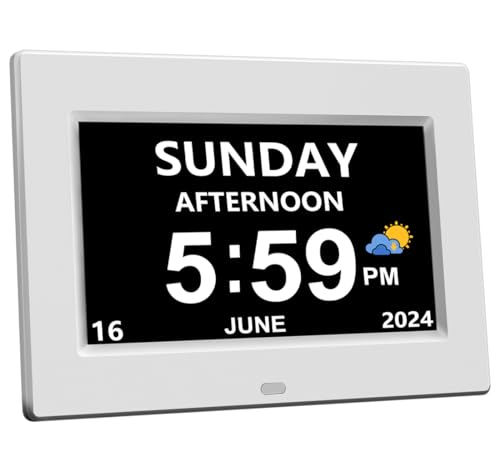
The ROCAM is a calendar clock first and a reminder second, which is what makes it useful. It holds up to 20 alarms, each able to show a written message such as a medication name or an appointment, and it offers 12 clock styles from analog to full text. A set of 18 gentle alert tones means the sound can be matched to the room.
The tradeoff is learning time. It has more menus than a plain alarm clock, so someone has to sit down once and program the schedule. Because its prompts are read rather than heard, it will not help a person with very low vision, and the screen is the only channel that carries the message.
Ownership is mostly a set-it-once job. After setup it sits on a shelf and displays day, date and the next reminder in plain language. Compared with the 12-alarm AINFTIME it offers eight more alarm slots and written messages, while the Bovintex's three recorded alarms are far simpler to set up but cover far less of the day.
Best for: Households that want written reminders for pills and appointments on one clear screen.
Check price on AmazonSpecs
- Alarms: Up to 20
- Clock styles: 12
- Alert tones: 18 gentle tones
- Prompt type: Written on-screen message
Pros
- +Holds up to 20 alarms for a full day
- +Written on-screen message names each reminder
- +Twelve clock styles suit different eyesight
- +Colors can be changed to suit the room
Cons
- −More menus to learn than a simple clock
- −Reading-based prompts miss very low vision
AINFTIME DST Digital Clock 12 Alarms
About this pick
The AINFTIME is a digital day-and-date clock built around twelve alarm slots. The numerals are large and high contrast, with a soft light the maker describes as free of blue light, so it reads easily at bedtime. Daylight saving adjusts automatically for North American, UK and EU settings, which removes a chore that often leaves clocks an hour wrong.
Its limits are plain. Alerts are tones only, with no spoken or written prompt, and the listing states that the power adapter is not included. Any USB adapter rated at 5V and 1A will run it, but that is one more purchase for a household without a spare.
In practice it fits a person who needs a reliable clock with several dose times and does not want much to learn. It has fewer menus than the ROCAM, though it also lacks the ROCAM's message text. Against the 8-alarm TabTime it offers more slots, but it stays on a shelf while the TabTime travels in a pocket.
Best for: People wanting a large day-and-date clock with a dozen dependable alarm slots.
Check price on AmazonSpecs
- Alarms: 12
- Power: USB, 5V/1A adapter
- Daylight saving: Automatic, by region
- Light: Soft, no blue light
Pros
- +Twelve alarms cover a busy dose schedule
- +Daylight saving adjusts by itself
- +Large high contrast digits are easy to read
- +Soft light without blue glow suits bedrooms
Cons
- −Power adapter is not in the box
- −Tone-only alerts, no spoken prompt
MEDCENTER Talking Alarm Clock for Medication
About this pick
The MEDCENTER speaks. You record a personal message for each dose, and the clock plays it back loudly and clearly when the alarm sounds. The display uses bold white digits, and the listing positions the layout as straightforward enough for dementia care and for people who have trouble hearing a quiet tone.
The cost of that approach is setup. A family member or caregiver generally has to record and check each message, and the listing gives no alarm count to compare with the AINFTIME or the ROCAM. If you need many separate dose times, confirm the number of slots before you commit.
Daily life with it is gentle. A familiar voice saying what to take is more noticeable than a repeating beep, and the big numerals double as a plain bedside clock. Compared with the Bovintex, which also records your voice, the MEDCENTER leans on a larger display and louder output, while the Bovintex is rechargeable and smaller.
Best for: Anyone who responds better to a familiar spoken message than to a tone.
Check price on AmazonSpecs
- Prompt type: Recorded voice message
- Display: Extra large, bold white
- Volume: Loud, clear alarms
- Audience: Low vision, hearing difficulty
Pros
- +Plays back your own recorded message
- +Bold white digits are easy to read
- +Loud clear volume for hard of hearing users
- +Layout kept simple for memory care
Cons
- −No alarm count given to compare
- −Recording needs someone to do setup
Bovintex Rechargeable Talking Alarm Clock
About this pick
The Bovintex records your own voice for each of its three alarms, then plays the message at an adjustable volume. It charges over USB in about three hours, and the maker lists up to six months of use per charge, so there are no coin cells to replace and no cable stuck in the wall.
The limit is built into the name. Three alarm slots fit a morning, midday and evening routine, but a four-dose schedule will not fit at all. The body is also compact, which means a smaller display than the MEDCENTER or the ROCAM.
For the right household that is a fair trade. It is the simplest recorded-voice option here, light enough to move from nightstand to kitchen, and the long charge cycle makes it easy to forget about. The TabTime offers eight alarm slots by comparison, but only as a tone, so the choice comes down to whether a voice or the extra slots matter more.
Best for: Three-dose routines where a warm recorded voice beats a beep.
Check price on AmazonSpecs
- Alarms: 3 custom voice
- Charge time: About 3 hours
- Run time: Up to 6 months
- Volume: Adjustable
Pros
- +Three alarms in your own recorded voice
- +One charge lasts up to six months
- +About three hours fills it from empty
- +Volume can be adjusted to the room
Cons
- −Only three slots, so four doses will not fit
- −Small body means a smaller display
TabTime Pill Reminder and Timer
About this pick
The TabTime is a pocket-sized timer with eight independent daily alarms. Once you program the times, the maker says it keeps repeating them each day until the battery needs replacing, which is the whole appeal: no app, no screen to hunt through and no reminder text to set.
Its compact size cuts both ways. It fits a pocket, purse or travel bag, but the small display is harder to read at a glance, and the alert is a tone only with no spoken prompt. Someone who needs a message or a voice should look at the ROCAM, MEDCENTER or Bovintex.
Ownership is minimal. You change the battery occasionally and otherwise leave it alone. Against the AINFTIME's twelve alarm slots it covers fewer dose times, but it moves with you, so it suits a person who is out for most of the day and needs the same nudge in the car or at a friend's house.
Best for: Active people who want a small go-anywhere timer for several daily doses.
Check price on AmazonSpecs
- Alarms: 8 per day
- Power: Battery
- Size: Pocket-sized
- Alert: Tone
Pros
- +Eight alarms set once and repeating daily
- +Pocket size travels in a bag easily
- +No app, account or pairing to manage
- +Suits a long day with several dose times
Cons
- −Small display is harder to read quickly
- −Tone alerts only, no spoken prompt
Cozycabin 7-Day Pill Organizer with Alarm
About this pick
The Cozycabin puts the reminder and the pill box in one unit. It has 15 compartments with push buttons marked by a day letter, a large screen that shows the time, a built-in memory function and a programmable alarm. The sealing buckle is described as limiting moisture and dust and keeping the lid from popping off.
The catch is that sorting is still a manual weekly job, and the listing describes no voice prompt, only an alarm. If loading the compartments is the hard part for someone with stiff fingers, a box alone does not solve it, and a timer cannot confirm the dose was taken.
That said, having the alarm and the pills in the same place is its main strength, since the prompt arrives where the dose is stored. Compared with the TabTime you gain a place to store medication, whereas you give up the pocket-sized timer's portability.
Best for: Anyone who wants the alarm and the weekly pill box together in one unit.
Check price on AmazonSpecs
- Compartments: 15
- Alarm: Programmable
- Display: Large screen
- Closure: Sealing buckle
Pros
- +Alarm and weekly compartments in one unit
- +Large screen shows the time clearly
- +Day-letter buttons mark each compartment
- +Sealing buckle limits moisture and dust
Cons
- −Weekly sorting is still a manual job
- −No spoken prompt is described in the listing
How We Evaluated These Medication Reminders Under $50
Each pick was assessed across 5 criteria weighted for real-world use.
Alarm capacity and flexibility
We compared how many separate alarms each device lists and how they are used. The ROCAM leads with up to 20, followed by the AINFTIME at 12, the TabTime at 8 and the Bovintex at 3. We also considered whether a slot can carry its own message.
Prompt clarity
We looked at whether the reminder is a tone, a voice or a written message, based on each product page. Recorded voice on the MEDCENTER and Bovintex scored well for noticeability, and the written text on the ROCAM scored well for specificity. Tone-only units scored lower here.
Readability of the display
We reviewed digit size, contrast and lighting as described by the maker and in buyer feedback. Models with large, bold or high contrast numerals ranked ahead of the compact TabTime. Clock style options and night lighting counted in the score.
Setup and daily upkeep
We scored how much effort it takes to program the device and keep it running. Charging cycles, battery changes and the need for a separate USB adapter all counted. The easiest units ask for the fewest steps after the first morning.
Fit for the budget
We judged what each device adds at this budget level compared with a basic timer. The ROCAM leads on features, the AINFTIME on a clean clock with a dozen alarms, and the Cozycabin on combining storage with alerts. Based on product specs and buyer feedback, not hands-on testing.
How to Choose the Right Medication Reminders Under $50
By Type of Prompt
The way a reminder reaches you matters more than the brand. Match the prompt to how the person notices things.
| Situation | Best pick | Why |
|---|---|---|
| Prefers a familiar voice | MEDCENTER Talking Alarm Clock for Medication | Plays your recorded message loudly and clearly |
| Wants to read what to take | ROCAM Dementia Clock Large Display | Up to 20 alarms with on-screen messages |
| Just needs a cue at set times | AINFTIME DST Digital Clock 12 Alarms | Twelve tone alarms on a clean display |
| Only three dose times a day | Bovintex Rechargeable Talking Alarm Clock | Three recorded voice alarms, simple setup |
If you are unsure, test the sound in the room where the device will sit before you rely on it.
By Budget
Within the cap, think in tiers by how much the device does for you.
| Tier | Best pick | What you get |
|---|---|---|
| Entry | TabTime Pill Reminder and Timer | Eight tone alarms in a pocket-sized body |
| Entry to mid | Bovintex Rechargeable Talking Alarm Clock | Recorded voice and a rechargeable battery |
| Mid | AINFTIME DST Digital Clock 12 Alarms | Large display and a dozen alarm slots |
| Upper | ROCAM Dementia Clock Large Display | Twenty alarms with written messages |
Spending toward the top of the cap buys flexibility and readability, not a better reminder for everyone.
Talking Clock vs Written Messages
These two approaches solve the same problem in opposite ways.
Talking clock
A recorded voice such as the one on the MEDCENTER or Bovintex works through hearing, so it suits people with low vision or who tend to skip reading. It needs someone to record the messages and the Bovintex stops at three slots. Choose this if a spoken cue is more reliable than a screen.
Written messages
The ROCAM shows a named reminder on screen, which is clear for a person who reads well and wants to know exactly what is due. It depends on eyesight, and the 20 alarms need a one-time setup. Choose this if a caregiver can program it and the user relies on sight.
Where the Device Will Live
A reminder only works if it is in the right room.
| Location | Best pick | Reason |
|---|---|---|
| Bedside table | AINFTIME DST Digital Clock 12 Alarms | Soft light without blue glow reads easily at night |
| Kitchen counter | ROCAM Dementia Clock Large Display | Messages stay visible next to where pills are taken |
| Pocket or travel bag | TabTime Pill Reminder and Timer | Pocket-sized with eight alarms |
| Next to the pills | Cozycabin 7-Day Pill Organizer with Alarm | Alarm and compartments in one box |
Move the device into the room where the dose is taken, not just where the clock looks nice.
For Caregivers Setting It Up Remotely
Some households have a family member arranging the device for someone else.
Look for
Choose a unit that can be programmed once and left alone, with a long charge or a replaceable battery and no app. A clear display and a recordable voice help, because the caregiver can personalize the message in advance.
In this comparison
The Bovintex and MEDCENTER both allow recorded voice messages, with the Bovintex running up to 6 months per charge. The ROCAM allows 20 written messages, and the TabTime needs only a battery swap. Keep the adapter for the AINFTIME on hand because it is not supplied.
When to Spend More
Know when a bigger feature set is worth it.
| Spend more if | Save if |
|---|---|
| You need more than eight dose or appointment alarms, so the ROCAM or AINFTIME makes sense | Three doses a day are enough and the Bovintex covers them |
| Reading is difficult and a loud talking clock like the MEDCENTER matters | The person responds fine to a simple tone from the TabTime |
| You want storage and alert together, as on the Cozycabin | You already own a pill box and only need a timer |
| A caregiver can invest an hour in programming the ROCAM | The user wants no menus at all |
None of these are medical devices, so keep any schedule changes confirmed with a pharmacist or doctor.
Frequently Asked Questions
Which medication reminder is best for someone with several doses a day?
Count the doses first. The ROCAM holds up to 20 alarms and the AINFTIME 12, so either handles a busy schedule with room to spare. The TabTime's 8 slots suit most people, while the 3-slot Bovintex is only right for three doses or fewer.
Is a talking reminder better than a beeping one?
For many people it is, because a familiar voice is easier to notice and feels less like an alarm. The MEDCENTER and Bovintex both let you record your own message. If hearing is the issue, check the volume range and test it in the room first.
Do these devices count as medical equipment?
No. They are prompts that make a dose time harder to miss, and they do not track whether a pill was taken. Keep any medication schedule confirmed with a pharmacist or doctor and treat the device as support, not oversight.
How often do I need to charge or change batteries?
It depends on the model. The Bovintex lists about 3 hours to charge and up to 6 months of use, the TabTime runs on a replaceable battery, and the AINFTIME is USB powered through an adapter you supply. A dead unit skips every alarm, so set a calendar reminder to check it.
Why does the AINFTIME need its own power adapter?
The listing states the maker left the adapter out. Any USB adapter with an output of 5V and 1A will run it, so most households already own one. If you do not, factor it into your choice.
Is a pill organizer with an alarm better than a stand-alone timer?
It depends on where the difficulty lies. The Cozycabin keeps pills and the alarm together, which helps when the prompt needs to arrive beside the dose. A stand-alone timer like the TabTime or a clock like the ROCAM can sit anywhere and is easier to read from a distance.
What is the most common mistake with a new reminder?
Setting AM and PM incorrectly is the usual error, followed by placing the device in a room where the person is rarely present. Check the first day's alarms against the schedule and move the clock if the alert is hard to hear. A quick test beats assuming it works.
Bottom Line
best overall: ROCAM Dementia Clock Large Display - best overall pick in this roundup.
See the full rankings above for all picks with pros, cons, and best-for summaries.
Browse on Amazon
All Prime-eligible options with current pricing.
Shop on Amazon →