6 Best Loppers for Thick Branches in 2026
Six loppers rated for branches from 1.5 to 2.25 inches, compared on bypass vs anvil blades, handle length, leverage systems and who each one suits.




At a Glance
Thick branches are where cheap loppers fail. A tool that handles pencil-thick shrub stems can stall halfway through a limb the width of a thumb or a wrist, leaving a torn, half-cut branch and a sore pair of shoulders. The honest way to shop is to look at three things together: the stated cutting capacity, the blade style, and how the handles multiply your effort.
This lineup spans a 1.5 inch entry bypass lopper up to a 2.25 inch pro-grade bypass model, plus an anvil lopper and two longer-reach options. Capacities in the 2 inch range are quoted for fresh green wood in most listings, so we treat them as ceilings rather than daily working sizes. We evaluated each pick on the specs and features stated on its product page and on the kind of buyer it fits.
Read the picks in order if you are undecided, then jump to the choosing tables to match your own branches and your own hands to a specific model. A lopper that fits your wood and your grip will always outperform a bigger number on a label.
6 Criteria to Look For Before Buying a Loppers for Thick Branch
Key buying criteria so you get the right fit the first time.
Cutting capacity versus real wood
Stated capacity is almost always measured on fresh green wood, so dry hardwood of the same diameter takes far more force. A practical rule is to buy a lopper rated at least a quarter inch above your usual branch so you are never working at the limit. In this lineup the Corona X Series Pro leads at 2-1/4 inches, the Fiskars PowerGear2 and AIRAJ are rated at 2 inches, and the Fiskars 28 inch bypass is rated at 1.5 inches. If your thickest limbs are 2 inches, the Corona has headroom while the 1.5 inch Fiskars would be far past its rating.
Bypass versus anvil blades
Bypass blades pass each other like scissors and give a cleaner cut on live wood, which helps a pruning wound close. Anvil blades press the edge against a flat plate and excel on dry, dead wood but crush live stems. Decide what you cut more of before you shop. The Fiskars PowerGear2, Fiskars 28 inch and Corona X Series Pro are bypass picks, while the TABOR GG12A and AIRAJ are anvil picks.
Handle length and leverage
Handle length multiplies the force you apply at the jaws, so a 30 inch lopper cuts a given branch with noticeably less effort than a 20 inch one. Longer tools also reach farther but swing wider and weigh more. A practical band for home use is 28 to 36 inches. The Fiskars 28 inch sits at the short end, the TABOR is at 30 inches, the PowerGear2 at 32 inches, and the Hickok at 36 inches.
Compound or gear leverage systems
Compound and gear systems trade a longer handle stroke for more force at the blade, which is what makes thick branches manageable for people with less hand strength. Marketing multipliers vary widely, so read them as rough indicators rather than measured numbers. The Fiskars PowerGear2 and Power-Lever and the TABOR and AIRAJ compound designs all use some form of this idea. Expect to open the handles wider and work through a longer stroke on every cut.
Fixed versus telescoping handles
Telescoping handles let you reach overhead without a ladder and shorten for control, but every lock is a possible failure point and the extended tool flexes more under load. A fixed handle is simpler and stiffer. The AIRAJ extends from 27 to 37 inches, while the Hickok is fixed at 36 inches and the TABOR GG12A is fixed at 30 inches. Always seat the lock fully and give the tool a tug before a heavy cut.
Handle material and weight
Aluminum handles cut weight compared with steel, which matters because a two-handed lopper is held out in front of you for long stretches. Rubberized or cushioned grips reduce vibration and slipping. The Hickok and AIRAJ use aluminum handles per their listings, and the TABOR adds rubberized grips. Check the product page for weight, since the listing bullets for several picks do not state it.
6 Best Loppers for Thick Branches in 2026
Fiskars 32 in PowerGear2 Bypass Lopper
About this pick
The 32 inch PowerGear2 is a bypass lopper with a fully hardened steel blade and a stated capacity of 2 inches. The PowerGear2 mechanism is the headline feature, and the listing describes it as multiplying leverage over traditional designs so each squeeze delivers more cutting force than a plain pivot lopper of the same size. A low-friction blade coating is included to reduce gumming and help the blade glide.
Bypass blades slice past each other like scissors, which is why this style is the usual choice for live, green growth where a clean cut helps the branch heal. The tradeoff is that bypass blades can bind if you twist the tool mid-cut or force a limb beyond its capacity. At 32 inches it is long enough to give real leverage and some extra reach, yet it is still a ground-level tool, not a pole pruner.
In ownership terms, expect a two-handed tool you will carry across a yard rather than clip to a belt, and check the listing for the exact weight before you buy. Next to the 28 inch Fiskars Power-Lever at 1.75 inches, the PowerGear2 adds four extra inches of handle and a quarter inch more rated capacity. Next to the Corona X Series Pro at 2.25 inches, it gives up a quarter inch of capacity but is the pick when you want the Fiskars leverage design and coating in a more familiar homeowner format.
Best for: Homeowners who prune mostly live branches up to about 2 inches and want a leverage-assisted bypass lopper.
Check price on AmazonSpecs
- Overall length: 32 in
- Cut capacity: 2 in
- Blade type: Bypass
- Leverage system: PowerGear2
Pros
- +Bypass blade cuts live wood cleanly
- +2 in stated capacity covers most yard limbs
- +Leverage system reduces squeeze force
- +Low-friction coating limits sap gumming
Cons
- −Bypass blade can bind if twisted mid-cut
- −Not the longest reach in this list
- −Capacity figure assumes green wood
Corona Tools X Series Pro Bypass Lopper
About this pick
The X Series Pro has the largest stated capacity here at 2-1/4 inches, and it is built around a bypass blade for clean cuts through living wood. The listing frames it as pro-grade, aimed at repeated use on large limbs and dense woody growth in trees and shrubs. If your branches routinely approach the 2 inch mark, this is the model with the most headroom.
Headroom matters because a lopper working at the very edge of its capacity wears faster and takes far more effort per cut. Running a 2 inch limb through a 2-1/4 inch tool is easier on your hands and on the blade than running that same limb through a 2 inch tool. The listing does not state handle length or weight in the bullets we have, so check the product page for those numbers before you commit, because a long, heavy lopper is tiring on a full afternoon of cutting.
Compared with the Fiskars PowerGear2 at 2 inches, the Corona gives you a quarter inch more capacity, while the Fiskars gives you a named leverage system you can read about. Compared with the TABOR GG12A at 2 inches, the Corona is a bypass design aimed at live wood, whereas the TABOR is an anvil design aimed at dry wood. Pick the Corona when the biggest thing on your list is a thick, living limb.
Best for: Property owners with mature shrubs and trees who regularly cut live limbs near 2 inches.
Check price on AmazonSpecs
- Cut capacity: 2-1/4 in
- Blade type: Bypass
- Positioning: Pro-grade
Pros
- +Largest stated capacity at 2-1/4 in
- +Bypass action suits live wood
- +Pro-grade build aimed at repeated use
- +Headroom lowers effort on 2 in limbs
Cons
- −Handle length and weight not in listing bullets
- −Overkill for light shrub trimming
- −No named leverage system in the listing
TABOR TOOLS GG12A Anvil Compound Lopper
About this pick
The TABOR GG12A is an anvil lopper with compound action and 30 inch handles, and its listing targets dry, dead and woody branches up to 2 inches. The hardened carbon steel blade carries a low-friction non-stick coating, and the handles have rubberized grips. Anvil designs press a blade onto a flat surface, which is why they are the traditional choice for deadwood.
The downside of anvil cutting is that it crushes living tissue instead of slicing it, so this is the wrong tool for pruning healthy green shrubs where wound healing matters. For clearing storm damage, dead limbs and old overgrown wood, that crushing action is a non-issue and the compound mechanism does the heavy lifting. The 30 inch handles are a practical middle length, giving leverage without becoming unwieldy.
In use you will want both hands firmly on the grips and a stable stance, because compound action trades a longer stroke for extra force. Against the AIRAJ at 2 inches and 27 to 37 inches of reach, the TABOR is fixed length, so it is simpler but cannot extend. Against the Fiskars PowerGear2, the TABOR is better matched to dry wood and worse matched to live wood, so decide which job you have most often before choosing.
Best for: Cleaning up dead limbs, storm debris and dry overgrowth up to about 2 inches.
Check price on AmazonSpecs
- Length: 30 in
- Blade type: Anvil
- Mechanism: Compound action
- Cut capacity: 2 in
Pros
- +Compound action multiplies cutting force
- +Anvil blade suits dry dead wood
- +30 in handles give solid leverage
- +Rubberized grips aid a secure hold
Cons
- −Anvil blade crushes live branches
- −Fixed length cannot extend for reach
- −Listing targets dry and woody growth only
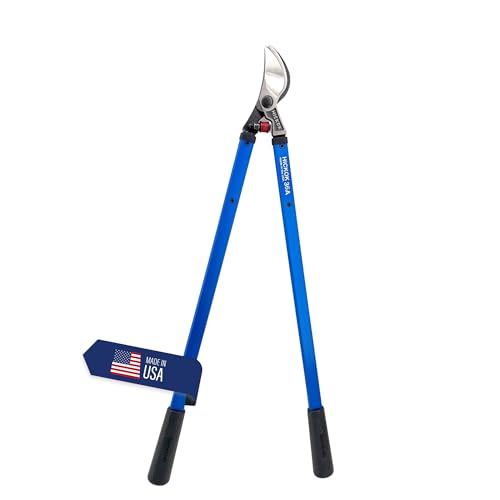
Hickok 36 in Heavy Duty Loppers
About this pick
The Hickok loppers are 36 inches long with aluminum handles, the longest fixed-length tool in this group. The listing promotes extended reach for higher branches and describes the aircraft-grade aluminum as strong yet light, which is meant to reduce fatigue. The blade is described as forged, hardened and heat-treated steel.
Long handles do two things at once. They extend how far you can reach without a ladder, and they raise the leverage you can apply at the jaws, so thick branches take less effort. The cost is control, because a 36 inch tool swings wide and takes more room to position precisely in dense growth. The bullets we have do not state the cutting capacity or whether the blade is bypass or anvil, so check the product page for both before assuming it will match your branch size.
For ownership, the aluminum handle keeps carrying weight manageable compared with a steel handle of the same length, and a two-handed overhead cut is where the extra length pays off. Against the 32 inch Fiskars PowerGear2, the Hickok adds four inches of reach but does not name a leverage mechanism. Against the AIRAJ that extends from 27 to 37 inches, the Hickok is a single fixed length, so it is less flexible in tight spots but has fewer locks to fail.
Best for: Cutting higher branches from the ground when you want maximum fixed-length leverage.
Check price on AmazonSpecs
- Length: 36 in
- Handle material: Aircraft-grade aluminum
- Blade: Forged, heat-treated steel
Pros
- +36 in length gives extended reach
- +Aluminum handles keep weight down
- +Forged heat-treated steel blade
- +Long handles raise leverage at the jaws
Cons
- −Capacity not stated in listing bullets
- −Blade style not stated, check page
- −Swings wide in dense growth
AIRAJ 27-37 in Extendable Anvil Loppers
About this pick
The AIRAJ combines an anvil blade, compound action and an adjustable aluminum handle that runs from 27 to 37 inches. The listing says the blade is SK5 steel with a Teflon coating and that the compound action uses four pivot points. Stated capacity is 2 inches.
Adjustable handles let you work short for control and long for reach, which matters when one afternoon includes both a low shrub and an overhead limb. The anvil blade shares the usual limits, namely strong performance on dry wood and crushing on live wood. Extending the handles also adds flex and weight at the tip, so check that the locking mechanism is fully engaged before every heavy cut.
Compared with the fixed 30 inch TABOR GG12A, the AIRAJ matches its 2 inch capacity and anvil style while adding seven inches of adjustable reach. Compared with the 36 inch Hickok, it tops out one inch shorter but can shrink to 27 inches for work near the ground. If you want one tool for varied jobs and mostly cut dry or dead wood, this is the flexible choice.
Best for: Mixed jobs where you need both short control and extra reach on dry or dead wood.
Check price on AmazonSpecs
- Handle range: 27 to 37 in
- Blade type: Anvil
- Pivot points: Four
- Blade steel: SK5 with Teflon coating
Pros
- +Handles adjust from 27 to 37 in
- +Compound action with four pivot points
- +SK5 blade with Teflon coating
- +2 in stated capacity
Cons
- −Anvil blade crushes green wood
- −Extension locks need checking each use
- −Telescoping adds flex at full length
Fiskars 28 in Garden Bypass Lopper
About this pick
This 28 inch Fiskars is a straightforward bypass lopper with a steel blade, a low-friction coating and a non-slip grip handle. Its stated capacity is 1.5 inches, the lowest in this group, and it is the most affordable pick by the listing price ranks. It is aimed at tree and shrub trimming at the lighter end of thick.
If your branches are mostly under an inch and a half, this lopper is a sensible fit and it keeps cost and weight down. It has no named leverage system, so effort per cut is higher than on the PowerGear2 once you approach the limit. That makes it a good tool for regular shaping and a poor tool for the occasional 2 inch limb.
Storage and handling are simple, with no extension locks to maintain. Compared with the Fiskars 28 inch Power-Lever, which is also 28 inches but rated 1.75 inches with a compound lever, this one gives up a quarter inch and the lever assist in exchange for simplicity. Compared with the 32 inch PowerGear2, it gives up half an inch of capacity and four inches of length. Choose it if budget and simplicity outrank raw capacity.
Best for: Everyday shrub and small tree pruning with branches under about 1.5 inches.
Check price on AmazonSpecs
- Length: 28 in
- Cut capacity: 1.5 in
- Blade type: Bypass
Pros
- +Lowest price rank among these picks
- +Bypass blade for clean live cuts
- +Non-slip grip handle
- +Simple fixed design, nothing to adjust
Cons
- −1.5 in is the lowest capacity here
- −No named leverage assist
- −Struggles near its rating on hard wood
How We Evaluated These Loppers for Thick Branches
Each pick was assessed across 5 criteria weighted for real-world use.
Cutting capacity and headroom
We compared the stated capacity of each lopper and noted that most figures assume green wood. The Corona X Series Pro leads at 2-1/4 inches, the Fiskars PowerGear2, TABOR GG12A and AIRAJ list 2 inches, and the Fiskars 28 inch bypass lists 1.5 inches. Picks with more capacity than the usual branch rated higher.
Blade style fit
We separated bypass picks from anvil picks, because the right style depends on whether you cut live or dead wood. Bypass models here are the three Fiskars and Corona designs, and anvil models are the TABOR and AIRAJ. A pick scored higher when its listing was clear about what wood it targets.
Leverage and ergonomics
We looked at handle length, leverage systems and grip details stated in each listing. The PowerGear2 and the compound-action anvil models offer the most named assistance, while the 36 inch Hickok relies on length. Where weight or handle length was missing, we said so and told readers to check the product page.
Reach and adjustability
We considered how far each tool reaches without a ladder. The Hickok at 36 inches and the AIRAJ at 37 inches fully extended lead, while the Fiskars 28 inch is the most compact. Adjustable handles earned credit for versatility and lost a little for the extra lock to maintain.
Value and positioning
We placed each pick in the lineup: the Fiskars 28 inch is the lowest price rank, the Corona and Hickok sit at the top of the price ranks, and the PowerGear2 and TABOR fall in the middle. We favored picks whose stated features justify their position and flagged those where the listing leaves key details out.
How to Choose the Right Loppers for Thick Branches
By Branch Thickness
Match the diameter you actually cut to a stated capacity with room to spare.
| Your thickest branch | Pick | Why |
|---|---|---|
| Up to 1.5 in, mostly live shrubs | Fiskars 28 in Garden Bypass Lopper | Rated 1.5 in with a bypass blade and simple design |
| Around 1.75 to 2 in, live wood | Fiskars 32 in PowerGear2 Bypass Lopper | Rated 2 in with a leverage system and bypass blade |
| Around 2 in, dry or dead | TABOR TOOLS GG12A Anvil Compound Lopper | Anvil compound action rated 2 in on dry wood |
| Regularly near 2 in, live | Corona Tools X Series Pro Bypass Lopper | 2-1/4 in capacity leaves headroom |
| Mixed, with overhead limbs | AIRAJ 27-37 in Extendable Anvil Loppers | 2 in rating with adjustable reach |
By Budget
Relative tiers based on the price ranks in the listings.
| Tier | Pick | What you get |
|---|---|---|
| Entry | Fiskars 28 in Garden Bypass Lopper | Lowest price rank, 1.5 in capacity, bypass blade |
| Entry to mid | AIRAJ 27-37 in Extendable Anvil Loppers | Extendable anvil with 2 in rating at a lower rank |
| Mid | TABOR TOOLS GG12A Anvil Compound Lopper | Compound anvil, 30 in, 2 in rating |
| Mid to premium | Fiskars 32 in PowerGear2 Bypass Lopper | Leverage system, 2 in, longer handles |
| Premium | Corona Tools X Series Pro Bypass Lopper | 2-1/4 in pro-grade bypass |
| Premium reach | Hickok 36 in Heavy Duty Loppers | 36 in aluminum handles, top price rank |
Bypass vs Anvil
The blade geometry decides what the tool is good at.
Bypass
Two blades slide past each other like scissors, giving a clean cut on live branches that helps the wound heal. Picks on this side are the Fiskars 32 in PowerGear2, the Fiskars 28 in and the Corona X Series Pro. Choose bypass if you prune living shrubs and trees.
Anvil
One sharp blade closes on a flat plate and crushes through dry, dead wood with strong force. Picks on this side are the TABOR GG12A and the AIRAJ 27-37 in. Choose anvil if your work is deadwood and storm cleanup.
By Handle Length
Longer handles mean more leverage and reach but less control.
| Situation | Pick | Reason |
|---|---|---|
| Tight shrub borders | Fiskars 28 in Garden Bypass Lopper | Shortest at 28 in for control |
| Balanced home use | TABOR TOOLS GG12A | 30 in fixed handles |
| More leverage on 2 in limbs | Fiskars 32 in PowerGear2 | 32 in plus leverage system |
| Maximum fixed reach | Hickok 36 in Heavy Duty Loppers | 36 in aluminum handles |
| Short and long in one tool | AIRAJ 27-37 in | Adjusts from 27 to 37 in |
For Overhead Pruning Specifically
Reaching up changes the equation because you hold the tool with arms raised.
Look for
Light handles, a positive lock if telescoping, and enough length to avoid a ladder. Weight matters more than usual because your arms are elevated, so favor aluminum over steel.
In this comparison
The Hickok at 36 in and the AIRAJ at up to 37 in give the most reach. The Hickok has fewer parts, while the AIRAJ shortens for ground work. Check the Hickok page for capacity before relying on it for thick overhead limbs.
When to Spend More
Spending more makes sense when the work is demanding.
| Spend more if | Save if |
|---|---|
| Your limbs approach 2 in, so choose the Corona X Series Pro for its 2-1/4 in headroom | Your branches stay under 1.5 in, so the Fiskars 28 in is enough |
| You cut live wood often and want the PowerGear2 leverage system | You only cut occasionally and a simple bypass lopper will do |
| You need long reach and choose the Hickok 36 in aluminum build | You work at ground level where a 28 to 30 in tool is fine |
| You want one tool with adjustable reach like the AIRAJ | Your jobs are consistent and the fixed TABOR GG12A covers them |
Frequently Asked Questions
How do I choose between the Fiskars PowerGear2 and the Corona X Series Pro?
Both are bypass loppers for live wood. The Corona offers 2-1/4 inches of stated capacity, while the Fiskars lists 2 inches and a named leverage system. If your limbs sit near the 2 inch mark, take the Corona for headroom. If you cut a mix of sizes, the Fiskars is a well-rounded choice.
Do I need a long-handled lopper for thick branches?
Longer handles multiply the force you apply, so thick branches get easier as length increases. A band of 28 to 36 inches is practical for most homeowners. The Fiskars 28 inch sits at one end and the Hickok at 36 inches sits at the other. Longer tools weigh more and swing wider, so match length to your strength and workspace.
Is the 2 inch capacity safe for dry hardwood?
No, you should treat it as a ceiling for fresh green wood. Dry hardwood of the same diameter takes much more force and can damage the blade. For dry limbs an anvil model such as the TABOR GG12A is better suited, and you should still cut larger dry limbs in stages. If you often hit capacity, step up to a larger rated tool.
Why do my loppers crush the branch instead of cutting it?
That is typical of anvil blades on live wood, because the blade presses into a flat plate rather than slicing. It can also happen with a dull or gummed bypass blade. Use bypass for green growth and keep the blade clean. A low-friction coating such as the one on the Fiskars models helps reduce sap buildup.
How should I maintain loppers for thick branches?
Wipe the blade clean of sap after use, keep the pivot lightly oiled and store the tool dry. Check the pivot bolt for looseness, because play makes blades spread and cut poorly. On telescoping models like the AIRAJ, also check that the locks seat fully before each job. Sharpen the cutting edge on a schedule that matches how often you use it.
Is a telescoping lopper weaker than a fixed one?
A telescoping lopper has more flex at full extension and more parts that can loosen, so it is generally less stiff than a fixed tool of equal length. In exchange it gives you adjustable reach. If you need maximum rigidity for thick cuts, the fixed 30 inch TABOR or 36 inch Hickok are simpler. Lock the AIRAJ fully and avoid side loading it.
Can one lopper handle both live and dead branches?
It can, but with compromises. A bypass tool will cut dead wood up to its rating, though dry wood is harder and can chip the blade. An anvil tool will cut live wood but crush it. If you do both often, the most dependable approach is to own one bypass and one anvil lopper, for example the Fiskars PowerGear2 and the TABOR GG12A.
Bottom Line
best overall: Fiskars 32 in PowerGear2 Bypass Lopper - best overall pick in this roundup.
See the full rankings above for all picks with pros, cons, and best-for summaries.
Browse on Amazon
All Prime-eligible options with current pricing.
Shop on Amazon →