5 Best Locking Pill Dispensers (2026)
Five locking pill dispensers compared by lock type, alarm count and capacity, for families managing medication safely at home with simple controls.


At a Glance
A locking pill dispenser keeps medication from being taken twice, mixed up or reached by children or visitors, which is why families often choose one when managing a parent's routine. This roundup compares five: four automatic dispensers with alarms and a compact metal locking pill case for people who want a simple key lock without electronics.
The picks differ in where the lock sits and how many alerts they offer. The Senyerkare and JULOS both list up to 9 daily alarms with a lock on the top or front, the LiveFine holds 28 days with a locking lid and an easy-fill carousel that takes up to 18 pills per slot, the Windtrace has 28 compartments with a built-in lock, and the Ezy Dose has two keys and holds up to 26 aspirin-sized pills per compartment.
We evaluated each model based on product specs and buyer feedback. A dispenser does not replace supervision for advanced dementia, so ask the prescriber or pharmacist which device fits the regimen. The ranking favors locks that are easy for a caregiver to use, controls that are not confusing and alarms that are hard to miss.
6 Criteria to Look For Before Buying a Locking Pill Dispensers (2026)
Key buying criteria so you get the right fit the first time.
Lock type and placement
The Senyerkare puts the key lock on the top panel and the JULOS on the front, while the LiveFine uses a locking lid and the Ezy Dose a key case. Lock types include key, PIN and fingerprint, and a mechanical key override lets caregivers in during emergencies. Choose a lock the caregiver can reach without flipping the unit. Always keep a spare key in a known place so a lost key does not lock out a dose.
Number of daily alarms
The Senyerkare and JULOS list up to 9 daily alarms, and the LiveFine up to nine doses a day, versus many dispensers that stop at 6. A good dispenser keeps missed pills in the tray and locks until the next alarm. Count how many dose times you really need. Write down the daily dose times before programming so you know how many alarms you need.
Ease of loading
Check how easy loading is for arthritic hands, since dexterity matters as much as software. The LiveFine has an easy-fill carousel and the JULOS a curved lid. If you load weekly, test the lid and slots. Fill the unit once with a trial load of vitamins to see how it handles your hands.
Alert style
The Windtrace has a loud alarm and a flashing blue light, and the Senyerkare uses sound and light. Simple beep-and-flash units work without Wi-Fi but caregivers must check in person. Pick the alert that suits the user's hearing. Pick a tone that is audible from the room where the dispenser sits.
Power and backup
Ask what happens in a power outage, since battery backup decides whether a refill stays usable. Some units need cell swaps about every 60 days, and USB cords can get knocked loose. The Ezy Dose needs no power. Plug the unit into an outlet that stays on, or keep fresh batteries on hand.
Capacity and pill size
The LiveFine holds up to 18 pills per slot, the Windtrace has 28 large compartments, and the Ezy Dose holds up to 26 aspirin-sized pills per compartment. Large vitamins and fish oils may not fit small slots. Match capacity to the prescription. Measure your largest tablet before choosing a slot size.
5 Best Locking Pill Dispensers (2026)
Senyerkare Automatic Pill Dispenser
About this pick
The Senyerkare puts the key lock on the top panel, so a caregiver can unlock it without turning the device upside down. It supports up to 9 customizable daily alerts, where many dispensers stop at 6, which helps with complicated routines. Four buttons marked with symbols keep programming simple. The tradeoff is that nine alarms are only useful if you can set them up, so a caregiver should help the first time. Sound and light alerts fit most people, though a quiet room may find them loud. A lock helps, but it does not replace supervision. It costs the most among the automatic models, a premium over the JULOS. Compared with the JULOS, the lock sits on top rather than the front, which some caregivers find easier. Choose it for complex schedules.
Best for: Complex schedules with a caregiver who unlocks it
Check price on AmazonSpecs
- Daily alarms: Up to 9
- Lock: Top-panel key lock
- Controls: 4 buttons with symbols
- Alerts: Sound and light
Pros
- +Up to 9 customizable daily alarms
- +Top-panel lock avoids flipping the unit
- +Symbol-marked 4-button setup
- +Sound and light alerts
Cons
- −Highest cost among the automatic models
- −Caregiver should help with first setup
JULOS Automatic Pill Dispenser
About this pick
The JULOS mounts its key lock on the front, so you can unlock it without flipping the whole unit and spilling pills. It has 28 slots and up to 9 daily alarms with sound and light. A curved lid is designed for arthritic hands and limited grip. The tradeoff is that a front lock is convenient but still needs a key to be kept safe. The listing emphasizes easy retrieval, though you should still check it with your own hands. It sits near the low end of the automatic range. Compared with the Senyerkare, the JULOS has a front lock and a lower cost. Choose it if grip strength is limited and you want a lock that is easy to reach.
Best for: Limited grip strength where a front lock is easier to reach
Check price on AmazonSpecs
- Slots: 28
- Daily alarms: Up to 9
- Lock: Front-mounted key lock
- Lid: Ergonomic curved
Pros
- +Front key lock avoids flipping the unit
- +28 slots and up to 9 alarms
- +Curved lid helps arthritic hands
- +Sound and light alerts
Cons
- −Less top-end polish than higher-cost models
LiveFine 28-Day Automatic Pill Dispenser
About this pick
The LiveFine holds a 28-day supply in an easy-fill carousel that accommodates up to 18 pills per slot, which suits large prescriptions or vitamins. A locking lid keeps access controlled, and audio and visual alerts remind you of up to nine doses per day. A jumbo LCD display shows the schedule. The tradeoff is that a large capacity makes the unit bigger, so it needs a spot on the counter. The jumbo display is readable, though the lock is a lid-style lock and not a front key lock. It sits in the upper mid range of cost. Compared with the Windtrace, it holds more pills per slot, while the Windtrace uses larger compartments. Choose it for many pills per dose.
Best for: People taking many pills per dose
Check price on AmazonSpecs
- Capacity: 28 days
- Doses per day: Up to 9
- Slot capacity: Up to 18 pills
- Display: Jumbo LCD
Pros
- +Up to 18 pills per slot
- +Locking lid controls access
- +Up to nine doses per day
- +Jumbo LCD shows the schedule
Cons
- −Larger unit needs counter space
- −Lid lock is less convenient than a front lock
Windtrace 28-Slot Pill Dispenser
About this pick
The Windtrace leans on a loud alarm and a bright flashing blue light, which suits someone who sleeps through softer tones or has some hearing loss. It has 28 large compartments for bigger tablets and supplements. The tray is removable and made of food grade material per the listing, and it is described as mix-proof and kid-proof with a built-in lock. The tradeoff is that the alert may be too loud for a small room. It lists six dosage rings, which covers common daily patterns. It offers no app, which keeps setup simple but offers no remote alerts. It costs less than the Senyerkare. Compared with the LiveFine, it has larger compartments and a louder alert. Choose it for strong alerts.
Best for: Strong sound and light alerts with large compartments
Check price on AmazonSpecs
- Compartments: 28 large
- Lock: Built-in
- Alert: Loud alarm, flashing blue light
- Dosage rings: 6
Pros
- +Loud alarm with a bright flashing light
- +Large compartments suit bigger tablets
- +Removable tray simplifies refills
- +Built-in lock with mix-proof design
Cons
- −Alert may be too loud in small rooms
- −No app or spoken setup help
Ezy Dose Locking Pill Case
About this pick
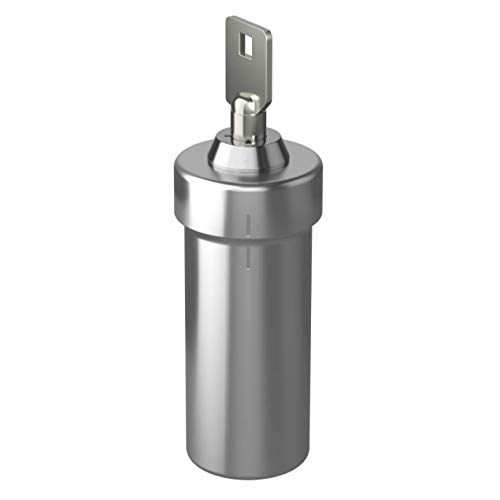
The Ezy Dose is a manual locking pill case with two keys and snap-shut lids, so it needs no power, no app and no alarms. The compact metal case holds up to 26 aspirin-sized pills per compartment and helps you plan and distribute daily doses. It is the simplest lock in the roundup. The tradeoff is that it has no reminders, so you need a separate alarm or routine. Because it is a plain case, it suits people who remember their pills but want them secured. It is the lowest-cost pick. Compared with the Windtrace, it offers a basic lock without alerts. Choose it if you want security for a modest routine.
Best for: A simple secure case for people who do not need alarms
Check price on AmazonSpecs
- Material: Compact metal
- Keys: 2 included
- Capacity: 26 aspirin-sized pills per compartment
- Power: None needed
Pros
- +Lowest cost pick
- +Two keys included
- +No power, app or setup
Cons
- −No alarm or reminder
- −Manual use depends on memory
How We Evaluated These Locking Pill Dispensers (2026)
Each pick was assessed across 5 criteria weighted for real-world use.
Lock security
We compared lock types and placement, from the Senyerkare's top-panel lock to the Ezy Dose's key case. A lock that is easy to reach scored higher for caregivers. We noted the need for a backup key.
Alarm coverage
We looked at alarm counts, including the Senyerkare and JULOS at up to 9. More alarms scored higher for complex schedules. Sound and light combinations earned more.
Ease of use
We checked controls and loading, such as the Senyerkare's symbol-marked 4-button setup and the JULOS curved lid. The strongest pick, the Senyerkare, was set against the most basic, the Ezy Dose, for features and simplicity. Controls that need no manual to operate earned the most credit.
Capacity
We compared per-slot capacity, including the LiveFine at up to 18 pills and the Ezy Dose at 26 aspirin-sized. Larger capacity helps with big prescriptions. Fit mattered more than a big number.
Value
We compared cost tiers, with the Ezy Dose lowest and the Senyerkare the premium. Each extra feature had to justify its cost. Features that did not improve safety or routine earned little credit.
How to Choose the Right Locking Pill Dispensers (2026)
By Need
Match the dispenser to the routine.
| Scenario | Recommended pick |
|---|---|
| Complex schedule with many daily doses | Senyerkare Automatic Pill Dispenser |
| Limited grip strength | JULOS Automatic Pill Dispenser |
| Many pills in each dose | LiveFine 28-Day Automatic Pill Dispenser |
| Hearing loss or deep sleeper | Windtrace 28-Slot Pill Dispenser |
| Lock only, no alarm | Ezy Dose Locking Pill Case |
By Budget
| Budget tier | Recommended pick |
|---|---|
| Lowest-cost pick | Ezy Dose Locking Pill Case |
| Low-cost automatic | JULOS Automatic Pill Dispenser |
| Mid-range automatic | Windtrace 28-Slot Pill Dispenser |
| Upper mid-range, large capacity | LiveFine 28-Day Automatic Pill Dispenser |
| Premium for 9 alarms | Senyerkare Automatic Pill Dispenser |
Automatic vs Manual Lock Case
Automatic (Senyerkare, JULOS, LiveFine, Windtrace)
These add alarms and a lock, and only release the right dose. They cost more and need power.
Manual (Ezy Dose)
This is a simple locking case with two keys and no power. It suits people who remember doses but need security.
Recommendation: choose an automatic model when reminders matter and the Ezy Dose when only security matters.
Lock Location
Where the lock sits changes daily use.
| Preference | Recommended pick |
|---|---|
| Top-panel key lock | Senyerkare Automatic Pill Dispenser |
| Front-mounted key lock | JULOS Automatic Pill Dispenser |
| Built-in lock with large compartments | Windtrace 28-Slot Pill Dispenser |
| Locking lid with big capacity | LiveFine 28-Day Automatic Pill Dispenser |
For Medication Safety at Home Specifically
Look for
Choose a lock that prevents double dosing, an alert the user will notice and a tray that holds missed pills until the next alarm. Ask the prescriber or pharmacist which device fits the regimen.
In this comparison
The Senyerkare and JULOS offer up to 9 alarms with accessible locks. The Windtrace gives the loudest alert.
When to Spend More
Spend more if
Spend more on the Senyerkare for complex schedules, or the LiveFine for large capacity.
Save if
Save with the JULOS for a front lock, or the Ezy Dose if you only need a locking case.
Frequently Asked Questions
How do I choose between these locking pill dispensers?
Start with whether you need alarms. The Senyerkare and JULOS offer up to 9 daily alarms with accessible locks, while the Ezy Dose is a manual key case. Then consider capacity and the user's hearing.
Will a locking dispenser stop double dosing?
A good one keeps missed pills in the tray and locks until the next alarm. That reduces mistakes, but it does not replace supervision for advanced dementia. Ask the prescriber or pharmacist.
What if the key is lost?
Keep a spare and store it somewhere the caregiver can find. The Ezy Dose includes two keys. A mechanical key override helps in emergencies.
Do I need Wi-Fi or an app?
Not for these. Simple beep-and-flash units work without Wi-Fi, but caregivers must check in person. App features lose about half their value if the user has no smartphone.
What happens in a power outage?
It depends on the battery backup. Some units need cell swaps about every 60 days, and USB cords can get knocked loose. The Ezy Dose needs no power.
Can arthritic hands use these?
The JULOS has a curved lid designed for limited grip, and the Senyerkare uses large symbol-marked buttons. Test loading before relying on it. Dexterity matters as much as software.
Are these a substitute for care?
No. A dispenser helps with routine, but it does not replace supervision. Be cautious of unverified claims that a device cuts errors by half.
Bottom Line
best overall: Senyerkare Automatic Pill Dispenser - best overall pick in this roundup.
See the full rankings above for all picks with pros, cons, and best-for summaries.
Browse on Amazon
All Prime-eligible options with current pricing.
Shop on Amazon →