6 Best Hearing Amplifiers Under $50 in 2026
Six personal sound amplifiers that stay under a $50 cap, compared on stated gain, battery life, controls and fit. These are amplifiers, not hearing aids.




At a Glance
Personal sound amplifiers are consumer devices that make voices, television and everyday sound louder. They are not hearing aids. A hearing aid is a regulated medical device that is programmed to an individual hearing loss, while an amplifier raises volume broadly and is meant for casual listening situations. Many listings in this price band use the words hearing aid loosely, so read them with care.
Keeping that distinction in mind, the cap still buys a surprising range. Some units are single behind-the-ear shells sold as a pair, one is a neckband with a free companion app, and others are built around a physical volume wheel and nothing else. Stated gain runs from the high 30s to 50 dB, and battery claims range from a few dozen hours to 80.
We evaluated six amplifiers from their product pages and buyer feedback, not from hands-on testing. The picks are sorted by who they suit: simple controls, long battery life, a smartphone link or a snug fit. If you notice changes in your hearing, an audiologist or clinician is the right first call, and any of these should be started at low volume.
6 Criteria to Look For Before Buying a Hearing Amplifiers Under $50
Key buying criteria so you get the right fit the first time.
Amplifier or hearing aid
A personal sound amplifier raises volume across the board, while a hearing aid is programmed to an individual loss and regulated as a medical device. Many listings here say hearing aid even though they describe amplifiers, such as the Jusha, NurdHong and lvonge pages. Treat that wording as marketing, and do not expect the fitting a clinic provides. If you notice changes in your hearing, an audiologist or clinician is the right first step.
Stated gain and volume safety
Gain tells you how much louder a unit can make sound. The ANCwear lists 38 dB plus or minus 5, the vimaydo up to 45 dB and the Jusha 50 dB. More gain is not automatically better, because high volume near the ear can be harmful within minutes. Start at the lowest setting, increase slowly and stop if sound becomes uncomfortable.
Battery life and charging
A flat amplifier is silent, so battery claims matter. The lvonge lists 80 hours per charge, the vimaydo 40 hours and the Jusha 30 hours on a 200 mAh cell, while the MEDca pairs state no hours. Charge time also differs, with the Jusha at about one to two hours. Choose the one whose charging routine you will actually keep.
Controls you can operate
Fiddly controls make a device unusable for many older hands. The ANCwear uses a physical volume wheel, the MEDca one-touch pair has a single control, and the lvonge uses plus, minus and A buttons for five levels and two programs. The Jusha adds an app on top of that. Pick the interface that matches the person's comfort with buttons and phones.
Fit and comfort
A loose fit causes whistling and a tight one becomes tiring. The ANCwear includes several ear dome sizes, the NurdHong and similar designs offer multiple sizes, and the MEDca units use a bendable ear tube. A properly fitted tip also improves how well the amplifier works. Try each dome size before you decide a unit is faulty.
Single unit or pair
Some listings sell two amplifiers while others sell one, and the vimaydo does not state its pack quantity. The MEDca models are explicitly sold as pairs, which covers both ears for the same outlay. If you only need one ear, a single unit costs less and takes less to look after. Always confirm quantity before ordering.
6 Best Hearing Amplifiers Under $50 in 2026
ANCwear Hearing Amplifier with Volume Wheel
About this pick
The ANCwear is built for people who want nothing to learn. A physical volume wheel is the whole interface: switch it on, turn the wheel and listen. There is no app, no Bluetooth pairing and no smartphone setup, which makes it one of the most approachable units at this price.
The listing states 38 dB of amplification, with a tolerance of plus or minus 5, across a 200 to 3100 Hz range. Several ear dome sizes are included, and a properly fitted dome helps reduce the whistling that comes from a loose seal. The cost of simplicity is that it has no Bluetooth, so it cannot stream television, and its stated gain is lower than the 45 dB of the vimaydo.
Ownership is easy: choose a dome, set the wheel and go. Because it sits at the lower end for gain it is gentler for people who find louder units harsh. Compared with the Jusha neckband it gives up the app and calls, but it also avoids the one extra setup step that some buyers skip.
Best for: People who want a plain on-off amplifier with a wheel they can feel.
Check price on AmazonSpecs
- Amplification: 38 dB, plus or minus 5
- Frequency range: 200 to 3100 Hz
- Control: Physical volume wheel
- App or Bluetooth: None
Pros
- +Lists 38 dB plus or minus 5 amplification
- +States a 200 to 3100 Hz frequency range
- +Several ear dome sizes for a snug fit
- +Physical wheel needs no app or pairing
Cons
- −No Bluetooth, so no direct TV streaming
- −Lower stated gain than the vimaydo
vimaydo Rechargeable Hearing Amplifier
About this pick
The vimaydo is the clearest on paper. It lists up to 45 dB of gain and 40 hours of use per full charge, and it uses a built-in rechargeable cell rather than button batteries. The behind-the-ear shape is lightweight, and the maker positions it for conversation, television and everyday listening.
The caution is that more gain deserves more care. At 45 dB it can be uncomfortably loud if you start high, so begin low and raise it slowly. The listing is unclear on how many units come in a pack, and it states no weight or charge time, so confirm these before buying.
In practice it suits someone who values a stated battery number and wants to skip button cells. It offers more gain than the ANCwear's 38 dB and a shorter battery listing than the lvonge's 80 hours. Against the MEDca pairs it is explicit about specs, where those leave run time out.
Best for: Buyers who want published gain and battery numbers without button cells.
Check price on AmazonSpecs
- Gain: Up to 45 dB
- Battery: 40 hours per charge
- Style: Behind the ear
- Power: Built-in rechargeable
Pros
- +Lists a maximum gain of up to 45 dB
- +Listed 40 hours per full charge
- +Built-in rechargeable cell avoids button batteries
- +Lightweight behind-the-ear design
Cons
- −Quantity per pack is not clear in the listing
- −High gain calls for extra volume caution
- −No weight or charge time listed
lvonge Digital Hearing Amplifier IPX4
About this pick
The lvonge is the stamina leader on the listing, with a claimed 80 hours on one charge, enough for roughly a week without topping up. It also carries an IPX4 water resistance rating, which covers light splashes and sweat, and offers two program modes plus five volume levels. Plus and minus buttons change volume, while an A button changes program.
The controls are slightly more involved than a wheel, so there is a small learning curve to remember which button does what. The maker describes a built-in noise reduction chip, but those claims are not independently verified here, and the listing leaves out a gain figure.
Day to day the long charge cycle is the draw. It suits anyone who forgets to charge and wants a device that lasts through a full week. Compared with the ANCwear it adds modes and water resistance but costs simplicity, and against the Jusha it trades Bluetooth for endurance.
Best for: People who dislike charging and want a week of use between plug-ins.
Check price on AmazonSpecs
- Battery: 80 hours per charge
- Water resistance: IPX4
- Programs: 2 modes
- Volume: 5 levels
Pros
- +Lists 80 hours of working time per charge
- +IPX4 rating covers light splashes and sweat
- +Two program modes switch with an A button
- +Five volume levels with plus and minus keys
Cons
- −Listing gives no stated gain figure
- −Noise reduction claims cannot be verified here
Jusha CZ-T01 Neckband Hearing Amplifier
About this pick
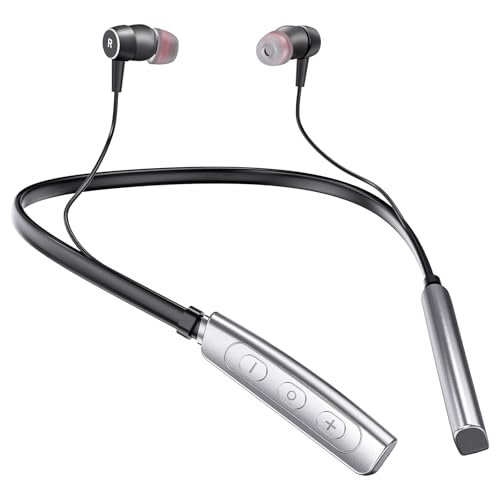
The Jusha CZ-T01 is a neckband that doubles as a Bluetooth earphone. It lists 50 dB of full-range gain, 34 channels and a 200 mAh lithium battery good for 30 hours per charge, with a charge time of about one to two hours. A free app handles setup and Bluetooth lets you take phone calls.
The listing overreaches on hearing loss, using phrases such as moderate to severe, which a consumer amplifier cannot promise. Treat it as a sound amplifier with a phone link, and know that the app adds a setup step that some owners never complete.
For the right person the neckband is convenient: it keeps the tips from getting lost and leaves hands free. It has the highest stated gain here, which also calls for caution at higher volume. Compared with the ANCwear it adds Bluetooth and calls, and against the vimaydo it offers more channels but a shorter battery claim.
Best for: Anyone who wants calls and an app alongside basic amplification.
Check price on AmazonSpecs
- Gain: 50 dB listed
- Channels: 34
- Battery: 200 mAh, 30 hours
- Charge time: About 1 to 2 hours
Pros
- +States 50 dB gain and 34 channels
- +30 hours per charge on a 200 mAh battery
- +Charges in about one to two hours
- +Free app and Bluetooth for calls
Cons
- −Listing language overreaches on hearing loss
- −App setup adds a step some will skip
MEDca Digital Hearing Amplifier Pair One-Touch
About this pick
This MEDca model comes as a pair and keeps its controls minimal. A one-touch volume control means there are no menus to learn, no programming step is needed before the first use, and a bendable ear tube allows some adjustment of fit. It is rechargeable, which avoids buying button cells.
The listing gives no run time or gain figure, so you cannot compare it by the numbers. Some claims, such as being designed by audiologists, come from the maker and are not independently verified. It also lacks the mode selection found on other MEDca models.
For someone who wants both ears covered and a simple device, it is a reasonable starting point. Compared with the lvonge's 80 hours it states no battery figure, and against the ANCwear it offers a pair instead of a single wheel-controlled unit. Treat it as a basic amplifier, and not a substitute for a fitted hearing aid.
Best for: Buyers who want a ready-to-wear pair with no menus or programming.
Check price on AmazonSpecs
- Pack: Pair of 2
- Volume: One-touch control
- Setup: No programming
- Fit: Bendable ear tube
Pros
- +One-touch volume with no menus to learn
- +No programming step before first use
- +Sold as a pair, so both ears are covered
- +Rechargeable instead of button cells
Cons
- −Listing gives no run time or gain figure
- −Designer claims are not independently verified
MEDca Digital Hearing Amplifiers Pair with USB Dock
About this pick
This MEDca set pairs two behind-the-ear amplifiers with a USB dock that charges both at once. That is the whole advantage: one cradle, one cable and both ears ready in the morning. The rechargeable design avoids button batteries, and the familiar behind-the-ear shape means little adjustment.
The weak point is information. The listing gives no run time in hours, and its claim of removing static and noise is not verified here. The dock must also travel with the amplifiers if you leave home overnight, which adds one more item to pack.
It works well as a bedside setup, where the dock is a natural parking spot. In comparison with the one-touch MEDca pair, the dock version emphasizes charging convenience over control simplicity. Against the vimaydo it lacks the published 40-hour figure, so expect to learn the real run time from use.
Best for: People who like a bedside dock that charges both amplifiers together.
Check price on AmazonSpecs
- Pack: Pair
- Charging: USB dock
- Style: Behind the ear
- Finish: Premium gold
Pros
- +Pair charges together on one USB dock
- +Rechargeable design avoids button batteries
- +Behind-the-ear form is common and familiar
- +Sold as a pair, so both ears are covered
Cons
- −Listing gives no run time in hours
- −Noise-removal claim is not verified here
- −Dock must travel with the amplifiers
How We Evaluated These Hearing Amplifiers Under $50
Each pick was assessed across 5 criteria weighted for real-world use.
Stated sound output
We compared the gain and frequency figures that each product page lists. The Jusha states 50 dB, the vimaydo up to 45 dB and the ANCwear 38 dB with a 200 to 3100 Hz range. Units that give no figure, such as the MEDca pairs, scored lower for transparency.
Battery and charging
We looked at claimed hours per charge and how easy it is to recharge. The lvonge leads with 80 hours, followed by the vimaydo at 40 and the Jusha at 30. Dock and Type-C charging were also considered.
Ease of control
We considered how many steps stand between switching on and hearing better. The ANCwear's wheel and the MEDca one-touch pair scored highest. App-based setup, as on the Jusha, scored lower for people who dislike phones.
Honesty of the listing
We checked whether the language overstates what an amplifier can do. Listings that promise to treat hearing loss or lean on hearing aid wording lost points. We favored clear gain, battery and size claims, and our scores reflect product specs and buyer feedback, not hands-on testing.
Fit for the budget
We asked what each unit adds beyond a bare amplifier at this level. The Jusha adds Bluetooth and an app, the lvonge adds endurance and water resistance, and the ANCwear adds clean simplicity. The pairs add two-ear coverage.
How to Choose the Right Hearing Amplifiers Under $50
By Control Style
How you adjust the sound decides how often you will use it.
| Situation | Best pick | Why |
|---|---|---|
| Wants nothing to learn | ANCwear Hearing Amplifier with Volume Wheel | A physical wheel, no app or pairing |
| Prefers one button for two ears | MEDca Digital Hearing Amplifier Pair One-Touch | One-touch volume and no programming |
| Wants preset programs | lvonge Digital Hearing Amplifier IPX4 | Two modes and five volume levels |
| Comfortable with an app | Jusha CZ-T01 Neckband Hearing Amplifier | Free companion app and 34 channels |
Whichever you choose, test the volume at the lowest setting first.
By Budget
Within the cap, think in tiers by what is included.
| Tier | Best pick | What you get |
|---|---|---|
| Entry | MEDca Digital Hearing Amplifier Pair One-Touch | A rechargeable pair with minimal controls |
| Entry to mid | ANCwear Hearing Amplifier with Volume Wheel | Published gain range and several ear domes |
| Mid | vimaydo Rechargeable Hearing Amplifier | Up to 45 dB and 40 hours listed |
| Upper | Jusha CZ-T01 Neckband Hearing Amplifier | Bluetooth, app and 50 dB gain |
More money at this level buys features, not clinical fitting.
Behind the Ear vs Neckband
The body style changes comfort and convenience.
Behind the ear
The vimaydo, MEDca pair, ANCwear and lvonge sit on the ear and are light enough to forget. They are discreet and easy to wear with glasses, but small parts are easy to misplace. Choose this if you want a low-profile look.
Neckband
The Jusha rests on the shoulders, keeping the tips attached and enabling phone calls. It is more visible and may not suit people who dislike a band around the neck. Choose this if you want calls and hands-free use.
How Often You Plan to Charge
Charging habits vary widely.
| Charging habit | Best pick | Reason |
|---|---|---|
| Charges rarely | lvonge Digital Hearing Amplifier IPX4 | 80 hours listed per charge |
| Charges every few days | vimaydo Rechargeable Hearing Amplifier | 40 hours listed per charge |
| Charges nightly at the bedside | MEDca Digital Hearing Amplifiers Pair with USB Dock | Dock charges both at once |
| Wants quick top-ups | Jusha CZ-T01 Neckband Hearing Amplifier | About one to two hours to charge |
Keep the charger where the amplifiers are stored so it becomes a habit.
For Television and Conversation Specifically
Everyday listening is where most owners use these.
Look for
Choose a moderate gain, a comfortable fit and easy volume control. Avoid starting at maximum, and take the device off if sound becomes sharp. A unit that streams television needs Bluetooth.
In this comparison
The Jusha adds Bluetooth for calls, the vimaydo offers up to 45 dB for conversation, and the ANCwear provides 38 dB with a wheel. None is a hearing aid, so they are best for casual listening.
When to Spend More
Know when to look beyond this band.
| Spend more if | Save if |
|---|---|
| You suspect real hearing loss and need a fitted device, so see an audiologist rather than the Jusha | You want casual help with television and conversation |
| You need verified gain and quality, which none of these lists independently | The vimaydo's published numbers are enough |
| You want a pair with proven battery data beyond the MEDca listings | A basic rechargeable pair covers your needs |
| Comfort over long wear is critical | The ANCwear's several domes fit well |
An amplifier does not replace an audiology evaluation.
Frequently Asked Questions
Are these hearing aids?
No. They are personal sound amplifiers, consumer devices that raise volume broadly. A hearing aid is programmed to an individual hearing loss and regulated as a medical device. Some listings blur this line, so judge the product by what it actually does.
Which has the strongest amplification?
The Jusha lists 50 dB, the vimaydo up to 45 dB and the ANCwear 38 dB plus or minus 5. A higher number is not always better, since loud sound near the ear can be harmful. Pick the lowest gain that makes conversation comfortable.
Which lasts longest on a charge?
The lvonge lists 80 hours per charge, ahead of the vimaydo at 40 hours and the Jusha at 30 hours. The MEDca pairs state no hours. Real use may differ, especially at high volume.
Do I need a pair or a single unit?
That depends on whether you want both ears covered. The MEDca models come as pairs, while the vimaydo does not state its quantity. Check the pack contents before ordering.
Why does mine whistle?
Whistling usually means a loose seal between the tip and your ear. The ANCwear includes several ear dome sizes, and a properly fitted dome helps reduce feedback. Lowering the volume also helps.
Is Bluetooth worth having?
Only if you want calls or music through the device. The Jusha offers Bluetooth and an app, but the extra setup step suits some people less. If you prefer simplicity, the ANCwear's wheel is easier.
When should I see a professional?
If you notice changes in your hearing, an audiologist or clinician is the right first step. An amplifier can help with convenience, but it does not diagnose or treat anything. Treat these units as everyday listening aids, and book an evaluation sooner rather than later if conversation keeps getting harder, since no amplifier can tell you why.
Bottom Line
best overall: ANCwear Hearing Amplifier with Volume Wheel - best simple controls pick in this roundup.
See the full rankings above for all picks with pros, cons, and best-for summaries.
Browse on Amazon
All Prime-eligible options with current pricing.
Shop on Amazon →