Best French Press Coffee Makers
We compared four current French press coffee makers on real usable volume after grounds displacement, plunge force and stability, sediment, heat retention.


At a Glance
MuellerLiving French Press Coffee Maker, Double-Walled Stainless Steel, 34oz
↓ See why we picked itFrench press capacity numbers on the box are measured as the volume of the empty carafe, not the volume of brewed coffee you actually pour into a cup. Once ground coffee and its displacement are accounted for, a 34oz press yields noticeably less than 34oz of drinkable coffee, and most comparisons never mention this.
We compared four current French press models on usable brewed volume, how much force and stability the plunge actually requires, how each build retains heat, and how easy it is to source replacement screens and parts. Sediment is a property of French press brewing itself rather than something any of these models fully eliminates, so we focused on which ones manage it best rather than which ones falsely claim to remove it.
5 Criteria to Look For Before Buying a French Press Coffee Maker
Key buying criteria so you get the right fit the first time.
Usable volume after grounds displacement
A press stated at 34oz yields closer to 27 to 28oz of drinkable coffee once a standard dose of coarse grounds is accounted for. Plan your cup count around usable volume, not the number printed on the box. Getting this wrong is one of the more common reasons a coffee makers purchase disappoints once it actually arrives, since usable volume after grounds displacement affects real day-to-day use in a way marketing photos and bullet points don't always make obvious. Before buying, check the specific listing's stated details on usable volume after grounds displacement rather than assuming every coffee makers in this comparison handles it the same way, since this is exactly the kind of detail that varies more than buyers expect within the same price range.
Plunge force, stability, and burn risk
Plunging requires steady, even downward pressure, and an off-angle push is the most common way a glass carafe cracks. Framed glass designs like the Bodum Chambord add lateral stability during the plunge that unframed glass carafes lack. This is the kind of detail that looks minor in a spec list but shapes how satisfied you actually are with a coffee makers weeks after buying, since plunge force, stability, and burn risk plays out differently in daily use than it does on paper. Read the product listing and recent reviews specifically for mentions of plunge force, stability, and burn risk, since this detail is often understated in the bullet points but shows up clearly once real buyers have used the coffee makers for a while.
Sediment is inherent, not a design flaw
No mesh filter, however fine, fully eliminates sediment in a French press, since the brewing method itself keeps fine particles in contact with the water. Expect a small amount at the bottom of the cup regardless of which model or filter layer count you choose. Buyers who skip past sediment is inherent, not a design flaw tend to be the ones leaving disappointed reviews later, not because the coffee makers was defective, but because this specific detail didn't match what they actually needed. Compare how each coffee makers in this roundup actually handles sediment is inherent, not a design flaw rather than assuming they're interchangeable on this point, since the listings here differ on it more than the headline specs suggest.
Heat retention: glass vs steel
Double-walled stainless steel presses like the MuellerLiving hold heat noticeably longer than single-wall glass or single-wall steel. If you drink slowly over 20 to 30 minutes, this is a bigger practical difference than most spec sheets suggest. Heat retention: glass vs steel is easy to overlook next to flashier specs, but it's frequently the difference between a coffee makers that fits your routine and one that quietly becomes a hassle. Confirm the exact detail on heat retention: glass vs steel directly from the current listing before ordering, since this is one of the more common places where two similarly priced coffee makers options genuinely diverge.
Screen and replacement part availability
Filter screens eventually bend or wear from repeated plunging. Models that ship with spare screens, like the Secura, or that use widely sold standard-size parts, like the Bodum Chambord, save you a replacement-parts search later. Getting this wrong is one of the more common reasons a coffee makers purchase disappoints once it actually arrives, since screen and replacement part availability affects real day-to-day use in a way marketing photos and bullet points don't always make obvious. Before buying, check the specific listing's stated details on screen and replacement part availability rather than assuming every coffee makers in this comparison handles it the same way, since this is exactly the kind of detail that varies more than buyers expect within the same price range.
Best French Press Coffee Makers
Cafe Du Chateau French Press Coffee Maker, 34 oz
About this pick
This press is stated at 34oz, but once you account for the volume that a standard dose of coarse grounds displaces, expect closer to 27 to 28oz of actual brewed coffee, roughly three to four 8oz cups rather than four full ones. That gap between stated and usable capacity applies to every glass press in this comparison, not just this one, so plan portions accordingly.
The glass carafe means you can watch the brew and see grounds settle, but it also means the plunge requires steady, even downward pressure since glass has no give if the plunger binds. A sudden hard push on an off-angle plunger is the most common way glass French press carafes crack, so plan to plunge slowly and hold the handle rather than pushing from the top.
Best for: Buyers who want a straightforward glass press and are comfortable adjusting portion expectations for real usable volume.
Check price on AmazonSpecs
- Capacity: 34oz stated capacity
- Feature 2: Glass carafe
- Material: Stainless steel filter
- Feature 4: 4-piece filter structure
Pros
- +Reasonable price for a 4-piece stainless filter structure
- +Glass body lets you monitor brew color and grounds settling
- +Replacement screens are commonly available for this model
Cons
- −Actual usable brewed volume is meaningfully less than the 34oz stated capacity
- −Glass carafe requires careful, even plunge pressure to avoid cracking
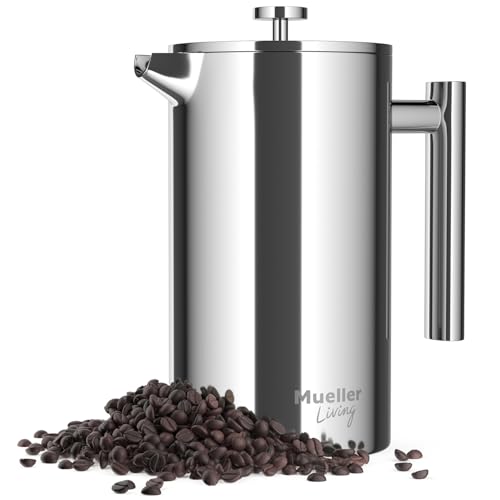
MuellerLiving French Press Coffee Maker, Double-Walled Stainless Steel, 34oz
About this pick
The double-walled stainless steel body holds heat noticeably longer than a single-wall glass carafe, which matters for French press specifically since the brew sits in contact with the grounds the entire time you are drinking it unless you decant it to a separate container. A steel build also survives an accidental drop or an uneven plunge far better than glass.
Same displacement math applies here as with any French press: the stated 34oz becomes closer to 27 to 28oz of drinkable coffee once grounds are accounted for. Because the body is opaque, you lose the ability to visually check grounds settling before you plunge, which glass presses allow.
Best for: Buyers who want the coffee to stay hot longer and prefer a build that will not crack if dropped or plunged unevenly.
Check price on AmazonSpecs
- Capacity: 34oz stated capacity
- Material: Double-walled stainless steel
- Feature 3: 4-level filtration
- Feature 4: Dishwasher safe
Pros
- +Double-walled steel retains heat far longer than glass
- +Far more durable than a glass carafe for daily use or travel
- +4-level filtration reduces fine sediment reaching the cup
Cons
- −Opaque body means you cannot see grounds settle before plunging
- −Higher price than the comparable glass options here
Secura French Press Coffee Maker, 304 Stainless Steel, 34oz
About this pick
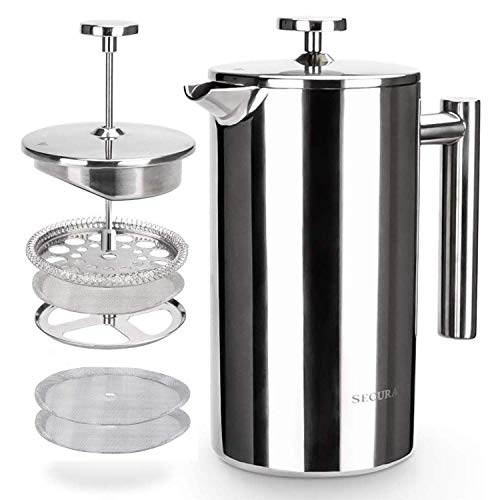
At under $26, this is the lowest-priced press in this comparison and it still ships with two spare stainless filter screens, which addresses one of the real long-term costs of French press ownership: screens do eventually wear or bend, and having spares on hand from day one avoids a replacement-parts search later.
It is a single-wall stainless build, so it does not hold heat as long as the double-walled MuellerLiving, but it is more durable than glass. The same 34oz-stated, roughly 27 to 28oz-usable capacity math applies here too, and a standard mesh filter will not fully eliminate fine sediment; expect a small amount at the bottom of the cup regardless of filter quality.
Best for: Budget-conscious buyers who still want spare filter screens included rather than sourced separately later.
Check price on AmazonSpecs
- Capacity: 34oz stated capacity
- Material: 304 stainless steel
- Filtration: 3-layer filter with 2 spare screens
- Feature 4: Cool-touch handle
Pros
- +Lowest price in this comparison and includes two spare screens
- +Stainless steel body is more durable than glass
- +Cool-touch handle and knob for safer pouring
Cons
- −Single-wall construction does not retain heat as long as a double-walled press
- −Opaque body, same as the MuellerLiving, so no visual check on grounds before plunging
Bodum Chambord French Press Coffee Maker, 34oz
About this pick
The Chambord is the classic French press silhouette, with a borosilicate glass carafe held inside a stainless steel frame that gives it more drop resistance than an unframed glass carafe while keeping the visual benefit of glass. The steel frame also gives the plunger more stable guide contact, which reduces the chance of the plunger binding sideways mid-press, a common cause of glass presses cracking under uneven force.
As with every model here, treat the 34oz label as the carafe's fluid capacity, not your yield. Once grounds are in and displaced, expect roughly 27 to 28oz of drinkable coffee. The glass carafe still loses heat faster than a double-walled steel design, so if you tend to drink slowly over 30 minutes, expect the last cup to be noticeably cooler than the first.
Best for: Buyers who want the classic glass French press look with more structural support than an unframed glass carafe.
Check price on AmazonSpecs
- Capacity: 34oz stated capacity
- Feature 2: High-heat borosilicate glass
- Material: Polished stainless steel frame
- Size: Made in Portugal
Pros
- +Steel frame adds drop resistance and plunge stability versus unframed glass
- +Retains the visual benefit of a glass carafe
- +Widely available replacement glass beakers and screens
Cons
- −Glass still loses heat faster than a double-walled steel press
- −Costs more than the Secura for a comparable stated capacity
How We Evaluated These French Press Coffee Makers
Each pick was assessed across 5 criteria weighted for real-world use.
Usable brewed volume vs stated capacity
We calculated realistic usable volume after grounds displacement for each stated capacity, rather than repeating the carafe's empty fluid capacity as if it were the yield.
Plunge mechanics and build stability
We compared how each carafe's construction, framed glass, unframed glass, or single or double-wall steel, affects plunge stability and crack or burn risk.
Sediment management
We noted that sediment cannot be fully eliminated by any French press filter and instead compared filter layer count as a means of reducing, not removing, it.
Heat retention over a full serving session
We compared glass, single-wall steel, and double-wall steel builds for how much heat is lost over a typical 20 to 30 minute drinking session.
Cleaning and replacement part access
We checked whether spare screens are included and how standard each model's parts are, since screen wear is a normal part of long-term French press ownership.
How to Choose the Right French Press Coffee Makers
By Priority: Heat Retention vs Visual Monitoring
| Priority | Recommended Pick |
|---|---|
| Coffee stays hot longest, drink slowly | MuellerLiving Double-Walled French Press |
| Want to see the brew and grounds settle | Cafe Du Chateau or Bodum Chambord |
| Lowest price, still get spare parts | Secura French Press |
Real Usable Volume, Not the Label
All four models here are stated at 34oz. Actual usable brewed coffee is meaningfully less once grounds are accounted for.
| Stated Capacity | Approx. Usable Brewed Volume | Approx. 8oz Cups |
|---|---|---|
| 34oz | 27 to 28oz | 3 to 3.5 cups |
If you regularly serve four full 8oz cups, plan on using slightly more grounds and water than the stated capacity suggests, or choose a press with a larger stated capacity than you think you need.
Glass vs Steel Build
Glass (Cafe Du Chateau, Bodum Chambord)
Lets you monitor the brew visually and see grounds settle before plunging, but loses heat faster and requires more careful, even plunge pressure to avoid cracking.
Steel (MuellerLiving, Secura)
More durable against drops and uneven plunges, and the double-walled MuellerLiving retains heat significantly longer. You lose the ability to see the brew, and cleaning the opaque interior takes a bit more attention.
Plunge Technique to Reduce Cracking and Burn Risk
This applies to any French press, but matters most on unframed glass carafes.
Push the plunger down slowly and evenly with the handle centered, never at an angle. Stop if you feel resistance rather than forcing it, since binding under force is what typically cracks a glass carafe or splashes hot coffee over the rim.
When to Buy Spare Parts Upfront
Buy spares now if
You brew daily. Filter screens wear from repeated plunging, and the Secura already includes two spares, which covers roughly a year or more of regular use before you need to source replacements.
Skip spares for now if
You brew occasionally. A single filter screen on any of these models will typically outlast several months of light, weekly use.
Frequently Asked Questions
Why does my French press yield less coffee than its stated capacity?
The stated capacity is the carafe's empty fluid volume, not the volume of brewed coffee you get after adding grounds. Coarse coffee grounds displace roughly 15 to 20 percent of that stated volume, so a 34oz press typically yields closer to 27 to 28oz of drinkable coffee.
Will a French press always leave sediment at the bottom of the cup?
Yes, to some degree. French press brewing keeps grounds in direct contact with water rather than filtering them out during brewing, so even a fine multi-layer mesh filter will let some sediment through. More filter layers reduce it but do not eliminate it entirely.
Is a glass or steel French press better?
Glass lets you monitor the brew and grounds visually but loses heat faster and is more prone to cracking under an uneven plunge. Steel, especially double-walled steel, holds heat significantly longer and survives drops and uneven plunges better, at the cost of losing visual monitoring.
Why did my French press carafe crack?
Cracking on glass carafes is most often caused by plunging at an angle or forcing the plunger through resistance instead of stopping and adjusting. Push slowly and evenly with the handle centered, and never force a binding plunger.
How often do French press filter screens need to be replaced?
With daily use, expect a filter screen to start losing effectiveness after roughly six months to a year of regular plunging, depending on grind coarseness and cleaning habits. Models that ship with spare screens, like the Secura, cover this without an immediate replacement-parts search.
Bottom Line
best overall: Cafe Du Chateau French Press Coffee Maker, 34 oz - best overall pick in this roundup.
See the full rankings above for all picks with pros, cons, and best-for summaries.
Browse on Amazon
All Prime-eligible options with current pricing.
Shop on Amazon →