6 Best Emergency Weather Radios Under $30 in 2026
Six low-cost NOAA weather radios compared on power sources, battery size, flashlight options and portability, so you can pick the right outage backup.



At a Glance
A weather radio is one of the cheapest ways to keep hearing official forecasts when the power and the internet go down. At this budget you will find two kinds of product: crank and solar models that double as small phone chargers, and slim battery radios that run on AA cells. We evaluated six of them on product specs and buyer feedback, looking at power options, band coverage, lighting and how easy each one is to keep in a drawer.
The tradeoff to understand early is that a bigger battery number does not automatically mean a better radio. Cheap power-bank claims are often hard to verify, while a plain AA radio with good reception can be more dependable than a gadget with five features. This lineup lets you compare both approaches side by side.
Below we cover what a small outlay buys, where the compromises appear compared with pricier radios, and which pick suits which household. None of these devices should be treated as a guarantee of warning in a real emergency, so keep spare batteries and a backup plan.
6 Criteria to Look For Before Buying a Emergency Weather Radios Under $30
Key buying criteria so you get the right fit the first time.
Power source variety
A radio is useless once its battery dies, so the number of ways to refill it matters. The PRUNUS J-369 lists five routes including a three AA backup, the FosPower A1 offers four, and the J161 relies on two AA cells only. For a long outage, aim for at least one route that does not depend on the sun or your arm, such as AA batteries or USB. Cranking should be treated as an emergency measure, not a plan.
Battery capacity honesty
Budget radios advertise big numbers, and not all are comparable. The FosPower A1 is listed as 7400mWh, equal to 2000mAh, and the PRUNUS J-369 as 11100mWh, so check whether a listing uses mWh or mAh before comparing. The iRonsnow at 2000mAh is a smaller cell. Treat any stated capacity as a ceiling, since real output after conversion losses will be lower.
Band coverage you need
All six receive the NOAA weather band between 162.40 and 162.55 MHz, but extra bands vary. The XHDATA D221 adds shortwave from 5.6 to 22.0 MHz, while the PRUNUS J161 sticks to AM, FM and weather. Shortwave only matters if you enjoy listening to distant stations. For most households, a clear weather band and a steady FM signal is enough.
Lighting quality
A flashlight on a radio is often an afterthought. The Emgykit uses three 3W LED beads, the iRonsnow a single 1W LED, and the FosPower A1 adds a four LED reading lamp on top of a 1W torch. If you expect to walk around in the dark, choose the brighter beam. For a bedside, a reading lamp is gentler on the eyes.
Size and portability
Where the radio lives decides whether it gets grabbed. The XHDATA D221 weighs only 125g and measures 125 by 74 by 30 mm, so it travels in a jacket. The crank models are bulkier and suit a kit shelf. Think about whether you want a go-bag radio or a bedside unit before choosing.
Ease of use under stress
Simple controls beat clever features when you are tired and nervous. The PRUNUS J161 has few buttons, and the iRonsnow shows a four-light charge indicator at 25 percent steps. A cluttered radio like the J-369 rewards practice. Run through the tuning and charging routine once while the lights are on, and write the local weather frequency on the case.
6 Best Emergency Weather Radios Under $30 in 2026
FosPower NOAA Emergency Weather Radio A1
About this pick
The FosPower A1 gives the most complete feature set among the budget radios here. Its built-in 7400mWh battery, listed as 2000mAh, can top up a phone while the radio itself plays AM, FM and the NOAA weather band. Four power routes, including a hand crank and a solar panel, mean you are never fully stuck.
Lighting is better than average at this level. A four LED reading lamp handles a table or a bedside, and a separate 1W flashlight helps with walking around in a dark hallway. An SOS function is also listed for signalling.
The cost of all that is bulk, as the A1 is larger than the simple AA radios in this group. Cranking by hand is a backup, not a daily method, so plan to charge it ahead of a storm and keep it topped up. Compared with the iRonsnow at 2000mAh, it carries a larger quoted reserve, though both rely on a crank for emergencies. Next to the pocket-sized XHDATA at 125g, it is a toolbox rather than a pocket radio, which suits a kit shelf better than a purse.
Best for: Households who want radio, light and phone top-up in one device.
Check price on AmazonSpecs
- Battery: 7400mWh (2000mAh)
- Charging: Solar, crank, USB, AAA
- Lighting: 4 LED lamp, 1W flashlight
- Bands: AM, FM, NOAA
Pros
- +Largest battery reserve of the crank models
- +Solar and crank charging both included
- +Reading lamp plus separate flashlight
- +Covers AM, FM and NOAA broadcasts
Cons
- −Bulkier than the AA pocket radios
- −Crank charging is slow for real power
- −Battery claims are hard to verify
Emgykit Hand Crank Radio with AM/FM/NOAA
About this pick
Emgykit upgraded the flashlight on this model from a single 1W bead to three 3W LED beads, which makes the beam noticeably more useful than on typical crank radios. A long-press SOS alarm is also included for signalling. The radio covers AM, FM and the NOAA weather band.
Power comes from three routes: a hand crank, a solar panel and a Type-C port. The Type-C option is the practical one, since you can recharge from a wall adapter before a storm and rely on the crank only if needed.
The listing does not publish a battery capacity, so comparing runtime with the FosPower A1 at 7400mWh is guesswork. That is the main drawback for a buyer who wants to charge a phone. It is a better fit if your priority is a bright flashlight and a simple radio rather than a power bank. Against the PRUNUS J-369 at 11100mWh it offers far less reserve but a stronger torch, and the Type-C charging is easier to live with than hunting for AA cells. Keep it in a window or near a lamp when you want solar trickle.
Best for: Anyone who wants a bright torch and SOS alarm alongside the radio.
Check price on AmazonSpecs
- Flashlight: 3W, 3 LED beads
- Charging: Crank, solar, Type-C
- Bands: AM, FM, NOAA
- Alarm: SOS function
Pros
- +Upgraded three-bead 3W flashlight is bright
- +Type-C charging simplifies pre-storm top-ups
- +Long-press SOS alarm for signalling help
- +Hand crank and solar as true backups
Cons
- −No battery capacity stated on the listing
- −Not designed as a phone charger
- −Solar panel is small and slow to charge
PRUNUS J161 NOAA Weather Radio AM FM
About this pick
The J161 is a pared-back handheld that runs on two AA batteries and weighs little enough for a jacket pocket. It receives the seven NOAA frequencies between 162.40 and 162.55 MHz, plus FM from 87 to 108 MHz. A stereo earphone is included so you can listen quietly.
Simplicity is the selling point. There is no crank to turn, no panel to aim and no built-in cell to degrade, so the radio will work whenever you have fresh AA batteries. That also makes it easy to understand for relatives who dislike gadgets.
The flip side is that you give up phone charging and a flashlight altogether. If batteries run out during a long outage, you need spares on hand. Compared with the XHDATA D221, it covers fewer bands, since the XHDATA adds shortwave, but it keeps the same two-AA convenience. Against the FosPower A1 it is far smaller, though it cannot light a room or charge a handset. Alkaline cells stored in a drawer last for years, which makes it a quiet, reliable kit companion.
Best for: Glove-box or go-bag use where weight and simplicity matter.
Check price on AmazonSpecs
- Power: 2 AA batteries
- Weather band: 162.40-162.55 MHz
- FM range: 87-108 MHz
- Extras: Stereo earphone
Pros
- +Runs on two common AA batteries
- +Pocket-size body fits any emergency kit
- +Earphone included for quiet listening
- +Seven NOAA frequencies covered
Cons
- −No flashlight or phone charging
- −Needs spare batteries stored nearby
- −No shortwave band on this model
XHDATA D221 AM FM Shortwave NOAA Radio
About this pick
XHDATA built the D221 around a DSP chip, which the maker says delivers accurate weather broadcasts from seven NOAA stations. It adds shortwave from 5.6 to 22.0 MHz to the usual FM and AM coverage, making it the most capable pure receiver in this price bracket.
It measures roughly 125 by 74 by 30 mm and weighs about 125g without batteries, which is lighter than a phone in a case. Two AA cells power it, so there is no battery pack to age. This is a radio for people who actually want to listen, not just own something for a shelf.
The tradeoff is that it does little beyond receiving. There is no crank, no solar panel and no flashlight, so you must keep spare cells. Compared with the PRUNUS J161, it brings shortwave and stronger tuning at a similar size, though the simplest controls may feel fiddly to a first-time user. Next to the PRUNUS J-369 at 11100mWh it is far less of an all-in-one, but it is easier to carry. If curiosity about distant stations appeals, this one rewards it.
Best for: Hobby listeners who also want a dependable weather band.
Check price on AmazonSpecs
- Weight: 125g without batteries
- Size: 125 x 74 x 30 mm
- Shortwave: 5.6-22.0 MHz
- Weather band: 162.40-162.55 MHz
Pros
- +Shortwave range adds distant stations
- +Light at 125g and truly pocketable
- +DSP chip helps with tuning accuracy
- +Covers seven NOAA weather stations
Cons
- −No crank, solar or built-in light
- −Dial controls take practice to learn
- −Needs spare AA batteries on hand
iRonsnow Solar Hand Crank Weather Radio 2000mAh
About this pick
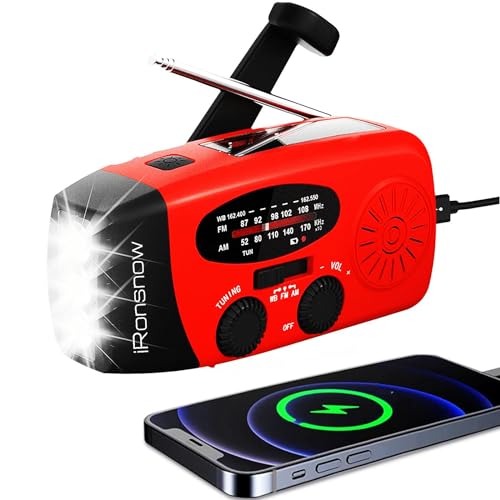
The iRonsnow is a classic crank and solar radio with a 2000mAh emergency battery, upgraded in this version with a four light level indicator. Each light stands for roughly 25 percent, so you can see at a glance how full the cell is. That small feature removes a lot of guesswork when planning for an outage.
A 1W LED flashlight and a long-press SOS flashing mode cover basic lighting and signalling. The radio itself receives AM, FM and the NOAA weather band, and it can send a little power to a phone in a pinch.
Performance is modest, as with every crank radio at this budget. You turn the handle for minutes to gain a short stretch of listening time, so treat the crank as a last resort. The 2000mAh cell is smaller than the FosPower A1 reserve of 7400mWh, though the indicator makes it easier to manage. Against the Emgykit, the flashlight is dimmer at 1W instead of 3W, yet the visible battery level is a plus. This is a good pick for people who like to know their status.
Best for: Cautious planners who want to see their charge level at a glance.
Check price on AmazonSpecs
- Battery: 2000mAh
- Indicator: 4 lights at 25% steps
- Flashlight: 1W LED
- Alarm: Long-press SOS
Pros
- +Four-light indicator shows charge in steps
- +Crank, solar and USB routes available
- +SOS flashing mode for signalling
- +Can send a small top-up to a phone
Cons
- −Smaller reserve than the FosPower A1
- −1W flashlight is dimmer than rivals
- −Hand cranking yields little runtime
PRUNUS J-369 11100mWh Emergency Weather Radio
About this pick
PRUNUS lists the J-369 with an 11100mWh battery and five ways to power it, including crank, solar, AA cells and USB. That makes it the largest quoted reserve in this lineup, ahead of the FosPower A1 at 7400mWh. A DSP chip is used for tuning across weather band, FM and AM.
An LED flashlight and a reading lamp round out the package. The AA backup option is the clever part, because three alkaline cells give you a way to keep the radio running even if the built-in battery ages or drains. Few budget radios offer that fallback.
Bulk and complexity are the cost. With five power methods and several buttons, it takes longer to learn than the two-AA PRUNUS J161. It also sits in a family of radios whose capacity claims are rarely verified by independent tests, so treat the headline number cautiously. Compared with the Emgykit, you get more reserve but a less distinctive flashlight, and compared with the iRonsnow, the same crank and solar basics with more headroom. Charge it ahead of a storm and store it fully topped up.
Best for: People who want the most backup options for long outages.
Check price on AmazonSpecs
- Battery: 11100mWh
- Power ways: 5, including crank and solar
- Backup cells: 3 AA
- Lighting: Flashlight and reading lamp
Pros
- +Largest quoted battery in this lineup
- +Three AA backup keeps radio running
- +Flashlight and reading lamp both included
- +Five different ways to power it
Cons
- −More buttons than a simple AA radio
- −Capacity claim is not independently checked
- −Larger and heavier than pocket models
How We Evaluated These Emergency Weather Radios Under $30
Each pick was assessed across 5 criteria weighted for real-world use.
Power and reserve
We compared quoted battery sizes, charging routes and fallback options from each listing. The PRUNUS J-369 leads on stated capacity, the FosPower A1 follows, and the AA radios were scored on whether spare cells are easy to find. Claims that could not be verified were treated carefully.
Reception and bands
We reviewed which bands each radio covers and what the maker says about its tuning chip. The XHDATA D221 gets credit for shortwave and DSP tuning, while every pick receives the NOAA band. Clarity of the stated frequency range raised the score.
Lighting and signalling
Flashlight output, reading lamps and SOS features were reviewed from specs. The Emgykit stands out with a three-bead 3W beam, and the iRonsnow and Emgykit both offer SOS modes. Radios without lights lost points for outages at night.
Portability and build
We weighed size, weight and whether the radio suits a go-bag. The D221 is the lightest at 125g, and the J161 is similarly pocketable. The crank models were judged as shelf or bedside devices.
Value at this budget
Each radio was judged on what it delivers within a small spend. Features that added real function, such as Type-C charging or an AA fallback, earned credit. Padding such as extra buttons that never get used did not.
How to Choose the Right Emergency Weather Radios Under $30
By Power Preference
Decide how you want to refill the radio before you look at anything else.
| Preference | Pick | Reason |
|---|---|---|
| Only common AA batteries | PRUNUS J161 NOAA Weather Radio AM FM | Two AA cells, no battery pack to age |
| Rechargeable plus AA backup | PRUNUS J-369 11100mWh Emergency Weather Radio | Five power ways including three AA |
| Quick wall top-up | Emgykit Hand Crank Radio with AM/FM/NOAA | Type-C port alongside crank and solar |
| Battery bank for a phone | FosPower NOAA Emergency Weather Radio A1 | 7400mWh reserve with USB output |
| Visible charge status | iRonsnow Solar Hand Crank Weather Radio 2000mAh | Four-light indicator in 25 percent steps |
Whichever you pick, charge it fully before storm season.
By Budget
Everything here sits inside the cap, so think in tiers of features.
| Tier | Pick | What you get |
|---|---|---|
| Entry | PRUNUS J161 NOAA Weather Radio AM FM | Pocket radio with earphone and NOAA band |
| Entry | XHDATA D221 AM FM Shortwave NOAA Radio | Shortwave and DSP tuning in a light body |
| Mid | iRonsnow Solar Hand Crank Weather Radio 2000mAh | Crank, solar and a charge indicator |
| Upper | FosPower NOAA Emergency Weather Radio A1 | Bigger battery, lamp and flashlight |
| Upper | PRUNUS J-369 11100mWh Emergency Weather Radio | Most power routes and largest stated reserve |
Spending more later usually adds S.A.M.E. alert programming and better speakers.
Crank Radio vs AA Radio
Crank and solar
These models, such as the FosPower A1, Emgykit, iRonsnow and J-369, carry a built-in cell and can recharge with no spare parts. They add lights and phone top-up but are larger. They suit a kit shelf.
AA battery radio
The PRUNUS J161 and XHDATA D221 are small, light and easy to understand. They depend on spare alkaline cells, which can be stored for years. They suit a go-bag or a coat pocket.
Want features: choose crank. Want simplicity: choose AA.
Where It Will Live
Location shapes which design makes sense.
| Location | Pick | Reason |
|---|---|---|
| Jacket or go-bag | XHDATA D221 AM FM Shortwave NOAA Radio | 125g and about 125 by 74 by 30 mm |
| Bedside table | FosPower NOAA Emergency Weather Radio A1 | Reading lamp and bigger body |
| Hallway cupboard | Emgykit Hand Crank Radio with AM/FM/NOAA | Bright 3W torch for finding things |
| Car glovebox | PRUNUS J161 NOAA Weather Radio AM FM | Two AA cells and a small footprint |
Keep the radio where everyone in the home can find it in the dark.
For Power Outages Specifically
Look for
A reliable fallback power route, a charge level you can read, and controls you can operate in the dark. A radio you have already tested at home beats a fancier one you have never turned on.
In this comparison
The PRUNUS J-369 has the widest fallback with three AA cells, the iRonsnow shows charge in four lights, and the FosPower A1 pairs a lamp with a 7400mWh reserve.
Practice cranking and tuning once a season.
When to Spend More
| Spend more if | Save if |
|---|---|
| You want S.A.M.E. county-specific alerts that sound automatically, which none of these listings promise | You will tune to the weather band yourself, as with the PRUNUS J161 |
| You need a louder speaker for a large home | A bedside radio such as the FosPower A1 is close enough to hear |
| You want proven battery capacity | You treat the J-369 figure as a ceiling and keep AA cells nearby |
| You depend on it daily for months | The Emgykit is a once-a-year outage backup |
These radios are backups, so test them rather than assuming.
Frequently Asked Questions
Will these radios wake me up with a weather warning?
None of the listings here promise automatic alert activation, so you generally need to leave the radio on and tuned to a NOAA channel. Alerting radios with county-specific programming usually cost more. If overnight warnings matter, check the product page for an alert feature before buying, and keep a phone alert as backup.
Which is better, the FosPower A1 or the PRUNUS J-369?
The J-369 quotes 11100mWh and five power routes including three AA, while the A1 lists 7400mWh with a four LED lamp and a 1W flashlight. Choose the J-369 for fallback power and the A1 for lighting. Both use cranks that are slow in practice.
Can a hand crank radio charge my phone?
In a pinch, yes, but expect a tiny amount of power for a lot of effort. The built-in cells on the FosPower A1 and J-369 are better for a top-up than the crank. Plan to charge the radio from a wall before a storm and use the crank only as a last resort.
Are AA radios more reliable than battery pack models?
They are simpler, which helps. The PRUNUS J161 and XHDATA D221 have no internal cell to degrade, and alkaline AA cells store well. The tradeoff is no flashlight or phone charging. Keep a fresh set in a labelled bag next to the radio.
How do I know a battery capacity claim is real?
You usually cannot from a listing alone. Check whether the number is in mWh or mAh, since the A1 lists both. Treat it as an upper limit and assume the usable energy is lower. A radio with an AA fallback gives you insurance.
How often should I test an emergency radio?
Turn it on once a season, tune to the weather band, charge it and check the flashlight. Crank models should be topped up every few months because stored cells slowly drain. Replace AA cells every year or two as a habit.
What does spending more add over these picks?
Higher budgets typically bring county-specific alert programming, louder speakers and better build quality. For plain forecasts and a flashlight, these six already cover the basics. If you rely on overnight warnings, a dedicated alert radio is worth a look.
Bottom Line
best overall: FosPower NOAA Emergency Weather Radio A1 - best overall pick in this roundup.
See the full rankings above for all picks with pros, cons, and best-for summaries.
Browse on Amazon
All Prime-eligible options with current pricing.
Shop on Amazon →