5 Best Dusters for Blinds in 2026
Five blind dusters compared by slat design, pole reach, washable heads and refills, so you can clean Venetian and mini blinds without climbing or bending.



At a Glance
Blinds are one of the most annoying surfaces in a house to dust. Every slat has a top edge that collects a fine grey layer, and a flat cloth or a general purpose duster only touches one slat at a time. The job gets worse when the blinds are tall, when the window sits over a sofa or a kitchen sink, or when you would rather not stretch overhead for twenty minutes. A tool built for slats changes how long the job takes, and it changes how often you are willing to do it.
This guide compares five tools that fit that task in different ways. The EVEPRUS and the ReNext are finger style slat cleaners that you wear or hold like a glove. The Hiware is a curved brush with microfiber sleeves that grips several slats at once. The Swiffer kit adds a three foot handle to disposable dusters, and the Tiumso is a five head kit with a pole that stretches to 100 inches, which suits tall windows and blinds above a doorway. Some other long pole dusters in this price range are general purpose, so we kept only the tools whose listings describe blind use or a slat friendly head.
We evaluated each pick from product specifications and patterns in buyer feedback, not from hands on lab work. We looked at how many slats each design can clean per pass, whether the cleaning surface can be washed or replaced, how far it reaches, and how awkward the tool is to hold when your arm is raised. The sections below explain which tool fits which type of blind, and where a cheaper option is the smarter buy.
6 Criteria to Look For Before Buying a Dusters for Blind
Key buying criteria so you get the right fit the first time.
Slat spanning head design
The biggest time saver on blinds is a head that touches several slats at once. A finger or multi arm design cleans the top and underside of neighboring slats together, while a flat head cleans one surface at a time. The EVEPRUS with seven fingers per tool and the Hiware with three curved arms both work this way, and the Swiffer kit's flat duster does not. As a rule, if you have more than four windows with blinds, prefer a spanning design, because the time you save on each pass multiplies quickly.
Washable versus disposable heads
Blinds collect fine dust that clogs a cloth in a few strokes, so you will go through a lot of cleaning surface. Washable microfiber like the EVEPRUS fingers, the Hiware sleeves and the Tiumso heads can be rinsed and reused, while the Swiffer heads are thrown away after use. A disposable system is convenient but turns into a repeat purchase, especially if you dust weekly. Check that the listing explains how to wash and dry the head, since tumble drying flattens microfiber.
Reach and pole stability
A pole helps with tall windows, but it also moves the weight away from your hand, which makes your forearm tire faster. The Swiffer handle at about three feet is easy to control, while the Tiumso at up to 100 inches gives you reach but wobbles near its end. Extend the pole only as far as the job needs, and prefer one with a locking joint that does not rotate. If your blinds are within reach, a handheld tool like the Hiware is steadier than any pole.
Fit for your blind type
Slat width, material and curve decide whether a tool fits. The Hiware's listing says it suits curved blinds and is not great for straight or very large ones, which is a clear warning to measure your slats before you order. Narrow aluminum mini blinds bend under pressure, so pick a soft head and a light touch. Faux wood and real wood blinds tolerate a firmer brush, but wooden slats should not be soaked when you wash them.
Extra heads and attachments
Several tools in this group include accessories that make the purchase more useful. The EVEPRUS includes two mini vent dusters for air conditioner grilles, the ReNext doubles as a window AC duster, and the Tiumso adds chenille and crevice heads. Those extras matter if you plan to dust vents and cobwebs with the same purchase. If you only care about blinds, do not pay extra for attachments you will leave in a drawer.
Comfort and arm position
Dusting blinds usually means holding your arm raised, and the strain adds up faster than most buyers expect. A short rigid handle such as the Hiware's 8.5 inch body gives more control than a floppy glove, while a long pole shifts the load to your wrist. Work in short sessions, rest your elbow against your body, and clean the top few slats with a stool or a pole to avoid overreaching. A tool that feels light in the hand will get used more often.
5 Best Dusters for Blinds in 2026
EVEPRUS 7-Finger Blind Cleaner Duster Set
About this pick
The EVEPRUS set is built around one idea: fingers that slide between slats. Each of the two main tools has seven microfiber fingers, and the listing says the double headed layout lets you work on roughly six blinds at a time depending on how you shape your hand. Because each finger fills the gap between neighboring slats, one stroke picks up the dust from both faces of a slat instead of just the top edge. The set also includes two small vent dusters, which makes it useful for air conditioner grilles and shutters as well.
The tradeoff is that this is a close range tool. You hold it by hand, so your arm reaches only as high as your shoulder, and tall windows still need a stool or a pole based tool. The microfiber is washable, which keeps running costs near zero, but the fingers will mat if they are tumble dried, so plan on air drying. Heavy kitchen grease on blinds is also beyond a dry microfiber finger, and that job needs a damp cloth first.
In daily ownership this is the least fiddly tool in the group. There is no pole to assemble, and the pieces store flat in a drawer. Compared with the Hiware at eight and a half inches long, the EVEPRUS covers more slats per stroke because every finger works at once. Compared with the Swiffer kit it never runs out of refills. It is the pick for standard Venetian and mini blinds at normal window height.
Best for: Venetian and mini blinds within arm's reach that need frequent, fast dusting.
Check price on AmazonSpecs
- Main tool: 2 dusters, 7 fingers each
- Material: Washable microfiber
- Extras: 2 mini vent dusters
Pros
- +Seven fingers slide between slats
- +Washable microfiber, no refills to buy
- +Two tools plus mini vent dusters
- +No pole or assembly to manage
Cons
- −Reach limited to your own arm
- −Matted fibers if tumble dried
- −Not suited to greasy buildup
Hiware Window Blind Cleaner Duster Brush
About this pick
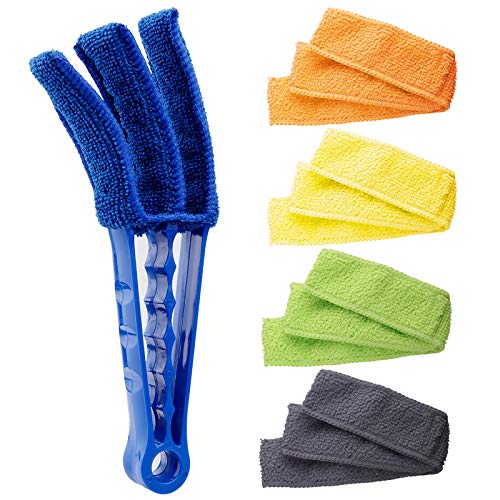
The Hiware is a handheld brush with three curved arms, and each arm wears a microfiber sleeve. The curve matches the arc of typical Venetian slats, so the arms hug the top and bottom of a pair of blinds in the same pass. The listing calls out the sturdy polyethylene frame and an 8.5 inch body, and it ships with five sleeves, which gives you spares while one set dries. That sleeve count is the main reason to choose it over a single piece tool.
The listing is honest about its limits: it says the brush is not great for straight blinds or very large ones, and that heavy or stuck on dust is better handled with the maker's cleaning solution. That candor matches what the shape suggests. The curved arms are designed for blinds with a bit of curl, and flat vertical blinds or wide faux wood slats may not seat properly. If your blinds are wide and flat, look at the finger style tools instead.
Ownership is easy. The sleeves slip on and off for washing, and the body is rigid, so it will not flop around the way a cloth glove does. Compared with the EVEPRUS you get firm contact and a defined shape, but you cover fewer slats per stroke because there are three arms instead of seven fingers. It is one of the more affordable tools here, and it is the one to buy if you like a solid handle and have curved slats.
Best for: Curved Venetian blinds where a firm handheld brush with spare sleeves is preferred.
Check price on AmazonSpecs
- Sleeves: 5 microfiber
- Length: 8.5 inches
- Frame: Polyethylene
Pros
- +Five sleeves give spares while others dry
- +Curved arms match slat shape
- +Rigid body is easy to control
- +Cleans tops and bottoms in one pass
Cons
- −Not made for straight or very wide blinds
- −Stuck on dust needs extra cleaner
- −Fewer contact points than finger tools
ReNext Mini Washable Blind Cleaner Brush
About this pick
The ReNext is the leanest option, and the listing gives little detail beyond its title. That title describes a mini, washable and removable blind cleaner with a slatted head that also doubles as a window air conditioner duster. In practice that means a small handheld tool that you run along slats, and a cover that comes off for rinsing. We can say what the listing states and no more, since it does not list dimensions, fiber type or sleeve count.
That sparse information is also the main consideration for buyers. If you want exact measurements before you order, you will not get them from this page, so it fits shoppers who care more about a low cost trial than a precise spec comparison. The mini size is an advantage for tight spots like the gap behind a radiator or the narrow slats of a bathroom blind, but it also means more passes across a wide window. The removable cover keeps it reusable instead of disposable.
As an ownership proposition it is simple: use it, rinse the cover, let it dry and start again. Compared with the Hiware, which comes with five labeled sleeves, the ReNext leaves you with fewer spares, and compared with the EVEPRUS it covers fewer slats at once. It is a sensible starter tool if you want to find out whether a dedicated blind brush saves you time before spending more on a set.
Best for: Shoppers who want a low-cost, compact blind brush to try before buying a larger set.
Check price on AmazonSpecs
- Type: Handheld slat brush
- Care: Washable, removable
- Use: Blinds and window AC fins
Pros
- +Compact size fits narrow gaps
- +Removable cover rinses clean
- +Also usable on window AC fins
- +Among the most affordable here
Cons
- −Listing gives few measurements
- −Many passes needed on wide windows
- −Fewer spares than sleeve-based sets
Swiffer Duster Kit with 3 ft Extendable Handle
About this pick
The Swiffer kit is the odd one out because it is not blind specific, but the listing names blinds among the surfaces the extendable handle is meant to reach. You assemble the poles, slide a heavy duty duster onto the end and fluff the fibers. The dust busting strips are meant to break down built up layers, and the coated fibers are described as grabbing dust instead of pushing it around. Twelve refills make the first few months of use easy.
The tradeoff is the refill habit. When the duster is full you throw it away and slide on another, which is convenient but means you will eventually buy more refills. On slats the flat duster tends to work best when you wipe along the length of each slat, since it does not slide between them the way fingers do. The three foot handle helps with the top of a window, but it is not tall enough for blinds above a stairwell or an entry door.
For ownership, storage is easy and there is nothing to wash. Compared with the Tiumso, which stretches to 100 inches and has washable heads, the Swiffer reaches less far and creates ongoing cost, but the setup takes seconds and the heads are lighter. If you dust blinds only occasionally and prefer a clean, throwaway routine, this is the quick option. If you dust every week, a washable tool will pay for itself sooner.
Best for: Occasional blind dusting by people who prefer a throwaway routine and a short handle.
Check price on AmazonSpecs
- Handle: 3 ft extendable
- Refills: 12 heavy duty dusters
- Type: Disposable
Pros
- +Twelve refills included in the kit
- +Three foot handle adds modest reach
- +No washing or drying needed
- +Light and quick to assemble
Cons
- −Refills mean ongoing purchases
- −Flat head does not enter between slats
- −Handle too short for tall windows
Tiumso 5-in-1 Microfiber Duster Kit with Pole
About this pick
The Tiumso is a general purpose kit, and it earns its place here for reach. The stainless steel pole telescopes from a short length to about 100 inches, and the listing says the bendable microfiber head can be angled to reach dead corners. That combination lets you dust blinds that sit above a patio door or at the top of a tall window without a stool. The kit includes five heads, among them a bendable microfiber head, a chenille head and a crevice style tip.
Its weakness for blinds is the lack of a purpose built slat tool. The bendable head can wrap around a slat, but it does not slide between two the way the EVEPRUS fingers do, so you will work one slat at a time. A pole at near full extension also wobbles, and holding it overhead becomes tiring faster than a short tool in the hand. Keep the pole shorter than you think you need and move your feet instead.
Storage and care are straightforward, because the heads detach and can be washed, then air dried. Compared with the Swiffer kit it costs more but has no refills, and compared with the EVEPRUS it reaches far higher but covers far fewer slats per pass. The best use is as the high reach partner to a handheld slat tool, where the pole covers the top row and the finger style tool handles the rest.
Best for: Tall windows and blinds above doors where reach matters more than slat-by-slat speed.
Check price on AmazonSpecs
- Pole: Stainless steel, up to 100 inches
- Heads: 5 types incl. bendable and chenille
- Care: Washable, detachable
Pros
- +Pole extends to 100 inches
- +Five heads cover several jobs
- +Bendable head reaches odd angles
- +Heads detach and wash
Cons
- −No dedicated slat-spanning head
- −Long pole wobbles at full reach
- −More parts to store
How We Evaluated These Dusters for Blinds
Each pick was assessed across 5 criteria weighted for real-world use.
Slat coverage per pass
We compared how many slats each tool is designed to touch in a single stroke. The EVEPRUS leads with seven fingers per tool and a double headed design, the Hiware follows with three curved arms, and the Tiumso and Swiffer work on one surface at a time. Because blinds have dozens of slats, this measure matters more than almost any other spec. We read the listings and buyer comments for consistent notes about missed edges.
Washability and running cost
We looked at whether the cleaning surface can be rinsed and reused or has to be replaced. The EVEPRUS, Hiware, ReNext and Tiumso are washable, while the Swiffer kit relies on twelve disposable refills. We also noted care instructions, since heat can damage microfiber. Lower running cost earned credit, but convenience for occasional users was weighed fairly.
Reach and handling
Reach is judged by how well a tool serves tall windows without a stool, balanced against how steady it feels. The Tiumso reaches furthest at up to 100 inches, the Swiffer handle at 3 feet is a moderate step, and the EVEPRUS, Hiware and ReNext are hand tools with no extension. We also considered weight in the hand and whether the grip stays secure when your arm is raised.
Match to blind type
Not every tool fits every blind. We read the listings for stated limits, such as the Hiware's caution about straight and very large blinds, and we considered the likely fit of finger tools on narrow mini slats versus wider faux wood. Tools that clearly describe blind use ranked higher than general purpose kits, which are included only when their listing names blinds or when their head shape suits slats.
Lineup positioning and value
Within this group the EVEPRUS earns Best Overall for slat coverage and washability, the Hiware is the firm brush choice with five sleeves, and the ReNext is the low cost starter. The Swiffer kit is the throwaway option with the most refills, and the Tiumso is the long reach choice with five heads. We weighed value as the match between what the listing promises and what a buyer would reasonably use.
How to Choose the Right Dusters for Blinds
By Blind Type and Window Height
Your blinds and the height of your windows narrow the choice more than any other factor.
| Situation | Recommended pick | Why |
|---|---|---|
| Standard Venetian or mini blinds at normal height | EVEPRUS 7-Finger Blind Cleaner Duster Set | Seven fingers per tool clean several slats at once |
| Curved slats, you want a firm handle | Hiware Window Blind Cleaner Duster Brush | Curved arms and five sleeves suit this shape |
| Tall windows or blinds above a door | Tiumso 5-in-1 Microfiber Duster Kit with Pole | Pole extends to 100 inches |
| Narrow gaps, bathroom or small windows | ReNext Mini Washable Blind Cleaner Brush | Mini body fits tight spaces |
| Occasional dusting, no washing | Swiffer Duster Kit with 3 ft Extendable Handle | Disposable heads, 12 refills included |
Measure one slat before you order. Width and curve decide whether a brush seats properly.
By Budget
Prices in this group are relative, and the cheaper tools are often the better fit for a single set of blinds.
| Budget tier | Recommended pick | Why |
|---|---|---|
| Entry | ReNext Mini Washable Blind Cleaner Brush | Lowest cost way to test a dedicated blind tool |
| Entry to mid | Hiware Window Blind Cleaner Duster Brush | Five sleeves make it a good value brush |
| Mid | EVEPRUS 7-Finger Blind Cleaner Duster Set | Two finger tools plus mini vent dusters |
| Premium | Tiumso 5-in-1 Microfiber Duster Kit with Pole | Five heads and a very long pole |
| Premium kit with refills | Swiffer Duster Kit with 3 ft Extendable Handle | Twelve disposable refills in the box |
A disposable kit costs more over time if you dust weekly, even when the starter price looks low.
Washable Microfiber vs Disposable Dusters
The most practical choice for blinds is how you want to handle used dust.
Washable microfiber
Washable heads are reusable and cost almost nothing after the first purchase, but you must rinse them and wait for them to dry. Fibers can clump if tumble dried, so most makers say to air dry. In this group the EVEPRUS, Hiware, ReNext and Tiumso fall on this side. Pick washable if you dust more than once a month and do not mind a small cleaning step.
Disposable electrostatic
Disposable dusters are quick: attach one, dust, throw it away. The Swiffer Duster Kit with 3 ft Extendable Handle is the only pick here on this side, with twelve refills in the box. The tradeoff is the refill purchase later and the waste. Pick disposable if you dust a few times a year, hate laundry chores or dust in a place where a messy washable head would be a problem.
If you cannot decide, buy a washable tool first. You can always add refills later.
Handheld vs Pole Tools
This second axis decides how you stand while you work.
| Preference | Recommended pick | Why |
|---|---|---|
| No stool, easy storage | EVEPRUS 7-Finger Blind Cleaner Duster Set | Hand tool, nothing to assemble |
| Steady grip, rigid body | Hiware Window Blind Cleaner Duster Brush | 8.5 inch body keeps control |
| Moderate reach for windows | Swiffer Duster Kit with 3 ft Extendable Handle | Three foot handle reaches the top slats |
| Maximum reach | Tiumso 5-in-1 Microfiber Duster Kit with Pole | Pole to 100 inches |
| Pocket-size tool | ReNext Mini Washable Blind Cleaner Brush | Compact handheld body |
If you pick a pole, keep it short enough to hold steady.
For Dusty Kitchens and Allergy Households Specifically
Blinds in busy rooms carry more than ordinary dust.
Look for
Look for a washable head that traps dust instead of flicking it into the air, and plan to wash it often. In a kitchen, wipe a layer of grease with a damp cloth first, since dry microfiber smears it. If dust bothers you, open the window slightly, close the blinds, and work from the top slat down. Rinse the head outdoors or in a sink, and replace it when it stops gripping.
In this comparison
The EVEPRUS 7-Finger Blind Cleaner Duster Set is the most practical, because you can wash both main tools after each session. The Hiware's five sleeves also work well, as you can rotate clean ones in. The Swiffer kit is a convenient disposable alternative when you do not want to wash anything.
Check the listing for care instructions before you wash any head.
When to Spend More
Spend where it helps your own windows, not where the box looks impressive.
| Spend more if | Save if |
|---|---|
| You have many windows. The EVEPRUS 7-Finger Blind Cleaner Duster Set speeds up every one of them | You have one or two small windows. The ReNext Mini Washable Blind Cleaner Brush is enough |
| Your blinds sit high. The Tiumso 5-in-1 Microfiber Duster Kit with Pole saves repeated stool climbs | Your blinds are at eye level. A handheld tool like the Hiware Window Blind Cleaner Duster Brush covers them |
| You want convenience for the long haul. The Swiffer kit's twelve refills make a start easy | You dust weekly. A washable head costs nothing extra to reuse |
Buy the cheapest tool that fits your slat type, then upgrade only if it slows you down.
Frequently Asked Questions
How do I choose between a finger-style and a brush-style blind duster?
Finger style tools like the EVEPRUS wrap around each slat, so they clean more surface per stroke and suit most Venetian and mini blinds. Brush style tools like the Hiware offer firmer contact and a rigid body, but their curved arms fit best on blinds with a slight curve. If you are unsure about your slat shape, pick the finger style set first, because it adapts to more profiles.
Are blind dusters worth the money compared with a plain cloth?
Yes, if you clean blinds more than a couple of times a year. A cloth touches one slat at a time and can bend thin aluminum slats, while a spanning tool does several at once with less pressure. The washable options here can be reused for years, so the small price difference tends to disappear quickly. For occasional dusting a damp cloth still works.
How often should I wash the duster head?
Rinse a washable head whenever it looks grey or feels clogged, which for blinds is often every one or two sessions. Use mild soap and warm water, squeeze gently and air dry. Avoid bleach and tumble drying, which is standard advice for microfiber heads. A tool with spare sleeves, like the Hiware, lets you keep working while one set dries.
Is it true that you should close the blinds before dusting?
It helps. Tilt the slats closed in one direction, dust, then tilt them the other way and dust again so you reach both faces. Start at the top and work down so falling dust lands on slats you have not cleaned yet. Dusting the window sill last avoids doing it twice.
Can I use these tools on wooden or faux wood blinds?
A dry microfiber tool is gentle enough for wood and faux wood blinds when used lightly. Avoid soaking real wood slats, because moisture can warp them, and wipe any damp spot dry. Fingers and sleeves can also pick up fine grit, so dust first and wash afterward. Always follow the care directions that came with your blinds.
What if my blinds have heavy, sticky buildup?
Dry dusters will not cut through kitchen grease or years of film. The Hiware listing itself recommends cleaning solution for heavy or stuck on dust, and that advice applies to every tool here. Wipe the slats with a damp, soapy cloth first, then use the duster for regular upkeep. Once the film is gone, a quick weekly dusting keeps it from returning.
Bottom Line
best overall: EVEPRUS 7-Finger Blind Cleaner Duster Set - best overall pick in this roundup.
See the full rankings above for all picks with pros, cons, and best-for summaries.
Browse on Amazon
All Prime-eligible options with current pricing.
Shop on Amazon →