4 Best Cordless Steam Irons in 2026
Four cordless steam irons compared by wattage, heat-up time, steam run time and base design, from Panasonic and Rowenta bases to a corded and cordless hybrid.


At a Glance
A cordless steam iron removes the one thing that drags on every ironing session: the cable that snags on the board, pulls the iron off line and tangles around your wrist when you turn a sleeve. Cordless models sit on a charging base and carry stored heat with them, so you lift, press and return the iron to the base to reheat. The freedom is real, but so is a tradeoff that every buyer should understand before choosing one.
The tradeoff is time. A cordless iron holds heat for a limited run, then needs to go back on its base, which means the rhythm of ironing changes. The four irons here handle that differently. The two Panasonic models list 1500 watts with a 360 degree soleplate, the Rowenta Freemove lists 1600 watts with a 30 second heat-up and a 10 second reheat, and the OMAIGA offers a 2-in-1 design that switches between cordless and corded power.
We evaluated them from the listings, the stated specifications and recurring buyer feedback, without claiming hands-on testing. Only four products on the market list genuine cordless operation, so we have kept the guide to four rather than padding it with corded irons that merely have a retractable cable.
6 Criteria to Look For Before Buying a Cordless Steam Iron
Key buying criteria so you get the right fit the first time.
Heat run time per charge
A cordless iron works from stored heat in its soleplate, so run time before a return to the base is the number that matters most. The Panasonic NI-WL700A lists one minute of steam ironing or five minutes of dry ironing per heat cycle, while the Rowenta Freemove lists a 10 second reheat when the indicator blinks. Steam drains heat faster than dry pressing, so a cordless iron suits short garments better than a mountain of laundry. Expect to return to the base often and plan the order of your ironing accordingly.
Heat-up and reheat speed
Waiting for the iron costs more time on a cordless model because you reheat repeatedly. The Rowenta Freemove lists a 30 second initial heat-up and a 10 second reheat, while the Panasonic NI-WL700A takes just under two minutes to reach high temperature. The OMAIGA avoids waiting by letting you switch to corded power. If you iron several garments in a row, shorter reheats are worth more than a high wattage number printed on the box.
Corded fallback option
Only the OMAIGA offers a true 2-in-1 mode, switching to corded continuous power with a twist of the base, and the other three are cordless only. A corded mode is useful for large batches, thick fabrics or any time you want steady heat. Pure cordless designs are lighter on the board and easier on the wrist. Decide whether you iron one or two items at a time or a full basket, and let that guide the choice.
Soleplate shape and movement
Cordless irons are used differently from corded ones because you can turn and lift freely, so the plate shape matters more. The Panasonic models use a 360 degree Freestyle double-tipped soleplate so the iron leads with either end. This helps with sleeves and shirt fronts and reduces the twisting of your wrist. The Rowenta uses a stainless plate and the OMAIGA a nonstick ceramic plate. Look for smooth edges that do not catch on pleats.
Water tank capacity
A small tank means frequent refills, and refilling a hot cordless iron is a hassle. The OMAIGA lists a 380 milliliter tank, the largest stated here, while the other three do not give a tank volume in their visible bullets. If you steam heavily, a larger tank helps. Fill only to the marked line, let the iron cool slightly before refilling, and empty the tank after use to protect the base.
Base design and storage
The base is a major part of a cordless iron, since it charges the iron and holds it upright. A wobbly base is a spill risk, and a bulky one takes space. The Rowenta's blinking indicator tells you when to return the iron for reheating, which makes the base part of the workflow. Place the base on a stable, heat-safe surface within reach, and keep the contact points clean so heat transfers evenly.
4 Best Cordless Steam Irons in 2026
Rowenta Freemove Cordless Steam Iron 1600W
About this pick
The Rowenta Freemove has the strongest cordless numbers in this guide. The listing gives a 1600 watt element, a 30 second heat-up and a 10 second reheat when the indicator light blinks and you return the iron to its base. Those two timing figures are the ones that decide whether a cordless iron feels like freedom or like a chore, because a short reheat keeps you moving and a long one makes you wait between garments.
The maker emphasizes total freedom to move around the clothes without a cord, including awkward spots like the sleeves and the hem of a long skirt. A stainless steel soleplate gives a robust glide, and the portable steamer positioning suggests that vertical steaming is part of the plan. A blinking indicator tells you when it is time to return to the base, which is a simple cue that needs no learning.
Compared with the Panasonic NI-WL700A, which lists a heat-up in just under two minutes, the Rowenta starts much faster. Compared with the OMAIGA, it commits fully to cordless operation instead of offering a corded fallback. If you want a cordless iron that reheats quickly and starts almost at once, the Freemove is the one to buy.
Best for: Cordless ironing with the shortest wait to start and reheat.
Check price on AmazonSpecs
- Power: 1600 watts
- Heat-up: 30 seconds
- Reheat: 10 seconds on the base
- Soleplate: Stainless steel
Pros
- +30-second heat-up is listed
- +10-second reheat on the base
- +1600 watt element
- +Stainless steel soleplate
Cons
- −No corded fallback for long sessions
- −Must return to the base regularly
- −Higher price tier than the OMAIGA
Panasonic NI-WL700A Cordless Steam Dry Iron 1500W
About this pick
The Panasonic NI-WL700A is the only cordless iron in this group whose listing spells out how long the heat lasts. After heating to a high temperature in just under two minutes, it provides one minute of steam ironing and five minutes of dry ironing before it needs to go back on the base. That honesty is valuable, because a cordless buyer should know that steam use drains heat far faster than dry pressing.
The 360 degree Freestyle soleplate has a double-tipped, contoured shape, so the iron moves naturally forwards, backwards and sideways without twisting the wrist to lead with a point. This matters for sleeves, yokes and shirt fronts. The stainless steel, nonstick surface is described as maneuvering without tugging or wrinkling the fabric, and the 1500 watt rating covers both steam and dry duty.
Compared with the Rowenta Freemove at 1600 watts, the Panasonic heats more slowly, but it gives you clear run times to plan around. Compared with the NI-QL1100L, the two share the same wattage and soleplate design, so the choice often comes down to color and availability. For anyone who irons lightly and wants a straight cordless design with a clear idea of how long each charge of heat lasts, it is the more informative choice.
Best for: Careful planners who want published run times for steam and dry use.
Check price on AmazonSpecs
- Power: 1500 watts
- Heat-up: Just under 2 minutes to high temperature
- Run time: 1 minute of steam ironing or 5 minutes of dry ironing
- Soleplate: Stainless, nonstick, 360 degree Freestyle, double-tipped
Pros
- +Run times are published for steam and dry
- +360 degree Freestyle double-tipped soleplate
- +Steam and dry in one iron
- +1500 watt element
Cons
- −Only 1 minute of steam per heat cycle
- −Heat-up takes just under 2 minutes
- −Slower than the Rowenta Freemove
Panasonic NI-QL1100L Cordless Steam Dry Iron 1500W
About this pick
The NI-QL1100L is the other Panasonic in this guide, in a silver and light blue finish. Its listing mirrors the NI-WL700A closely, with a cordless 1500 watt steam and dry design, a sleek contoured 360 degree Freestyle soleplate and a curved, stainless steel nonstick plate with a dual-tipped shape. The point of that shape is natural movement in any direction, without tugging or wrinkling the fabric.
The visible bullets for this model do not repeat the run time figures that the NI-WL700A lists, so we cannot compare steam minutes between the two without guessing, and we do not. What is clear is that the maker positions the iron as an end to twisted, tangled power cords for a variety of fabrics. The curved plate is helpful on pleats and around buttons, where a flat plate can catch and drag.
If you like the Panasonic design but prefer a different color, the NI-QL1100L is the alternative to the NI-WL700A. Compared with the Rowenta Freemove, it offers a smoother-moving plate but a slower stated warm-up path. Compared with the OMAIGA, it is a pure cordless design with no corded mode. Choose it when the finish appeals and you want a reliable cordless Panasonic.
Best for: Panasonic fans who want the cordless design in another finish.
Check price on AmazonSpecs
- Power: 1500 watts
- Modes: Steam and dry
- Soleplate: Curved stainless steel, nonstick, dual-tipped
- Design: Sleek, contoured 360 degree Freestyle
Pros
- +1500 watt cordless steam and dry
- +Curved dual-tipped stainless plate
- +Moves in any direction
- +Sleek contoured body
Cons
- −Run times not listed in the main bullets
- −Similar to the NI-WL700A
- −No corded fallback
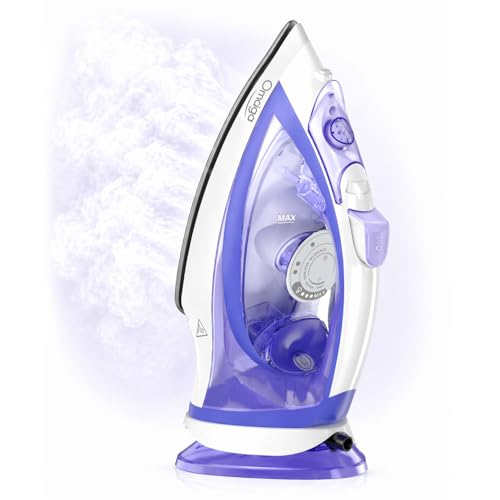
OMAIGA 2-in-1 Cordless and Corded Steam Iron 1550W
About this pick
The OMAIGA solves cordless iron's biggest frustration by not choosing sides. The listing describes a 2-in-1 design that switches between cordless ironing and corded continuous power with a simple twist of the base. In cordless mode you get the freedom of a cable-free press for a time, and when the heat runs low or a pile of laundry grows, you switch to corded and keep going without stopping to reheat.
The listing quotes up to 20 grams per minute of continuous steam and 0.6 grams per press of burst steam from a 1550 watt element. These are modest numbers for a household iron, and they are honest ones. A 380 milliliter water tank, the largest tank stated in this group, reduces the number of refills during family laundry, and the nonstick ceramic soleplate glides across common fabrics. Auto shutoff and self-clean are also listed.
Compared with the Rowenta Freemove at 1600 watts, the OMAIGA is slower to commit but more flexible for long sessions. Compared with the two Panasonic irons, it offers more tank volume and a corded fallback. For a family that irons big batches and wants cordless convenience for quick jobs, the OMAIGA is the most practical option.
Best for: Big laundry loads that need a corded fallback.
Check price on AmazonSpecs
- Power: 1550 watts
- Modes: Cordless or corded with a base twist
- Steam: Up to 20g/min continuous, 0.6g/press burst
- Tank: 380 ml, with a non-stick ceramic soleplate
Pros
- +Switches between cordless and corded
- +380 ml tank cuts refills
- +Up to 20g/min continuous steam
- +Auto shutoff and self-clean listed
Cons
- −Steam output is modest
- −Twisting the base adds a step
- −Less cordless-focused than the Rowenta
How We Evaluated These Cordless Steam Irons
Each pick was assessed across 5 criteria weighted for real-world use.
Heat management
We compared stated heat-up, reheat and run time. The Rowenta Freemove leads on speed with 30 seconds to heat and 10 seconds to reheat, the Panasonic NI-WL700A is the only one to publish steam and dry minutes, and the OMAIGA sidesteps the problem with a corded mode.
Power and steam
We looked at wattage and steam figures. The Rowenta at 1600 watts leads, the OMAIGA at 1550 watts quotes 20g/min of steam, and the Panasonic pair sits at 1500 watts. We noted where steam output was not stated and did not guess.
Movement and handling
We judged soleplate design and the freedom to move. The Panasonic 360 degree double-tipped plates earned credit for natural movement, and the Rowenta earned credit for total freedom without a cord. Awkward shapes and unclear handling lowered scores.
Flexibility for real laundry
We considered how each iron handles a large pile. The OMAIGA's 2-in-1 mode and 380 ml tank make it the most forgiving, and the pure cordless models suit lighter loads. We weighed this against the simplicity of the pure cordless designs.
Listing clarity
Finally, we judged how honestly each listing described limits. The NI-WL700A publishes run times, the OMAIGA publishes steam output, and the NI-QL1100L is lighter on numbers. Clear disclosure earned a higher score than confident but vague claims.
How to Choose the Right Cordless Steam Irons
By Laundry Volume
How much you iron at a time decides how much a cordless design helps.
| Laundry situation | Recommended pick | Why |
|---|---|---|
| A shirt or two a week | Panasonic NI-WL700A Cordless Steam Dry Iron 1500W | Published run times fit short jobs |
| A basket of family laundry | OMAIGA 2-in-1 Cordless and Corded Steam Iron 1550W | Corded mode and 380 ml tank |
| Quick touch-ups before leaving | Rowenta Freemove Cordless Steam Iron 1600W | 30-second heat-up |
| Sleeves and awkward shapes | Panasonic NI-QL1100L Cordless Steam Dry Iron 1500W | 360 degree curved plate |
| Mixed use, some long sessions | OMAIGA 2-in-1 Cordless and Corded Steam Iron 1550W | Switch between modes |
Cordless suits short, frequent sessions better than marathon laundry days. If your routine is a full basket once a week, the OMAIGA corded mode is the safer fit, and if it is two or three shirts spread across the week, any of the three pure cordless irons will feel liberating by comparison with a cable that drags across the board.
By Budget
Tiers rather than numbers.
| Budget tier | Recommended pick | Why |
|---|---|---|
| Entry to mid | OMAIGA 2-in-1 Cordless and Corded Steam Iron 1550W | Hybrid and large tank |
| Mid | Panasonic NI-WL700A Cordless Steam Dry Iron 1500W | Published run times |
| Mid to higher | Rowenta Freemove Cordless Steam Iron 1600W | Fast heat-up and reheat |
| Higher | Panasonic NI-QL1100L Cordless Steam Dry Iron 1500W | Panasonic design in another finish |
Cordless irons cost more than corded ones, so spend on reheat speed.
Pure Cordless vs Hybrid
This is the central tradeoff in the category.
Pure cordless
The Rowenta Freemove and both Panasonic models commit to a cable-free iron. They are lighter on the board and have no switching step, but you must return to the base to reheat. Choose them for short sessions and a tidy ironing routine.
Hybrid cordless and corded
The OMAIGA lets you twist the base to switch to corded continuous power, so a long session never stalls. It trades a little cordless purity for flexibility. Choose it for big loads or if you worry about running out of heat.
Short-session ironers should pick the Rowenta, and basket ironers should pick the OMAIGA.
Speed vs Information
Some listings promise speed and others publish details.
| Preference | Recommended pick | Why |
|---|---|---|
| Fastest to start | Rowenta Freemove Cordless Steam Iron 1600W | 30-second heat-up |
| Fastest to reheat | Rowenta Freemove Cordless Steam Iron 1600W | 10-second reheat |
| Published steam minutes | Panasonic NI-WL700A Cordless Steam Dry Iron 1500W | 1 minute steam, 5 minutes dry |
| Published steam output | OMAIGA 2-in-1 Cordless and Corded Steam Iron 1550W | 20g/min continuous |
| Plate shape for sleeves | Panasonic NI-QL1100L Cordless Steam Dry Iron 1500W | Curved dual-tipped plate |
Information is useful because cordless limits are real. A listing that tells you the Panasonic NI-WL700A gives one minute of steam, or that the OMAIGA tops out near 20g/min, lets you set expectations before the iron arrives, which is better than discovering the limit halfway through a shirt.
For Sleeves and Detail Work Specifically
Cordless irons shine on shapes that tangle a cord.
Look for
A double-tipped plate that leads in either direction, a body that is comfortable to turn, and a quick reheat so you can return to the base without losing flow. Avoid very heavy irons for sleeve work, because holding them in the air tires the wrist.
In this comparison
The Panasonic NI-WL700A and NI-QL1100L both use the 360 degree Freestyle plate meant for movement in any direction. The Rowenta Freemove adds the fastest reheat, so it works well when you press many small pieces in a row.
Press sleeves first while the iron is hottest.
When to Spend More
Extra cost should buy less waiting.
| Spend more if | Save if |
|---|---|
| You press many pieces and want the Rowenta Freemove reheat | You iron a few pieces and the OMAIGA is enough |
| You want published run times from the Panasonic NI-WL700A | You are happy to learn run time by feel |
| You want a corded fallback and a large tank like the OMAIGA | You never iron more than a few items |
| You prefer the Panasonic NI-QL1100L finish | Color does not matter and the NI-WL700A is cheaper |
A faster reheat saves more time than any other feature. Spend extra on the Rowenta Freemove if you return to the base many times per session, and save with the Panasonic NI-WL700A or the OMAIGA if your sessions are short or you can switch to corded power when heat runs low.
Frequently Asked Questions
How long does a cordless iron stay hot?
It depends on the model and on whether you use steam. The Panasonic NI-WL700A lists one minute of steam ironing or five minutes of dry ironing per heat cycle. Steam drains heat faster than dry pressing. You then return the iron to its base to reheat, which takes 10 seconds on the Rowenta Freemove.
Is a cordless iron as powerful as a corded one?
Not for long sessions. Cordless irons rely on stored heat, so they suit short jobs and sleeves better than a whole basket. The wattage figures are similar, with the Rowenta at 1600 watts and the Panasonic pair at 1500, but the iron cannot sustain heat without returning to its base. The OMAIGA solves this with a corded mode.
Which cordless iron heats fastest?
The Rowenta Freemove lists a 30 second heat-up and a 10 second reheat, which is the fastest in this guide. The Panasonic NI-WL700A takes just under two minutes to reach high temperature. Fast heat-up matters more on a cordless iron because you reheat repeatedly.
Why are there only four picks?
Only four products in the research set were truly cordless. Other irons advertised a retractable cord, which is a different feature and does not give the same freedom. We kept the guide honest rather than padding it with corded irons.
Can I use distilled water in a cordless iron?
It depends on the maker. Some irons are designed for tap water, some allow distilled water and some recommend a mix for very hard water. Check the manual for your model. Empty the tank after each use to reduce mineral buildup.
Does a cordless iron need a special base?
Yes. The base charges the iron and holds it upright, so you cannot use the iron without it. Place the base on a stable, heat-safe surface and keep the contact points clean. If the base is lost or damaged, the iron cannot be used as designed.
How should I plan an ironing session with a cordless iron?
Start with the items that need the most heat, such as cotton shirts and linen, while the soleplate is at its hottest, then move to delicate pieces as the temperature drops. Use steam in short bursts, because the Panasonic NI-WL700A listing shows a single minute of steam per heat cycle against five minutes of dry pressing. Return the iron to its base whenever the Rowenta Freemove indicator light blinks, and keep a hanger nearby so pressed garments do not crease again while you reheat.
Is the OMAIGA really cordless?
Yes, in cordless mode it works from stored heat like the others, and the listing says you can twist the base to switch to corded continuous power. That makes it a hybrid. If you want a pure cordless design with a quick reheat, the Rowenta Freemove is the better match.
Bottom Line
best overall: Rowenta Freemove Cordless Steam Iron 1600W - best overall pick in this roundup.
See the full rankings above for all picks with pros, cons, and best-for summaries.
Browse on Amazon
All Prime-eligible options with current pricing.
Shop on Amazon →