Best Coffee Makers for Offices
We segmented four current office coffee makers by daily cup volume instead of ranking them on one list, and calculated real per-employee monthly cost.



At a Glance
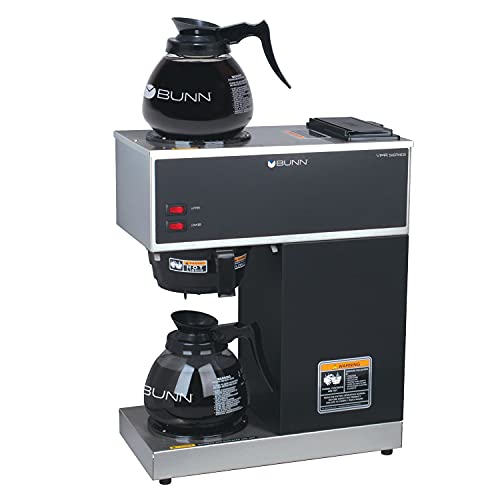
BUNN VPR-2GD 12-Cup Pourover Commercial Coffee Brewer with Two Decanters
↓ See why we picked itHamilton Beach 2-Way Brewer Coffee Maker, Single-Serve and 12-Cup Pot
↓ See why we picked itMost office coffee roundups hand you a single ranked list of drip brewers, pod machines, and commercial units as if a 4-person startup and a 60-person floor need the same equipment. They rarely mention how long a line forms at 9am, who has to refill and clean the machine, or what a coffee habit actually costs per employee each month.
We researched four current models that represent genuinely different office scales, from a single pod machine for a small team to a commercial pourover brewer built for high-volume breakrooms, and evaluated each on peak-demand handling, cleaning labor, monthly cost per employee, and the power or counter setup it actually needs.
6 Criteria to Look For Before Buying a Coffee Makers for Office
Key buying criteria so you get the right fit the first time.
Daily cup volume and peak-15-minute demand
Count roughly how many cups your office drinks in a full day, then estimate how many of those happen in the same 15-minute morning window. A machine that comfortably handles 20 cups spread across 8 hours can still create a real line if 10 of those cups land between 8:50 and 9:05am. Getting this wrong is one of the more common reasons a office coffee makers purchase disappoints once it actually arrives, since daily cup volume and peak-15-minute demand affects real day-to-day use in a way marketing photos and bullet points don't always make obvious. Before buying, check the specific listing's stated details on daily cup volume and peak-15-minute demand rather than assuming every office coffee makers in this comparison handles it the same way, since this is exactly the kind of detail that varies more than buyers expect within the same price range.
Queue time at peak demand
A single 10-cup pot brewing in 3 to 8 minutes can serve roughly one person a minute once it is hot, so a team of 15 hitting the machine at once means a genuine wait. Dual-decanter or multi-unit setups exist specifically to cut this queue, not just to hold more coffee. This is the kind of detail that looks minor in a spec list but shapes how satisfied you actually are with a office coffee makers weeks after buying, since queue time at peak demand plays out differently in daily use than it does on paper. Read the product listing and recent reviews specifically for mentions of queue time at peak demand, since this detail is often understated in the bullet points but shows up clearly once real buyers have used the office coffee makers for a while.
Refill and cleaning labor
Carafe-based brewers need someone to add grounds, add water, and rinse the basket several times a day, while pod machines only need occasional reservoir refills and periodic descaling. Assign this responsibility explicitly rather than assuming it happens on its own. Buyers who skip past refill and cleaning labor tend to be the ones leaving disappointed reviews later, not because the office coffee makers was defective, but because this specific detail didn't match what they actually needed. Compare how each office coffee makers in this roundup actually handles refill and cleaning labor rather than assuming they're interchangeable on this point, since the listings here differ on it more than the headline specs suggest.
Monthly cost per employee
Pod coffee typically runs 40 to 75 cents per cup versus roughly 15 to 25 cents per cup for bulk ground coffee and filters. For a 20-person office averaging one cup a day each, that is a difference of roughly $120 to $300 per month between a pod-based and a ground-coffee setup. Monthly cost per employee is easy to overlook next to flashier specs, but it's frequently the difference between a office coffee makers that fits your routine and one that quietly becomes a hassle. Confirm the exact detail on monthly cost per employee directly from the current listing before ordering, since this is one of the more common places where two similarly priced office coffee makers options genuinely diverge.
Power, plumbing, and counter needs
Commercial dual-decanter units and always-hot tank brewers can draw enough current that they need a dedicated outlet rather than sharing a circuit with a microwave and fridge. Confirm outlet availability and counter depth before ordering a commercial-style unit. Getting this wrong is one of the more common reasons a office coffee makers purchase disappoints once it actually arrives, since power, plumbing, and counter needs affects real day-to-day use in a way marketing photos and bullet points don't always make obvious. Before buying, check the specific listing's stated details on power, plumbing, and counter needs rather than assuming every office coffee makers in this comparison handles it the same way, since this is exactly the kind of detail that varies more than buyers expect within the same price range.
Downtime risk and service availability
A single machine serving an entire office has no backup if it breaks, so consider whether a replacement part or loaner is realistically available locally, or whether a second smaller unit as backup is worth the extra cost. This is the kind of detail that looks minor in a spec list but shapes how satisfied you actually are with a office coffee makers weeks after buying, since downtime risk and service availability plays out differently in daily use than it does on paper. Read the product listing and recent reviews specifically for mentions of downtime risk and service availability, since this detail is often understated in the bullet points but shows up clearly once real buyers have used the office coffee makers for a while.
Best Coffee Makers for Offices
BUNN VPR-2GD 12-Cup Pourover Commercial Coffee Brewer with Two Decanters
About this pick
The VPR-2GD is built for offices where a single 12-cup pot cannot keep up, since it brews into two separate decanters that sit on independently switched warmers. That lets one decanter refill while the other is actively being poured, which matters during a real 9am rush when a dozen people want coffee inside 15 minutes.
This is a genuine commercial appliance rather than a home brewer pressed into office duty, so it needs a dedicated 120V outlet and enough counter depth for two warming plates side by side. It costs several times more than a home-style pod or drip machine, and that premium only pays off once daily cup volume is high enough to justify it.
Best for: Offices of roughly 20 or more daily coffee drinkers with a real morning rush and a dedicated breakroom outlet.
Check price on AmazonSpecs
- Feature 1: Dual 12-cup decanters
- Feature 2: Upper and lower warmers
- Design: Commercial pourover design
- Feature 4: Continuous brew capable
Pros
- +Two decanters keep pace with peak-demand queues far better than one pot
- +Commercial-grade components built for all-day daily use, not occasional home brewing
- +Upper and lower warmers keep both decanters at serving temperature
Cons
- −Highest upfront cost of any option in this comparison by a wide margin
- −Needs more counter space and a dedicated outlet than a typical home brewer
BUNN GRB Velocity Brew 10-Cup Home Coffee Brewer
About this pick
The GRB keeps an internal tank hot at all times, so a full pot brews in about 3 minutes instead of the 8 to 10 minutes a standard drip machine needs to heat water from cold. For a team of 8 to 20 people cycling through two or three pots a day, that turnaround keeps a queue from forming at the machine the way a slower brewer would.
A single unit like this still means one person is refilling grounds and water and rinsing the carafe throughout the day, so factor in a few minutes of staff time per pot. It draws standby power continuously to keep the tank hot, which is a real but modest addition to the office electricity bill compared to a pod machine that only powers on when brewing.
Best for: A shared breakroom for roughly 8 to 20 people that goes through multiple pots on a typical workday.
Check price on AmazonSpecs
- Feature 1: Internal always-hot tank
- Size: Full pot in about 3 minutes
- Capacity: Drip-free carafe
- Warranty: 3-year warranty
Pros
- +Fast pot-to-pot brewing keeps up with a steady mid-morning cadence
- +Lower upfront cost than a commercial dual-decanter unit
- +3-year warranty covers typical office duty cycles
Cons
- −Only one pot at a time, so it can still queue during a sharp morning spike
- −Standby power draw runs continuously, unlike an on-demand pod machine
Hamilton Beach 2-Way Brewer Coffee Maker, Single-Serve and 12-Cup Pot
About this pick
This model solves a common small-office problem: some employees want a single cup right now and others want to start a shared pot for the team. It runs both brewing paths off two separate reservoirs, so someone brewing a single cup does not interrupt a carafe already in progress on the other side.
Because it uses scooped ground coffee rather than pods on both sides, there is no per-cup pod cost to track, only bulk coffee and filters, which is meaningfully cheaper per cup at office volume. The tradeoff is more manual cleaning than a pod machine, since both the single-serve basket and the 12-cup basket need regular grounds disposal and rinsing.
Best for: A small office of roughly 4 to 10 people with a mix of single-cup and full-pot preferences.
Check price on AmazonSpecs
- Capacity: Single-serve and 12-cup carafe modes
- Feature 2: 2 separate reservoirs
- Feature 3: AutoPause & Pour
- Feature 4: Ground coffee only, no pods
Pros
- +Covers single cups and a full pot without buying two machines
- +Ground coffee only, so cost per cup is lower than pod-based brewing at volume
- +AutoPause & Pour lets someone grab a cup mid-brew without a mess
Cons
- −More basket cleaning than a pod-based machine
- −Two reservoirs to refill and monitor instead of one
Keurig K-Mini Single Serve K-Cup Pod Coffee Maker
About this pick
For a small office of two to six people, a pod machine like the K-Mini avoids the cleaning and staffing questions that come with any carafe-based brewer entirely. There is no shared grounds basket to empty and no pot sitting on a warming plate going stale between cups.
The real cost of this convenience is per-pod pricing, which typically runs 40 to 75 cents a cup and adds up faster than bulk ground coffee once more than a handful of people are drinking daily. It also only brews one cup at a time with no queue-easing second unit, so it starts to bottleneck once a team grows past roughly six regular coffee drinkers.
Best for: A very small office or shared desk area where two to six people want individual cups with zero shared cleaning.
Check price on AmazonSpecs
- Feature 1: Under 5in wide
- Capacity: One-cup reservoir
- Feature 3: 6 to 12oz brew sizes
- Feature 4: 90-second auto-off
Pros
- +No shared carafe or basket to clean between users
- +Smallest footprint of any option here, fits on a shared desk or small counter
- +Standard 120V plug, no special electrical needs
Cons
- −Per-pod cost is the highest per-cup price in this comparison at real volume
- −One cup at a time creates a real queue once a team grows past a handful of daily drinkers
How We Evaluated These Coffee Makers for Offices
Each pick was assessed across 5 criteria weighted for real-world use.
Peak-demand queue handling
We assessed how each model performs when several employees want coffee within the same short morning window, not just its rated brew time under ideal, spaced-out conditions.
Cleaning and refill labor
We compared how much hands-on maintenance, grounds disposal, and reservoir refilling each model realistically requires across a workday, since this labor is often invisible until someone has to do it daily.
Real monthly cost per employee
We estimated per-cup cost across pods versus bulk grounds and filters, then scaled that to typical office headcounts to show the actual monthly spend, not just the machine's sticker price.
Power and counter footprint
We noted electrical and space requirements for each model, since commercial-style units can need a dedicated outlet that a standard home brewer does not.
Downtime and service risk
We considered what happens to the office if the sole coffee machine fails, and how straightforward sourcing a replacement or backup realistically is for each category.
How to Choose the Right Coffee Makers for Offices
By Office Size
Segment your pick by rough headcount and daily coffee drinkers rather than by brand reputation alone.
| Office Size | Recommended Pick |
|---|---|
| 2 to 6 people, individual cups | Keurig K-Mini |
| 4 to 10 people, mixed single-cup and full-pot needs | Hamilton Beach 2-Way Brewer |
| 8 to 20 people, steady pot-to-pot demand | BUNN GRB Velocity Brew |
| 20+ people with a real morning rush | BUNN VPR-2GD Commercial Brewer |
By Morning Queue Risk
If more than a handful of employees arrive within the same 15-minute window, a single pot or single pod machine will create a visible line.
Low queue risk
Staggered arrival times or a small team. The K-Mini or Hamilton Beach 2-Way keep up fine.
High queue risk
A shared start time or shift change bringing many people to the breakroom at once. The dual-decanter BUNN VPR-2GD is built specifically for this.
Estimated Monthly Cost Per Employee
Assuming one coffee per workday per employee, roughly 21 workdays a month.
| Brewing Method | Approx. Monthly Cost per Employee | Notes |
|---|---|---|
| Pod-based (Keurig K-Mini) | $8 to $16 | Based on 40 to 75 cent pods, highest per-cup cost |
| Ground coffee, shared brewer | $3 to $5 | BUNN GRB or Hamilton Beach 2-Way, bulk coffee and filters |
| Commercial pourover | $3 to $5 plus service costs | BUNN VPR-2GD, similar per-cup cost to ground coffee at scale |
Pod machines cost less upfront but more per cup over time, which flips the value equation once headcount grows past a small team.
Power and Space Checklist
Small pod or 2-way machines
Standard 120V outlet, no special wiring, fits on a normal counter or desk.
Commercial dual-decanter units
Confirm a dedicated outlet is available and measure counter depth for two side-by-side warmers before ordering.
Skipping this check is the most common reason a commercial-style brewer does not fit where an office planned to put it.
Who Handles Refills and Cleaning
Carafe-based brewers need daily hands-on maintenance that pod machines mostly avoid.
Assign this responsibility to a specific person or rotation before installing a shared carafe brewer. An unassigned machine is the most common source of office coffee complaints, not the equipment itself.
Frequently Asked Questions
How many cups per day can a single 10 or 12-cup office brewer realistically handle?
A machine like the BUNN GRB brewing a fresh pot every few minutes can support roughly 20 to 30 cups across a full workday if demand is spread out. The real constraint is peak demand, since a morning rush concentrated into 15 minutes will queue people even on a fast brewer.
Is a pod machine or a ground-coffee brewer cheaper for an office?
Pod machines have a lower upfront price but cost roughly 40 to 75 cents per cup in pods, while ground coffee and filters typically run 15 to 25 cents per cup. For more than a handful of daily drinkers, ground coffee brewers become cheaper within the first few months.
Do commercial coffee brewers need special electrical work?
Some do. A dual-decanter unit like the BUNN VPR-2GD can draw enough current that it needs its own dedicated outlet rather than sharing a circuit with other breakroom appliances. Confirm this with facilities before ordering a commercial-style unit.
Who should be responsible for cleaning a shared office coffee maker?
Assign this explicitly rather than assuming it happens informally. Carafe and basket-based brewers need grounds emptied and baskets rinsed multiple times a day, and an unassigned machine is one of the most common sources of office coffee complaints.
What happens if the office's only coffee machine breaks down?
For a single-machine office, consider keeping a small backup unit like a pod machine on hand, or confirm how quickly a replacement part or loaner is available locally before relying on one machine for the whole team.
Bottom Line
best overall: BUNN VPR-2GD 12-Cup Pourover Commercial Coffee Brewer with Two Decanters - best for high-volume offices pick in this roundup.
See the full rankings above for all picks with pros, cons, and best-for summaries.
Browse on Amazon
All Prime-eligible options with current pricing.
Shop on Amazon →