6 Best Chair Standing Aids in 2026
Six chair standing aids compared, from freestanding frames to a self-powered lift cushion, with stated weight limits, height ranges and fit notes.


At a Glance
A chair standing aid covers a wide range of products, and that is the first thing worth understanding. Some are handle frames that give you a place to push from, some tuck under the furniture, and one pick here is a portable cushion that raises the seat itself. They solve the same everyday problem of getting up from a chair, but they work in different ways and suit different homes.
This lineup covers six picks: Vive, Support Way, Baithem, AERRTIS, Stander and the Carex Upeasy Seat Assist. The frames list stated limits of 250 lb to 300 lb where a figure is given, and handle heights run from 29 inches up to 40.5 inches. The Carex is rated for users from 95 lb to 220 lb and states up to 70 percent lift support. We evaluated each one from its product page, noting stability features, adjustment range and what the maker says the product is not for.
Before choosing, decide whether you need a handle to push from or a seat that rises, and measure the chair or sofa. Always check the stated weight limit against the user and set the handle so the elbow stays slightly bent. A clinician or occupational therapist can confirm which style suits a person's strength, balance and transfers. Nothing here is medical advice or a claim of medical benefit.
6 Criteria to Look For Before Buying a Chair Standing Aid
Key buying criteria so you get the right fit the first time.
Handle frame or lifting cushion
Chair standing aids split into two camps with different jobs. A frame such as the Vive or Stander gives you a firm handhold, while a cushion such as the Carex raises the seat as you rise. If the trouble is pushing up from a deep sofa, a handle helps most. If the seat height is the problem, a cushion may suit better. Many people end up needing both, and a clinician can advise which.
Stated weight limit
Weight limits are manufacturer figures, and they differ by product type. The Vive and Baithem state 300 lb, the Stander states 250 lb, and the Carex is rated for users from 95 lb to 220 lb. The Support Way and AERRTIS text we reviewed does not give a figure, so check the page. Choose a limit comfortably above the user's weight, and for a cushion make sure the user falls inside the stated band.
Handle height range
A handle at the wrong height makes you stoop or reach. The Baithem spans 29 to 36 inches, the Support Way 29.5 to 38.7, the Stander 31 to 40.5 and the AERRTIS 34.5 to 40.5. A good setting leaves your elbow slightly bent when you press. Taller users should shop the top of these ranges, while shorter users should avoid the AERRTIS since its lowest setting is 34.5 inches.
Anchored or freestanding
An anchored frame stays put because the furniture holds it, while a freestanding frame stays put because of its base and your placement. The Stander and Vive are anchored by the chair or cushion. The Support Way, Baithem and AERRTIS stand alone and can move between rooms. Anchored suits one main seat, and freestanding suits several spots, but check that nothing slides on a smooth floor.
Furniture compatibility
The wrong frame simply will not fit some chairs. The Stander needs four open legs with feet 17 to 33 inches deep, the Vive needs a seat that holds a cushion, and the Carex excludes wheelchairs, cars, recliners and chairs with wheels. Check the sofa underside and the chair type before buying. Measure the chair and compare it to the listed fit notes.
Weight and portability
How easily the aid moves affects how often it gets used in different rooms. The Baithem is just 7 lb, the Carex is 9 lb with carry handles, and the aluminum AERRTIS is described as lightweight. A lighter frame has less mass of its own, so floor surface matters more. Pick the lightest option only if the user will actually carry it.
6 Best Chair Standing Aids in 2026
Vive Stand Assist Rail for Couch and Chair
About this pick
The Vive is the most adaptable frame in this group for ordinary household seating. It fits around the base of secure cushions or beneath loose cushions, so plush sofas, recliners and upholstered chairs are all listed as suitable. The aluminum frame states a 300 lb limit, and the soft foam grip covers keep the hold comfortable. Two handles let you push up straight ahead instead of leaning toward one armrest. Because the frame is held by the seat cushion, it works best where the cushion is firm and stays put, and it is a weaker match for a thin, sagging seat. It is also a fixed installation rather than something to move around the house. Ownership is simple. You assemble it, adjust it once and check now and then that it has not drifted. Compared with the Stander at 250 lb it states a higher limit, and compared with the Baithem at 7 lb it is a more permanent fixture. For a household with one main sofa and cushions that stay in place, it covers the most situations.
Best for: A main sofa or armchair with firm cushions that stay in place.
Check price on AmazonSpecs
- Stated limit: 300 lb
- Frame: Aluminum, black finish
- Handles: Dual, soft foam covers
Pros
- +Works with sofas, recliners and upholstered chairs
- +Stated 300 lb limit on an aluminum frame
- +Lifetime guarantee stated by the maker
Cons
- −Needs firm cushions to stay put
- −Fixed install, not a movable aid
- −Less secure on thin or sagging seats
Support Way Couch Stand Assist with Dual-Tube Frame
About this pick
The Support Way is a freestanding frame with a reinforced double-tube build and a wide four-legged stance. It adjusts across six pin positions from 29.5 to 38.7 inches and has two cushioned handles. The listing says it can be used by the couch, a toilet or a shower with no installation, which makes it more of a house-wide support than a furniture attachment. Because nothing pins it to the furniture, a firm floor and careful placement matter. The page says it fits low sofas, dining chairs and bedsides, and the pin system is straightforward to change. The listing text we reviewed does not state a weight limit, so check the current product page before relying on it for a heavier user. In use, the benefit is flexibility, since one frame can serve several spots. Compared with the Vive's fixed cushion tuck, it moves easily, and compared with the AERRTIS at 34.5 to 40.5 inches it tops out lower. If you want one movable support for a couch, a bedside and a bathroom entrance, this is the sensible pick.
Best for: Homes that want one movable frame for a couch, bedside and other spots.
Check price on AmazonSpecs
- Height range: 29.5 to 38.7 in
- Positions: Six quick-adjust pins
- Frame: Reinforced dual-tube, four legs
- Install: None, moves room to room
Pros
- +No installation needed and easy to relocate
- +Reinforced dual-tube frame with a wide stance
- +Fits low sofas and dining chairs
Cons
- −Weight limit not stated in the text reviewed
- −Freestanding, so placement is on the user
- −Top height lower than the AERRTIS
Baithem Movable Standing Aid Rail
About this pick
The Baithem is the lightest frame here, at just 7 lb in carbon steel, with a stated 300 lb capacity. The grip adjusts from 29 to 36 inches, and the base has Y-shaped stabilizer legs wrapped in thickened rubber to resist slipping and to protect floors. The listing describes it as tool-free and easy to take apart. The low weight is a real advantage for anyone who wants to carry it from the lounge to the bedside. The trade-off is that a lighter frame has less mass of its own to resist movement, so floor surface and placement matter. Its 36 inch top height is also lower than the Stander at 40.5 inches, so taller users may find it short. Ownership is easy because you can lift it without strain. Compared with the Stander, which has to be set under furniture legs, it is much easier to carry, and compared with the Vive's fixed cushion tuck it moves freely. If the person using it wants a light, repositionable support for several rooms, this is the easiest to handle.
Best for: Anyone who wants a light frame to carry between a couch, bed and bathroom.
Check price on AmazonSpecs
- Stated limit: 300 lb
- Weight: 7 lb, carbon steel
- Grip height: 29 to 36 in
Pros
- +Only 7 lb and easy to relocate
- +Stated 300 lb limit on carbon steel
- +Rubber-wrapped Y legs help resist slipping
- +Tool-free assembly and disassembly
Cons
- −Top height of 36 in is short for tall users
- −Light frame has less mass to resist movement
- −Freestanding, so it needs careful placement
AERRTIS Portable Stand Assist Aid
About this pick
The AERRTIS offers eight height settings from 34.5 to 40.5 inches, which puts its whole range at the high end of this lineup. It has three foam-wrapped handle positions, so you can choose the grip that feels best. The aluminum frame is described as lightweight, and a U-shaped wide base pairs with a Y-shaped support leg to spread weight. The listing says it can help with rising from sofas, getting up from a sleeping position, picking items up from the floor or walking with added stability. Some of those uses ask a lot of a handle frame, so treat the walking and floor-pickup claims cautiously and check with a clinician. The text we reviewed does not give a weight limit, so confirm it on the product page. The high range is the reason to pick it. Compared with the Baithem at 29 to 36 inches and the Support Way at 29.5 to 38.7 inches, it is clearly aimed at taller users. If the handle on other frames never reaches high enough, this is the one to look at.
Best for: Taller users who need a handle that starts at 34.5 in and reaches 40.5 in.
Check price on AmazonSpecs
- Height range: 34.5 to 40.5 in, eight settings
- Handles: Three foam-wrapped positions
- Frame: Lightweight aluminum
- Base: U-shaped with Y-shaped support leg
Pros
- +Three handle positions to pick a grip
- +Foam handles with an anti-slip base
- +Lightweight aluminum frame moves easily
Cons
- −Weight limit not stated in the text reviewed
- −Lowest setting of 34.5 in is too high for some
- −Walking and floor-pickup claims need caution
Stander CouchCane Standing Aid
About this pick
The CouchCane uses a base that sits beneath the feet of a four-legged chair or couch, so the furniture itself holds the frame down. The handle adjusts from 31 to 40.5 inches and the base from 17 to 33 inches apart. The page states a 250 lb limit and is explicit that it is not intended for freestanding use. That design gives it a more planted feel than the movable frames, because the weight of the chair keeps it in place. The cost is compatibility. It needs furniture with open legs and feet in the stated depth range, which rules out sofas with solid bases. Its 250 lb limit is also the lowest figure in the group. Ownership means checking that the pads are still properly under the feet. Compared with the Vive at 300 lb it lists less capacity, but it holds more firmly than the freestanding Baithem or Support Way. If you have a four-legged armchair or sofa and want a steady, anchored handle, this is the strongest fit.
Best for: Four-legged chairs and sofas where an anchored handle beats a movable one.
Check price on AmazonSpecs
- Stated limit: 250 lb
- Handle height: 31 to 40.5 in
- Base length: 17 to 33 in apart
Pros
- +Furniture feet pin the base so it stays planted
- +Handle reaches 40.5 in for taller users
- +Clear guidance on compatible furniture
Cons
- −Stated 250 lb is the lowest limit in the group
- −Needs furniture with accessible legs
- −Not intended for freestanding use
Carex Upeasy Seat Assist Lifting Cushion
About this pick
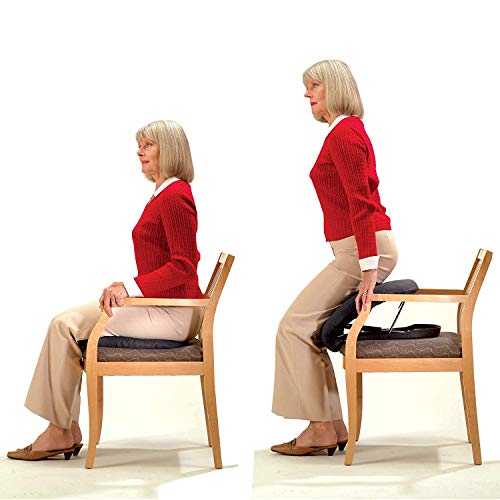
The Carex is a different kind of standing aid, a portable cushion that raises the seat as you stand rather than a handle to push from. It uses a hydro-pneumatic mechanism with no cords or batteries and states up to 70 percent lift support for users between 95 lb and 220 lb. It weighs 9 lb, has built-in carry handles and a polyurethane foam cushion with a polyester cover that wipes clean with a damp, soapy cloth. The page says it fits most armchairs and is not recommended for wheelchairs, automobiles, reclining chairs or chairs with wheels. That exclusion list is important, as is the stated user weight range, since the mechanism is matched to a weight band. It assists the rise but does not replace leg strength or a handhold. Ownership is easy, because it carries like a small bag and needs no outlet. Compared with the Vive at 300 lb it covers a lower weight range, and compared with the frames it does something different by raising the seat. If the problem is the height of the seat rather than the lack of a handhold, this is the pick to consider.
Best for: Armchairs where raising the seat helps more than adding a handle.
Check price on AmazonSpecs
- Lift support: Up to 70%
- User weight: 95 to 220 lb
- Weight: 9 lb with carry handles
- Power: Hydro-pneumatic, no batteries
Pros
- +Self-powered with no cords or batteries
- +States up to 70% lift support
- +Only 9 lb with built-in carry handles
- +Washable surface wipes clean easily
Cons
- −Stated range tops out at 220 lb
- −Not for recliners, wheelchairs or cars
- −Works on chairs, not as a standalone handle
How We Evaluated These Chair Standing Aids
Each pick was assessed across 5 criteria weighted for real-world use.
Aid type and how it works
We separated handle frames from the lifting cushion and noted how each attaches, anchors or stands alone. The Vive and Stander are held by the furniture, the Support Way, Baithem and AERRTIS stand alone, and the Carex raises the seat. This was the first filter before any comparison.
Stated limits and ranges
We recorded each stated limit and user weight range from the page, from the Stander's 250 lb to the Carex's 95 to 220 lb band. Where a page did not state a limit, we said so. All figures were treated as manufacturer claims.
Height adjustment
We compared handle height ranges, from the Baithem's 29 to 36 inches to the AERRTIS at 34.5 to 40.5 inches. We looked at whether the steps suited shorter or taller users. The Stander and AERRTIS lead on reach.
Stability design
We looked at base shapes and anti-slip features, including the Baithem's Y legs, the AERRTIS U-shaped base and the Support Way's four-legged stance. We also noted that anchored frames rely on the furniture. These details came from the page text only.
Portability and ownership
We weighed carry weight, assembly and cleaning, such as the Baithem at 7 lb and the Carex at 9 lb with a wipe-clean cover. We considered how often each pick would realistically be moved. The Vive and Stander were treated as fixed installs.
How to Choose the Right Chair Standing Aids
By Aid Type
Decide whether the problem is a missing handhold or a low seat.
| Situation | Pick | Why |
|---|---|---|
| Needs a firm handhold on a cushioned sofa | Vive Stand Assist Rail for Couch and Chair | Fits around or under cushions at a stated 300 lb. |
| Needs a handle on a four-legged chair | Stander CouchCane Standing Aid | Base pads sit under the feet with a 31 to 40.5 in handle. |
| Needs one frame for several rooms | Support Way Couch Stand Assist with Dual-Tube Frame | Freestanding with six positions from 29.5 to 38.7 in. |
| Needs the lightest carry-around frame | Baithem Movable Standing Aid Rail | Weighs 7 lb with a stated 300 lb limit. |
| Seat height is the main issue on an armchair | Carex Upeasy Seat Assist Lifting Cushion | Raises the seat with up to 70% lift support. |
A clinician or occupational therapist can confirm whether a handle or a cushion is the better fit.
By Budget
Relative tiers show what each level of spending tends to buy.
| Tier | Pick | What you get |
|---|---|---|
| Entry | Baithem Movable Standing Aid Rail | A 7 lb frame with a stated 300 lb limit. |
| Entry to mid | Support Way Couch Stand Assist with Dual-Tube Frame | A freestanding dual-tube frame with six positions. |
| Mid | Vive Stand Assist Rail for Couch and Chair | A cushion-tuck 300 lb frame with a lifetime guarantee. |
| Mid to premium | AERRTIS Portable Stand Assist Aid | Eight heights and three handle positions. |
| Premium | Carex Upeasy Seat Assist Lifting Cushion | A self-powered lift of up to 70% for 95 to 220 lb users. |
Tier placement reflects relative listing positioning and may shift, so check the current product page.
Anchored vs Freestanding
How the frame stays in place changes where you can use it.
Anchored
An anchored frame is held by the chair or cushion, so it feels planted but works on only one seat. The Vive and the Stander fall here, at 300 lb and 250 lb. Choose this side if one main sofa is the target and you want a steady handle. Skip it if the furniture has no open legs and thin cushions.
Freestanding
A freestanding frame relies on its own base and your placement, so it can serve a couch, a bedside and more. The Support Way, Baithem and AERRTIS belong here, and the Baithem weighs just 7 lb. Choose this side if you want one aid for several spots. Skip it on slippery floors without testing.
Whichever style you choose, check for movement before putting weight on the handle.
By User Height
Handle height should keep the elbow slightly bent.
| User | Pick | Why |
|---|---|---|
| Shorter user | Baithem Movable Standing Aid Rail | Starts at 29 in and tops out at 36 in. |
| Average height | Support Way Couch Stand Assist with Dual-Tube Frame | Covers 29.5 to 38.7 in. |
| Tall user | Stander CouchCane Standing Aid | Handle adjusts from 31 to 40.5 in. |
| Very tall user | AERRTIS Portable Stand Assist Aid | Starts at 34.5 in and reaches 40.5 in. |
Set the handle so your elbow is slightly bent when you press down.
For Armchairs Specifically
Armchairs often pair a firm seat with a fixed height, which changes the options.
Look for
Look for an aid that works with the chair's legs or cushion and does not need a wide sofa. A firm seat suits a lifting cushion, and open legs suit an under-leg base. The seat must not be on wheels and should not be a recliner for the cushion.
In this comparison
The Carex is designed for most armchairs and firm sofas and states up to 70% lift support. The Stander suits four-legged armchairs, and the Vive covers upholstered chairs. The Baithem is the easiest to carry if the chair changes rooms.
Confirm the setup with a clinician or occupational therapist.
When to Spend More
A higher-tier pick is worth it in some cases and wasteful in others.
| Spend more if | Save if |
|---|---|
| The seat height itself is the problem, so the Carex cushion helps | A handhold alone solves the problem, so a frame is enough |
| The user is tall and needs the Stander or AERRTIS reach to 40.5 in | Average height reaches comfortably on the Baithem or Support Way |
| You want the Vive's cushion-tuck fit and lifetime guarantee | You only need a temporary frame for short-term recovery |
| You need a stated 300 lb limit such as the Baithem or Vive | The user is well within lower limits and is lightly built |
Fit matters more than price, so measure before ordering.
Frequently Asked Questions
What is the difference between a standing aid and a lift cushion?
A standing aid frame such as the Vive or Stander gives you a handle to push from. A lift cushion such as the Carex raises the seat as you stand. Handles help when you need leverage, and cushions help when the seat is too low. Some people use both.
Do these aids work with recliners?
It depends on the model. The Vive lists recliners among suitable seats, while the Carex says it is not recommended for reclining chairs. Always read the compatibility notes for your exact chair. Motion mechanisms and sliding legs can defeat some styles.
How do I pick the right height?
Set the handle so your elbow stays slightly bent when you press down from a seated position. The picks here range from 29 inches on the Baithem to 40.5 inches on the Stander and AERRTIS. Taller users should look at the top of those ranges. Test it before leaning on it.
Can a freestanding frame slide on the floor?
Yes, it can, especially on smooth floors or loose rugs. The Baithem, Support Way and AERRTIS use rubber bases and wide stances to resist slipping, but nothing pins them in place. Check the placement every use. If it moves, reposition it or choose an anchored frame.
How do I check the weight limit?
Compare the stated limit to the user's weight and leave some margin. The Vive and Baithem state 300 lb, the Stander 250 lb, and the Carex 95 to 220 lb. The Support Way and AERRTIS text we reviewed did not give a limit. Treat these as manufacturer claims.
Is a lifting cushion a replacement for a lift chair?
No. A cushion like the Carex gives up to 70% lift support for a limited user weight range, while a lift chair is a different product. The cushion is meant for people who can already bear weight on their legs. A clinician can advise whether a different device is needed.
Bottom Line
best overall: Vive Stand Assist Rail for Couch and Chair - best overall pick in this roundup.
See the full rankings above for all picks with pros, cons, and best-for summaries.
Browse on Amazon
All Prime-eligible options with current pricing.
Shop on Amazon →