5 Best Cell Phone Signal Boosters Under $500 (2026)
Five cell phone signal boosters compared on gain, coverage claims, band lists and install effort, from a 72dB unit to a dual port kit for tricky homes.


At a Glance
A generous budget cap does not guarantee that a booster is a bigger hammer, and the five kits here show why. The ZORIDA lists the highest gain at 72dB but only 2,000 square feet, the Hiboost lists 4,000 square feet for homes, offices and metal buildings, the BrstsWhel claims 7,000 square feet, the BoostHome headlines 8,000 square feet but describes one to two rooms, and the ESBANY adds dual output ports.
We evaluated five picks based on product specs and buyer feedback, weighting gain, coverage honesty, band lists and install difficulty. The Hiboost and ZORIDA support all U.S. carriers, the BrstsWhel names Band 5, 12, 13 and 17, and the ESBANY names Band 12, 17, 4 and 66. A booster only amplifies an existing outdoor signal, so each of these depends on checking your signal first.
More budget buys you clearer specs and a wider range of use cases than the lowest cost kits, though it does not buy certainty about square footage. The sections below show which kit fits a small apartment, a metal shop, a larger home or an awkward layout.
6 Criteria to Look For Before Buying a Cell Phone Signal Boosters Under $500 (2026)
Key buying criteria so you get the right fit the first time.
Gain relative to your signal
With a strong outdoor signal, downlink output power matters more, and with a weak one, gain matters most. The ZORIDA lists 72dB, the highest figure in this guide, while the Hiboost, BrstsWhel, ESBANY and BoostHome publish no gain in their highlights. Gain figures differ by source, with some material citing 63 to 72 dB for broadband boosters, so do not quote one number as a hard cap. Check your outdoor signal first with an app such as CellMapper.
Honest coverage area
Coverage depends on floor plan, construction and outdoor signal, and no maker can guarantee a square footage figure. The Hiboost lists 4,000 square feet, the BrstsWhel 7,000 with about 800 at one to two bars, the ZORIDA 2,000, and the BoostHome headlines 8,000 while describing 5000. Plan around the weak signal figure, not the headline. Ask the seller to confirm the coverage figure for your outdoor signal level before you buy.
Carrier and band coverage
Carrier band compatibility is one of the three key variables, along with coverage area and gain. The BrstsWhel names Band 5, 12, 13 and 17, the ESBANY names Band 12, 17, 4 and 66 with no Band 13, and the Hiboost, ZORIDA and BoostHome claim all carriers without naming bands. Check your phone's field test screen for your carrier's bands before choosing. A kit that names bands is easier to verify than one that only claims all carriers.
Antenna separation
Outside and inside antennas too close cause feedback, and the booster cuts gain to protect the network. Required separation is model specific, with one maker suggesting about 25 to 30 feet vertical, another listing about 60 feet for one model and another vendor saying 30 to 50 feet. Forced lower gain shrinks coverage, which matters most with high gain kits like the ZORIDA. Read the manual and plan the antenna placement before buying cable.
Building materials and use case
Metal roofs and low-E glass can block signals and change where the outside antenna should sit. The Hiboost is listed for metal buildings and shops, and the ESBANY is listed for metal roofs and low-E glass. If your home or shop is metal, favor a kit that addresses it. Place the outside antenna where the signal is strongest.
Registration and compliance
Consumer boosters are sold as kits with antennas and cables, so look for an FCC ID and wording about meeting the Network Protection Standard. The ZORIDA states it can be used without registering with the carrier, which removes a step. Listings that give no compliance wording are harder to trust. Ask the seller for documentation before purchase.
5 Best Cell Phone Signal Boosters Under $500 (2026)
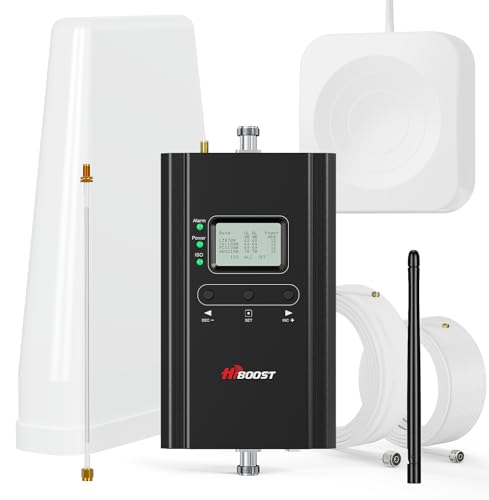
Hiboost 4,000 Sq Ft Home and Office Booster
About this pick
The Hiboost kit is the broadest in purpose, listed for homes, offices, shops and metal buildings. It supports all U.S. and Canadian carriers and states 5G compatibility, with a listed coverage of up to 4,000 square feet. That puts it in the middle of this group in size, larger than the 2,000 square feet ZORIDA and smaller than the 7,000 square feet BrstsWhel. For a typical single family home, 4,000 square feet is about the right scale, and the metal building mention suggests it is meant for tough environments where signal struggles. The cost is the highest tier among the five, and the highlights do not state a gain figure to compare. Because metal blocks signal, the outside antenna placement is critical. It is the kit to consider if you also want to cover a workshop or small office alongside the house. As with every booster, check the outdoor signal first and keep the antennas apart to avoid feedback, since poor separation forces lower gain. Compared with the ESBANY, it trades the dual output ports for a simpler carrier list and a broader stated use.
Best for: Single family homes that also need a shop or office covered
Check price on AmazonSpecs
- Coverage: Up to 4,000 sq ft listed
- Networks: 5G and 4G LTE
- Carriers: All U.S. and Canadian carriers
- Use: Home, office, shop, metal building
Pros
- +Supports all U.S. and Canadian carriers
- +Roomy 4,000 sq ft listed coverage
- +5G and 4G LTE listed
- +Listed for metal buildings and shops
Cons
- −Top cost tier among the five
- −No gain figure in the highlights
BrstsWhel 7000 Sq Ft Home Booster
About this pick
Where the Hiboost lists 4,000 square feet, the BrstsWhel pushes the claim to 7,000 square feet across three to five rooms. It names Band 5, 12, 13 and 17 and lists 5G and 4G LTE, so Verizon, AT&T and T-Mobile phones all have a path. That is the most explicit band list of the five kits in this guide. The feature text is refreshingly clear about limits. With one to two bars outside, indoor coverage is closer to 800 square feet, and that is the figure a weak signal home should plan around. The cost sits in the upper middle of the group, below the Hiboost but above the lowest cost kits. A multi room kit leans on antenna separation more than a one room unit, because poor separation forces the booster to cut gain and shrinks coverage. Required distance is model specific, so read the manual before drilling anything. Next to the ZORIDA's 72dB, the BrstsWhel does not publish a gain figure in its highlights, so its appeal is band breadth and room count rather than raw amplification.
Best for: Larger homes with a decent outdoor signal and mixed carriers
Check price on AmazonSpecs
- Coverage: Up to 7,000 sq ft
- Rooms: 3 to 5 rooms
- Bands: 5, 12, 13 and 17
- Weak signal: About 800 sq ft at 1 to 2 bars
Pros
- +Names bands 5, 12, 13 and 17 explicitly
- +Largest stated coverage with 3 to 5 rooms
- +Lists 5G and 4G LTE
- +Feature text admits weak signal limits
Cons
- −Headline range needs a strong outdoor signal
- −No gain figure published
ZORIDA 72dB Signal Booster
About this pick
The ZORIDA lists a 72dB gain, the highest figure in this roundup, with coverage up to 2,000 square feet for several devices at once. It supports all U.S. carriers and 5G, and it can be used without registering with the carrier. That high gain is aimed at a weak outdoor signal where more amplification is needed. The small stated area is the honest tradeoff, because 2,000 square feet suits an apartment, a small house or a couple of rooms. Skipping carrier registration removes a hurdle that some buyers find confusing. The catch is that high gain makes careful antenna separation especially important. Gain figures differ by source, so 72dB should be read as a listing claim, not a verified specification. If the outside and inside antennas sit too close, the booster must lower its gain and the benefit of the high figure disappears. Compared with the Hiboost at 4,000 square feet, the ZORIDA covers half the area but promises stronger amplification for a weaker signal.
Best for: Small homes with a weak outdoor signal
Check price on AmazonSpecs
- Gain: 72dB listed
- Coverage: Up to 2,000 sq ft
- Networks: 5G and 4G
- Carriers: All U.S. carriers, no registration
Pros
- +Highest listed gain at 72dB
- +No carrier registration needed
- +Supports all major U.S. carriers
- +5G and 4G listed
Cons
- −Needs careful antenna separation
- −Only 2,000 sq ft listed
ESBANY Dual Port Band 12/17/4/66 Booster
About this pick
For awkward homes, the ESBANY brings a feature the others here lack: dual output ports. Each port can feed an inside antenna, so a second area can be covered from one booster. It lists Band 12, 17, 4 and 66 for AT&T, T-Mobile and US Cellular. The listing says it handles metal roofs, low-E glass and modern construction materials, and it frames the dual band design as suited to both urban and rural locations. In a long ranch house or a two story home with a weak spot at each end, the second output can matter. The limits are that the extra antenna is likely sold separately and that Band 13 is missing, so Verizon phones are left out. It sits in the lowest cost tier of this guide, which makes it strong value for features among the five. No coverage area figure is stated, so do not assume it matches the BrstsWhel's claim. Compared with the BoostHome, it serves fewer carriers but has a more specific band list, which makes it easier to check against a phone.
Best for: Long or two zone homes on AT&T, T-Mobile or US Cellular
Check price on AmazonSpecs
- Ports: Dual output for an extra antenna
- Bands: 12, 17, 4 and 66
- Carriers: AT&T, T-Mobile and US Cellular
- Construction: Listed for metal roofs and low-E glass
Pros
- +Dual output ports for a second antenna
- +Listing targets metal roofs and low-E glass
- +Lowest cost tier
Cons
- −Extra antenna is likely sold separately
- −No Band 13, so Verizon phones are left out
BoostHome Multiroom Signal Booster
About this pick
The BoostHome is the lowest cost route to an all carrier home booster, sold for all U.S. carriers with 5G compatibility. Its title claims up to 8,000 square feet, but the feature text describes one to two rooms and up to 5000 square feet. Treat that mismatch as the reason to plan for the smaller figure. With one to two bars outside, the same text suggests indoor coverage near 800 square feet. For a single problem room such as a back bedroom or a den, that is enough. For a whole house, it is not. The listing is light on band and gain detail, so you are trusting the all carrier claim. Compared with the Hiboost, which also supports all U.S. and Canadian carriers but states a more modest and consistent 4,000 square feet, the BoostHome asks you to read between the lines. Pick it only when cost is the priority and the problem is limited to a room or two.
Best for: Low cost fixes for one or two problem rooms
Check price on AmazonSpecs
- Carriers: All U.S. carriers
- Networks: 5G compatible
- Title claim: Up to 8,000 sq ft
- Feature text: 1 to 2 rooms, up to 5000 sq ft
Pros
- +Among the lowest cost kits in the guide
- +Works with all U.S. carriers
- +Light install for a first time buyer
- +5G compatible listing
Cons
- −Listing disagrees with itself on coverage size
- −Realistic reach is one to two rooms
How We Evaluated These Cell Phone Signal Boosters Under $500 (2026)
Each pick was assessed across 5 criteria weighted for real-world use.
Gain and amplification
The ZORIDA at 72dB led, and the Hiboost, BrstsWhel, ESBANY and BoostHome, which publish no gain, were the least transparent. We treated gain as a listing claim. Scores come from listing text and buyer feedback.
Coverage honesty
The BrstsWhel and BoostHome both give about 800 square feet for weak signal, and the Hiboost and ZORIDA state single, consistent figures. We favored listings that tie coverage to outdoor signal. No coverage was independently measured.
Band and carrier clarity
We scored how clearly each listing names bands and carriers. The BrstsWhel and ESBANY name specific bands, while the Hiboost, ZORIDA and BoostHome rely on all carrier claims. Vague claims scored lower.
Install and layout fit
We looked at the effort and flexibility of setup. The ESBANY's dual ports offer layout flexibility, and the Hiboost is broad in use. The ZORIDA scored for skipping registration. Buyer comments about setup informed the scores.
Value for the budget
We asked which kit gives the most for its tier. The ESBANY offers the most features at the lowest tier, the Hiboost the broadest use, and the ZORIDA the highest gain. We discounted vague claims.
How to Choose the Right Cell Phone Signal Boosters Under $500 (2026)
By Home Size
Start with the area you need to cover.
| Situation | Recommended pick | Why |
|---|---|---|
| Apartment or a couple of rooms | ZORIDA 72dB Signal Booster | 72dB over 2,000 sq ft |
| Typical single family home | Hiboost 4,000 Sq Ft Home and Office Booster | 4,000 sq ft listed |
| Large home with good signal | BrstsWhel 7000 Sq Ft Home Booster | 3 to 5 rooms |
| Two zones in a long home | ESBANY Dual Port Band 12/17/4/66 Booster | Dual output ports |
| One problem room on a tight budget | BoostHome Multiroom Signal Booster | Lowest cost all carrier kit |
By Budget
These tiers are relative within the cap.
| Budget tier | Recommended pick | What you get |
|---|---|---|
| Lowest cost tier | ESBANY Dual Port Band 12/17/4/66 Booster | Dual ports and four bands |
| Lowest cost tier alternative | BoostHome Multiroom Signal Booster | All carrier home kit |
| Mid tier | BrstsWhel 7000 Sq Ft Home Booster | Largest stated coverage |
| Upper tier | ZORIDA 72dB Signal Booster | Highest gain |
| Top of this guide | Hiboost 4,000 Sq Ft Home and Office Booster | Broad use and carrier support |
The ZORIDA and Hiboost cost more but are the most transparent about what they offer.
High Gain vs Large Area
These two goals pull in different directions.
High gain
The ZORIDA lists 72dB over 2,000 square feet, which targets a weak outdoor signal in a small home. It rewards careful antenna separation and a good outside spot.
Large area
The BrstsWhel claims 7,000 square feet and the Hiboost 4,000, but both depend on a good outdoor signal. With one to two bars, the BrstsWhel falls to about 800 square feet.
Recommendation
Choose the ZORIDA for a weak signal in a small home, and the Hiboost or BrstsWhel for a larger home with a decent signal.
By Carrier
Match the kit to the phones in the house.
| Carrier situation | Recommended pick | Why |
|---|---|---|
| All three major carriers | BrstsWhel 7000 Sq Ft Home Booster | Band 5, 12, 13 and 17 |
| Any U.S. or Canadian carrier | Hiboost 4,000 Sq Ft Home and Office Booster | All carriers listed |
| No carrier registration wanted | ZORIDA 72dB Signal Booster | Can be used without registering |
| AT&T, T-Mobile or US Cellular | ESBANY Dual Port Band 12/17/4/66 Booster | Band 12, 17, 4 and 66 |
| Mixed carriers, one room | BoostHome Multiroom Signal Booster | All carrier claim |
For Metal Buildings and Shops Specifically
Metal blocks signal, so the setup needs extra care.
Look for
A kit listed for metal buildings or metal roofs, an outside antenna that sits where the signal is strongest and enough cable length to separate the antennas.
In this comparison
The Hiboost is listed for shops and metal buildings across all carriers. The ESBANY is listed for metal roofs and low-E glass for AT&T, T-Mobile and US Cellular.
When to Spend More
The upper end of this cap buys clarity and breadth.
Spend more if
You want a clearly documented kit with broad carrier support, which makes the Hiboost worthwhile. The ZORIDA is worth it if your outdoor signal is weak and the home is small.
Save if
You have an awkward layout and AT&T or T-Mobile, in which case the ESBANY covers it at the lowest tier. The BoostHome also works for one or two rooms.
Frequently Asked Questions
How do I choose between the Hiboost and the BrstsWhel?
The Hiboost lists 4,000 square feet for homes, offices and shops with all U.S. and Canadian carriers. The BrstsWhel claims 7,000 square feet across three to five rooms and names Band 5, 12, 13 and 17. Choose the Hiboost for broad use and the BrstsWhel for a larger home with a decent outdoor signal.
Is 72dB gain always better?
Not necessarily. Gain matters most with a weak outdoor signal, while output power matters more with a strong one. A high gain kit also needs careful antenna separation, or it will lower its gain to avoid feedback.
Why do coverage figures vary so much?
Coverage depends on floor plan, construction and the outdoor signal, and no maker can guarantee a square footage figure. The BrstsWhel and BoostHome both give about 800 square feet at one to two bars. Treat the headline as a best case.
Do I need to register the booster with my carrier?
Some listings say it is not needed, as with the ZORIDA, but rules can vary. Check your carrier's requirements and look for an FCC ID on the listing. When in doubt, ask the seller for documentation.
Can I use a booster in a metal building?
Yes, but the outside antenna placement matters because metal blocks signals. The Hiboost is listed for shops and metal buildings, and the ESBANY is listed for metal roofs and low-E glass. Test the outdoor signal in several spots before mounting.
What if my signal is very weak outdoors?
A booster only amplifies an existing signal, so with no signal it cannot help. With one to two bars, expect a much smaller area, such as about 800 square feet for the BrstsWhel. Check with an app such as CellMapper before you buy.
Bottom Line
best overall: Hiboost 4,000 Sq Ft Home and Office Booster - best overall pick in this roundup.
See the full rankings above for all picks with pros, cons, and best-for summaries.
Browse on Amazon
All Prime-eligible options with current pricing.
Shop on Amazon →