6 Best Automatic Pill Dispensers for Elderly Adults in 2026
Six automatic pill dispensers for older adults compared on setup, readability, alerts and refill effort, with notes for family and pharmacists.


At a Glance
Most older adults who look at pill dispensers are not looking for a high-tech gadget. They want something that is readable, quiet enough for a small apartment, loud enough to notice, and easy for a daughter or a neighbor to load. This guide compares six models on exactly those practical points.
A dispenser helps organize doses and prompt the person at set times. It does not check that the right medication was loaded, and it cannot tell whether a pill was swallowed. We evaluated every model based on product specs and buyer feedback, and we kept the focus on features, leaving medical decisions to a pharmacist or doctor.
One decision shapes the rest: will the older adult run the device alone, or will a family member manage it from afar? The answer points toward either a self-contained unit or an app-linked one. Also think about the room it will live in. A kitchen counter near the morning routine tends to work better than a bedroom shelf, since the device then sits in the line of sight at the times it matters. Bring the loaded dispenser to the next pharmacy or doctor visit so the schedule on the screen can be compared with the written plan, and update both whenever the prescriber changes anything.
6 Criteria to Look For Before Buying a Automatic Pill Dispensers for Elderly Adult
Key buying criteria so you get the right fit the first time.
Who Does the Setup
The person who programs the dispenser determines the right design. The Betife 2nd Gen lets an older adult set things alone with six large keys and a spoken video. The Ideerfit 42-Day and the Betife Bluetooth let a relative set times from an app. Decide this first, because it narrows the field faster than any other spec.
Readability of the Screen
A display that cannot be read is a display that gets ignored. The EziMedPil adds a built-in magnifier, the Betife Bluetooth uses a large LCD with eight icons and the Med-Q uses big day letters. Look for large type and strong contrast. If vision is limited, pick the magnifier or icon-driven designs.
Alert Strength
Older adults may have hearing or vision changes, so the cue should use more than one sense. The Windtrace pairs a loud alarm with a flashing blue light, while the Med-Q lights the exact box and raises its volume. Place the unit where the alert will carry. A relative can listen from the next room during setup.
Tray Size and Pill Size
Large capsules and thick tablets need roomy compartments. The Windtrace uses 28 large compartments, and the EziMedPil also offers 28. The Ideerfit 42-Day uses three trays of 14 slots. Ask a pharmacist if the dosage forms in use will fit and stay separate. Very small tablets can slip between compartments, and long capsules can jam a narrow slot, so look at the actual pills beside the compartment dimensions in the listing photos before deciding. Also consider whether a person with tremor or arthritis can tilt the tray or press the release without effort.
Connectivity Needs
Apps add reach but also failure points. The Ideerfit 42-Day supports remote setup by family, and the Betife Bluetooth needs a phone nearby. The Windtrace, EziMedPil and Med-Q need no phone at all. Choose connectivity only if a relative will actually watch for notifications.
Refill Rhythm
How often someone must reload affects daily life. The Med-Q is a weekly layout, the Windtrace, EziMedPil and Betife Bluetooth cover about 28 days, and the Ideerfit 42-Day stretches to 42. A longer cycle means fewer refill sessions but a bigger task each time. Match the cycle to the person who will do it.
6 Best Automatic Pill Dispensers for Elderly Adults in 2026
Ideerfit 42-Day Automatic Pill Dispenser with App
About this pick
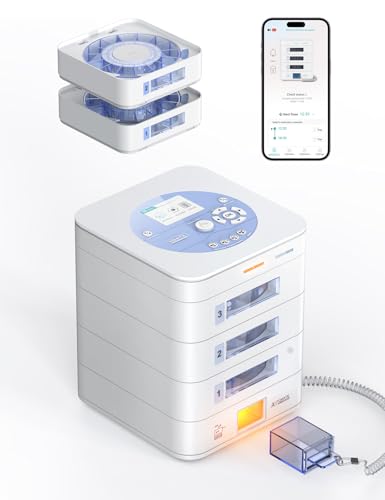
The Ideerfit 42-Day model is designed so a family member can set dosing times through an app while the older adult uses the device itself. It also supports on-device setup with step-by-step voice guidance, which gives the user a way to adjust times without a phone. An LCD display and a digital lock round out the hardware.
The expandable tray has three trays of 14 slots, with each tray representing one time of day such as morning, noon or night. That arrangement stretches into a 42-day supply for once-daily use of a single tray. Families who live far away may appreciate the remote setup, though app alerts should never be the only safeguard.
The tradeoff is complexity. Next to the Windtrace, which uses a single removable tray, the Ideerfit asks more of whoever loads it. It pays off for households where someone elsewhere is helping manage the routine and the older adult is comfortable with a simple device.
Best for: Older adults whose family wants to set or adjust the schedule from a distance.
Check price on AmazonSpecs
- Supply: 42 days
- Trays: 3 trays of 14 slots each
- Setup: App by family or on-device with voice
- Lock: Digital lock
Pros
- +Family can set times from an app
- +On-device setup includes voice guidance
- +Three 14-slot trays by time of day
- +Digital lock and an LCD display
Cons
- −More complex to load than a single tray
- −App alerts should not be the only safeguard
Betife 2nd Gen Automatic Pill Dispenser
About this pick
Betife's second generation simplifies the control panel to six keys with oversized icons, and each key performs a single function. A spoken quick-start video helps a first-time owner through setup. For an older adult who dislikes menus, this approach lowers the barrier to programming it personally.
The mechanical side includes a tray-to-cover seal under 2 mm, intended to stop pills from drifting between compartments. The seller also calls it mix-proof and kid-proof. Those are design goals, and real outcomes depend on pill shapes and careful loading.
It has no app, which is a plus for anyone who prefers to avoid phones. Compared with the Betife Bluetooth model, this one is the less connected, easier-to-read option. It is the safest bet if the person will be doing most of the setup alone.
Best for: Older adults who want to program the device themselves with large, labeled keys.
Check price on AmazonSpecs
- Console: 6 buttons, one function each
- Guide: Spoken quick-start video
- Seal: Under 2 mm tray to cover
- Design: Mix-proof and kid-proof
Pros
- +Oversized icons with one task per key
- +Spoken quick-start video for first setup
- +Under 2 mm tray seal limits pill drift
- +No phone or app needed to operate
Cons
- −No remote family access to the schedule
- −Listing says little about alarm tones
EziMedPil Automatic Pill Dispenser with Alarm
About this pick
The EziMedPil combines a clear LCD with a built-in mini magnifying glass under a transparent top lid. That pairing is an unusual touch, aimed at older eyes that find small digits hard to read. The 28-compartment tray is described as large capacity for home use.
It is a quiet fit for people who do not want an app or complex menus. The alarm function and display handle the reminders, while the see-through lid lets a visiting relative check how much is left. Its listing does not detail the alarm tone, so check that the sound is noticeable in your home.
Compared with the Med-Q, it dispenses from a tray instead of lighting a single lid, and it holds a month where the Med-Q holds a week. The Windtrace matches its 28 compartments but has no magnifier. Choose this model when readability is the leading concern.
Best for: Older adults with vision difficulty who want a magnifier built into the lid.
Check price on AmazonSpecs
- Display: Clear LCD
- Aid: Mini magnifying glass
- Compartments: 28
- Lid: Transparent top
Pros
- +Mini magnifier helps read the display
- +Transparent lid shows remaining pills
- +28 compartments cover a month of single doses
- +Runs without any app or phone link at all
Cons
- −Alarm tone details are limited
- −No lit-box cue or app oversight
Windtrace Automatic Pill Dispenser with Alarm
About this pick
The Windtrace gives older adults a loud alarm and a bright flashing blue light at dose time. It comes with six dosage rings to arrange the schedule, and the tray lifts out for loading. The compartments are large, which helps with bigger tablets and thick fingers.
It is the model to pick when hearing is a worry and the household wants a strong cue. The tray is made of food-grade material, and 28 compartments suit a monthly refill of single daily doses. A blue light is easy to spot across a room.
It is basic in the best sense, with no app and no voice guidance. Next to the Betife 2nd Gen it offers a louder alert but a less guided setup. Whoever sets the rings should read the instructions first and ask a pharmacist about the loading plan.
Best for: Older adults with hearing difficulty who need a strong sound and light cue.
Check price on AmazonSpecs
- Compartments: 28 large
- Rings: 6 dosage rings
- Alert: Loud alarm and blue flash
- Tray: Removable
Pros
- +Loud alarm with a bright flashing light
- +Large compartments suit bigger tablets
- +Removable tray simplifies refills
- +Six dosage rings match the schedule
Cons
- −No app and no spoken setup help is offered
- −Alert may be too loud in small rooms
Med-Q Electronic Pill Dispenser with Alarm
About this pick
The Med-Q is closer to a classic weekly organizer than a machine. When a dose is due, a red light flashes on the matching box and the alarm beeps with rising volume. Large day letters and easy-lift lids keep the experience familiar.
It works well for an older adult who already sorts pills by day and wants a gentle prompt. Because nothing rotates and nothing locks, there is little to learn. The listing includes early memory loss among its audiences, but it is a prompt, not a safeguard.
Weekly loading means more frequent refills than the 28-compartment models like the Windtrace. In return, a family member can see the whole week at a glance. It is a good first dispenser for someone nervous about technology.
Best for: Someone who likes a weekly organizer and only needs a light and alarm to point to the right box.
Check price on AmazonSpecs
- Cue: Red light on the box due
- Alarm: Beeps, louder over time
- Labels: Large day letters
- Lids: Open with light touch
Pros
- +Red light points to the right box
- +Familiar weekly layout needs no learning
- +Large day letters are easy to read
- +Lids open with only a light touch
Cons
- −Weekly refills come around often
- −Nothing locks between scheduled doses
Betife 28-Day Bluetooth Smart Pill Dispenser
About this pick
This Betife connects to a phone over Bluetooth so that the schedule can be set in an app. It also offers on-device operation through a large LCD with eight intuitive icons for people who would rather skip the phone. The alarm system is described as robust.
The design suits a household where a younger relative handles the phone side while the older adult uses the screen. Bluetooth means the phone has to be nearby for syncing, so it is not a remote-monitoring solution the way a Wi-Fi unit would be. Test the connection before counting on it.
Compared with the Ideerfit 42-Day, it sits closer to a standard 28-day dispenser with an app option. Next to the Betife 2nd Gen, it adds connectivity but loses the spoken quick-start video. It fits families who want options and are comfortable with a little technology.
Best for: Families who want phone programming with an on-device fallback for the older adult.
Check price on AmazonSpecs
- Connection: Bluetooth to a phone
- Display: Large LCD, 8 icons
- Supply: 28 days
- Setup: App or on-device
Pros
- +App control with Bluetooth sync
- +On-device use through an eight-icon LCD
- +28-day capacity for monthly refills
- +Alarm system described as robust
Cons
- −Phone must be nearby for Bluetooth syncing
- −Not as guided as the Betife 2nd Gen
How We Evaluated These Automatic Pill Dispensers for Elderly Adults
Each pick was assessed across 5 criteria weighted for real-world use.
Setup independence
We looked at how much an older adult can do alone. The Betife 2nd Gen's six-key console and spoken video led here, and the Windtrace followed with straightforward rings. App-first designs scored lower for solo users but higher for family-managed households. We did not run hands-on trials.
Legibility
Screens and labels were compared for size, contrast and aids. The EziMedPil's magnifier and the Betife Bluetooth's eight-icon LCD stood out. The Med-Q earned points for large day letters. Small, low-contrast displays scored lower.
Alert reach
Alerts were judged on how many senses they use and how adjustable they are. The Windtrace's sound plus blue light and the Med-Q's lit box with rising volume scored well. Models with limited alarm details in the listing were marked cautiously. Placement in the home also matters.
Family involvement
We considered how easily a relative can help. The Ideerfit 42-Day offers app setup by family, and the Betife Bluetooth syncs with a phone. The simpler units rely on a relative visiting in person. Remote tools should supplement, not replace, regular check-ins.
Lineup positioning
The Ideerfit 42-Day leads on remote setup and capacity at 42 days, the Betife 2nd Gen on solo ease, and the EziMedPil on readability. The Windtrace leads on alert strength, the Med-Q on familiarity and the Betife Bluetooth on app control with a 28-day tray.
How to Choose the Right Automatic Pill Dispensers for Elderly Adults
By Who Manages the Routine
The manager of the routine decides which design will last.
| Situation | Pick | Reason |
|---|---|---|
| Older adult sets it up alone | Betife 2nd Gen Automatic Pill Dispenser | Six large keys and a spoken video |
| Family sets times remotely | Ideerfit 42-Day Automatic Pill Dispenser with App | App setup by family and a 42-day tray |
| Mixed: phone plus on-device | Betife 28-Day Bluetooth Smart Pill Dispenser | App control and an eight-icon screen |
| Wants the weekly-box feel | Med-Q Electronic Pill Dispenser with Alarm | Lit box and large day letters |
| Hard of hearing | Windtrace Automatic Pill Dispenser with Alarm | Loud alarm with a flashing blue light |
Ask the older adult which approach feels natural before deciding.
By Budget
Relative tiers by how much technology each model includes.
| Tier | Pick | What you get |
|---|---|---|
| Entry | Med-Q Electronic Pill Dispenser with Alarm | Weekly boxes with a light and alarm |
| Mid | Windtrace Automatic Pill Dispenser with Alarm | 28 large compartments with sound and light |
| Mid | EziMedPil Automatic Pill Dispenser with Alarm | Magnifier, LCD and 28 compartments |
| Premium | Ideerfit 42-Day Automatic Pill Dispenser with App | App, voice guidance, digital lock and 42-day supply |
Check current listings, because versions change.
App-Linked vs Stand-Alone
Connectivity is the biggest divider in this lineup.
App-linked
App-linked models let a relative adjust times without visiting. The Ideerfit 42-Day and the Betife Bluetooth work this way. They add a point of failure, since phones need to be nearby or notifications can be missed. Choose them if a family member will actively manage it.
Stand-alone
Stand-alone units run on their own buttons and display. The Betife 2nd Gen, Windtrace, EziMedPil and Med-Q work this way. They are simpler to explain and need nothing but power. Choose them if the older adult prefers to stay off the phone.
Whichever you choose, schedule a regular in-person check.
By Refill Interval
A second axis to compare is how long a loaded tray lasts.
| Refill pattern | Pick | Reason |
|---|---|---|
| Every six weeks | Ideerfit 42-Day Automatic Pill Dispenser with App | Expandable tray covers 42 days |
| Monthly | Windtrace Automatic Pill Dispenser with Alarm | 28 large compartments |
| Monthly with an app | Betife 28-Day Bluetooth Smart Pill Dispenser | 28-day capacity with phone setup |
| Weekly | Med-Q Electronic Pill Dispenser with Alarm | Seven-day layout that is easy to inspect |
Align the refill day with a pharmacy pickup if possible.
For Independent Living Specifically
Older adults living alone need a device that works without help every day.
Look for
Strong alerts, readable displays, easy lids and a routine that does not rely on a phone. Place the unit where it will be seen daily. Keep the pharmacist's number nearby.
In this comparison
The Windtrace offers a loud alarm and light, the EziMedPil adds a magnifier, and the Betife 2nd Gen uses large keys. The Med-Q is the gentlest weekly prompt for someone comfortable with a familiar layout.
A weekly call or visit from family helps catch problems early.
When to Spend More
Pay extra only when a feature solves a real daily obstacle.
| Spend more if | Save if |
|---|---|
| Family will use the app, as with the Ideerfit 42-Day | The older adult runs everything alone |
| Reading is hard, as with the EziMedPil's magnifier | The Med-Q's large letters are enough |
| You want guided setup, as with the Betife 2nd Gen | A relative programs it once |
| Hearing is poor, as with the Windtrace's loud alarm | A gentler cue works at home |
Spend where it removes a real obstacle.
Frequently Asked Questions
Which dispenser is easiest for an older adult to set up alone?
The Betife 2nd Gen is the strongest candidate, with six oversized keys and a spoken quick-start video. The Windtrace is also direct, using dosage rings. Ask a relative to help with the first loading and test run, and keep the printed instructions in a drawer near the unit so a new helper can follow the same steps.
Do I need a smartphone?
No. The Betife 2nd Gen, Windtrace, EziMedPil and Med-Q work without one. The Ideerfit 42-Day and the Betife Bluetooth offer app setup but also allow on-device use. Only choose app features if someone will use them.
How do I know the dispenser is loaded correctly?
A dispenser cannot check that on its own. Have a pharmacist review the loaded tray at least the first time and count doses against the schedule. Keep the original containers handy for reference.
What if the older adult has trouble hearing the alarm?
Pick a unit that pairs sound with a light, such as the Windtrace, and place it where it is seen. Ask a relative to confirm the alert is noticeable in the room. A secondary reminder on a phone or from a caller can help.
Will an app notify family if a dose is missed?
Listings describe app setup and syncing, but notifications can be missed, so do not treat them as a guarantee. A phone call remains more dependable than a silent alert. Test the full alert path in the first week by letting one reminder go unanswered and confirming that a person actually notices it, then adjust volume, placement or notification settings until the result is dependable.
How long does a loaded tray last?
It depends on the model and the number of daily doses. The Ideerfit 42-Day covers 42 days of single doses, the 28-compartment models about four weeks, and the Med-Q one week. Multiple daily doses shorten each cycle.
Is a dispenser a substitute for professional advice?
No. It is an aid for routine, not a medical device that replaces clinical guidance. Confirm schedules, interactions and storage with a pharmacist or doctor, especially after any prescription change.
Bottom Line
best overall: Ideerfit 42-Day Automatic Pill Dispenser with App - best for remote family help pick in this roundup.
See the full rankings above for all picks with pros, cons, and best-for summaries.
Browse on Amazon
All Prime-eligible options with current pricing.
Shop on Amazon →